

AI Reputation Management Tools in 2026
📖 12 min read
TL;DR
- What it is: A five-layer tech stack that monitors, manages, and optimizes how AI systems describe your brand across answer engines, reviews, and search.
- Who it's for: Multi-location businesses, enterprise brands, and anyone whose customers ask AI "who's best?" before they ask Google.
- How it works: Real-time sentiment monitoring + review automation + AI perception tracking + content optimization + fraud detection, working together to train AI models on accurate brand signals.
- Bottom line: If you don't shape what the machines say about you, they'll decide who you are without you in the room.
What are AI reputation management tools in 2026?
AI reputation management tools in 2026 are platforms that monitor, influence, and optimize how artificial intelligence systems—from ChatGPT to Google AI Overviews to Perplexity—describe and recommend your brand when users ask questions. These tools help businesses control their narrative by feeding AI models accurate, structured, positive signals from reviews, content, and authoritative sources rather than leaving reputation to algorithmic chance.
Best for: Multi-location brands and service businesses. • Not ideal for: Pure B2B without review footprints. • Fast takeaway: You're training models, not just convincing people.
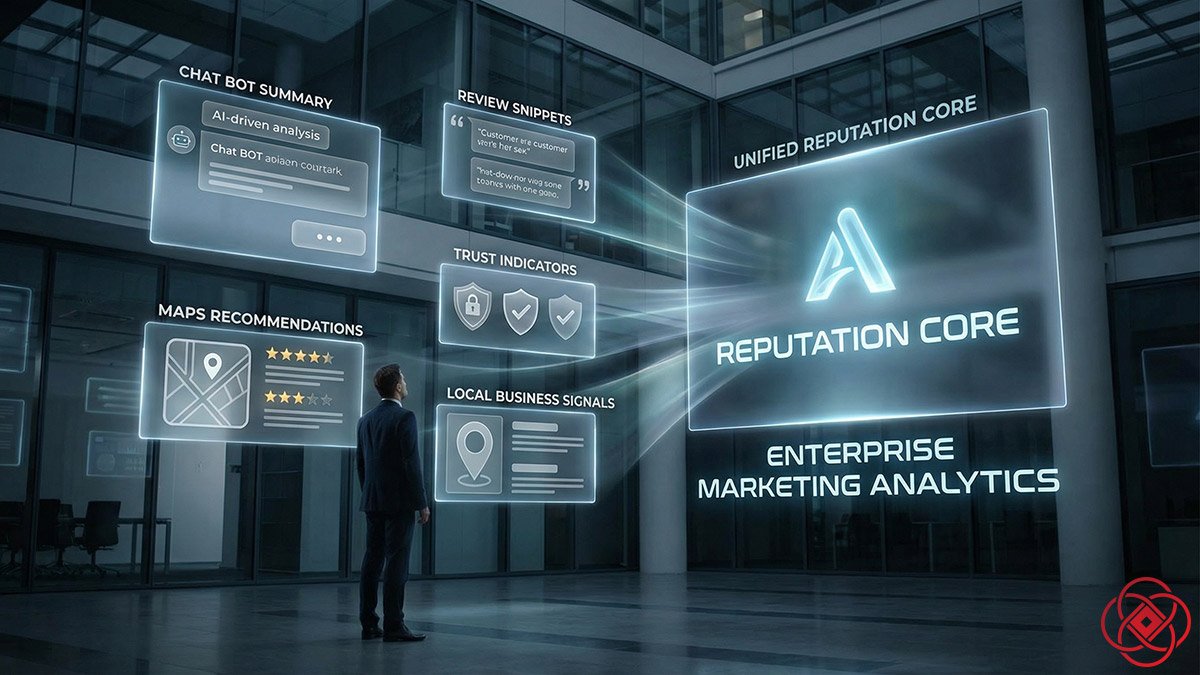
AI isn't just another channel in reputation marketing in 2026; it's the environment your reputation lives in. If you don't shape what the machines say about you, they'll decide who you are without you in the room.
The new reputation battlefield
Reputation used to be about Google search, Yelp stars, and maybe a local news story. Now it's about what AI systems say when someone asks, "Who's the best around me?" or "Is this company legit?"
Three big shifts define 2026:
- AI answer engines as gatekeepers. Tools like Google's AI Overviews, ChatGPT, Perplexity, Gemini, and "Ask Maps" are summarizing your entire footprint into a single answer. That answer is your new homepage.
- Always-on monitoring as table stakes. Serious platforms scan reviews, social, forums, and news in real time, flag sentiment swings, and surface emerging narratives within minutes. Anything slower is a liability.
- Reputation, local SEO, and AI search are fused. Review volume, sentiment, recency, and response behavior now feed directly into which brands AI agents recommend. You're not just convincing people; you're training models.
The game is not "more reviews." It's "better signals, in the right places, read correctly by humans and machines."
Tools you actually want in 2026
You don't need twenty tools. You need a compact stack that covers five layers: listening, reviews, content, AI perception, and risk.
1. Listening and sentiment intelligence
Use an AI-first monitoring platform that goes beyond simple mention alerts.
Enterprise / multi-location: Revuze, Sprinklr, Brandwatch, Birdeye.
Mid-market / flexible: Brand24, Mention, Talkwalker, ReviewTrackers.
Non-negotiable capabilities:
- Real-time sentiment and topic clustering on reviews, social, forums, and news.
- Narrative detection (what themes are rising: price, service, speed, trust).
- Location or product-level drill-downs, not just "brand is 4.3 stars."
This is your radar. It tells you what the market is really saying and where the fires are starting.
2. Review generation and response
Reviews are still the most visible trust asset; AI just changed how you win them.
Look for tools that:
- Automate review requests via SMS/email at the right moment in the customer journey.
- Centralize reviews from Google, Yelp, Facebook, industry sites, app stores, marketplaces.
- Draft AI-assisted responses in your voice, with human approval on high-risk items.
Examples in use:
- Birdeye's Reviews AI and Insights AI for multi-location review generation and response.
- Podium to turn everyday conversations into review opportunities and structured feedback.
- Rep AI-style tools that gather reviews everywhere and flag dangerous posts for manual review.
The rule in 2026: you respond to almost everything, fast, with empathy—and you never fully automate the risky stuff.
3. Content and story repair with AI
Reputation repair now looks a lot like a content studio powered by AI writing tools.
Leading setups use:
- Persona-trained GPT workflows to create blog posts, Q&A pages, and press releases aligned with E-E-A-T (experience, expertise, authoritativeness, trustworthiness).
- Video synthesis tools like Synthesia to produce believable testimonial and explainer videos in multiple languages.
- Cross-channel schedulers that push content to LinkedIn, Medium, YouTube, and niche platforms in structured, easy-to-parse formats.
You're not spinning; you're flooding the zone with honest, well-structured proof, everywhere the algorithms look.
4. AI perception and "answer engine optimization"
A new category has emerged: tools that show you how AI systems talk about you.
- Platforms like LLMrefs scan generative engines (Google AI Overviews, ChatGPT, Perplexity, Gemini) and report how often you appear, in what context, and next to which competitors.
- Reputation suites like RepTrak now map AI-generated descriptions against their trust frameworks, showing where your narrative is strong or weak.
This is where you stop guessing. You see the answers customers see, then work backward to feed those systems better inputs: clearer positioning, stronger reviews, structured lists, and cleaner data.
5. Risk detection and compliance
With AI-generated fake reviews rising (up to about 15% of reviews in some sectors), risk management is now core to reputation work.
Good platforms will:
- Detect likely fake or coordinated reviews, both for and against you.
- Log your responses and actions to show regulators and platforms you're acting in good faith.
- Provide predictive analytics on reputation risk: which topics are heating up, which locations are drifting, which products are triggering complaints.
The win here is simple: stay clean, stay transparent, and let the cheaters get swept up by enforcement waves.
Snapshot of key tool types
| Layer | Goal | Example tools (2026) |
|---|---|---|
| Listening | Monitor and analyze sentiment | Revuze, Sprinklr, Brandwatch |
| Reviews | Generate and respond to reviews | Birdeye, Podium, ReviewTrackers |
| Content | Repair and promote narratives | GPT workflows, Synthesia, schedulers |
| AI perception | See how AIs describe you | LLMrefs, RepTrak-style modules |
| Risk | Detect threats and fraud | Fraud-detection in Birdeye, platform tools |
Best practices that actually work now
Tactics change. Principles don't. In 2026, the brands that win at AI-driven reputation do five things well.
1. Design your footprint for AI, not just people
Large language models and AI search engines love certain structures.
- Use clear, labeled sections: "Who we serve," "What we're best at," "Proof and results."
- Publish "best of" and "who this is for" style pages with explicit, honest claims.
- Keep product and location data accurate across all major platforms; models penalize messy, conflicting info.
Think of every key page and profile as a "training data asset." You're not writing for robots, but you are making it as easy as possible for them to quote you correctly.
2. Make authenticity non-negotiable
AI has made fake reviews cheaper, and platforms have responded with tougher rules and stronger fraud detection.
So you:
- Ask real customers, at natural moments, for honest, detailed reviews—and make it easy.
- Never buy reviews, swap fake testimonials, or juice ratings; the short-term bump isn't worth the long-term damage.
- Encourage user-generated content—photos, stories, before-and-after examples—that AI can recognize as organic.
The more your proof looks and feels human, the more weight it carries with both people and machines.
3. Respond like a real person, at AI speed
AI can draft the first version of your review replies and social responses, but it shouldn't replace your judgment.
- Set guidelines: what you apologize for, what you explain, what you offer, what you never promise.
- Use AI to keep tone consistent and on-brand across thousands of interactions.
- Always have a human review and send responses for sensitive issues or legal risk.
The standard: fast, kind, specific, and actionable. That's what calms angry customers—and what teaches the models you are trustworthy.
4. Turn feedback into product decisions
The highest-ROI use of AI reputation tools is not more dashboards; it's better decisions.
Use your sentiment and topic analysis to:
- Spot recurring complaints and fix the underlying issue at the location, team, or product level.
- Identify phrases happy customers repeat and echo them in your copy and offers.
- Prioritize improvements that will change reviews and AI answers within a quarter, not a year.
Reputation is not a cosmetic problem. It's a reporting system for everything else you do.
5. Audit your reputation the way AI sees it
You know how you look in Google results. But do you know how you look in an AI answer?
Leading teams now:
- Run regular "synthetic persona audits"—asking AI questions as different types of customers in different regions to see how recommendations shift.
- Track how often they show up in "best for X" style AI lists and what proof is cited.
- Compare AI descriptions to their desired positioning, then plan content and review campaigns to close the gap.
You're not chasing every algorithm tweak; you're watching the story and steering it.
Trends that will shape the next 24 months
Zooming out, a few patterns are getting stronger, not weaker.
- AI monitoring as baseline. If your provider doesn't use AI to classify sentiment, detect threats early, and route responses, they're behind.
- Convergence of ORM, CX, and product. Reputation data will feed directly into product roadmaps, staffing, and training.
- Regulatory pressure on manipulation. Expect more penalties, public shaming, and platform crackdowns on fake reviews and deceptive testimonials.
- Answer-engine optimization as a staple. "How do we show up in AI answers?" will be asked in every serious AI marketing meeting.
- Hybrid teams: AI + human editors. The winning model isn't "AI does it all." It's lean human teams using AI for business as leverage, not a mask.
The common thread: reputation is no longer a side project after ads and SEO. It's the foundation AI uses to decide if you even show up.
If you had to pick one place to start in your own stack—would you rather tighten your listening layer or overhaul how you generate and respond to reviews?
Should you invest in AI reputation management tools?
Use it if: Your brand has multiple locations, a significant review footprint, or customers who research before buying; you need visibility into what AI says about you; and you want to turn feedback into product improvements.
Skip it if: You're a pure B2B brand with no public reviews; your business model doesn't depend on local or consumer trust signals; or you're not ready to commit to daily monitoring and response.
Best first test: Start with a 30-day trial of an AI sentiment tool like Brand24 or Birdeye's basic tier, track how often your brand appears in AI answers using LLMrefs, and measure baseline review velocity and sentiment before adding automation.
Frequently Asked Questions
What is AI reputation management in simple terms?
AI reputation management is the practice of monitoring and influencing how AI tools like ChatGPT, Google AI Overviews, and Perplexity describe your brand when users ask questions. It combines review management, sentiment monitoring, and content optimization to ensure AI systems learn accurate, positive signals about your business.
How is AI reputation management different from traditional online reputation management?
Traditional ORM focused on Google search rankings, Yelp stars, and crisis response. AI reputation management adds real-time monitoring of how AI answer engines summarize your brand, uses structured data and content to train AI models, and tracks your appearance in conversational AI responses—not just search results. You're optimizing for machines that synthesize information, not just humans browsing links.
How long does it take to see results with AI reputation management?
Most businesses see improved review volume and response rates within 30–60 days. Sentiment shifts and better AI answer placements typically take 90–120 days as new signals accumulate and AI models retrain. The timeline depends on your starting review footprint, content frequency, and how quickly you fix underlying service issues flagged by feedback.
Which AI reputation management tool should I start with?
Start with a listening tool like Brand24 or Mention for real-time sentiment monitoring (mid-market) or Birdeye for multi-location review generation and response (enterprise). Add LLMrefs to track how AI engines describe you. These three layers—listening, reviews, and AI perception—form the minimum viable stack for 2026.
Can AI tools fully automate reputation management?
No. AI can draft review responses, monitor sentiment, and flag risks in real time, but humans must review and approve responses for sensitive issues, legal risks, or crisis situations. The winning model is AI-assisted workflows with human oversight, not full automation. Customers and platforms can detect purely automated responses, and trust suffers.
What's the biggest mistake businesses make with AI reputation management?
Buying fake reviews or over-automating responses. Platforms like Google and Yelp have stronger fraud detection in 2026, and AI answer engines penalize brands with inconsistent or suspicious signals. The short-term boost isn't worth the long-term damage. Focus on earning authentic reviews, responding with empathy, and fixing the underlying issues customers complain about.