

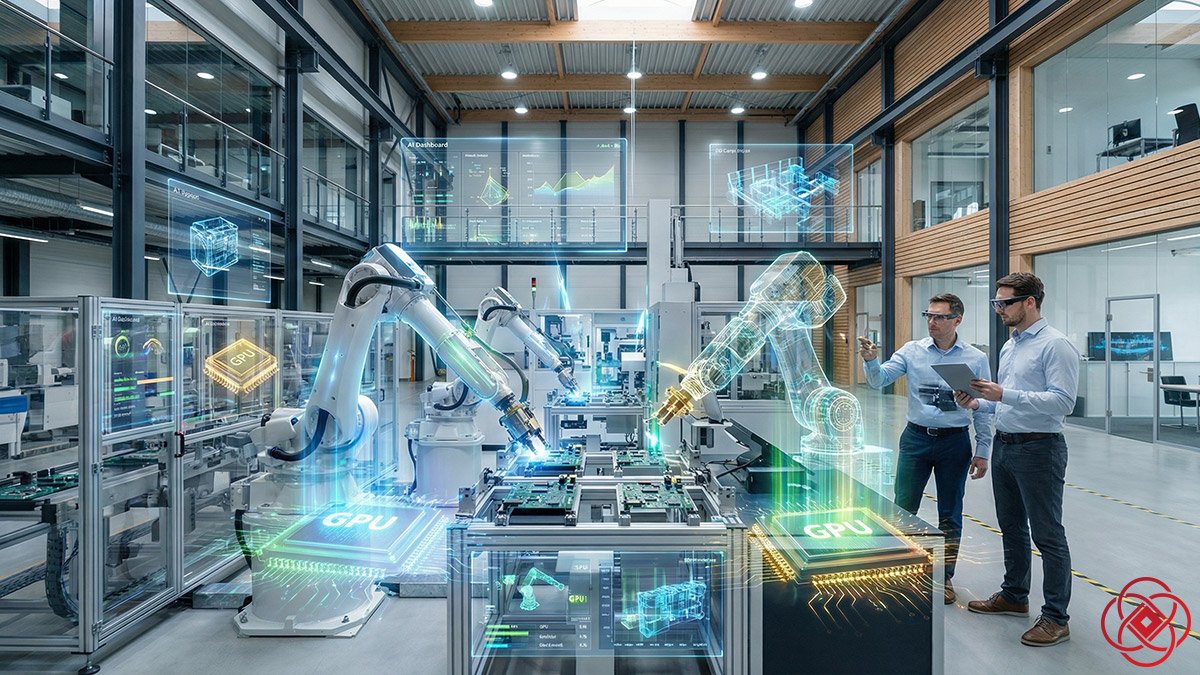
Siemens and NVIDIA Industrial AI Factory
📖 9 min read
TL;DR
- What it is: Siemens and NVIDIA are building an industrial AI operating system that uses digital twins and real-time simulation to make factories adaptive and self-improving.
- Who it's for: Manufacturing leaders, industrial engineers, system integrators, and anyone building software for smart factory environments.
- How it works: AI continuously analyzes a virtual replica of the factory, tests improvements in simulation, and deploys validated changes to physical operations automatically.
- Bottom line: This partnership creates a platform moment for industrial AI. Factories move from fixed automation to learning systems that adapt in near real-time.
What is Siemens and NVIDIA Industrial AI Factory?
Siemens and NVIDIA Industrial AI Factory is an industrial AI operating system that combines Siemens manufacturing control software with NVIDIA Omniverse simulation platform to create adaptive, AI-driven production environments. It helps manufacturers achieve continuous optimization by running endless virtual tests on digital twins before deploying changes to real factory floors.
Best for: Large-scale manufacturers seeking continuous adaptation. • Not ideal for: Facilities without robust IoT infrastructure. • Fast takeaway: Factories that learn and adapt themselves are replacing static automation systems.
If you want to know what the next industrial revolution looks like, don't look at a new machine or a shiny piece of robotics hardware. Look at the brain being built to control it.
That's exactly what Siemens and NVIDIA are doing. Together, they're crafting what they call an "industrial AI operating system" — a digital intelligence layer powerful enough to think across every inch of a factory. It's the next phase of automation: one where machines don't just follow orders but learn, adapt, and make decisions based on what's actually happening on the shop floor.
Siemens has long been synonymous with the heart of industrial manufacturing. NVIDIA, once known only for gaming graphics cards, has become the engine of the AI age. Now their partnership is expanding, and the goal is clear: build the world's first fully AI-driven, adaptive manufacturing site — the prototype of the factory of the future.
And that future starts in Erlangen, Germany, at Siemens' Electronics Factory in 2026.
From Automation to Adaptation
Factory automation isn't new. Robots weld, press, and assemble faster than any human ever could. But they don't understand why they're doing it. They react — they don't reason.
That's the missing piece that Siemens and NVIDIA want to solve.
The core idea? Create an AI Brain that sits at the center of every manufacturing process. This "brain" continuously analyzes the digital twin of the factory — the exact virtual replica of every machine, process, and output. The AI runs endless simulations inside this twin, testing changes that might make production faster, safer, or cheaper.
When the AI finds an improvement that works virtually, it validates it in real life — updating machines, fine-tuning workflows, or re-routing supply lines automatically.
Imagine your factory floor as a living organism: the AI is the central nervous system, constantly sensing, thinking, and adjusting.
That's a far cry from today's reality, where engineers might take weeks or months to test and implement changes manually. With AI-powered digital twins, the feedback loop becomes near-instant.
As Siemens CEO Roland Busch puts it, this isn't just automation — it's adaptation.
A New Industrial Stack Is Taking Shape
To make this happen, the two companies are merging Siemens' industrial operations software with NVIDIA's Omniverse platform — a real-time 3D collaboration and simulation environment powered by GPU acceleration.
Omniverse can render entire production systems in lifelike detail, down to the way air flows through a machine or how tiny fluctuations in temperature affect performance. Siemens' software then serves as the control layer, connecting virtual models to actual equipment through industrial IoT and operational technology (OT) systems.
That pairing — high-speed 3D simulation plus factory-level control — is the blueprint for what Siemens and NVIDIA call the Industrial Metaverse.
It's not the metaverse of meetings in VR headsets or digital avatars dancing on your screen. It's a practical, grounded use of simulation, built for engineers, not influencers. A digital world that mirrors the physical one — so you can test, predict, and deploy with precision before touching a single screw.
NVIDIA describes it as an industrial stack — a framework others can build on. Vendors, system integrators, and manufacturers will be able to plug into this environment, extending it with their own AI agents, workflows, and modular software.
In other words, this isn't just a Siemens or NVIDIA innovation. It's an open playing field for a new generation of industrial apps.
Who's Watching Closely: Foxconn, HD Hyundai, and PepsiCo
You can always tell how important a new technology is by who shows up to test it.
In this case, the early interest is staggering. Foxconn, the world's largest electronics manufacturer, is exploring the use of industrial digital twins to manage massive multi-site operations. HD Hyundai is investigating ways to bring AI-driven optimization to shipbuilding and heavy construction. KION Group — the logistics and materials-handling giant — is looking at smart factories that manage themselves.
Even PepsiCo is exploring applications across food and beverage production lines, where small gains in efficiency translate into massive annual savings.
These companies aren't joining purely out of curiosity. They see what's coming — a shift from fixed, rule-based automation to learning-based systems that improve over time. The same leap we saw in consumer AI now reaching the gritty, high-stakes world of industrial production.
What This Means for Builders and Innovators
For people building software, tools, and systems that serve the manufacturing world, this partnership marks the beginning of an entirely new ecosystem.
Here's why it matters:
- Digital twins are becoming the backbone of factory intelligence. Real factories will depend on these virtual versions not just for visualization, but for decision-making. That means there's new demand for simulation data, integration services, and AI models trained on industrial signals.
- AI agents are moving into physical spaces. The same reasoning that drives chatbots and copilots is now being ported into robots, conveyors, and production lines. Builders who can translate AI logic into physical control will find huge opportunity.
- Interoperability will become critical. Factories use hundreds of systems — from ERP and MES to PLCs and sensors. Any solution that connects these worlds, reliably and in real time, adds value to the emerging industrial stack.
- The "Industrial OS" opens new niches. As Siemens and NVIDIA establish the base layer, countless new layers — from analytics dashboards to domain-specific AI copilots — will be layered on top. This will resemble what happened after iOS or Android launched: a flood of developers building solutions no one had imagined before.
This is the shift industrial innovators have been waiting for — a true platform moment.
Factories That Think for Themselves
At a deeper level, this development touches something more profound: the idea that the physical world is becoming programmable.
For decades, software has been the language of the digital sphere. Now, through AI and advanced simulation, it's seeping into the tangible — shaping how steel gets bent, how chips get manufactured, even how packaging gets filled and sealed.
Once, humans programmed the machines. Soon, machines will help program themselves.
A factory that thinks for itself doesn't mean it replaces the people inside it. It means those people are finally freed from repetitive, reactive work — able instead to design, interpret, and innovate at a higher level. Engineers become strategists. Operators become curators of intelligence systems.
In a sense, the factory becomes what it was always meant to be: a place where human ingenuity and machine precision work in perfect sync.
The Road to 2026 and Beyond
The Siemens Electronics Factory in Erlangen isn't just another pilot project. It's meant to serve as the blueprint for how every modern manufacturing site could evolve — modular, adaptive, intelligent by design.
By combining real-time data capture from sensors, AI reasoning from simulation, and GPU-accelerated visualization from Omniverse, it aims to achieve what traditional factories can't: learn continuously, without halting production.
Once proven, the model will cascade across industries. Automotive plants, chip foundries, consumer goods lines — all could adopt variations of the same framework. Even smaller contract manufacturers could benefit by accessing cloud-based versions of these tools through Siemens Xcelerator or NVIDIA's cloud partnerships.
In the same way cloud computing democratized access to computing power, this could democratize intelligence for the industrial world. A small manufacturer could test process changes in a virtual model before risking costly downtime. A mid-size plant could experiment with AI agents to handle logistics scheduling or predictive maintenance — all before making a single physical adjustment.
The Big Picture: The Physical World, Reimagined
We've talked for years about "smart factories." But up until now, "smart" mostly meant connected — data flowing, sensors reporting, dashboards refreshing. What Siemens and NVIDIA are proposing is something different: factories that can think, reason, and learn.
And that, if you're in the business of building the future — whether as a software vendor, systems integrator, or industrial engineer — should make you pay attention.
Because in this new era, the competitive edge won't come from how much steel you move or how many robots you deploy. It will come from how intelligent your operations become — and how fast they can adapt when the world changes around them.
Siemens and NVIDIA aren't just updating automation. They're rewriting the definition of manufacturing itself — turning the dumb machinery of yesterday into the self-improving ecosystems of tomorrow.
The blueprint is already on the table. The question now is: Who will build on it first?
Should You Invest in Siemens and NVIDIA Industrial AI Factory?
Use it if: You operate large-scale manufacturing with existing IoT infrastructure, need continuous process optimization, or want to future-proof operations with AI-driven adaptation.
Skip it if: Your facility lacks digital infrastructure, you're in low-volume custom manufacturing, or your processes don't benefit from real-time optimization.
Best first step: Start with a digital twin pilot on one production line for 3-6 months, measuring cycle time reduction and defect rate improvement as key KPIs.
FAQ
What is industrial AI in simple terms?
Industrial AI applies artificial intelligence to manufacturing and production environments. Instead of following fixed rules, systems learn from data, predict outcomes, and optimize processes automatically. The Siemens and NVIDIA Industrial AI Factory represents this approach at enterprise scale.
How is a digital twin different from regular factory simulation?
Traditional simulations are static models built before deployment. Digital twins are live, connected replicas that mirror real equipment in real-time. When the physical factory changes, the digital twin updates instantly—and AI can test improvements against current conditions.
How long does it take to see results with industrial AI systems?
Early wins like predictive maintenance alerts can appear within weeks. Significant optimization gains—5-15% efficiency improvements—typically emerge after 3-6 months once the AI learns operational patterns. Full ROI often requires 12-18 months of continuous learning.
Do I need to replace all my factory equipment to use this technology?
No. The Siemens and NVIDIA platform connects to existing equipment through sensors and IoT gateways. You'll need data connectivity and some computational infrastructure, but most physical machinery can stay in place.
What industries benefit most from industrial AI factories?
Electronics manufacturing, automotive, semiconductor fabrication, food and beverage production, and heavy equipment assembly see the biggest gains. Any high-volume, process-driven manufacturing with tight tolerances benefits from AI-driven optimization.
Is this technology only for large enterprises like Foxconn?
Initially
