

DeepSeek R4 vs GPT-5: Business AI Breakdown
⏱ 6 min read
TL;DR
- What it is: A business-focused comparison between DeepSeek R4 (V4 Preview) and GPT-5, examining cost, performance, use cases, and risk tradeoffs
- Who it's for: Business leaders, enterprise buyers, and technical decision-makers choosing between AI models for different workflows
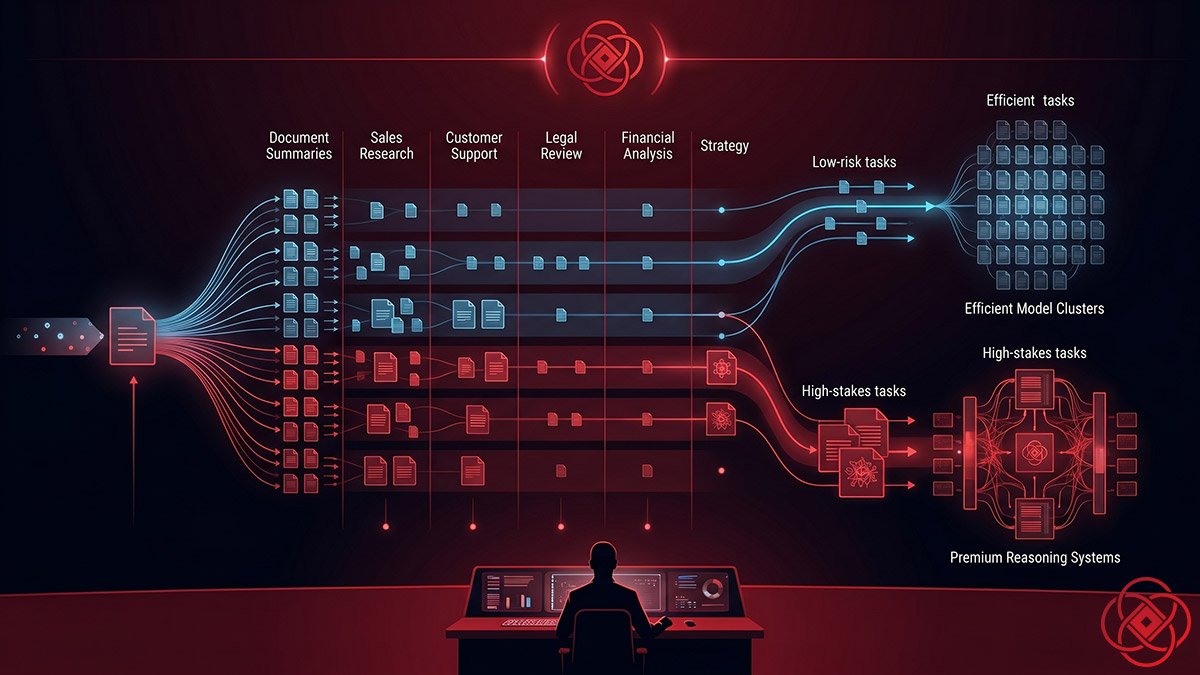
- How it works: Route cost-sensitive, high-volume tasks to DeepSeek R4 and high-stakes, frontier-level reasoning to GPT-5 based on business needs
- Bottom line: The future is not one model — it's a model stack where each AI serves a specific business purpose
DeepSeek R4 vs GPT-5: Which AI Model Should Your Business Use?
DeepSeek R4 vs GPT-5 is not a winner-take-all fight. It is a routing decision. DeepSeek R4 offers cost-effective reasoning for high-volume, long-context workflows, while GPT-5 delivers frontier-level performance for high-stakes business tasks. The smartest approach is building a model stack that matches each tool to its ideal job.
Best for: Teams running diverse AI workloads who need to balance cost efficiency with quality and risk management across different use cases.
AI model comparisons can get loud fast.
One model wins a benchmark. Another wins a coding test. A third claims lower cost. Then the market reacts as if the whole future has changed overnight.
But businesses do not buy noise.
They buy outcomes.
That is the right way to compare DeepSeek R4 and GPT-5. Not as trophies. Not as fan clubs. Not as brands. As working tools.
The real question is simple:
Which model helps your business do better work at a better cost with less risk?
That answer depends on what you are trying to build.
What is DeepSeek R4?
DeepSeek R4 is the SEO-facing name many people may use when searching around DeepSeek's newest reasoning model story. Officially, DeepSeek's current release is called DeepSeek-V4 Preview. DeepSeek describes V4 Preview as open-sourced and built around cost-effective 1M-token context. It includes DeepSeek-V4-Pro and DeepSeek-V4-Flash. The Pro version is listed at 1.6T total parameters with 49B active parameters, while Flash is listed at 284B total parameters with 13B active parameters.
That matters because DeepSeek is not just selling another chatbot.
It is pushing a model family built around long context, lower-cost inference, and agent workflows.
For business users, that means DeepSeek R4 is not only about asking questions. It is about feeding the model larger files, longer transcripts, more code, more documentation, and more operational context.
That opens the door to different work.
What is GPT-5?
GPT-5 is the type of model many businesses think of when they think about frontier AI. It is usually associated with high-end reasoning, strong general-purpose use, polished product integrations, and broad enterprise trust.
The reason businesses compare DeepSeek R4 against GPT-5 is not just technical. It is economic.
If DeepSeek can do a large part of the same work for less money, teams will test it. If GPT-5 is still stronger, safer, easier to govern, or better integrated, teams may stay with it.
This is where the comparison gets useful.
The main difference is not intelligence. It is tradeoff.
Most business buyers want one clean answer.
"Which model is better?"
That is the wrong question.
The better question is:
Better for what?
DeepSeek R4 may be attractive when a company needs lower-cost reasoning, long document analysis, coding support, agent workflows, and open-weight flexibility. GPT-5 may be the better choice when a company needs a mature enterprise stack, stronger trust controls, deeper vendor support, and more consistent frontier-level reasoning.
That is not a small difference.
It changes how you buy.
It changes how you test.
It changes how you deploy.
DeepSeek R4 may win on cost-sensitive workloads
DeepSeek's official pricing page lists V4-Flash at $0.14 per 1M input tokens on cache miss and $0.28 per 1M output tokens. V4-Pro is listed at discounted pricing through May 31, 2026: $0.435 per 1M input tokens on cache miss and $0.87 per 1M output tokens, with higher list prices shown beside them.
That is important for teams running high-volume workflows.
Think about:
- Customer support drafts
- Document summaries
- Sales research
- Internal knowledge search
- Contract review
- Code explanation
- Transcript analysis
- Agent task planning
A model can be impressive and still be too expensive to use at scale.
That is where DeepSeek R4 gets interesting. It gives teams a reason to ask whether every task needs the most expensive model.
Many do not.
GPT-5 may still win on trust and frontier quality
Cost is not everything.
A model that is cheaper but wrong at the wrong moment is not cheaper. It is expensive in a different way.
NIST's CAISI evaluation found that DeepSeek V4 Pro was the most capable PRC model it had evaluated to date, but also estimated that it lagged leading U.S. frontier models by about eight months in aggregate capability. CAISI also found that DeepSeek V4 scored better on DeepSeek's self-reported evaluations than on CAISI's own evaluation suite.
That does not make DeepSeek weak.
It makes the buying decision more honest.
DeepSeek R4 may be strong enough for many business workflows. GPT-5 may remain the safer choice for high-stakes reasoning, complex agent work, sensitive decisions, and executive-facing outputs.
The smart team does not pick one model for everything.
The smart team routes work by risk.
Use DeepSeek R4 where volume matters
DeepSeek R4 is a strong candidate for work where the task is frequent, structured, and reviewable.
Examples:
- Summarizing long research files
- Drafting first-pass sales emails
- Cleaning messy notes
- Generating content briefs
- Explaining code
- Reviewing internal docs
- Creating first-draft SOPs
- Building support macros
- Extracting fields from long documents
These are tasks where a human can review the output, and the cost savings can compound.
That is where DeepSeek R4 can become a business lever.
Small savings per task become large savings at scale.
Use GPT-5 where judgment matters
GPT-5-style frontier models may still make more sense when the task carries more risk.
Examples:
- Legal reasoning
- Financial analysis
- Security review
- Sensitive customer messaging
- Board-level strategy
- Medical or regulated content
- Complex multi-step agents
- High-value enterprise proposals
This does not mean GPT-5 is perfect.
No model is.
It means the business case changes when the cost of a mistake rises.
The best answer is a model stack
The future is not one model.
It is a model stack.
Use DeepSeek R4 for cost-effective work. Use GPT-5 for high-stakes work. Use smaller models for simple automation. Use retrieval systems to ground answers. Use human review where the decision matters.
This is how serious companies will use AI for business.
Not emotionally.
Not because a model is trending.
Because each model has a job.
Decision Guide
Use it if: You run high-volume AI workflows with mixed risk levels and want to optimize cost without sacrificing quality on critical tasks.
Skip it if: You only need a single model for low-volume work, or your entire operation requires the highest level of frontier reasoning and enterprise support.
Best first step: Audit your current AI workloads by risk level, then test DeepSeek R4 on three high-volume, low-risk tasks while keeping GPT-5 for your most critical work.
FAQ
What is the main difference between DeepSeek R4 and GPT-5?
The main difference is not raw intelligence but business tradeoffs. DeepSeek R4 offers lower-cost inference and long-context handling for high-volume workflows, while GPT-5 provides frontier-level reasoning, stronger enterprise trust, and better performance on complex, high-stakes tasks. The choice depends on your specific use case and risk tolerance.
How much cheaper is DeepSeek R4 compared to GPT-5?
DeepSeek V4-Flash costs $0.14 per 1M input tokens and $0.28 per 1M output tokens, while V4-Pro runs $0.435 per 1M input tokens and $0.87 per 1M output tokens through May 2026. Exact GPT-5 pricing varies by deployment, but DeepSeek generally offers significantly lower per-token costs for comparable reasoning tasks.
When should a business choose GPT-5 over DeepSeek R4?
Choose GPT-5 for high-stakes work where accuracy and judgment are critical: legal reasoning, financial analysis, security reviews, executive strategy, regulated content, and sensitive customer communications. GPT-5's maturity, enterprise integration, and frontier-level performance make it better suited for tasks where the cost of error is high.
Can DeepSeek R4 handle enterprise-scale deployments?
Yes, DeepSeek R4 can handle enterprise-scale deployments, especially for high-volume, cost-sensitive workloads like document summarization, code explanation, and agent workflows. However, enterprises should evaluate their specific governance, compliance, and integration requirements, as GPT-5 typically offers more mature enterprise support and vendor ecosystem.
How does DeepSeek R4 perform on reasoning benchmarks?
According to NIST's CAISI evaluation, DeepSeek V4 Pro is the most capable PRC model evaluated to date but lags leading U.S. frontier models by approximately eight months in aggregate capability. Performance on DeepSeek's own benchmarks was higher than on independent evaluations, suggesting results vary by test methodology.
What is a model stack and why does it matter for businesses?
A model stack is a strategic approach where businesses deploy multiple AI models for different purposes rather than relying on a single model for all tasks. This matters because it allows companies to optimize for cost, performance, and risk simultaneously — using cheaper models for high-volume work and premium models for critical decisions.
Should small businesses use DeepSeek R4 or GPT-5?
Small businesses with limited budgets and high-volume content needs may benefit from starting with DeepSeek R4 for routine tasks like customer support drafts, document summaries, and internal knowledge search. However, businesses handling sensitive data, regulated industries, or high-value client work should prioritize GPT-5's reliability and enterprise trust, even at higher cost.