

DeepSeek R4 Long Context: Why 1M Tokens Matters
⏱ 8 min read
TL;DR
- What it is: DeepSeek R4's 1M-token context window lets the model process massive amounts of information at once — documents, code, transcripts, and records together
- Who it's for: Teams analyzing long documents, building AI agents, reviewing code, or working with complex customer histories and technical knowledge bases
- How it works: The model can see up to 1 million tokens in a single session, reducing need to chunk, summarize, or repeat information across multiple calls
- Bottom line: Long context reduces friction in business workflows, but demands better prompt design, cost tracking, and output validation to avoid expensive mistakes
What Is DeepSeek R4 Long Context?
DeepSeek R4 long context refers to the model's 1M-token context window, enabling it to process and reason across extremely large inputs — equivalent to hundreds of pages of text, code files, meeting transcripts, and documents — all in a single request without losing information or requiring manual chunking.
Best for: Document analysis, customer support intelligence, code review, AI agents, and research workflows
Not ideal for: Simple queries, short tasks, or scenarios where smaller context is sufficient and more cost-effective
Most people think AI gets better when it gets smarter.
That is only part of the story.
AI also gets better when it can see more.
A model with a small context window is like a person reading one page at a time. It can help. But it keeps losing the room.
A model with a long context window can see the meeting notes, the policy, the contract, the code, the transcript, and the task at the same time.
That changes the work.
DeepSeek says 1M context is now the default across its official DeepSeek V4 services. The Hugging Face model card also lists DeepSeek-V4-Pro and DeepSeek-V4-Flash with 1M context length.
That is why DeepSeek R4 long context deserves attention.
Not because big numbers are impressive.
Because context is where business work lives.
What is long context?
Context is the information the model can consider at one time.
A short context window means the model can only process a limited amount of text before older information drops out or must be summarized.
A long context window means the model can process much more at once.
For a person, this is like keeping a large file open on the desk.
For a business, this is like giving the model more of the actual operating environment.
That can include:
Meeting transcripts.
Customer records.
Product docs.
Support tickets.
Code files.
Research reports.
Legal documents.
Brand guidelines.
Sales notes.
Internal SOPs.
The more relevant context the model can see, the better chance it has to give a useful answer.
Why 1M tokens matters
A 1M-token context window is large enough for serious business inputs.
It can support workflows that smaller context windows struggle with.
For example, a team may want to compare several long documents at once. Or analyze a product manual and support tickets together. Or inspect a large set of code files. Or summarize a long research archive.
Before long context, teams had to break this work into pieces.
That created problems.
The model missed connections.
The user had to repeat details.
The system needed complex chunking.
Summaries lost nuance.
Answers became thin.
Long context does not solve every problem.
But it reduces some of the friction.
Long context is not the same as good context
This is the part many teams miss.
More context is not always better.
Better context is better.
If you send the model a million tokens of messy, irrelevant material, you may get a slower and weaker answer.
The model has more to read.
More to sort.
More to confuse.
More chances to follow the wrong thread.
Long context is a bigger desk.
It is not a clean desk.
The work is still to put the right material in front of the model.
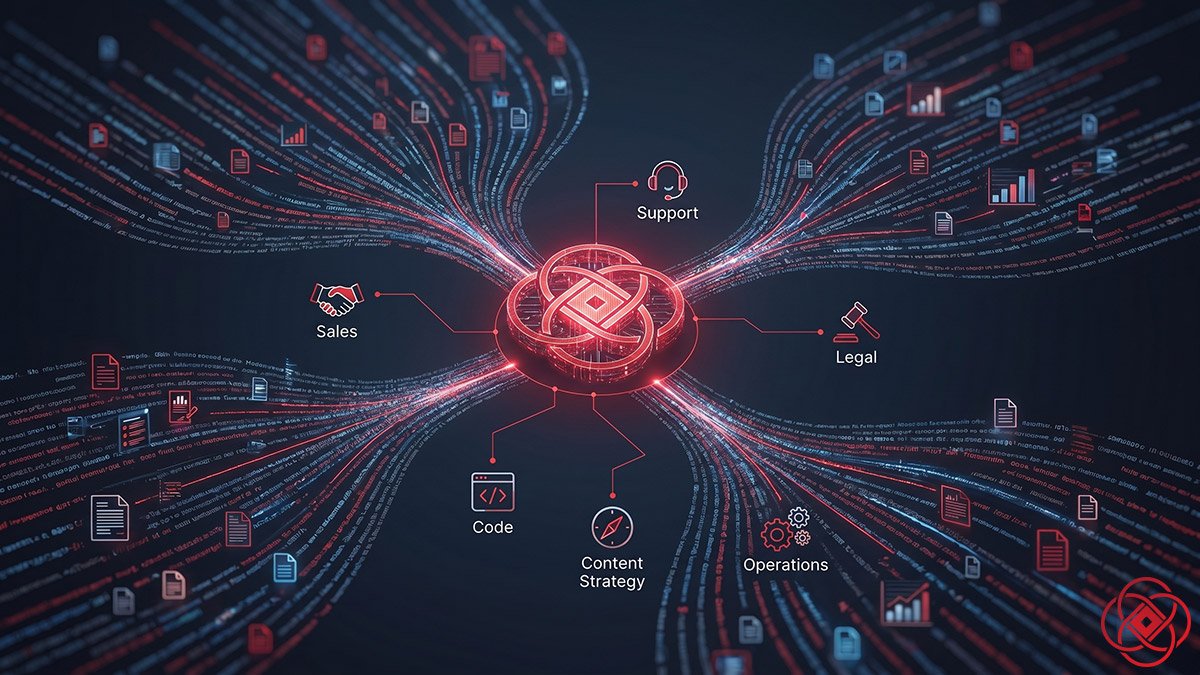
Best business use cases for DeepSeek R4 long context
The strongest use cases are jobs where the answer depends on many pieces of information.
1. Document analysis
A company can feed long reports, proposals, contracts, or manuals into the model and ask for summaries, risks, action items, or comparisons.
This is useful because business documents are rarely short.
2. Customer support intelligence
A support team can combine policies, ticket history, product notes, and customer messages.
The model can draft a better response because it sees the larger case.
3. Sales research
A sales team can analyze a prospect's website, public filings, notes, CRM records, and previous emails.
The output can be a better account brief.
4. Content strategy
A publisher can feed existing posts, keyword plans, competitor notes, and brand rules.
The model can help build better content clusters.
5. Code and technical review
A developer team can provide larger code context, logs, docs, and issue reports.
The model can reason across more of the system.
Why long context helps AI agents
Agents need memory.
Not emotional memory.
Working memory.
They need to know the task, the tools, the rules, the current state, and the history of what has already happened.
DeepSeek's V4 release emphasizes agent capabilities, and its API supports tool calls and structured outputs.
Long context can help agents stay on task.
It can reduce the need to constantly reload information.
It can help the agent connect steps.
But again, it must be governed.
A long-context agent without rules can become expensive and messy.
A long-context agent with clear instructions can become a useful worker.
The cost risk
Long context can increase cost.
If you send more tokens, you may pay more.
DeepSeek's pricing page explains that billing is based on input and output tokens, with different prices for cache hits and cache misses.
That means a 1M-token window is both an opportunity and a budget risk.
The smart approach is not to use the full window every time.
Use it when the task needs it.
For smaller tasks, send less.
For repeated context, use caching.
For large knowledge bases, use retrieval.
For long conversations, summarize old state.
This is how you keep long context from becoming long bills.
The accuracy risk
Long context can also create accuracy problems.
The model may miss important details buried deep in the input.
It may over-focus on recent sections.
It may blend unrelated points.
It may quote or summarize in ways that feel confident but need checking.
This is why long-context workflows need evaluation.
Ask the model to cite sections.
Ask it to separate facts from assumptions.
Ask it to list uncertainty.
Ask it to provide a structured answer.
Ask humans to review high-risk outputs.
Long context helps.
It does not remove responsibility.
How to use DeepSeek R4 long context well
Start with a clear task.
Give the model only relevant files.
Use headings.
Use clean labels.
Tell the model what matters.
Ask for structured output.
Limit the answer length.
Use retrieval when the source library is too large.
Track token cost.
Test outputs against known answers.
This is not complicated.
But it does require discipline.
The real business value
The value of long context is not that the model can read more.
The value is that your team can repeat less.
Less copying.
Less pasting.
Less summarizing.
Less explaining.
Less searching.
Less stitching together scattered details.
That is where the ROI lives.
Long context helps the model meet the business closer to where the work already is.
Inside messy documents.
Inside long calls.
Inside product specs.
Inside customer histories.
Inside code.
Inside knowledge bases.
That is where AI becomes more than a chat window.
Bottom line
DeepSeek R4 long context matters because business work is long.
The documents are long.
The meetings are long.
The histories are long.
The codebases are long.
A 1M-token context window gives teams more room to work. But it also demands better workflow design.
Use long context when the full picture matters.
Use shorter prompts when it does not.
The win is not using more tokens.
The win is getting better answers with the right context.
For pricing details, see DeepSeek R4 API Pricing. For agent workflows, read DeepSeek R4 for AI Agents. For model comparisons, check DeepSeek R4 vs GPT-5.
For the full model overview, read the pillar guide: DeepSeek R4 AI Model 2026.
Related DeepSeek R4 Guides
Decision Guide
Use it if: Your workflow requires analyzing multiple long documents together, building AI agents with complex state, reviewing large codebases, or working with extensive customer histories and knowledge bases.
Skip it if: Your tasks are short and straightforward, you're working with simple queries, or smaller context windows handle your needs more cost-effectively.
Best first step: Test with a medium-length task first (10K-50K tokens) to validate output quality and cost, then scale to full 1M-token workflows only when business value justifies the expense.
FAQ
What does 1M tokens actually mean in practical terms?
One million tokens is roughly 750,000 words or about 1,500 pages of text. In practice, it can hold multiple lengthy documents, dozens of code files, extensive meeting transcripts, or comprehensive customer histories all at once — enough for most complex business workflows.
Does using long context make DeepSeek R4 more expensive?
Yes, potentially. You pay for the tokens you send (input) and receive (output). Sending 1M tokens costs more than sending 10K tokens. Smart teams use caching for repeated context, retrieval for large knowledge bases, and only send full context when the task truly requires it.
Can I use DeepSeek R4 long context for customer support?
Yes. Long context excels at customer support intelligence because it can see ticket history, product documentation, policies, and current messages simultaneously. This helps the model draft more accurate, context-aware responses without constant manual copying and pasting.
Is long context better than RAG for document analysis?
It depends. Long context is better when you need the model to reason across all documents simultaneously. RAG (retrieval-augmented generation) is better for very large knowledge bases where only small relevant chunks are needed per query. Many teams use both strategically.
How does long context help with AI agents?
AI agents need working memory — task instructions, tool definitions, conversation history, and current state. Long context lets agents maintain this information across multi-step workflows without losing track, reducing errors and improving task completion rates.
What happens if I send irrelevant information in long context?
The model may get confused, focus on the wrong details, or produce weaker answers. Long context is a bigger desk, not a smarter brain. You still need to curate what you send — use clear headings, relevant sections, and explicit instructions about what matters most.
Can DeepSeek R4 long context handle code review?
Yes. Long context is particularly valuable for code review because it can see multiple files, dependencies, logs, and documentation together. This helps the model understand system architecture, trace bugs across files, and suggest changes that consider the broader codebase context.