

RedHub.ai • Smart Home Privacy
⏱️ Read Time: 8 minutes
TL;DR: The Nancy Guthrie case highlighted how "deleted" doorbell footage can still exist as residual data in backend systems—reshaping what consumers should assume about cloud retention and law enforcement access.
📚 In This Series
Deleted Doorbell Footage? It May Not Be Gone
On the morning of February 1, 2026, Nancy Guthrie was taken from her Tucson, Arizona home.
She was 84 years old—the mother of Today show anchor Savannah Guthrie. Her doorbell camera, a Google Nest device mounted at the front door, registered movement that morning. But Pima County Sheriff Chris Nanos told reporters there was no usable footage. Nancy didn't pay for a cloud subscription. The clip had been automatically overwritten.
That's what investigators said on February 5.
By February 11, FBI Director Kash Patel posted on X that agents had recovered footage from the camera after all—images showing a masked, armed individual outside Nancy's door on the morning of her disappearance.
The footage had been retrieved, Patel said, from "residual data located in backend systems."
Two words in that statement have been quietly upending how millions of people think about the cameras on their own front doors: residual data.
What Is "Residual Data" and How Did It Survive?
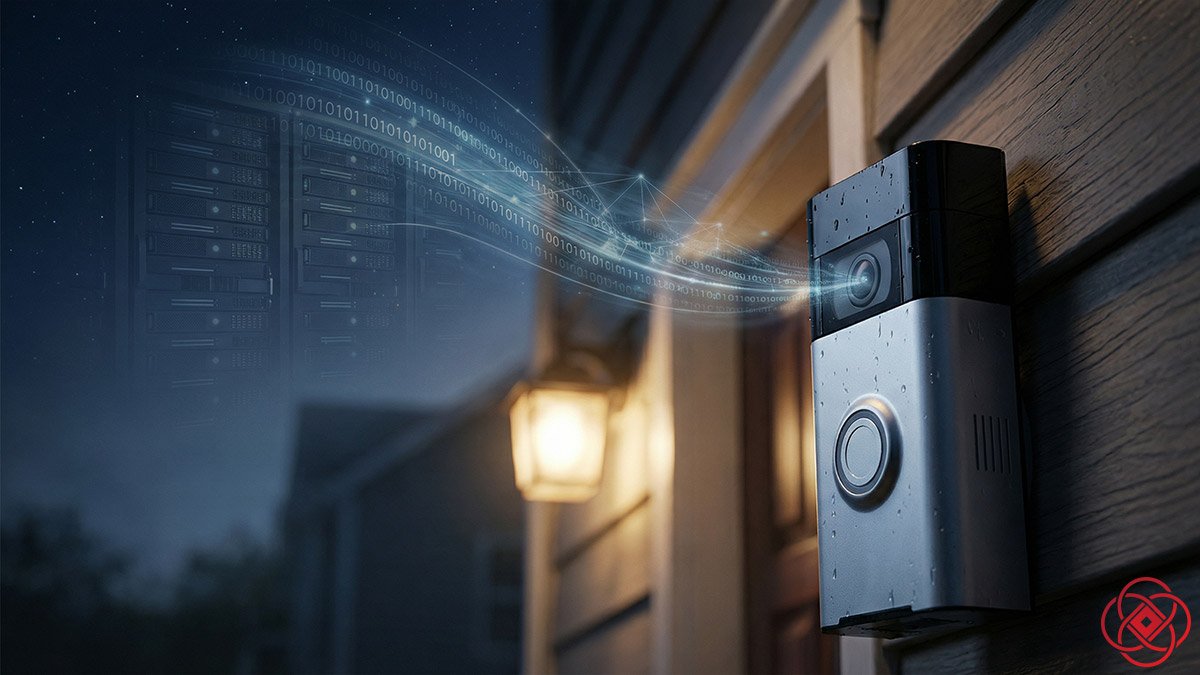
When a doorbell camera captures a motion event, it does two things almost simultaneously: it stores a clip locally on the device, and—if connected to the internet—it uploads that clip to the company's cloud servers.
For free-tier users who don't pay for a subscription, most companies advertise a short window of cloud access. Google Nest offers three hours of event history for older models, and six hours for newer ones. After that window, the footage becomes inaccessible to you from your app. You can no longer see it, download it, or share it.
But "inaccessible to you" is not the same as "deleted."
When data is flagged for deletion on a server, it is typically marked for removal—not immediately overwritten. The actual file remains in place on the storage medium until new data physically overwrites those sectors. This is a basic property of how digital storage systems work, and it is the same principle that allows forensic technicians to recover "deleted" files from hard drives in criminal investigations.
Cybersecurity expert Alex Stamos explained it this way: "Internal storage uses a very lenient deletion mechanism, so non-paying users can't access their data. Videos for non-subscribers are marked for deletion, but depending on the implementation details, the actual files may not be deleted for several days, and data may not be overwritten until free space is needed."
Patrick Jackson, CTO of privacy firm Disconnect, put it even more plainly: "There's an old adage that 'data is never deleted, it's just renamed.' When data is uploaded, it may be marked for deletion, but it may not actually be deleted."
In the Guthrie case, the footage had been uploaded to Google's servers before the camera was disconnected. Once there, it entered the system's deletion queue—technically inaccessible to Nancy, technically scheduled for removal—but physically still present on Google's infrastructure. Working with private sector partners, the FBI located it.
Google offers a limited amount of free cloud storage regardless of subscription status. Older Nest models store event clips for up to three hours; newer ones for up to six. Even without a paid plan, footage is uploaded to Google's servers during that window. The Verge reported: "When an item is deleted from a server, it doesn't get immediately overwritten."
Community discussions in Google's own Nest forums in the aftermath of the case revealed something even more striking. According to Google's own published documentation on data deletion: "Complete deletion of data from our servers is equally important for users' peace of mind. This process generally takes around 2 months from the time of deletion. This often includes up to a month-long recovery period in case the data was removed unintentionally. Our services also use encrypted backup storage as another layer of protection to help recover from potential disasters. Data can remain on these systems for up to 6 months."
Six months. Not three hours.
The three-hour window is how long you can see your footage. Six months is potentially how long it exists.
What the Timeline Looked Like
Understanding the gap between "no footage exists" and "we recovered the footage" requires walking through what actually happened step by step.
January 31 / February 1, ~2:47 a.m.: Nancy Guthrie's doorbell camera disconnects. About 30 minutes earlier, the camera had registered motion and uploaded a short clip to Google's servers.
February 1: Nancy is reported missing when she fails to appear at church. Pima County homicide detectives respond. Sheriff Nanos later says the scene was unusual enough that the presence of the sheriff himself and homicide detectives was warranted from the outset.
February 5: Sheriff Nanos tells reporters the doorbell clip was overwritten because Nancy lacked a subscription. He says efforts to recover footage are ongoing.
February 11: FBI Director Kash Patel posts stills from the Nest camera on X. The images show a masked, armed figure at Nancy's front door. The FBI states footage was recovered from "residual data in backend systems."
February 14 – ongoing: Investigators collect hundreds of hours of additional footage from Ring and other doorbell cameras throughout the neighborhood. Neighbor cameras—including a Ring camera—capture a vehicle circulating near the residence at approximately 2:30 a.m. As of late February, the Pima County Sheriff's office confirms it is reviewing hundreds of hours of footage, DNA evidence is under lab analysis, and all Guthrie family members have been cleared as suspects.
What This Means for Ring and Every Other Camera
The Guthrie case involved a Google Nest device. But the implications apply to every networked doorbell camera—including Ring.
Ring's data retention policies, per the company's own documentation, store motion-event videos for up to 180 days for subscribers. When videos are deleted by a user or a subscription lapses, Ring states they are "permanently lost." Ring's privacy policy acknowledges that "Removed Content and User Recordings may be retained by Ring to comply with certain legal obligations and are not retrievable without a valid court order."
That last clause is the key one: not retrievable without a valid court order.
It does not say they are deleted. It says you can't get them without a court order.
For law enforcement with proper legal process, a different set of doors is open.
Ring processed over 20,000 law enforcement requests for footage in 2020 alone. That was before Search Party. Before the Flock Safety partnership. Before AI-powered neighborhood scanning became a Super Bowl ad.
Jamie Siminoff himself pointed to the Guthrie case as part of the "perfect storm" that made the Super Bowl ad land so badly: "You have the AI angst, you have the Nancy Guthrie thing happening. All this came together and it created a perfect storm and it just hit and exploded."
He meant it as an explanation for why the ad was misread.
But read another way, he identified precisely why people's anxiety was rational. The Guthrie case didn't create fear about doorbell cameras in a vacuum. It demonstrated, in a real and ongoing criminal investigation, that footage people believed was deleted—footage they had no subscription to protect—was sitting in a corporate backend, accessible to investigators with the right tools and legal authorization.
The Ring Super Bowl ad ran one week later. Same week. Same news cycle. Same country.
What This Means for Your Camera, Right Now
You don't need to be Nancy Guthrie for this to matter.
Here's what the Guthrie case confirmed about the gap between what consumers believe about their footage and what is technically true:
What you think happens when footage "expires":
Your subscription lapsed, or you never had one. The clip is gone after a few hours. The camera is just a live-view device now.
What may actually happen:
The clip was uploaded to a cloud server during the active window. It was marked for deletion. It may physically remain on backend infrastructure for days, weeks, or in Google's case potentially up to six months, until it is overwritten or formally purged. It is not accessible to you. It may be accessible to the company, and to law enforcement with proper legal process.
What you can do about it:
• Enable end-to-end encryption if your device supports it. Ring offers E2EE, which means footage is encrypted in a way that Ring itself cannot access without your device keys. Google does not currently offer E2EE on Nest cameras. If this matters to you, it should inform which camera you use.
• Regularly review and manually delete footage from your cloud library, rather than letting it expire. Manual deletion is faster than automatic expiration—though as the Guthrie case shows, even manual deletion may not be instantaneous at the backend level.
• Understand your subscription terms. If you have a Ring Protect plan, footage is stored for up to 180 days. If you cancel, that footage doesn't vanish immediately. Read Ring's data retention documentation to understand the actual deletion timeline.
• Submit a data deletion request directly to the company. Under privacy laws in several states, you have the right to request deletion of your personal data. Ring and Google both have processes for this. Using them—and requesting confirmation—puts the obligation formally on the company.
• Consider whether your camera angle captures your neighbors. If your doorbell camera captures a neighbor's yard, their driveway, or a public sidewalk, that data doesn't just belong to your privacy calculus. It's in someone else's story too.
The Broader Question the Case Raised
Doorbell cameras were sold to consumers on a specific premise: you get to see who's at your door. You control the footage. You decide who sees it.
The Guthrie case cracked that premise open.
It revealed that the footage exists in a layered system—on the device, on the company's active servers, in backup infrastructure—and that the consumer's visibility into that system extends only as far as the interface allows. Beyond the interface is a back end that operates on its own retention logic, accessible to the company and to authorities under the right conditions.
This is not a scandal. In the Guthrie case, it may have produced the only evidence that can identify who took an 84-year-old woman from her home. That matters enormously.
But the same system that made that recovery possible is the same system that runs on millions of other doorframes. For every Nancy Guthrie case where the "residual data" helps find a perpetrator, there are millions of households where footage exists somewhere in a corporate backend—footage of comings and goings, routines, visitors, arguments on front porches—that the homeowner believes is gone.
It isn't necessarily gone.
It is just out of reach. For now. For most people. Under most circumstances.
Jamie Siminoff is right that video, in many cases, tells the truth.
What he didn't address in his explanation tour is who gets to decide when that truth gets told—and about whom.
This is part of RedHub.ai's ongoing series on AI transparency and smart home privacy. For the full investigation into Ring's Super Bowl ad, read The Trojan Dog: Ring Search Party Backlash. To audit every privacy setting on your Ring camera today, see our step-by-step guide: How to Turn Off Ring Search Party (Step-by-Step).