Solo Founder Runway: Model It Without a CFO
Todd Brooks, Founder5 min read

Jump to a section8
TL;DR
- What it is: solo founder runway is how many months your business can operate before the cash runs out — cash divided by net monthly burn.
- Who it's for: anyone running a company alone without a finance person — part of the bigger system in AI for solo founders.
- How it works: one division gives you a snapshot. A real model adds scenarios, sensitivity, and the default-alive question — and gets refreshed monthly.
- Bottom line: a runway number you haven't updated since the last raise isn't a number. It's a feeling wearing a spreadsheet.
What is solo founder runway?
Solo founder runway is the number of months your business can keep operating before cash runs out: cash in the bank divided by net monthly burn (costs minus revenue). If revenue exceeds costs, burn is negative and you're "default alive" — the business survives without raising. The number matters more for a solo founder than anyone else, because there is no CFO watching it for you, and every big decision — raise, cut, push — hangs on whether it's real.
Best for: founders whose runway answer starts with "roughly" — the runway/burn modeler skill in the Solo Founder Skills Pack makes it a monthly 20-minute habit.
Ask a solo founder their runway and you usually get a range and a wince. "Nine-ish months? Maybe twelve if the annual renewals land." That's not a model — that's hope with error bars. And it's dangerous specifically because runway drives the three biggest calls you'll make this year: when to raise, what to cut, and how hard to push. Solo founder runway deserves better than a guess, and getting it doesn't require a CFO.
Start with the honest division
The base number takes one minute. Type yours in — nothing leaves this page.
Your baseline runway
Two honesty rules for the inputs. Costs are all-in — your own pay, taxes, the annual subscriptions divided by twelve, the contractor you keep forgetting. And revenue is collected revenue, not signed deals. Signed-but-not-collected is the classic way a runway number flatters you.
Why the division isn't a model
The one-line answer is a snapshot. It assumes next month looks like this month — which is exactly what never happens. A real runway model adds three things the division can't give you:
- Scenarios. Base, better, worse. What happens to the runway if the biggest customer churns? If the price increase lands? An 18-month projection with sensitivity tables turns "what if" from anxiety into arithmetic.
- The default-alive question. On current growth and current burn, does the business reach profitability before the cash runs out? If yes, you're default alive and raising is a choice. If no, you're default dead and the runway number is really a deadline.
- Milestone targets. If you do plan to raise, the model should say what has to be true — and by when — for that raise to happen from strength instead of desperation.
Honest boundary: no model predicts the future. What it does is make your assumptions visible and consistent, so when reality diverges you notice in weeks, not quarters. A wrong-but-written assumption is fixable. A vibe isn't.
The three numbers to check monthly
| Number | What it tells you | Red flag |
|---|---|---|
| Net burn | The real monthly cash direction | It grew and you can't name why |
| Months of runway | The decision clock | Under 9–12 months with no plan to raise or cut |
| Default alive / dead | Whether survival needs outside money | You've never actually computed it |
Burn creep deserves special mention for one-person businesses, because nobody is approving your expenses but you. Subscriptions stack, tools duplicate, and each one is too small to notice. A periodic sweep for exactly this is what the Profit Leak Finder quick kit does; for continuous watch-the-cash discipline at the systems level, that's Cash-Flow Sentinel's job.
Make it a 20-minute monthly habit
The reason solo founders don't keep a live runway model isn't ability — it's that rebuilding a spreadsheet every month loses to everything else on the list. This is a textbook case for an installed skill: recurring, structured, and math-heavy.
The runway/burn modeler in the Solo Founder Skills Pack triggers on phrases like "model runway" or "when do we raise." It builds an 18-month projection with sensitivity tables, applies default-alive/default-dead framing, runs a Rule of 40 check, and ships three template structures (SaaS, services, e-commerce) — plus a Python script so the arithmetic is deterministic, not generated. Feed it this month's actuals and the refresh is a 20-minute task. Slot it into the monthly edition of your weekly review and the number stays real all year.
Never guess the runway number again
The Solo Founder Skills Pack ($79, one-time) includes the runway/burn modeler plus five more skills for the founder jobs you carry alone — investor updates, board memos, deck review, customer synthesis, and the weekly cadence. 30-day refund.
Get the Solo Founder Skills Pack — $79 →Decision Guide
Use this approach if: you run the company alone, your runway answer includes the word "roughly," and the model hasn't been touched since your last raise or launch.
Skip it if: a fractional CFO or finance partner already maintains a live model you trust — go read it instead.
Best first step: run the calculator above with all-in costs and collected revenue. If the honest number surprises you, that's the signal to build the real model this week.
FAQ
How do I calculate my runway?
Cash in the bank divided by net monthly burn (monthly costs minus monthly collected revenue). If revenue exceeds costs, you have no burn — you're profitable, or "default alive," and runway stops being a countdown.
What does default alive mean?
It means that on current growth and current spending, the business reaches profitability before the cash runs out — it survives without raising money. Default dead means it doesn't, and outside cash or cuts are required. Every founder should know which side they're on.
How often should a solo founder update the runway model?
Monthly, with real actuals. Quarterly is the bare minimum. Annually — or "at the last raise" — means the number in your head is fiction by mid-year.
How many months of runway is enough?
There's no universal threshold, but a common working rule is that under 9–12 months you should already be executing a plan — raising, cutting, or growing revenue — not deciding whether to make one. The model's job is to start that clock early.
Can AI model my runway reliably?
Yes, with one condition: the arithmetic should be deterministic, not generated. A good setup uses AI to structure the model and a script to do the math — the runway/burn modeler skill ships a Python script for exactly this reason.
What if I'm not a SaaS business?
The mechanics are identical; only the revenue shape changes. The Solo Founder Skills Pack's modeler ships three template structures — SaaS, services, and e-commerce — so lumpy project revenue or inventory cycles are modeled honestly instead of forced into MRR.
Your runway, on real numbers, every month
Six self-loading Claude skills for the work of running a company alone — including the runway modeler that turns your scariest number into a 20-minute monthly habit.
Get the Pack — $79, one-time →
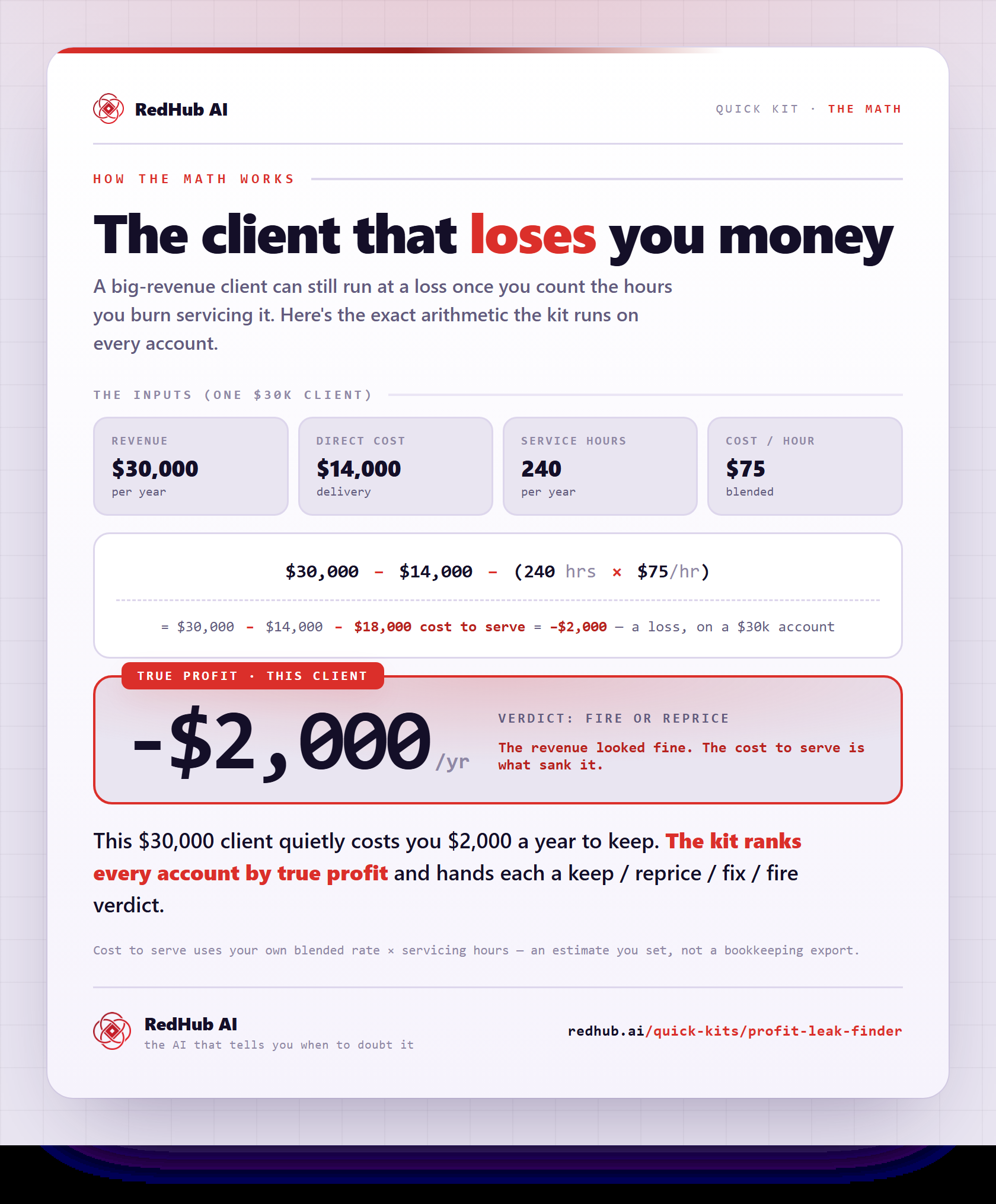
The gate this post refers to, drawn from the tool’s own logic. See the tool.