
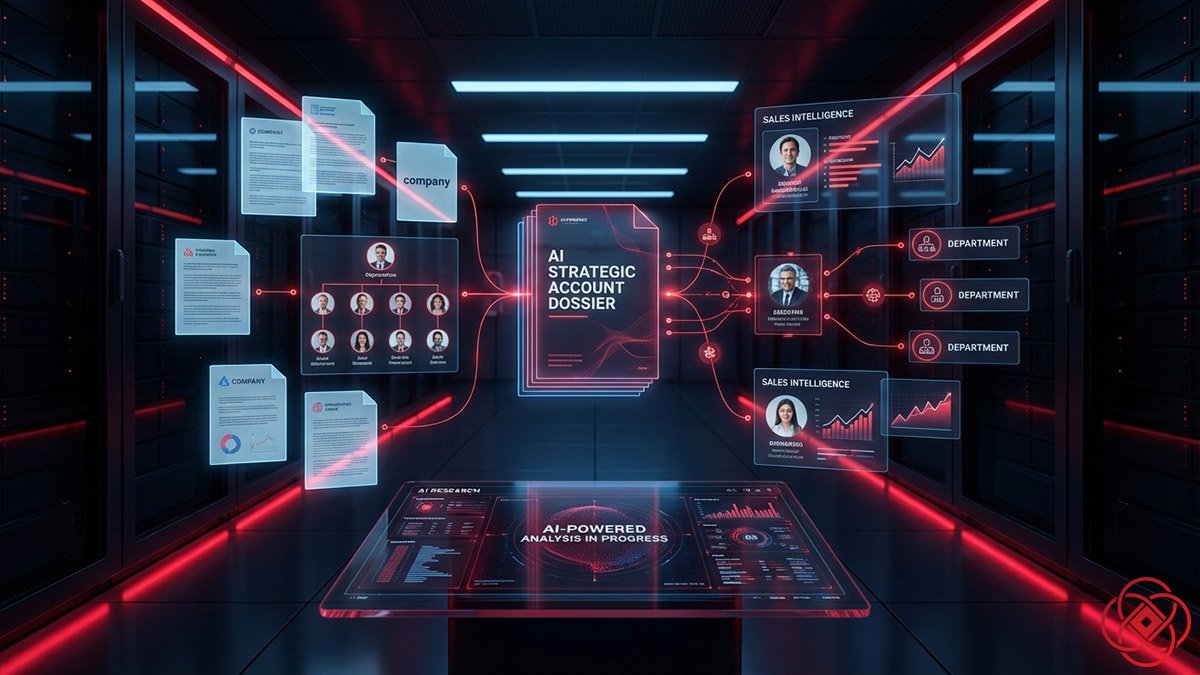
AI for Business • Sales Intelligence
Perplexity for Sales: Account Dossiers That Close Deals
Build living account dossiers with buyer maps and strategic intelligence that wins deals before the proposal stage.
TL;DR
- What it is: A systematic approach to using Perplexity to transform scattered public data and internal notes into living account dossiers that give sales teams complete context before every conversation.
- Who it's for: Sales reps, account executives, and revenue leaders who need to walk into conversations with real insight—not just names from LinkedIn.
- How it works: Build account narratives, map buying committees, craft contextual messaging, prep for meetings, and turn call notes into sharper follow-ups using structured prompts.
- Bottom line: You stop flying blind and start showing up with the precision that makes buyers feel understood and decisions feel easier.
What are account dossiers for sales?
Account dossiers for sales are comprehensive, research-backed profiles of target companies that synthesize public data, buyer committee structures, pain signals, and strategic context into a single shareable document. They help sales teams achieve higher win rates and shorter sales cycles by replacing generic pitches with informed, personalized conversations backed by real business intelligence.
Best for: Account-based selling, enterprise deals, complex sales cycles. • Not ideal for: Transactional sales, high-volume outbound with no customization. • Fast takeaway: Turn scattered account data into strategic intelligence that wins deals.
Most sales teams lose deals long before the proposal stage.
Not because the product is weak.
Not because the price is wrong.
But because they walk into conversations blind.
They know the company name, maybe the industry, maybe a title from LinkedIn. That's it. No context. No story. No real insight.
Perplexity changes that by turning scattered public data and your own internal notes into something a closer actually needs: a living account dossier built to win the next conversation, not just log the last one.
This is how to use it.
Start with one account, not a vague "ICP"
Spray-and-pray research doesn't move pipeline. Specific research does.
Pick a real account on your target list and open a new thread. Then give Perplexity a clear, high-intent prompt:
In seconds, you're not looking at a logo anymore. You're looking at a business with momentum, pressure, and direction.
Turn raw data into a story you can sell into
Information alone doesn't close deals. Story does.
Once you have a first-pass dossier, ask Perplexity to shape it into a narrative you can use on calls:
• Where this company is likely trying to go
• What's probably in their way
• Where our type of solution fits into that picture
Use plain language. No fluff."
Now you have something you can feel: a sense of stakes, timing, and angle. You're not just reciting facts; you're entering their world.
Map the buying committee before you ever send a calendar link
Deals die in the "mystery middle" of the org chart.
You talk to someone. They like it. Then it disappears into a group chat you never see.
Use Perplexity to map that terrain up front:
1. Ask for a buyer map
2. Then ask for specific names and angles
What you're doing here is simple but rare: treating the account like a system, not a single contact.
Build messaging that actually sounds like you did your homework
Generic outreach gets ghosted. Contextual outreach gets replies.
Once you've got the dossier and buyer map, ask Perplexity to help with message frames, not copy-pasta scripts:
• 3 cold email angles for the VP of Sales
• 3 for the RevOps leader
• 3 for the Head of Customer Success
Each angle should reference a real detail from the dossier and connect it to a clear outcome we help with. Keep them under 120 words."
The key word is angles. You're not asking for magic words. You're asking for ideas that you can then tweak into your own voice.
Turn calls and notes into sharper follow-ups
Most sales teams lose compounding insight because call notes die in CRMs.
After a discovery call, paste your notes or transcript into Perplexity and say:
• 5 key pains
• 3 desired outcomes
• Decision process and timeline
• Stakeholders mentioned
Then, draft a follow-up email that confirms our understanding and proposes next steps."
You're not automating authenticity. You're automating the structure of staying sharp and consistent.
Do this across accounts and patterns start to appear: common objections, repeated blockers, language your best buyers naturally use. That feedback loop makes your next dossier even better.
Use Perplexity to prep for every meeting like it matters
The fastest way to lose a deal is to show up unprepared.
Before a call, run a quick "meeting prep" prompt:
• 3 tailored opening questions
• 3 likely objections
• 3 proof points or stories that will resonate
• A suggested call agenda
Keep it tight. I want to respect their time."
Now you walk in with a plan, not just a deck.
You're no longer the rep asking, "So tell me about your business." You're the one saying, "From what I've seen, it looks like you're pushing into X and dealing with Y. Did I get that right?"
That alone changes your position in their mind.
Make account dossiers a system, not a heroic effort
If building dossiers is hard, your team will only do it for the biggest logos. Then everyone else gets guesswork.
Turn this into a repeatable motion:
1. Create a standard dossier template
Decide what every account dossier should include: company overview, recent news, buying committee, tech stack, current initiatives, risks, and suggested angles.
2. Turn that template into a saved prompt
Give your team the exact language to drop into Perplexity for each new account.
3. Store the outputs somewhere central
Whether it's your CRM, a shared folder, or a knowledge hub, keep dossiers discoverable so anyone touching the account has the same picture.
4. Update before key milestones
Before QBRs, renewals, or pricing discussions, rerun a quick "update this dossier with the latest developments" prompt.
Dossiers stop being "nice-to-haves" and become part of how your sales org thinks.
This approach integrates naturally with broader AI for business strategies and can be scaled across your enterprise AI operations.
Use research to qualify hard, not just pitch harder
The point of a dossier isn't just to find reasons to sell. It's to find reasons not to.
Ask questions like:
This is where you protect your time and your team's morale. You focus on deals where the fit, timing, and internal reality line up. You stop forcing opportunities that were never real.
A good account dossier isn't optimistic. It's honest.
From account dossier to deal strategy
Finally, pull it all together.
Ask Perplexity to draft a deal strategy one-pager:
• Why this account should buy anything
• Why they should buy this type of solution
• Why they should buy it from us
• What could block the deal
• Our plan for next 3–5 moves
Write it like a sales manager coaching a rep."
This becomes your internal anchor. You can review it with your manager, your team, or your founder. It forces you to be clear about the path forward, not just hopeful.
The new standard for prepared sales teams
Most sales orgs are still flying half-blind, even with more tools than ever.
The reps and leaders who win now are the ones who do the quiet work up front: they build a clearer picture of the account, the people, and the pressure they're under. They go from names in a CRM to real businesses with real stakes.
Perplexity won't close the deal for you.
But it will make sure that when you show up, you know more, see more, and speak with the kind of precision that makes a decision feel easy on the other side of the table.
📚 Explore the Perplexity Pro Business Series
Start here: Perplexity Pro for Business. Then go deeper with these implementation guides:
- Perplexity Pro Search: Competitive Intelligence Playbook
- What Makes Perplexity Spaces "Enterprise-Grade"
- Deep Research for Leaders: Turning Sources Into Strategy
- Perplexity for Sales: Account Dossiers That Close Deals
- Perplexity for Marketing: AEO + Campaign Angles with Receipts
External quick links: Perplexity • Perplexity Pro
Should you use account dossiers for sales?
Use it if: You're in account-based sales, enterprise deals, or complex B2B cycles where understanding context and buying committees matters. Your team needs repeatable research processes. You want higher win rates through better preparation.
Skip it if: You're selling high-volume transactional products. Your sales cycle is too fast for research. You're in pure inbound where buyers self-educate and come ready to buy.
Best first test: Pick 5 high-value target accounts. Build dossiers for each using the prompts in this guide. Track reply rates, meeting conversion, and deal velocity over 30 days vs. your baseline.
FAQ
How long does it take to build an account dossier?
With Perplexity, the initial dossier takes 10-15 minutes. This includes company overview, buyer mapping, and strategic context. Updates before key milestones take 5 minutes or less. Compare this to traditional manual research which can take hours per account.
Can I use account dossiers for smaller deals or SMB sales?
Yes, but scale the depth. For SMB or mid-market, focus on a 5-minute "lite dossier" with company overview, key decision-maker research, and 2-3 personalization hooks. The methodology works at any scale—just adjust the time investment to match deal size.
Where should we store account dossiers so the team can access them?
Best options: (1) CRM custom fields or notes section for account-level visibility, (2) Shared drive folders organized by account name, (3) Sales enablement platforms like Highspot or Seismic, or (4) Internal wiki/Notion workspace. Choose based on where your team already works daily.
How do I keep dossiers from becoming outdated?
Set update triggers tied to milestones: before quarterly business reviews, when renewing deals, after significant company news (funding, leadership changes), or every 90 days for active opportunities. Use a quick refresh prompt: "Update this dossier with any developments from the last [timeframe]."
What if my prospects aren't publicly active or their companies have limited online presence?
Focus on what IS available: industry trends affecting their sector, competitor movements, regulatory changes, hiring patterns on LinkedIn, and tech stack signals from job postings. Even limited public data combined with internal notes creates more context than most reps work with.
How do account dossiers improve close rates?
Dossiers improve three key metrics: (1) Meeting conversion increases because outreach is contextual, not generic, (2) Sales cycle shortens because you identify and engage the full buying committee faster, (3) Win rates rise because your messaging demonstrates understanding of their actual business situation, making "yes" feel lower-risk.