Cloudflare Dynamic Workers for AI Agents
Todd Brooks, Founderupdated July 22, 20267 min read
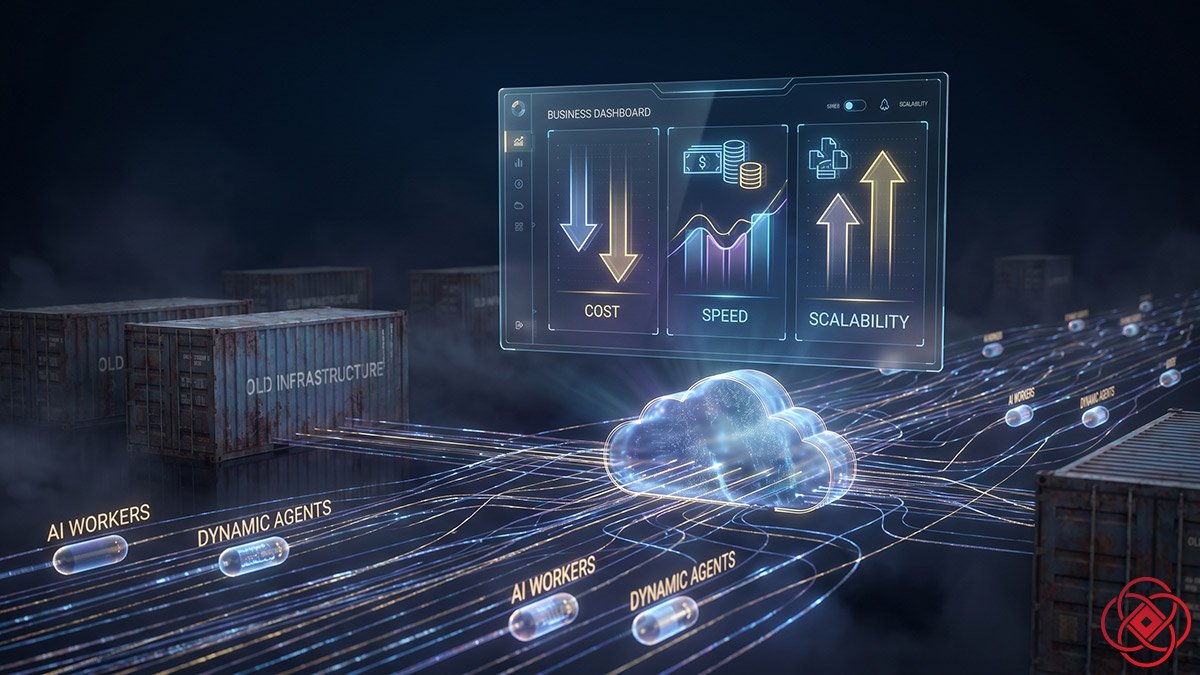
Jump to a section10
TL;DR
- What it is: Cloudflare Dynamic Workers run AI agents using V8 isolates with millisecond startup times at $0.002 per unique Worker per day
- Who it's for: Founders building AI agent products who need fast execution, zero cold starts, and infrastructure that scales without capacity planning
- How it works: V8 isolates replace containers, eliminating startup overhead and idle costs while scaling to millions of concurrent executions instantly
- Bottom line: Dynamic Workers change the unit economics of AI agent products, making features viable at lower pricing tiers and removing infrastructure scale constraints
What Are Cloudflare Dynamic Workers for AI Agents?
Cloudflare Dynamic Workers for AI Agents are ultra-lightweight execution environments built on V8 isolates that start in milliseconds, scale to millions of concurrent executions, and cost $0.002 per unique Worker loaded per day — eliminating the startup overhead and idle costs of container-based infrastructure.
Best for: Products where AI agents are core features and infrastructure costs directly impact pricing strategy and margin profile.
Here is a number that should stop you cold: $0.002.
That is what Cloudflare charges per unique Worker loaded per day on their new Dynamic Workers platform. Not per hour. Not per request. Per day.
If you have been pricing out what it costs to run AI agents in production using containers or traditional serverless infrastructure, that number is going to force you to redo your math.
Why Containers Were Always the Wrong Model for Agents
Containers were a breakthrough for web applications. Package your code and dependencies, spin up a consistent environment, scale horizontally. For stateless web requests — someone visits your site, the server responds, done — containers are fine.
AI agents are not that.
An AI agent that is doing real work — pulling data, making decisions, running tasks in sequence, adapting based on what it finds — is not a request-response cycle. It is more like a worker than a server. And containers were never designed for this. They take seconds to spin up. Cold starts kill latency-sensitive tasks. And the cost model penalizes you for the startup time even before your agent does anything useful.
The serverless alternative was not much better. Standard serverless platforms time out on long-running tasks. They cannot maintain state between invocations. They were built for functions, not agents.
Something new was needed. That is what Dynamic Workers are.
Watch the quick explainer below:
What Dynamic Workers Actually Are
Dynamic Workers are built on V8 isolates (opens in a new tab) — the same technology that powers browser tabs in Chrome. Each isolate is an ultra-lightweight execution environment. No operating system to boot. No container to spin up. Just code, ready to run.
The result: Dynamic Workers start in milliseconds. Not hundreds of milliseconds. Not "fast for a container." Milliseconds, at the tail end of human perception.
They scale to millions of concurrent executions with zero warm-up. If you go from one agent running to ten thousand agents running — say, because your product just got a surge of users — the infrastructure absorbs that without any pre-provisioning, any capacity planning, or any degradation in performance.
And the cost: $0.002 per unique Worker loaded per day. Compared to running containers — where you are paying for the full virtual machine or container instance whether or not it is doing work — the difference is not marginal. According to Cloudflare's announcement of Agent Cloud (opens in a new tab), Dynamic Workers run at a fraction of the cost of containers at 100x the speed.
For founders building products that use AI agents as a core feature, this is not a minor infrastructure optimization. It is a fundamental change to the unit economics of your product.
The Math That Changes Your Business Model
Let us make this concrete.
Say you are building a product where users can trigger an AI agent to run a competitive analysis — pulling from ten sources, formatting a report, flagging key insights. That task takes maybe 45 seconds. With a container-based approach, you are paying for:
- Container startup time (5–30 seconds of cost with no output)
- The full instance cost during the task
- Any idle time the container stays warm between jobs
With Dynamic Workers, you pay for the task. No startup overhead. No idle cost. No capacity buffer you have to pre-buy.
Now multiply that across your user base. If 1,000 users run that analysis daily, the cost difference between the container model and the Dynamic Workers model is significant enough to change your pricing strategy, your margin profile, and your ability to offer the feature to users on lower pricing tiers.
For founders pricing SaaS products that include agent features, the economics of the underlying infrastructure directly determine what price points are viable. Cheaper infrastructure means more pricing flexibility. More pricing flexibility means a larger addressable market.
The Competitive Picture
The major cloud providers — AWS Lambda, Google Cloud Functions, Azure Functions — have all iterated on serverless over the last decade. None of them have cracked the warm-start problem to this degree. None of them price the way Dynamic Workers are priced.
That is not an accident. Cloudflare is not trying to win the same market with a better price. They are betting that the agent era creates a fundamentally different set of requirements that the existing serverless paradigm was not designed to meet — and that whoever builds the right primitive for this era wins the category.
For builders, the strategic implication is straightforward: evaluate the infrastructure against the workload, not against the incumbent. The right question is not "is this better than Lambda?" The right question is "does this fit how AI agents actually behave?" On that question, Dynamic Workers are purpose-built for the job.
What This Means for You Right Now
If you are deploying or pricing an AI agent product, three things deserve your attention.
First, audit your current infrastructure costs for agent workloads. Break down startup time, active compute time, and idle time separately. The places where containers are costing you the most are the places where Dynamic Workers create the most value.
Second, reconsider your pricing tiers. If agents become dramatically cheaper to run, the "power user" features you gated at the highest tier might be viable to offer further down the funnel. That is not just a cost savings — it is a growth lever.
Third, stress-test your scale assumptions. Dynamic Workers scaling to millions of concurrent executions without warm-up means your infrastructure ceiling just went up dramatically. If you have been artificially constraining your agent features because of scale concerns, that constraint is largely gone.
For the security side of agent deployment — how to give agents access to the internal systems they need to run these tasks — see AI security best practices.
And if you want to understand what agents actually need when the tasks they are running are long, complex, and multi-step, explore AI enterprise infrastructure strategies.
The container era made cloud computing accessible. The Dynamic Workers era makes agent computing profitable. The math has changed. Your deployment strategy should too.
Decision Guide
Use it if: You are building AI agent products where infrastructure costs impact pricing tiers, you need millisecond startup times, or you expect unpredictable scale surges.
Skip it if: Your agents run long-duration tasks (hours, not seconds), require heavy OS-level dependencies that V8 isolates cannot support, or you are already locked into container infrastructure with acceptable economics.
Best first step: Audit your current agent infrastructure costs — break down startup time, active compute time, and idle time to identify where Dynamic Workers create the most value for your specific workload.
FAQ
What are Cloudflare Dynamic Workers for AI Agents in simple terms?
Dynamic Workers are ultra-lightweight execution environments built on V8 isolates that run AI agents with millisecond startup times instead of the multi-second cold starts of containers. They cost $0.002 per unique Worker per day and scale instantly to millions of concurrent executions without capacity planning.
How do Dynamic Workers differ from AWS Lambda or Google Cloud Functions?
Traditional serverless platforms like AWS Lambda use containers or micro-VMs that have cold start delays of hundreds of milliseconds to seconds. Dynamic Workers use V8 isolates that start in single-digit milliseconds with no warm-up period. The pricing model is also fundamentally different — you pay per day the Worker is loaded, not per invocation or compute time.
Can Dynamic Workers handle long-running AI agent tasks?
Dynamic Workers are optimized for tasks that complete within seconds to minutes. For long-running agent tasks that span hours or require persistent state across extended periods, Cloudflare's Project Think (opens in a new tab) provides sandboxed environments designed for multi-step, long-duration workflows with state preservation.
What types of AI agent products benefit most from Dynamic Workers?
Products where agents perform discrete tasks triggered by users — competitive analysis, report generation, data enrichment, API orchestration — see the most benefit. The economics shift dramatically for AI for business applications where hundreds or thousands of users trigger agents sporadically throughout the day.
How does the $0.002 per Worker per day pricing actually work?
You are charged $0.002 for each unique Worker code deployment that runs at least once in a 24-hour period. If the same Worker code handles 1 request or 10,000 requests that day, the cost remains $0.002. This eliminates the idle cost problem where containers consume resources between tasks.
Are there limitations to what V8 isolates can run compared to containers?
V8 isolates run JavaScript and WebAssembly, so agents requiring Python, native binaries, or heavy OS-level dependencies need to be adapted or use WebAssembly compilation. However, for most agent orchestration, API calls, and data processing tasks, V8 provides sufficient capability with dramatically better performance characteristics than containers.