Self-Improving AI: What SEAL and Related Work Show
RedHub AI Editorialupdated August 16, 20264 min read

In short
Self-improvement has a weak sense, a model adapting within a session, and a strong one, a system durably changing its own weights or code. MIT's SEAL has a model generate its own training data; on a simplified subset of the ARC benchmark it reached a 72.5 percent success rate against 20 percent and 0 percent baselines. That is an absolute rate, not an improvement figure. Results cluster where automatic verification is cheap.
Jump to a section6
This is general information about AI research and how to read its results. It is not technical advice for any specific system or research program.
The word covers two different things
Weak sense: a model gets better at your task as the conversation fills up with context. Close the tab and it is gone. Nearly every assistant on the market does this.
Strong sense: a system permanently rewrites its own weights or its own code, keeps the change, and is durably better afterwards. That is the research frontier.
Vendors say the strong phrase and ship the weak behavior. A product that promises to "learn your business" is almost always describing a longer context window or a retrieval index. Both are useful. Neither is self-improvement.
What SEAL scored
SEAL, from MIT, stands for Self-Adapting Language Models. The model writes its own training data and its own update directives, then applies them. It sets its own homework and then does it.
On a simplified subset of the ARC benchmark, SEAL hit a 72.5 percent success rate. The baselines reported beside it: 20 percent for test-time training using self-edits from an untrained model, and 0 percent for in-context learning with no adaptation.
That 72.5 is the share of problems solved. It is an absolute score, not a gain. Plenty of coverage reported it as a 72.5 percent improvement, which turns a solid result into a preposterous one and gives readers a reason to disbelieve everything else on the page.
Two qualifiers travel with the number and usually get dropped. It is a simplified subset of ARC, chosen to make the problem tractable, so it says nothing about the full benchmark. And ARC is abstract visual puzzles built to test generalization. They are not a proxy for work anyone is paying for.
Five questions that survive this news cycle
- Absolute or relative? "Reached 72.5 percent" and "improved by 72.5 percent" are different claims, swapped constantly. Settle this before reading further.
- Against what? A score with no baseline carries no information. SEAL's number means something because 20 and 0 sit next to it.
- On what, exactly? Full benchmark or subset. Choosing a tractable subset is legitimate research and a material qualifier, and it is the first thing summaries cut.
- Does it stick? Within the session, or written back into the weights. This one question separates the two senses of the word.
- Who reproduced it? New results are provisional until other groups repeat them. Provisional is the normal state of new research, not an insult.
The bottleneck nobody puts on a slide
A system that writes its own training data needs to know which of its outputs deserve learning from. On a benchmark that is free. The puzzle is solved or it is not.
Most valuable work has no scorer. Whether a piece of writing landed, whether a strategy was sound, whether a hiring call was right are questions with no automatic answer and often no answer for months. Point a self-improving loop at that and it does not improve. It drifts, confidently, toward whatever it already prefers.
This is why the wins cluster in code, mathematics and puzzles. Those are the places correctness is cheap to check. The distance between them and open-ended commercial work is not an engineering gap that closes next year. The signal the method runs on is missing.
Worth holding open: nobody knows how far a good-enough proxy scorer gets you. Model-graded evaluation is improving, and if it improves enough, the wall moves. That is a live question, not a settled one.
What it changes for buyers right now
Almost nothing, and that is the honest answer. Early research, confined to domains with automatic verification.
What should change is how you hear the word. When a vendor says its system learns and improves, ask which sense they mean, what the improvement is measured against, and how the system knows an output was good. The third question is the one that sorts them. A vendor with an answer has something. A vendor who finds the question odd has a context window.
That reading habit outlasts every system named here. Our AI Fluency Diagnostic ($79) grades it across a team and returns a verdict on where the gaps sit, if you would sooner measure it than assume it.
Frequently Asked Questions
What is self-improving AI?
The term covers two different things. The weak sense is a model adapting within a session as context accumulates, which disappears when the session ends. The strong sense is a system that permanently modifies its own weights or code and is durably better afterwards. Research results refer to the second. Vendor marketing often uses the phrase for the first.
What did MIT's SEAL achieve?
SEAL is a framework in which a model generates its own training data and update directives, then applies them. On a simplified subset of the ARC benchmark it reached a 72.5 percent success rate, against 20 percent for test-time training with untrained self-edits and 0 percent for in-context learning without adaptation.
Does 72.5 percent mean the system improved by that much?
No. It is an absolute success rate, the share of problems solved, not a percentage gain. It was widely reported as an improvement figure, which turns a real result into an implausible one. The baselines beside it, 20 percent and 0 percent, are what give the number meaning.
Why do these results appear mainly in code and maths?
A system that generates its own training data must be able to tell which of its outputs are worth learning from, and those domains have cheap automatic verification. The code runs or it does not. Most commercial work has no such scorer, and a self-improving loop without a reliable signal drifts instead of improving.
Should this change what AI tools I buy?
Not yet. The work is early and confined to domains with automatic verification. What it should change is how you read vendor claims. Ask which sense of "learns" is meant, what any improvement is measured against, and how the system knows an output was good. The third question separates a real capability from a longer context window.
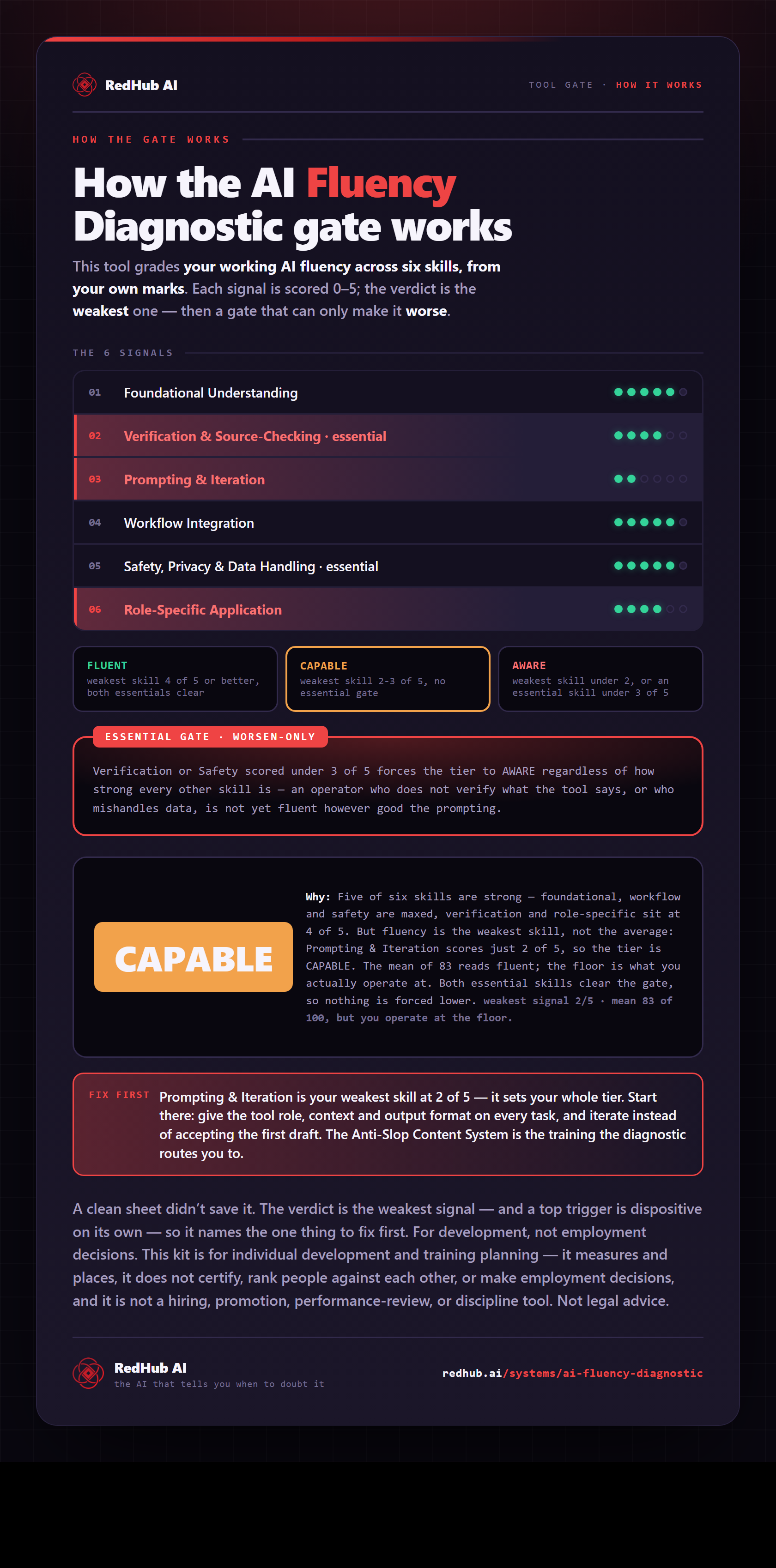
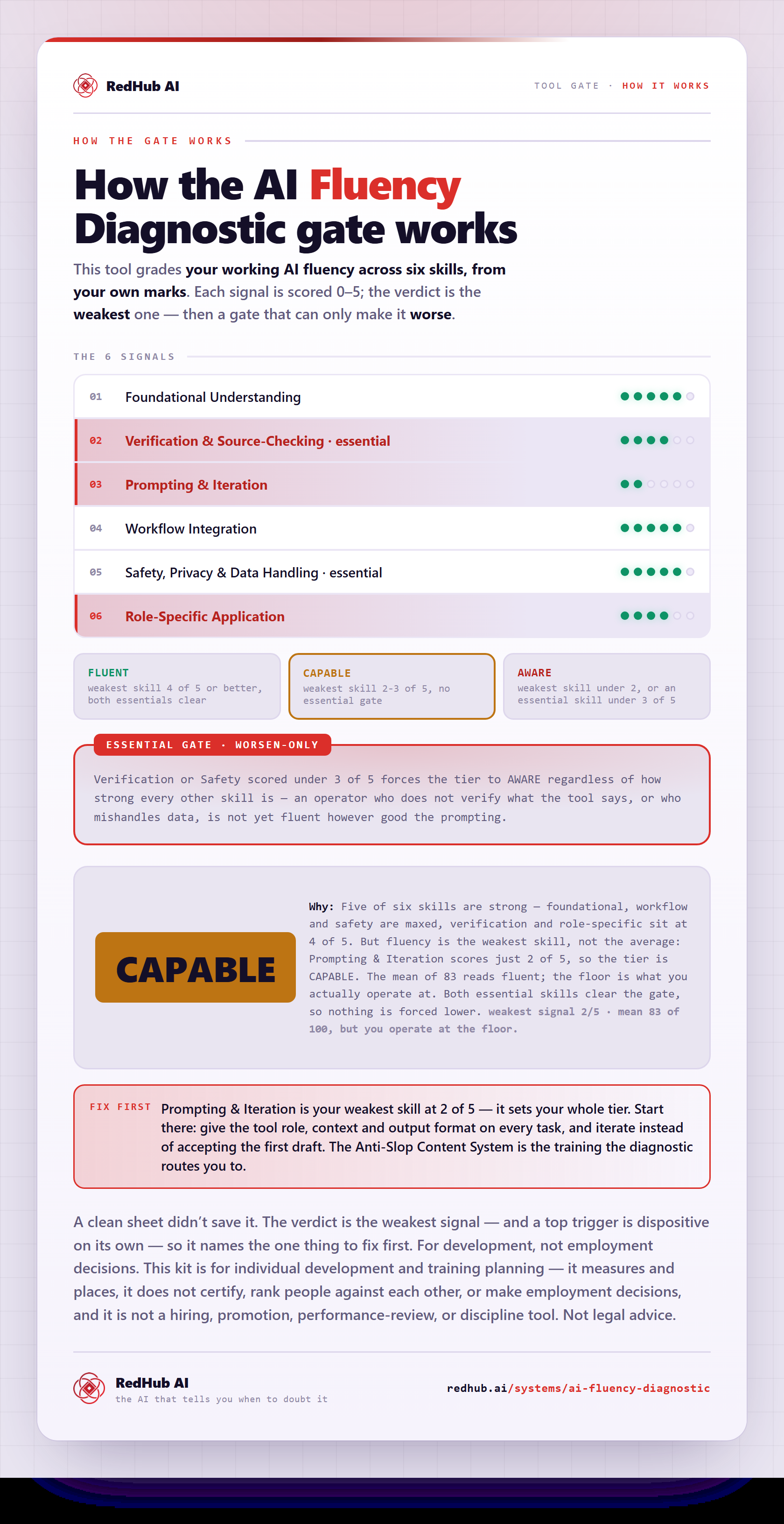
The gate this post refers to, drawn from the tool’s own logic. See the tool.