Claude Fable 5.2: What It Changes for Your Business
Todd Brooks, Founderupdated November 12, 202614 min read
Jump to a section12
- TL;DR
- What is Claude Fable 5.2?
- What Claude Fable 5.2 is
- What Anthropic says it did in testing
- The line most launch coverage skipped
- A long agent run is a reading bill
- What we will not tell you
- Where Fable 5.2 changes the work, by type
- Before you switch a model name
- A first pilot that tells you something
- The rest of this set
- Pairs well with
TL;DR
- What it is: Claude Fable 5.2 is Anthropic's model for the hardest technical work, released November 9, 2026, at $8 per million input tokens and $40 per million output tokens.
- What it did in testing: Anthropic says it designed three working electronic devices from short, one-paragraph prompts and coordinated more than 1,000 subagents for eight days to build a prototype operating system.
- What Anthropic tells most people: start with Claude Opus 5.5, which costs half as much per token, and move up to Fable only when the work needs it.
- The cost that surprises people: a long agent run is mostly reading, not writing. On one creator-reported build, input tokens outnumbered output tokens about 165 to 1.
- The number that decides it: cost per finished, accepted piece of work, measured on your own tasks. Per-token price can mislead in both directions.
What is Claude Fable 5.2?
Claude Fable 5.2 is Anthropic's model for demanding reasoning and long-running technical work, released November 9, 2026. It reads text and images and writes text, with a 1 million token context window and up to 128,000 output tokens per response. It costs $8 per million input tokens and $40 per million output tokens. Anthropic recommends starting most coding and knowledge work on Claude Opus 5.5 and moving up to Fable 5.2 for the most ambitious, open-ended technical problems.
Best for: founders and operators deciding whether Fable 5.2 belongs in their stack. To price it against a cheaper model on your own work, use the AI Unit-Economics & Token-Shock Exposure Kit.
An AI model designed a speakerphone. I don't mean a picture of one. It produced a circuit board layout, a 3D-printable case, the firmware and a parts list. A circuit-board company built it, and it worked without a single change to its circuitry. Anthropic published that result on November 9, alongside the launch of Claude Fable 5.2, and it is the most interesting thing I have read about an AI model this year.
RedHub is not affiliated with Anthropic, Diode, or any creator named here. Prices, specifications and availability are as published by Anthropic as of November 11, 2026, and can change. Benchmark results are Anthropic's own and were not reproduced by RedHub. Creator cost figures are as the creators reported them.
It is also the easiest thing to misread. The devices were prototypes, built and tested by human engineers. The price per token went down, and the cost of some projects people posted this week still ran into the thousands. And the company that built Fable tells most customers to start somewhere else. This guide covers what changed, what it costs once you count everything, and how to tell whether your work is the kind that justifies it.
What Claude Fable 5.2 is
Fable is Anthropic's top tier, above the Opus models most teams use day to day. Claude Mythos 5.2 launched the same day and is the same underlying model. The difference is the safeguards. Fable blocks most high-risk cybersecurity and biology tasks, so it is open to everyone. Mythos ships without certain of those cybersecurity and biology safeguards and is available only to organizations Anthropic has verified through its security and life sciences programs.
| Spec | Claude Fable 5.2 | Claude Opus 5.5 |
|---|---|---|
| Input price, per million tokens | $8 | $4 |
| Output price, per million tokens | $40 | $20 |
| Context window | 1M tokens | 1M tokens |
| Max output per response | 128K tokens | 128K tokens |
| Default effort (API) | high | medium |
| Reads / writes | Text and images in, text out | Text and images in, text out |
Two details in that table matter more than they look. First, Fable 5.2 is cheaper than the model it replaces. Anthropic's "What's new in Claude Fable 5.2" page (opens in a new tab) puts Fable 5.1 at $10 and $50. Anthropic also says the new model writes output up to 30% faster, and an optional fast mode generates up to 2.5 times faster at $16 and $80. One footnote: the default effort in the table is the API's. Anthropic says Claude apps and Claude Code default to medium.
Second, it writes text, not objects. When Fable builds a game, a 3D scene or a circuit board, it does it by writing code and driving other software. That sounds like a technicality. It is the reason every result below depended on tools, files and people around the model.
What Anthropic says it did in testing
The launch announcement (opens in a new tab) lists a lot. Three results matter most for a business reader, and each asks more of the model than the one before.
The first is a migration. Anthropic says a team of agents running an earlier version of Fable 5.2 moved a critical production service from Python to Rust, and that the service now starts about 26 times faster. That is a familiar business problem, old code nobody wants to touch, finished by software.
The second is endurance. One Anthropic engineer gave Fable an empty folder and the task of building a prototype operating system. Anthropic says the model coordinated more than 1,000 subagents for eight days, writing, testing and reviewing code, and produced a system that boots on a laptop with drivers, file storage, windows and an installer.
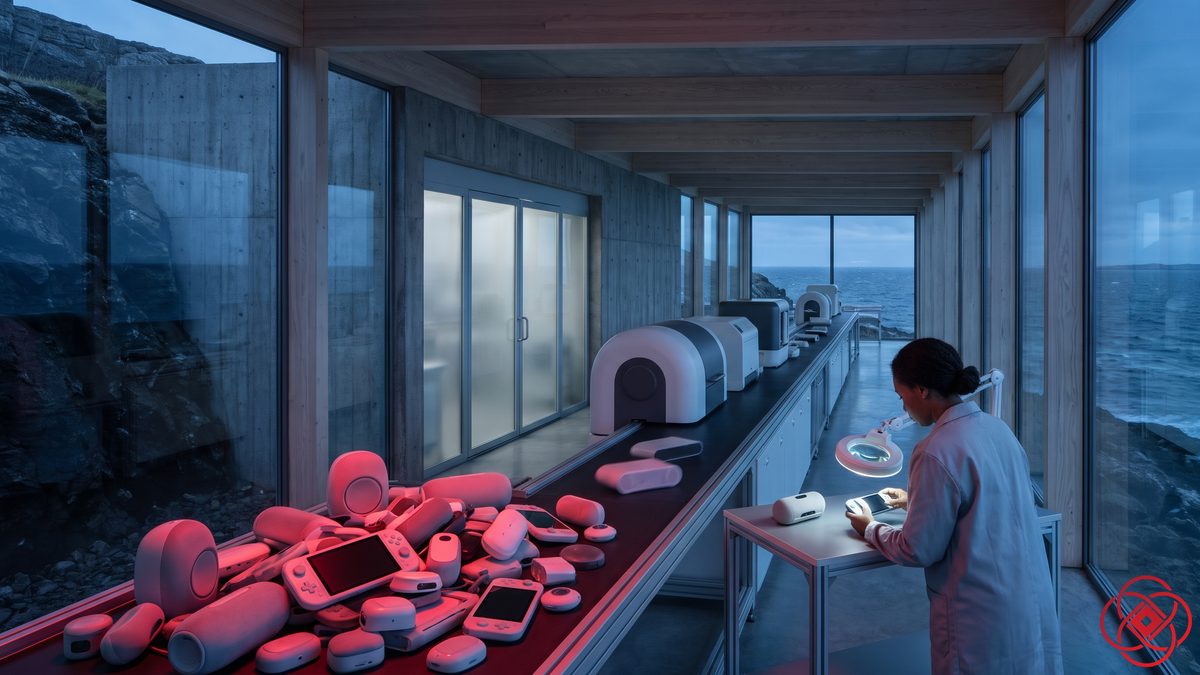
The third is the one that leaves the screen. Working with Diode, a company that designs and manufactures circuit boards, Fable designed a speakerphone, a voice-assistant hub and a handheld virtual pet. Anthropic's research write-up (opens in a new tab) says the model wrote the specifications, chose parts in stock at US distributors, routed four-layer boards, modeled the enclosures in CAD and wrote the firmware. All three devices worked without electrical changes. The same write-up says they have not been through electrical validation, thermal testing or certification, and that Anthropic has a commercial relationship with Diode. The hardware post in this set covers the details.
On benchmarks, Anthropic reports 49.1% on the FrontierCode 2.0 coding benchmark at Fable's second-highest effort setting, against 32.4% for Fable 5.1 and 45.5% for Opus 5.5 at its highest effort. Treat every score in the launch table as the result of Anthropic's own runs. They tell you the direction, and they do not tell you how the model does on your work.
One more score is worth a sentence because of what it measures. On the Remote Labor Index, Fable 5.2 at high effort scored 41.3%, against 21.3% for Opus 5.5, in Anthropic's launch table and on the Scale Labs leaderboard (opens in a new tab). The projects are real freelance jobs collected from Upwork, and the score is the share where trained reviewers judged the AI's work at least as good as the professional's, the standard being whether "a reasonable client" would accept it. Nate B Jones made the useful point in his launch video (opens in a new tab): the jump matters more than the number. The project set also leaves out work that needs physical labor, long-term evaluation or direct client contact, which covers much of what a small business actually sells.
The line most launch coverage skipped
Buried in the announcement is a sentence worth reading twice. For most coding and knowledge tasks, Anthropic says, "we recommend that users start with Claude Opus 5.5, our strongest daily driver." Fable is for "the most ambitious, open-ended technical work."
The developer docs go further. They say to move to Fable 5.2 "when your evals on a Claude Opus model at higher effort still don't meet your requirements." The launch post adds that Fable can also sit behind a cheaper model as an advisor, or in front of cheaper models as an orchestrator that hands them the simple parts. The practical design is Fable at the bottleneck, not Fable everywhere.
Here is the complication, and it cuts the other way. Anthropic also reports that on FrontierCode, Fable 5.2 at high effort, the API default, scored 45.3%, about level with Opus 5.5's best score of 45.5%, for roughly half the cost per task. A model that costs twice as much per token can still be the cheaper way to finish a job, for example when it reaches the answer in fewer tokens. Anthropic does not say why. The token price misleads when the work is hard. It also misleads when the work is easy and a cheaper model would have passed. Neither direction shows up until you measure it on your own tasks.
A long agent run is a reading bill
The launch week produced a flood of demos, and Paul J Lipsky's roundup of 18 Fable 5.2 builds (opens in a new tab) is a good record of it. It also carries the most useful cost data I have seen. Felix Rieseberg's first-person shooter, built from a short prompt, reportedly took eight hours and would have cost $550 at API prices: 445 million input tokens and 2.7 million output tokens. Lipsky also reports a bird-flock visual effect at about $23 and an Istanbul city recreation at $2,618 from a single prompt.
Look at the ratio in that first build. It used about 165 input tokens for every output token. An agent working for hours re-reads its files, its instructions and its own history on every step. The writing is the small part of the bill.
On launch day, Matt Shumer wrote (opens in a new tab) that he had spent "over 400B tokens testing Fable 5.2." He did not say what that cost, and I will not guess. A token count on its own is not a bill. It becomes one only when you know which rate each token was billed at, and on a long run most of them are re-reads.
Whether any of this reaches your card depends on how you pay. Nate B Jones made the point in his launch video: inside a subscription's weekly allowance, a Fable run costs nothing extra, while on the API every token is billed. Anthropic's plan page (opens in a new tab) narrows that. On Max and Ultra plans and premium Team seats, Fable models are included for up to 50% of your weekly usage limits. On Pro plans and standard Team seats, they run on pay-as-you-go usage credits from the first message. The same long build can cost a Max subscriber nothing beyond the subscription and a Pro subscriber every token. Check which one you are before you read any cost figure in this post as yours.
The arithmetic makes the point sharper. At list price, the 2.7 million output tokens come to about $108. At the full $8 input rate, 445 million input tokens alone would be $3,560. The reported $550 only adds up if roughly nine in ten of those input tokens were billed at the cache-read rate of $0.20 per million, and more than that if any were cache writes, which cost more than $8. That is my arithmetic on the creator's reported figures, not a measured breakdown. But it shows where the money goes on a long run: caching decides the bill more than the headline price does.
Anthropic's own docs flag two more cost behaviors. In an agent setup that invites delegation, "subagents can account for a large part of what a session costs." And on long tasks, the model sometimes ends a turn with a list of what remains rather than finishing. That second one is a review cost. Someone has to notice the work stopped short.
What we will not tell you
We are not going to tell you that Fable 5.2 is worth the money for your business. Nobody outside your business can know that. A benchmark measures the vendor's tasks, a creator's cost figure measures one prompt on one night, and neither one measures your proposals, your support tickets or your product files.
Start by asking whether the task needs a better model at all. Nate B Jones calls the common case task-level saturation: if the model you use today already handles the assignment, an upgrade gives you very little, however good the upgrade is. Anthropic's own model guide (opens in a new tab) points the same way. "Most workloads start with Claude Opus 5.5," it says, and it suggests moving to Fable 5.2 when "your evals at xhigh or max effort still fall short on demanding reasoning or long-horizon agentic work." That leaves three kinds of task: ones today's model already handles, ones where Fable is better but not by enough to pay for, and ones where the gain is worth the bill.
What we can give you is the measurement that separates the last two. The number that settles it is the cost per finished, accepted piece of work: the model's tokens, plus the human time to check the result, plus the cost of fixing what it got wrong.
Change one input and the answer flips. If the misses were caught by an automatic check instead of a senior writer, or if the work were simple enough that both models passed nearly every time, the cheaper model would win. That is the whole reason to measure.
Where Fable 5.2 changes the work, by type
| Kind of work | What changed | What still needs a person |
|---|---|---|
| Software | Longer unattended runs, bigger migrations, more subagents | Deciding what "done" means, and checking it |
| 3D scenes | Builds and edits scenes in Blender through a connector | Approving accuracy and keeping a version to go back to |
| Hardware | Board layout, enclosure and firmware in one project | Building, testing, certifying |
| Research and analysis | Handles more ambiguous, data-heavy tasks, per early testers | Judging whether the conclusion holds |
The pattern in the right-hand column is the thread through this whole set. Making things got cheaper this week. Checking them did not. On our own channel, Fable 5.2 built short product explainers like this one for the AEO Citation Audit Kit (opens in a new tab), and every claim in each video still had to match the product page before it went up.
Before you switch a model name
If your team calls the API directly, moving to Fable 5.2 takes more than changing one string. Anthropic's model page (opens in a new tab) lists four things to check:
- Thinking is always on. You control its depth with the effort setting, and you cannot turn it off.
- Forced tool use returns an error. Code that forces the model to call a specific tool will fail.
- Some sampling settings must be left out. Temperature, top_p and top_k should be omitted.
- Data retention is 30 days by default. Fable is not available under zero data retention unless Anthropic expressly authorizes it. Anthropic says eligible enterprise customers can get that through its Enterprise Frontier Safeguards program, now in private beta.
That last point belongs in front of whoever owns your data policy before anyone uploads customer records or engineering files.
A first pilot that tells you something
- Pick one task that is frequent and expensive. Something your team does every week that takes real time, such as proposals, code reviews or product images.
- Write down what a finished result looks like. Before anyone runs a model. If two people would disagree about whether a result passes, fix that first.
- Run the same past examples through Opus 5.5 and Fable 5.2. Twenty is enough to see a difference. Record tokens, passes and fix time for each.
- Price each model per finished task. Token cost plus the cost of the misses, not the token cost alone.
- Set a spending ceiling before any long run. An eight-hour agent session is a reading bill, and nobody watches it while it grows.
Price Fable 5.2 against a cheaper model, per finished task
The AI Unit-Economics & Token-Shock Exposure Kit computes cost per successful outcome for each AI workflow and bands it PREDICTABLE, DRIFTING, or TOKEN SHOCK. Its Model Swap tab takes both models' prices, the pass rate each scored on your own test, and the cost to fix a miss, then reads ROUTE DOWN, KEEP, or UNMEASURED. It reads UNMEASURED whenever a pass rate is blank, because it uses the numbers you bring and never tests a model itself. One spreadsheet, $59. A planning estimate, not financial advice.
Get the Token-Shock Exposure Kit →The rest of this set
- Can Claude design hardware? walks through the three devices, the 25-degree assembly fix, and what the prototypes have not proven yet.
- The Claude Blender connector covers how Claude works inside a 3D scene and why one approved scene is worth more than one animation.
- Fable 5.2 vibe coding separates a demo that works from a product customers can trust.
- Fable 5.2 business ideas looks at where the money may move when making things gets cheap.
Pairs well with
The free Decision Fit Check answers the question before this one: whether a task needs a frontier reasoning model at all, or something cheaper. The AI Cost-Per-Task Calculator compares human hours with AI cost for each team task and marks it Automate, Review, or Skip. The AI Spend Runaway & Billing-Safeguard Gate grades each account SAFEGUARDED, EXPOSED, or RUNAWAY RISK, which matters more once a single run can last eight hours.
Keep going: for the cost mechanics, read input vs output tokens. For agents that run for hours, read seven design rules for long-horizon AI agents.
Decision Guide
Try Fable 5.2 if: your team has a hard, open-ended technical task where Opus 5.5 at high effort still falls short, and a failed attempt costs real money.
Stay on Opus 5.5 if: the work is routine, the results are easy to check, or nobody has measured how often the cheaper model passes.
Best first step: run 20 past examples of one task through both models and price each one per finished result, misses included.
FAQ
What is Claude Fable 5.2?
Claude Fable 5.2 is Anthropic's model for demanding reasoning and long-running technical work, released November 9, 2026. It reads text and images, writes text, and has a 1 million token context window with up to 128,000 output tokens per response.
How much does Claude Fable 5.2 cost?
As of November 11, 2026, Anthropic lists $8 per million input tokens and $40 per million output tokens, down from $10 and $50 for Fable 5.1. Cache reads cost $0.20 per million tokens, batch processing is half price, and the optional fast mode costs $16 and $80.
What is the difference between Claude Fable 5.2 and Claude Mythos 5.2?
Anthropic says they are the same underlying model. Fable carries safeguards that block most high-risk cybersecurity and biology tasks and is available to everyone. Mythos is available only to organizations verified through Anthropic's verification programs.
Should I use Claude Fable 5.2 or Opus 5.5?
Anthropic recommends starting most coding and knowledge work on Opus 5.5 and moving to Fable 5.2 when Opus at higher effort still does not meet your requirements. The way to decide for your own work is to run the same tasks through both and compare the cost per finished, accepted result, including the cost of fixing misses.
Can Claude Fable 5.2 make 3D models or hardware directly?
Not directly. The model writes text, so it works by writing code and driving tools such as Blender or circuit-board design software. In Anthropic's hardware test, the design files came from the model, and engineers at Diode manufactured, assembled and tested the prototypes.
Is Claude Fable 5.2 available with zero data retention?
By default, no. Anthropic's documentation says Fable 5.2 requires 30-day data retention unless Anthropic expressly authorizes otherwise. Anthropic says eligible enterprise customers can use it with zero data retention through its Enterprise Frontier Safeguards program, which is in private beta.
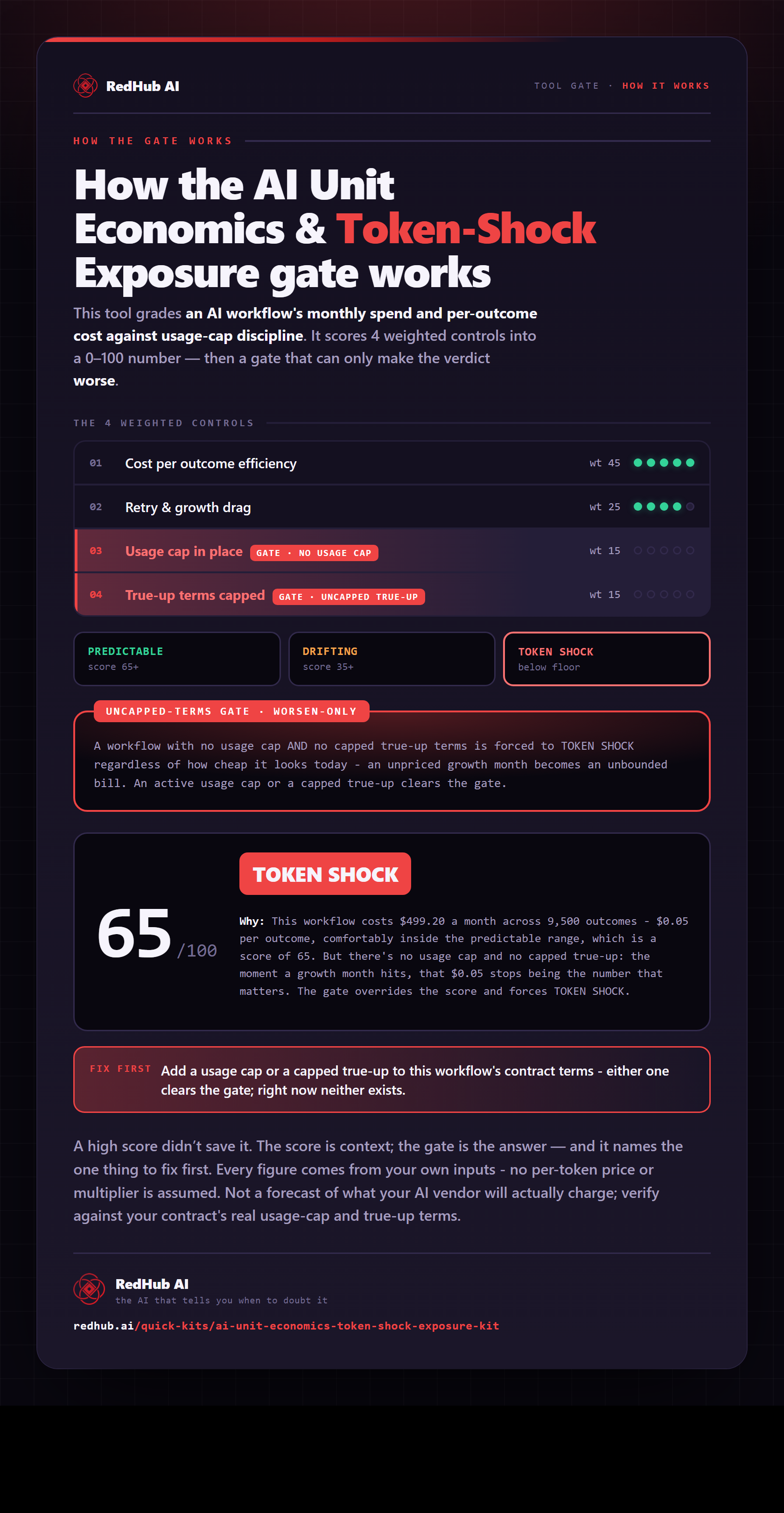
The gate this post refers to, drawn from the tool’s own logic. See the tool.