What an AI Audit Trail Actually Needs (Beyond Logs)
RedHub AI Editorialupdated September 2, 20267 min read

Jump to a section8
An AI audit trail is not a log file. It is four things joined together for one decision: the record of what the system decided, the inputs it had in front of it, the rule that was in force on that date, and the name of whoever approved the system to make that call. Most teams have the first. Almost nobody can produce all four for a decision made six months ago, which is the moment the question is always asked.
TL;DR: Logs record that something happened. An audit trail lets somebody who was not there reconstruct why. The gap between them is the joins — inputs, policy version, and approval — and those are what go missing first. Grade yours with the Audit Evidence Pack Assay — $119.
The Question That Arrives Late
Nobody asks about your audit trail on a good day. The question arrives attached to something else: a customer's security review, a board member who read an article, a complaint from someone whose application was declined, a new insurer, an acquirer's diligence list. It always has the same shape.
Show me how this decision was made.
And it is almost never about a decision from this week. It is about one from March. The person who set the system up has changed teams. The prompt has been edited twice since. The threshold moved in a release nobody wrote down. The record says the system declined the application, and everyone believes that was correct, and nobody can show why.
That situation is not a documentation failure in the ordinary sense. The team was not careless. They logged plenty. What they logged was the outcome, over and over, without the surrounding facts that make an outcome explicable.
The Four Joins
Think of an audit trail as a decision plus three things it has to be joined to. Each join is a separate question, and each one fails in its own way.
1. The decision record
What did the system do, to whom or what, and when? This is the part most teams have. It is usually in an application database or a log stream, it is usually reliable, and it is usually where the effort stops.
2. The context it saw
What inputs were in front of the model at the moment it decided? Not the inputs available in principle, but the ones supplied. If a retrieval step pulled three documents, which three? If a customer record was passed in, what did that record say then, before six months of updates?
This is the join that breaks most often, and it breaks silently. The record points at a customer ID. The customer row is mutable. Six months later the row says something different, so the decision now looks arbitrary or wrong against data that did not exist when it was made.
3. The rule in force that day
Which version of the prompt, the policy, the threshold, the model? Systems change constantly and most changes are improvements, so nobody thinks of them as things to preserve. But a decision judged against today's rule, when it was made under a different one, is being judged unfairly and there is no way to show that without a dated record of the rule.
4. Who approved it
Not who ran the code. Who accepted that this system was allowed to make this kind of call, and when. An account with no name attached to it ends with "the system did it," which is not an answer anybody accepts.
The test worth applying: pick one real decision your system made more than three months ago. Try to assemble all four. Time it. The result is your audit trail, and the number of minutes is more informative than any policy document you own.
Why "We Have Logs" Fails
Logs are evidence that an event occurred. An audit trail is evidence about why it occurred that way. The difference matters because the questions people ask are almost always causal.
A log answers did this happen. Nobody disputes that. What gets disputed is whether it should have happened, and answering that needs the inputs and the rule. Logs are also written for engineers debugging a system they already understand, so they leave out the obvious — and everything a stranger needs is the obvious.
There is a longer version of this argument in why having logs is not the same as having an audit trail, including the three places log-based records reliably come apart.
Three Ways a Trail Goes Missing
Evidence rarely disappears in one event. It degrades along three axes, and they are worth separating because the fix for each is different.
Time
Retention windows expire. Log tiers roll off to cold storage and then out. Nobody decided to delete the thing; a default did. The awkward version of this is a retention schedule that is doing exactly what it was configured to do, deleting records you now want, which is a policy question, not a technical one.
Change
Prompts get edited, thresholds move, vendors ship a new model version, the retrieval corpus is re-indexed. Every one of those changes what the system would do today, and none of them is normally recorded against the decisions made before it. This is the quiet one, and there is more on it in how quickly your evidence stops being true.
People
One person knows how to assemble the pack. They know which table joins to which, which export to run, which caveat to mention. None of it is written down and nobody else has ever done it. That is not a records problem at all. It is a single point of failure wearing a filing cabinet as a disguise.
What Good Looks Like, Concretely
A team with a working audit trail can do this, without heroics, for a decision from any month still inside their retention window:
- Pull the decision record by ID.
- Pull a frozen copy of the inputs as they stood at that timestamp — not a live lookup.
- Name the exact prompt, policy and model version in force on that date, from a dated record.
- Name the person who approved that system for that use, and the date they did.
- Hand the whole thing to somebody who was not there and have them follow it without a phone call.
Step five is the real test. Every other step can be satisfied by a person who already knows the answer. Only the last one proves the record stands on its own.
Start With One Decision
The mistake is treating this as a program. It is not — it is a drill you run once against a real decision, which will tell you within an hour which of the four joins you actually have. Teams that do this usually find two of four, and are surprised by which two.
What you cannot get from the drill is a consistent read across every kind of decision your systems make, which is where a fixed instrument helps. That is what the Assay is: 24 questions about the joins between a decision record and the context, policy and authorization behind it, returning ANSWERABLE, NEEDS A WITNESS or NO RECORD for each one. It grades what you can assemble, and it says so plainly — it is not a scanner, and every input is an answer you supply about your own wiring.
If you would rather test the durability question first, and free, the AI Compliance Assurance (opens in a new tab) assessment asks 24 questions about what makes evidence stop being reproducible — time, change and people — and returns a verdict with the one thing to fix first. A score of 93 there still comes back UNREPRODUCIBLE when nobody but one person can produce the pack. It measures whether evidence would survive being asked for, not whether the practice behind it is adequate, and it is a self-assessment rather than an audit.
Pairs well with
Once you know which joins are missing, the Retention Purge Scheduler ($59) settles how long each record is kept before a default decides for you, and the AI Risk Register & Treatment-Tracking System ($99) is where the gaps become tracked items with owners. If you would rather take the whole lane at once, the AI Audit & Accountability Bundle ($269) collects the accountability instruments together.
This is general operational guidance, not legal advice. If you need to know what any of this is legally required to look like for your business, ask a lawyer who knows your situation.
More in this guide
What is an AI audit trail?
A record that lets somebody who was not present reconstruct a specific automated decision: what the system decided, the inputs it saw at that moment, the prompt and policy version in force on that date, and who approved the system for that use. All four, joined to one decision.
Are application logs enough?
Usually not. Logs establish that an event happened, which is rarely what is disputed. What gets disputed is why it happened that way, and that needs the inputs and the rule version — which most logging never captures because it is written for engineers who already know the system.
How far back should an audit trail go?
As far back as your retention schedule says, and the useful exercise is finding out what that schedule actually says rather than what you assume. Many teams discover their real window is shorter than they thought because a storage tier ages records out on a default nobody chose deliberately.
What is the most common missing piece?
A frozen copy of the inputs. Records typically point at a mutable row, so six months later the row reads differently and the decision looks wrong against data that did not exist when it was made. The second most common is the dated policy or prompt version.
Does an audit trail prove the decision was right?
No, and it is worth being clear about that. It establishes that an account of the decision can be assembled. Whether the decision was correct, or genuinely consistent with the policy it cites, is a separate judgment that a record cannot make for you.
Is this a legal or compliance product?
No. This is operational record-keeping guidance, and nothing here states what any law or regulator requires. If you need to know your obligations, ask a qualified lawyer.
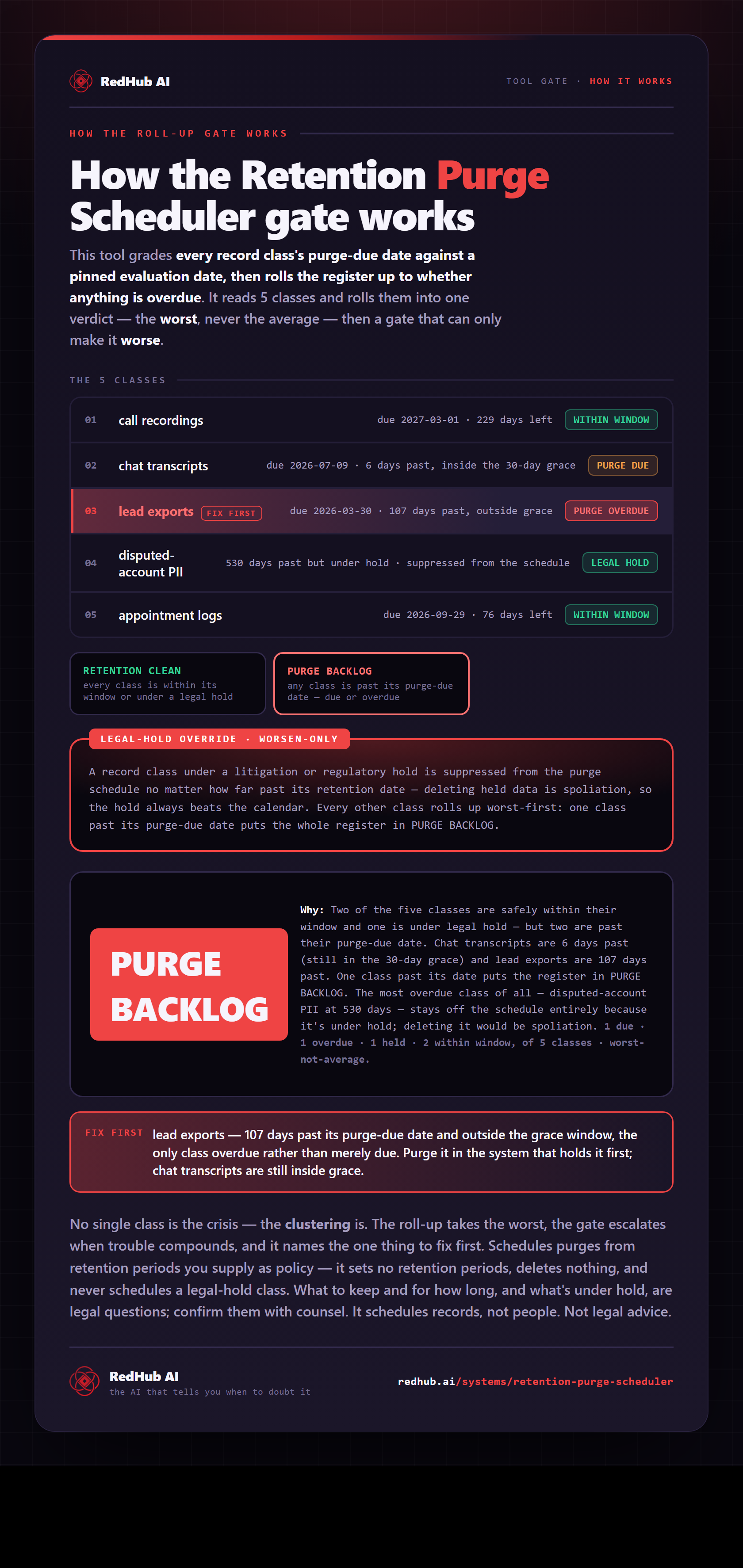
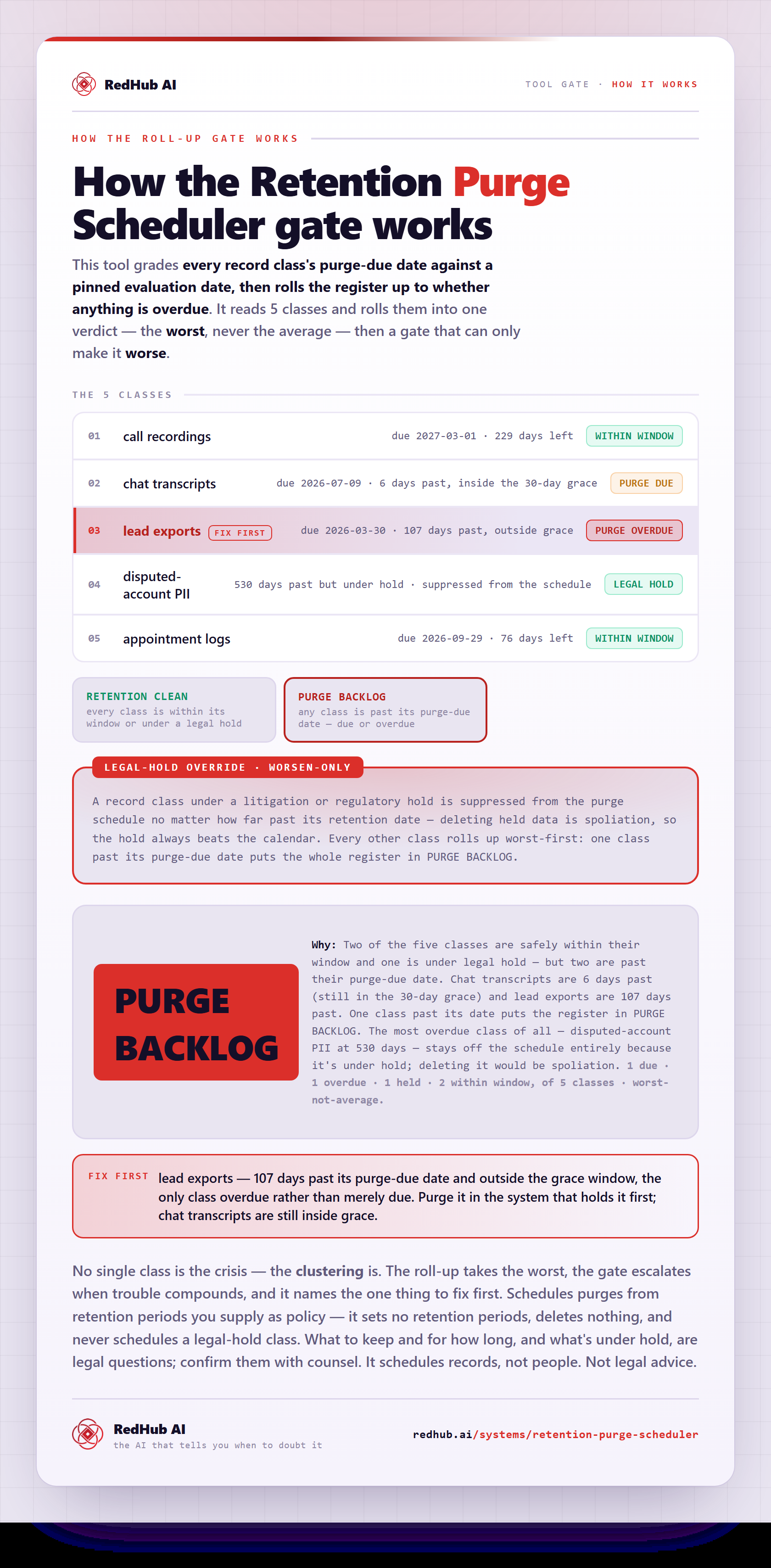
The gate this post refers to, drawn from the tool’s own logic. See the tool.