Why Having Logs Is Not Having an Audit Trail
RedHub AI Editorialupdated September 2, 20265 min read

Jump to a section7
Logs prove that an event happened. An audit trail explains why it happened that way. That is the whole difference, and it matters because nobody ever disputes whether your system did something — they dispute whether it should have. Answering the second question needs the inputs and the rule in force, which is precisely what logging leaves out.
TL;DR: Logs are written by engineers for engineers who already understand the system, so they omit the obvious — and everything a stranger needs is the obvious. Three specific failures follow from that. This is the "why logging is not enough" companion to the AI audit trail guide.
Logs Answer the Question Nobody Asked
Observability exists to help somebody fix a system that is misbehaving now. It is built for that: high volume, short retention, terse messages, and a reader who already holds the mental model of how the thing works.
An audit trail exists to help somebody understand a decision made months ago, who does not hold that model and cannot ask you. Nearly every design choice that makes a log good makes it a poor audit trail, which is not a criticism of logging. It is a mismatch of purpose that gets discovered late, because both artifacts look like "a record of what happened" until somebody tries to use one as the other.
The Three Places It Comes Apart
1. Logs record the outcome, not the reason
A typical line reads something like decision=decline subject=48213 model=v4. Everything in it is true and none of it explains anything. Which inputs produced that? What did v4's prompt say at the time? Was declining the expected behavior under the policy that was live?
The engineer writing the line knew all of that, which is exactly why they did not record it. Obvious context is invisible to the person who has it. A year later the obvious context is the only part anybody needs.
2. Logs point at things that move
Log lines carry identifiers, because carrying payloads would be enormous. That is the right call for logging and the wrong one for evidence, since almost every identifier points at something mutable.
Follow subject=48213 today and you get that subject as they are now. The address changed, the plan changed, the risk flag was cleared. The decision starts to look either arbitrary or wrong, and you have no way to show what the system was actually looking at. This is the failure that turns a defensible decision into an indefensible one without anybody touching the decision.
3. Logs expire on a schedule nobody chose for this purpose
Retention on log storage is set by volume and cost. Thirty days is common, ninety is generous, and both are far shorter than the window in which somebody asks about a decision. The record is not deleted maliciously or even deliberately — a tier ages it out on a default that was correct for debugging and wrong for evidence.
Worth checking today rather than in the moment: what your actual log retention is, as configured, not as remembered. Teams are frequently wrong about this by a factor of three, and a Retention Purge Scheduler ($59) is where that gets settled per record type instead of per storage tier.
What This Looks Like in Practice
A customer disputes an automated decline from four months ago. Your team pulls the logs and finds the line. It confirms the decline. It confirms the model version.
Then the questions start. What did the model see? The log has an ID; the row behind it has been updated twice. What did the prompt say in April? Nobody kept a dated copy, and the file has eleven commits since. Who signed off on the system being allowed to decline automatically? There is a Slack thread, probably, from before the workspace's retention cleared it.
Every one of those answers exists somewhere in somebody's head. None of them is in the record, and an account that depends on somebody's memory is the situation the bus-factor problem describes.
You Do Not Need to Replace Logging
The fix is not a new observability platform. It is a second, much smaller artifact written for a different reader and sitting beside the logs.
Decision records are low volume by nature. You are not recording every function call, only the decisions that could be questioned, which for most businesses is a tiny fraction of system activity. That means you can afford to store frozen inputs and keep them for years, precisely because there are so few of them relative to log lines.
Three practical moves, in order of return:
- Freeze the inputs at decision time. Copy what the model saw into the record rather than referencing it. This single change fixes the failure that does the most damage.
- Stamp a version identifier for the prompt, policy and model, and keep a dated record of what each version contained.
- Put a name on the approval for each class of decision, with a date.
The full field list is in what goes in an AI decision record. None of it requires new infrastructure.
Checking Where You Stand
The Audit Evidence Pack Assay ($119) reads the joins rather than the volume: 24 questions on whether a decision record connects to the context, policy and authorization behind it, returning ANSWERABLE, NEEDS A WITNESS or NO RECORD per join. It is explicit about its own nature — not a scanner, and every input is an answer you supply about your own wiring.
For the free version of the durability question, the AI Compliance Assurance (opens in a new tab) assessment asks 24 questions about what makes evidence stop being reproducible, including whether anything you rely on has a date somebody has honored. It measures durability, not adequacy, and it is a self-assessment rather than an audit.
Pairs well with
Set per-record retention deliberately with the Retention Purge Scheduler ($59); track the gaps as owned items in the AI Risk Register & Treatment-Tracking System ($99).
This is general operational guidance, not legal advice, and nothing here states what any law requires. Ask a qualified lawyer about your obligations.
More in this guide
What is the difference between logs and an audit trail?
Logs establish that an event occurred. An audit trail explains why it occurred that way, which needs the inputs the system saw and the rule that was in force. Disputes are almost always about the second thing.
Can I just keep my logs for longer?
Longer retention helps and does not fix it. The line still records an outcome and points at identifiers that have since changed, so you end up with a durable record that still cannot explain the decision.
Isn't this what observability tools are for?
They are built for an engineer debugging a system they already understand, with short retention and terse messages. An audit trail is for a stranger reading months later. Both are records of what happened, which is why the mismatch gets found late.
Won't storing frozen inputs get expensive?
Rarely, because decisions worth recording are a small fraction of system activity. You are not freezing every function call — only the decisions somebody could question, which is usually orders of magnitude fewer than your log volume.
What is the single highest-value change?
Freezing the inputs at decision time instead of referencing them. It fixes the failure that most often turns a defensible decision into an indefensible one without anybody touching the decision itself.
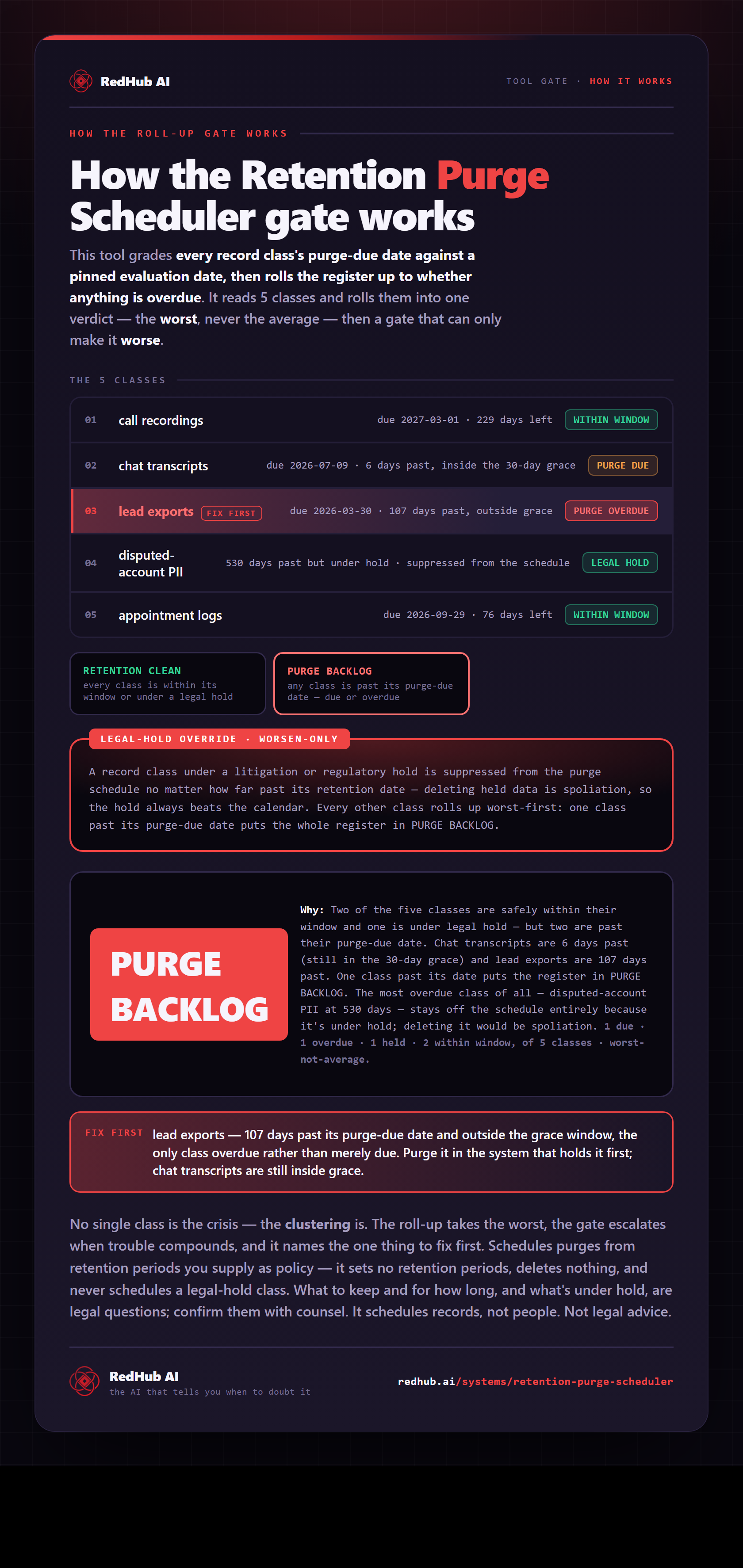
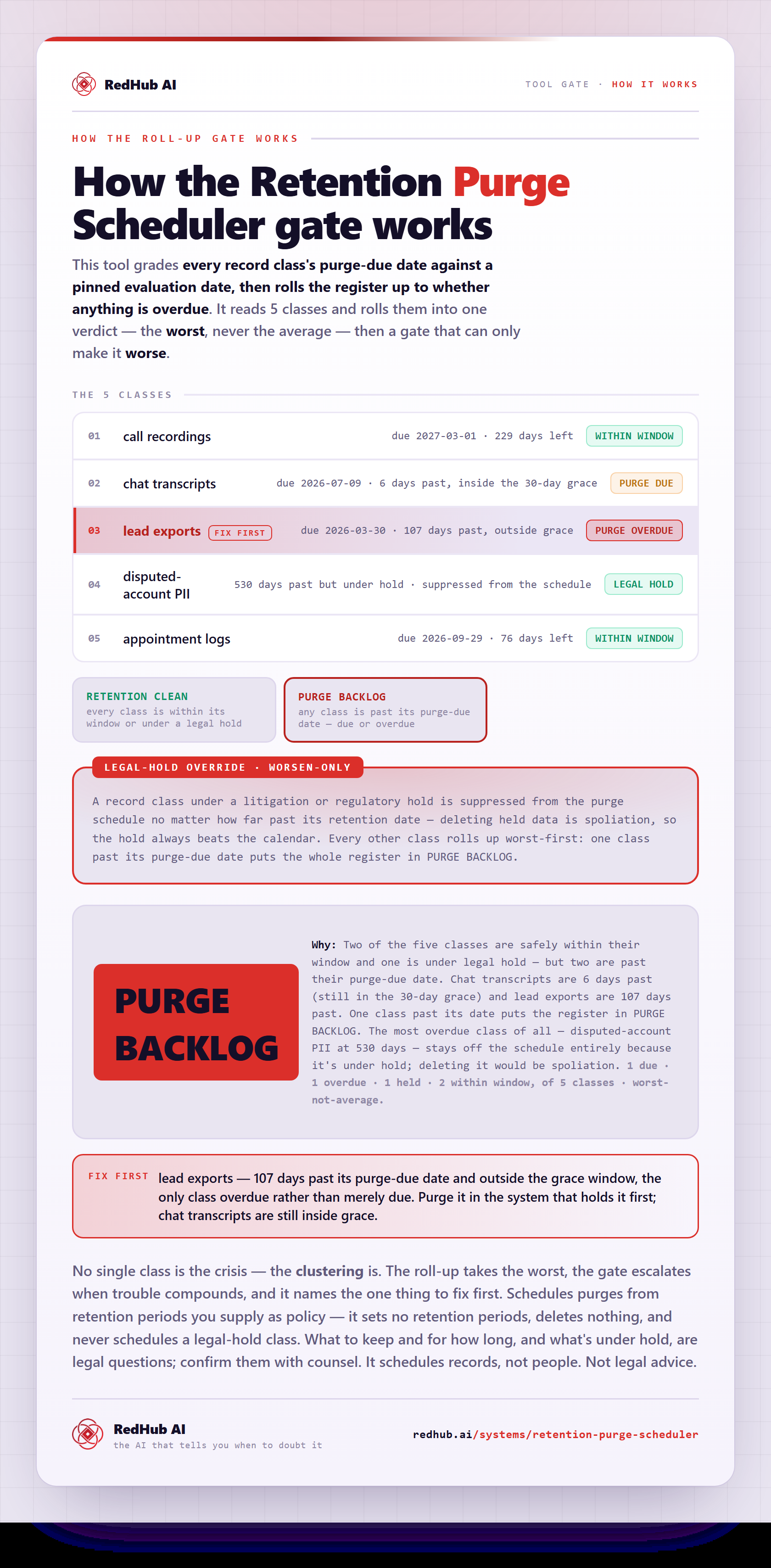
The gate this post refers to, drawn from the tool’s own logic. See the tool.