AI Back-Office Automation: The Honest Way to Run Ops, Paperwork, and the Books
RedHub AI Editorialupdated August 18, 20266 min read

Jump to a section9
TL;DR
- What it is: AI back-office automation uses software to run the repeatable admin work behind your business — support replies, paperwork, and the numbers — so a small team spends its hours on judgment, not data entry.
- Who it's for: founders, COOs, and ops leads at lean teams who want to run the back office with AI instead of hiring a rack of specialists.
- How it works: the honest version follows one rule — escalate, flag, reconcile. The tool handles the routine case and surfaces the uncertain one to a human instead of guessing.
- Bottom line: automate the repetition, not the judgment. The best back-office AI is the one that tells you what it isn't sure about.
What is AI back-office automation?
AI back-office automation is the use of AI-powered tools to handle the routine, behind-the-scenes work that keeps a company running — answering repeat customer questions, turning documents into usable data, and rolling numbers up into reports. Instead of a person doing each task by hand, the tool does the predictable part in seconds and hands the exceptions to a human. The honest approach draws a hard line: the AI never guesses on a judgment call. It escalates a sensitive ticket, flags a low-confidence field, and holds a report that doesn't reconcile.
Best for: lean teams running support, paperwork, and finance without a dedicated ops department — start with the AI Back-Office Bundle.
Every business runs the same three jobs behind the scenes: inquiries come in, paperwork comes in, and the numbers roll up. On a big team, three departments own those. On a lean team, one or two people own all of it — and it quietly eats their week. AI back-office automation is how a small team gets those hours back without hiring three specialists. But there's a right way and a dangerous way to do it, and the difference is a single rule.
The three jobs every back office actually does
Strip away the org chart and the back office is three repeatable loops. Each one is easy to automate and easy to get quietly wrong.
| Back-office job | What it looks like | The honest AI rule |
|---|---|---|
| Inquiries | Repeat support tickets, "where's my order," policy questions | Escalate — answer only from approved content, hand sensitive or uncertain tickets to a person |
| Paperwork | Invoices, receipts, forms, contracts turned into data | Flag — extract the clear fields, mark low-confidence or missing ones for review |
| The books | Reconciliations, roll-ups, month-end reports | Reconcile — run the tie-outs, hold any report that doesn't clear |
Notice the pattern in the right-hand column. It's the same discipline three times: don't guess — surface it. That's the whole thesis of an honest back office.
Key insight: the value of back-office AI isn't that it does the work. It's that it tells you which 5% of the work still needs your eyes — and stops there instead of confidently inventing an answer.
Why "automate everything" is the wrong goal
The pitch you usually hear is "let AI run your whole back office." That's the trap. A support bot that answers a refund-eligibility question it isn't sure about doesn't save you time — it creates a mess you find out about in a chargeback. An extractor that fills in a blank invoice total with its best guess doesn't clear paperwork — it poisons your books. The moment an AI hides its uncertainty, it stops being a tool and starts being a liability.
The goal isn't maximum automation. It's maximum automation of the predictable part, with a clean handoff on the rest. A back office that automates the routine and surfaces the uncertain is faster and safer. A back office that automates the judgment call is only faster until the day it isn't.
The escalate–flag–reconcile discipline
Here's how the honest rule shows up at each front door of the business.
- At the front door (inquiries): the tool answers repeat questions from your approved content and escalates anything sensitive, angry, or outside what it knows — always offering a real person.
- In the paperwork: the tool reads the document and pulls structured data, but flags any field it read with low confidence or couldn't find, so a human checks it before it flows downstream.
- At the books: the tool runs every tie-out and labels the result ties out, review, or does not reconcile — and holds the report until a real number clears.
Each stage has an honesty checkpoint, so a mistake surfaces at its source instead of three steps downstream where it's expensive to trace. A wrong figure caught in the paperwork never reaches a report; a report that doesn't reconcile never reaches a decision.
Run the back office on one honest rule
The AI Back-Office Bundle is three kits — Support Deflection (escalate), Document Extraction (flag), and Finance & Reporting Automation (reconcile) — plus a playbook that runs them as one discipline. No guarantees, humans in the loop.
Get the AI Back-Office Bundle — $249 →How the three tools chain together
The reason to run these as a system, not three disconnected apps, is that they hand off to each other. The extraction kit's flagged fields are exactly the figures you don't want flowing unchecked into your reporting. The reporting kit's reconciliations are the last gate before a number reaches a decision. Work flows left to right — conversations, then documents, then numbers, then reports — and each stage catches its own mistakes.
You can also adopt them one at a time. Many teams start with the single job that hurts most:
Start here if…
- Repeat tickets eat your inbox → Support Deflection Kit
- Invoices and forms eat your afternoons → Document Extraction Kit
- Month-end reporting is a white-knuckle ritual → Finance & Reporting Automation Kit
Bundle it if…
- You feel the drag on all three fronts at once
- You're systematizing the whole back office, not patching one hole
- You want the connective playbook that runs them as one rule
What this is not
Honesty runs both ways, so here's the lane. AI back-office automation makes the work faster and the mistakes visible — it does not promise a deflection rate, an accuracy number, or a fixed time savings. Humans stay in the loop by design: every step escalates, flags, or holds rather than running unattended. And the finance layer is a checking tool, not accounting, audit, tax, or financial advice — you enter the figures and it doesn't connect to your accounting system.
Want the deeper cuts? Read which back-office tasks to automate first, the biggest back-office automation mistake, the hidden cost of a manual back office, and how to build a lean AI back-office stack.
Decision Guide
Use it if: you're a lean team where one or two people own support, paperwork, and finance, and the admin load is capping your growth.
Skip it if: you already have staffed departments with their own vetted software, or your volume is too low to feel any back-office drag yet.
Best first step: pick the one job that hurts most this month and automate that. Bundle when the drag is on all three fronts.
FAQ
What is the back office in a small business?
The back office is the work customers never see but the business can't run without: answering support questions, processing paperwork like invoices and forms, and keeping the numbers reconciled and reported. On a lean team, the same one or two people usually own all of it.
Which back-office task should I automate first?
The one costing you the most hours or the most risk right now. If repeat tickets are drowning your inbox, start with support deflection. If invoices and forms eat your afternoons, start with document extraction. If month-end is a white-knuckle ritual, start with finance and reporting.
Is it safe to let AI run my back office?
It's safe when the tools are built to surface uncertainty instead of hiding it. The rule to insist on is escalate, flag, reconcile — the AI handles the routine case and hands the uncertain one to a person. It's unsafe the moment a tool guesses on a judgment call and presents the guess as fact.
Does AI back-office automation replace employees?
No — it replaces the repetitive parts of the work, not the people. The point is to free a small team from data entry and copy-paste so their hours go to decisions, exceptions, and customers. Every tool keeps a human in the loop for the cases it isn't sure about.
How much does it cost to automate the back office?
Individual kits run under $150 each; the AI Back-Office Bundle packages the three core kits plus a connective playbook for $249, versus $317 bought separately. There's no subscription — the kits are one-time tools you own.
What are the honest limits of these tools?
No guarantees: none of them promise a deflection rate, an accuracy figure, or a set time savings — they make the work faster and the mistakes visible. Humans stay in the loop, and the finance kit is a checking layer, not accounting, tax, audit, or financial advice.
Stop doing the back office by hand
Automate inquiries, paperwork, and the books with one rule — don't guess, surface it. Three kits, one playbook, humans in the loop.
Get the AI Back-Office Bundle — $249 →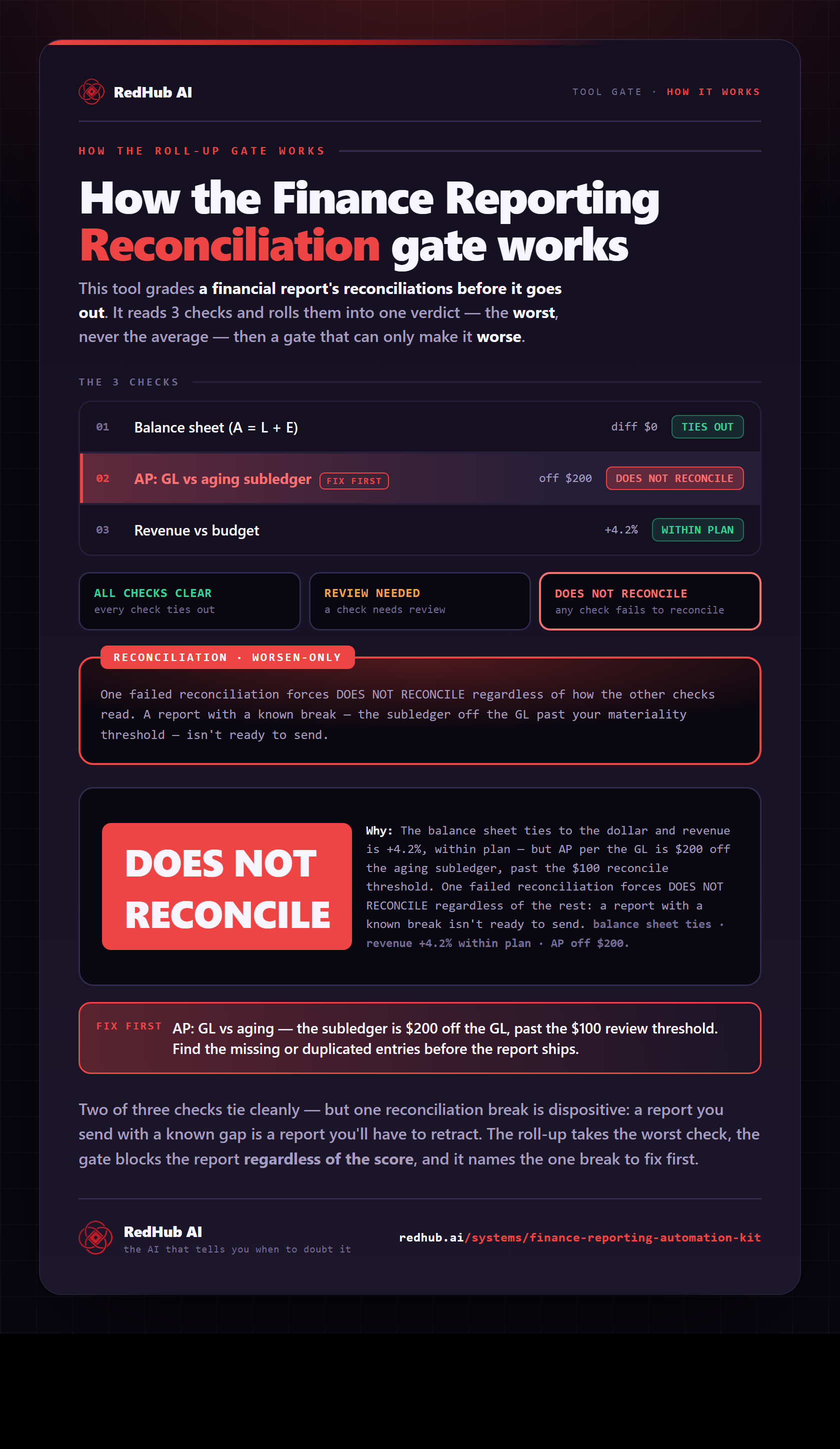
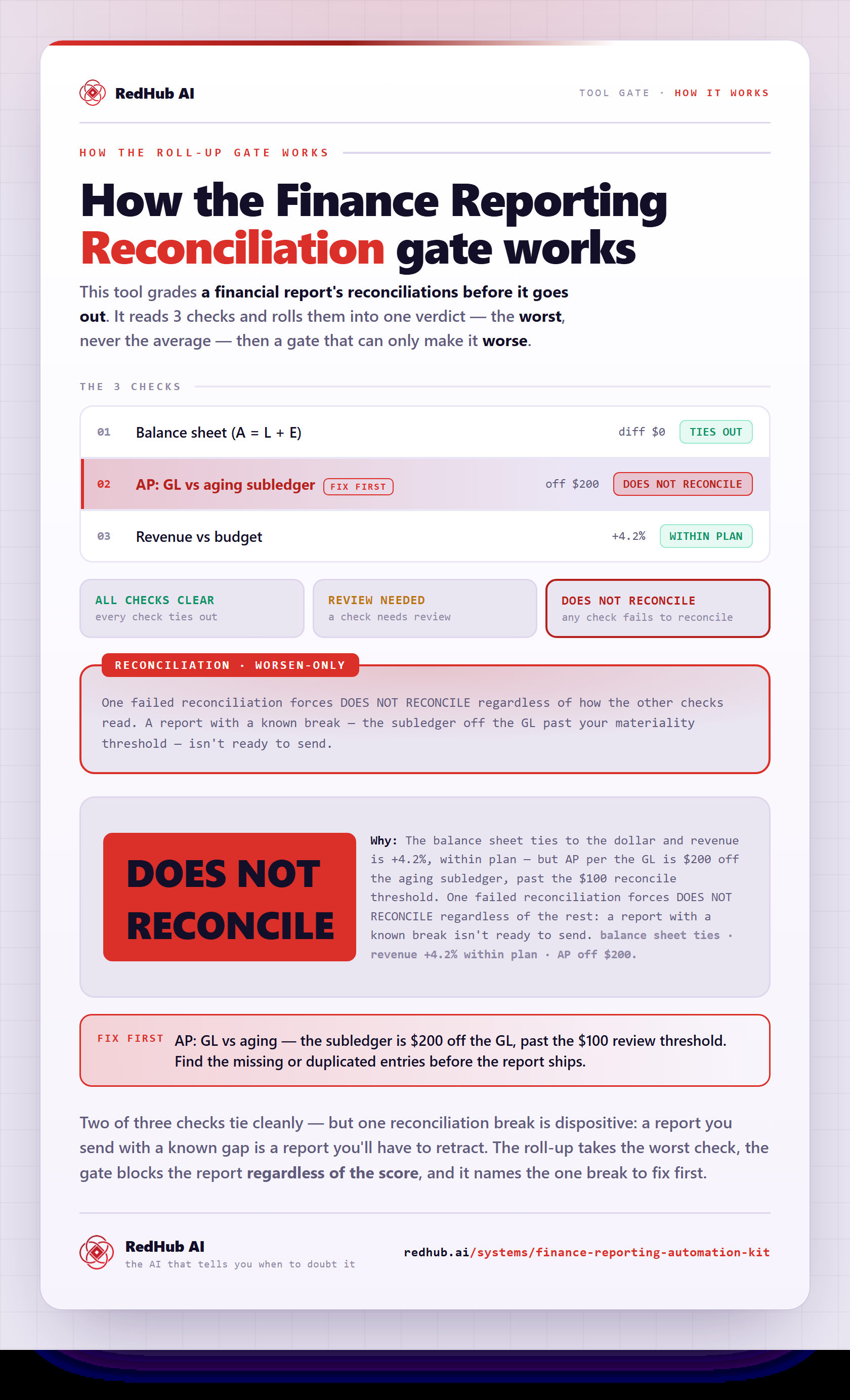
The gate this post refers to, drawn from the tool’s own logic. See the tool.