How to Stop Being the Bottleneck in Your Own Business
RedHub AI Editorialupdated September 7, 20265 min read

Jump to a section8
TL;DR
- What it is: the fix for the founder-shaped bottleneck — when everything routes through you and stalls when you're busy.
- Who it's for: founders whose team waits on them to move. See the leverage audit.
- How it works: spot where work waits on you, then move the decision — not just the task — to someone else, with guardrails.
- Bottom line: you're the bottleneck because you kept the decisions. Give them away with clear limits. A leverage read, not consulting.
How do I stop being the bottleneck in my business?
You stop being the bottleneck by moving decisions out of your inbox, not just tasks off your list. A founder becomes the bottleneck when every judgment call — approvals, replies, small spending, "is this okay?" — routes back to them, so work stalls whenever they're busy. The fix is to give the people doing the work the authority to decide, inside clear guardrails ("approve anything under $500," "reply to anything in the FAQ"). Then document the recurring decisions so the answer lives in a process instead of your head. The goal is a business that keeps moving when you don't.
Best for: founders whose team is capable but keeps waiting on them — the Founder-Time Leverage Audit shows where you're the choke point. A leverage read, not consulting.
Being the bottleneck doesn't feel like a bottleneck from the inside — it feels like being needed. People ask you things, you have the answers, work moves. But look closer and the pattern is costly: work only moves when you touch it, and everything queues behind whatever you're busy with. The business runs at the speed of your attention, which is the one resource you can't scale.
How to spot the choke points
The bottleneck hides in ordinary questions. Watch for these tells over a normal week:
- People wait for your approval on things they clearly understand better than you.
- Work stops when you're in meetings, traveling, or on vacation.
- Your inbox is a queue of "quick questions" that are really decisions.
- The same judgment calls come to you again and again.
Key insight: you're rarely the bottleneck on doing the work — you're the bottleneck on deciding. The tasks got delegated; the decisions didn't. That's why offloading tasks alone never fixes it.
Move the decision, not just the task
The core move is to transfer decision rights, not workload. When you hand someone a task but keep the approval, you've made yourself a required checkpoint — a more expensive bottleneck than before. Instead, give them the authority to decide within limits.
- Name the recurring decision. "Which vendor," "whether to refund," "is this reply okay" — find the calls that keep landing on you.
- Set the guardrail. Define the limit inside which someone else decides without asking: a dollar cap, a policy, a clear "if X then Y."
- Hand over the decision. Give the authority explicitly, and mean it — resist the urge to overturn calls made inside the guardrail.
- Document the answer. Write down the recurring decision so it lives in a process, not your head, and the next person doesn't have to ask.
Find where you're the choke point
The Founder-Time Leverage Audit gives you a portfolio read of how founder-bound your business is and grades each task by the leverage of getting it — and its decision — off your plate.
Get the Leverage Audit — $79 →Let people be wrong inside the guardrail
Here's the part that's hard emotionally: once you set a guardrail, you have to let people make calls you might have made differently. If you overturn every decision that isn't exactly yours, you've taught everyone to check with you again — and you're back to being the bottleneck, now with extra steps. A decision made 80% as well as yours, without waiting on you, is usually worth more to the business than a perfect one that stalled for three days in your inbox. Guardrails contain the downside; speed is the upside.
Build the business that runs without you
The end state isn't a founder who's uninvolved — it's a business that keeps moving when the founder steps away. That happens when decisions live in guardrails and documented processes instead of in one person's head. It also makes the business more valuable and more durable: a company that depends on the founder for every call is fragile, and buyers and teams both know it. Getting out of the bottleneck is how you turn yourself from a single point of failure into an owner.
For the full method, read the pillar on founder time management, and the deeper failure mode in why delegation fails.
Decision Guide
Use it if: work in your business stalls whenever you're busy, and your inbox is full of decisions dressed as questions.
Skip it if: your team already owns decisions within clear guardrails and things move without you.
Best first step: pick one recurring decision that lands on you weekly, set a guardrail, and hand the authority to whoever does the work.
FAQ
Why am I the bottleneck in my own business?
Almost always because decisions route back to you, even when tasks don't. You delegated the work but kept the approvals, so everything queues behind your attention. Offloading more tasks won't fix it — you have to move the decisions.
How do I know if I'm the bottleneck?
Watch for the tells: people wait on your approval for things they understand better than you, work stops when you're away, your inbox is full of "quick questions" that are really decisions, and the same calls come to you repeatedly.
What does "move the decision" mean?
It means giving the person doing the work the authority to decide within limits, instead of routing the call back to you. Name the recurring decision, set a guardrail (a dollar cap, a policy), hand over the authority, and document the answer so it lives in a process.
What if they make the wrong call?
Guardrails contain the downside, and a decision made 80% as well as yours without waiting is usually worth more than a perfect one that stalled for days. If you overturn every call that isn't exactly yours, you retrain everyone to check with you — and recreate the bottleneck.
Doesn't removing myself mean losing control?
You trade control of every decision for control of the guardrails and the strategy. That's more leverage, not less — the business keeps moving when you step away, which also makes it more valuable and less fragile.
Is this a management course?
No — it's a leverage read you apply yourself. It shows where you're the choke point and grades tasks by the leverage of removing them and their decisions. It doesn't promise an outcome or make the calls for you.
Build a business that moves without you
Move the decisions, not just the tasks — with guardrails, documented, and honored. A leverage read, not management consulting.
Get the Leverage Audit — $79 →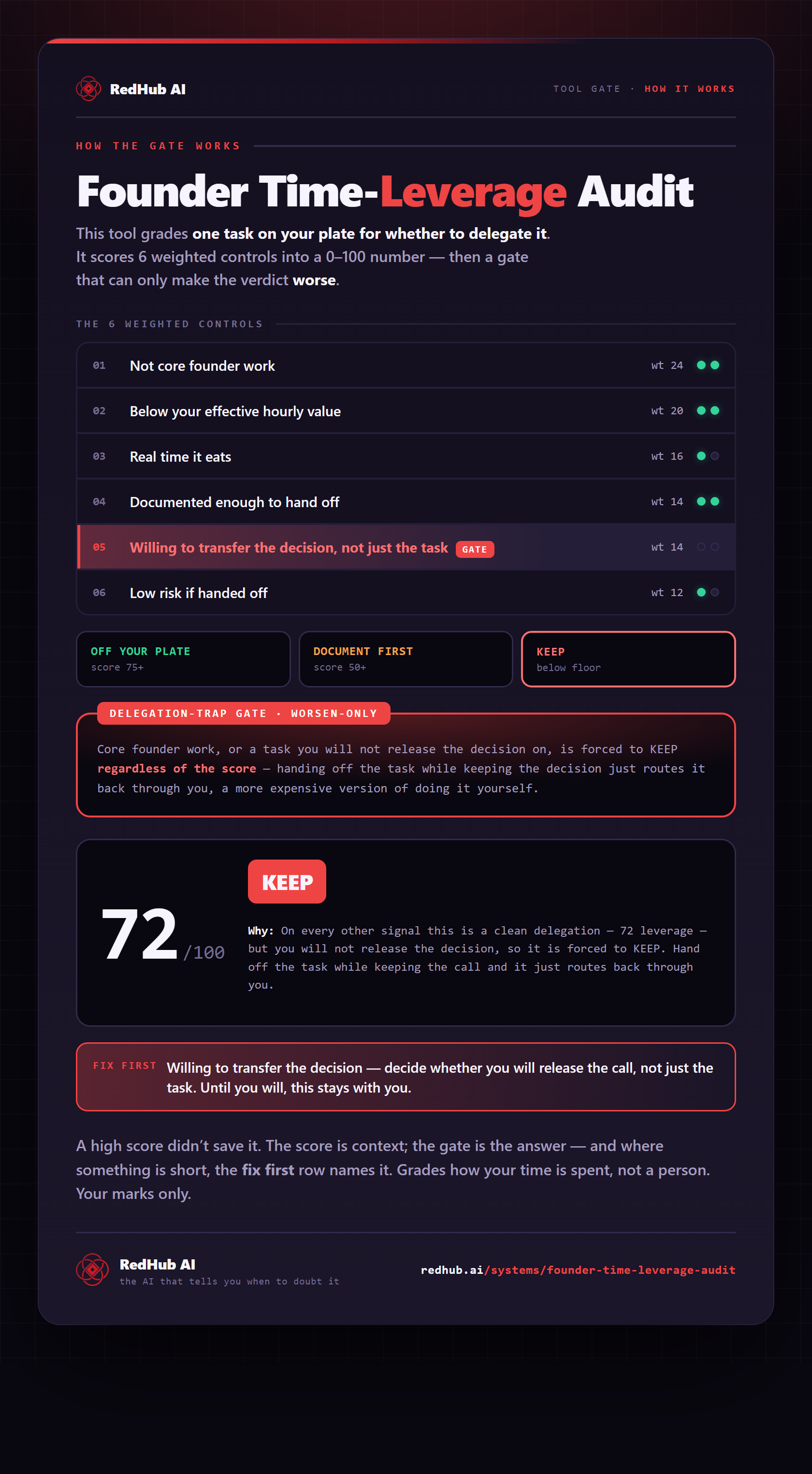
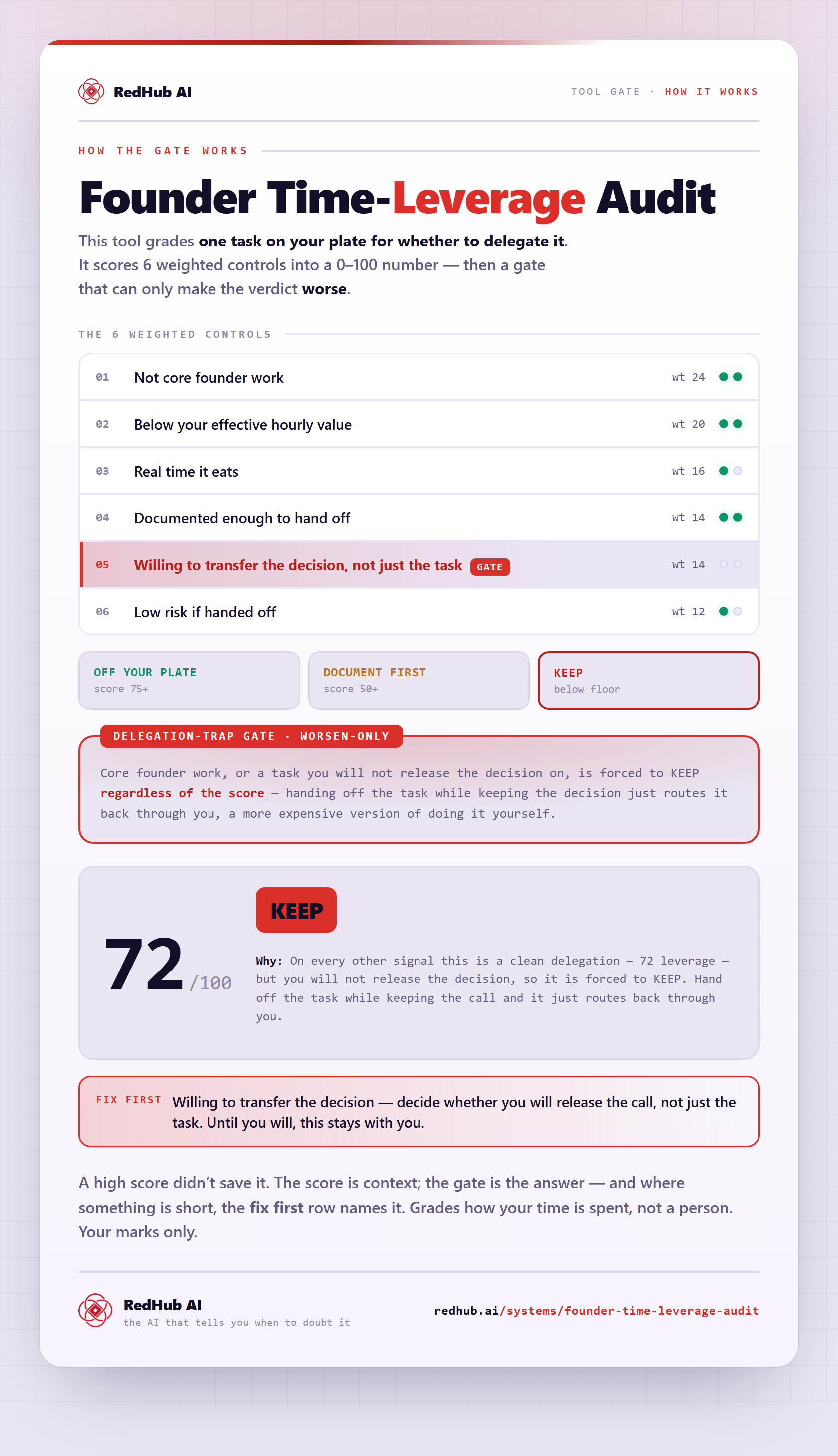
The gate this post refers to, drawn from the tool’s own logic. See the tool.