AI CRM Agents: What They Close and What They Cannot
RedHub AI Editorialupdated August 16, 20264 min read

In short
AI agents in a CRM are strong at work that otherwise goes undone, including research, activity logging, spotting stalled deals and drafting follow-ups. They are weak at reading whether a buyer is stalling or leaving. Volume is what makes the risk different: one bad message becomes hundreds, and recipients stop responding rather than complaining. Sort review by recoverability, fix record quality first, and confirm opt-outs work across every channel.
Jump to a section7
This is general information about sales automation. It is not legal or compliance advice, and automated outreach is regulated in ways that vary by channel and jurisdiction. Confirm your obligations with your own counsel before running one.
Nothing closes while you sleep
The category promise is a machine that works the pipeline overnight and hands you signed business in the morning. It does not happen, and the gap between the promise and the product is where most disappointment with these tools comes from.
What an agent does well is the work that never gets done anyway. Research before a call. Logging what happened after one. Noticing that a deal has gone quiet. Drafting the follow-up nobody had time to write. That work is valuable and it is neglected, so automating it is a real gain.
What it does badly is the part that closes: reading whether a buyer is stalling or leaving, knowing when to push and when to give room, and hearing the objection underneath the stated one.
The three jobs, and how they differ
- Data work. Enrichment, deduplication, activity logging, keeping fields current. Highest confidence, lowest risk, and the least exciting thing any vendor will show you. Start here, because a CRM full of stale records defeats everything downstream regardless of how good the agent is.
- Judgment support. Scoring, prioritization, surfacing deals that need attention. Useful when the model explains its reasoning so a rep can disagree. A score with no reasoning trains people to either follow it blindly or ignore it entirely, and both are worse than no score.
- Outbound communication. The agent contacts a human on your behalf. Highest value, highest risk, and the one that needs a person between the draft and the send.
The failure that costs more than it saves
An agent working a pipeline will eventually send something wrong to somebody who matters. A follow-up to a customer who churned angrily. A pricing reference to the wrong account. A cheerful nudge to someone who asked to be left alone.
Volume is what makes this different from a rep's bad day. A person sends one awkward email. An agent sends four hundred before anyone notices, and the ones that land badly are invisible, because nobody replies to say the message was wrong. They just stop responding, and your metrics show a soft decline nobody can trace.
Which is why send-time review is not friction. It is the control that keeps the failure recoverable.
What to check before turning one on
- Is your data good enough? An agent acting on stale records acts wrong at speed. Fix the records first, or the automation multiplies the mess.
- What can it send without a human? Answer deliberately. The default is usually more permissive than anyone intended, and nobody chose it.
- Does it honor opt-outs across every channel? Someone who unsubscribed from email should not receive a text. This is a legal question in many jurisdictions and a trust question everywhere.
- Can you see what it did? A log of every message sent, viewable by a person, before you need it, not after.
- What is the stop? One control that halts all outbound immediately, tested before launch, not discovered during an incident.
The complication worth naming
Everything above argues for a human in the loop, and human review is exactly the bottleneck automation was bought to remove. Review every message and you have automated the drafting and kept the constraint.
The resolution is not full autonomy or full review. It is sorting by recoverability. A research summary that is wrong wastes a rep's minute. A message to a live opportunity that is wrong can end it. Route the second through a person and let the first run, and the review load collapses to something a team will sustain.
Teams that skip this sorting end up in one of two places. They review everything until the review lapses from fatigue, or they review nothing and find out from the pipeline months later.
Where an agent earns its keep first
The strongest case is not new pipeline. It is the pipeline you already paid for and stopped working. Every CRM holds records that went quiet, and most teams cannot say which of them are worth a second attempt and which should never be contacted again.
That judgment is a rules problem, not a personality problem, which makes it the right shape for a system. Our CRM Win-Back System ($149) grades dormant records on readable rules and returns a verdict per record, including the ones it says to leave alone, which is the half that protects the relationship.
Frequently Asked Questions
Can AI agents close deals on their own?
No. Agents are strong at work that otherwise goes undone, such as pre-call research, activity logging, spotting stalled deals and drafting follow-ups. They are weak at the parts that close: reading whether a buyer is stalling or leaving, judging when to push, and hearing the objection underneath the stated one.
What is the biggest risk of automated CRM outreach?
Volume turns a single misjudged message into hundreds. A person sends one awkward email; an agent sends four hundred before anyone notices. The damage is largely invisible, because recipients rarely reply to say a message was wrong. They stop responding, and the result appears later as an untraceable decline in engagement.
Where should I start with CRM automation?
With data work: enrichment, deduplication, activity logging and keeping fields current. It is the lowest-risk category and the one vendors demo least, but an agent acting on stale records acts wrong faster. Fixing record quality first determines whether anything built on top of it behaves sensibly.
Does every AI-drafted message need human review?
Sort by recoverability instead of reviewing uniformly. A wrong research summary costs a rep a minute. A wrong message to a live opportunity can end it. Route the second through a person and let the first run. Teams that review everything eventually stop from fatigue, and teams that review nothing find out from the pipeline months later.
What controls should exist before launching an agent?
A defined boundary on what it may send without a human, opt-out handling that works across every channel, not per channel, a message log a person can read before an incident, not after, and a single tested control that halts all outbound immediately. The stop should be exercised before launch, not discovered during a problem.
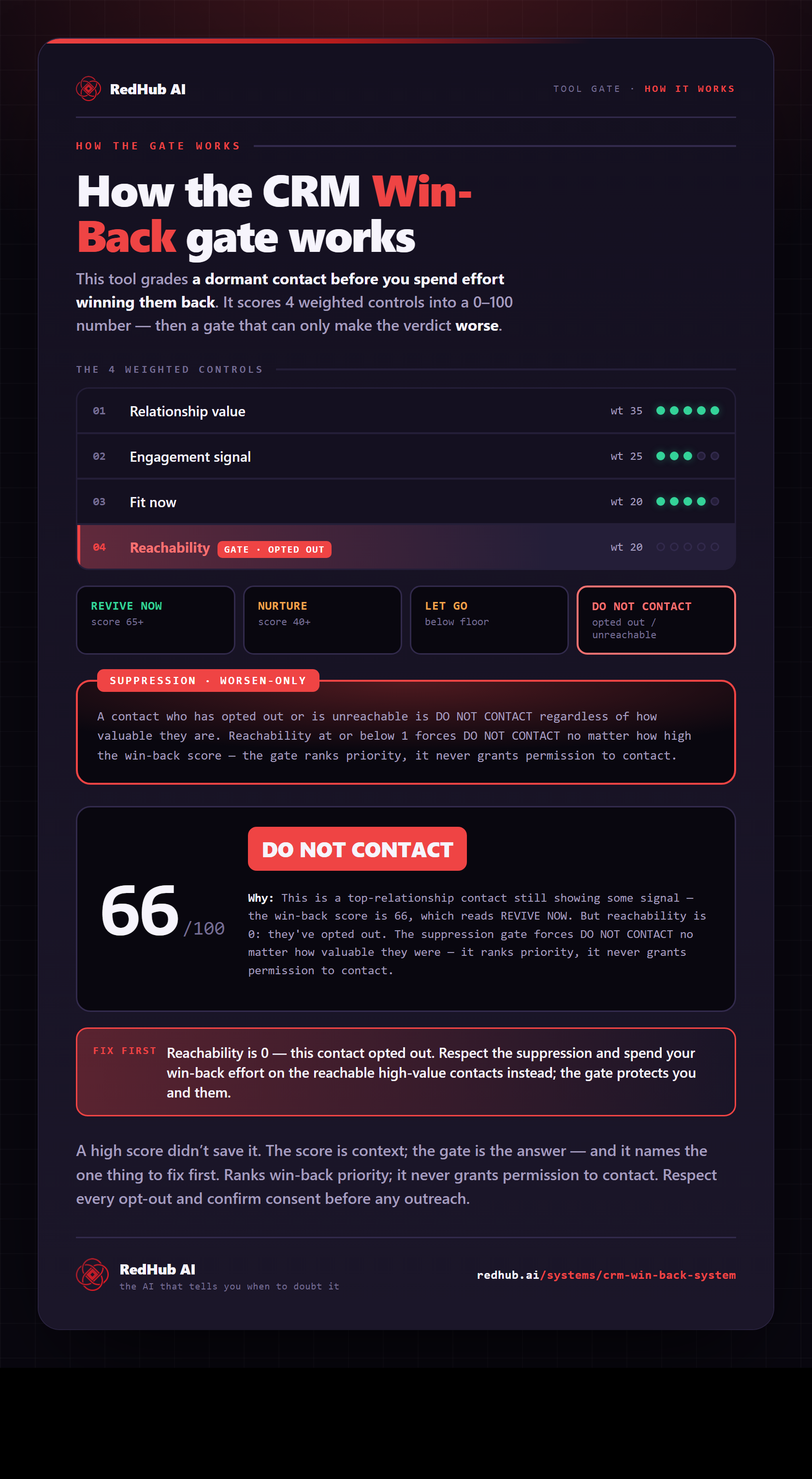
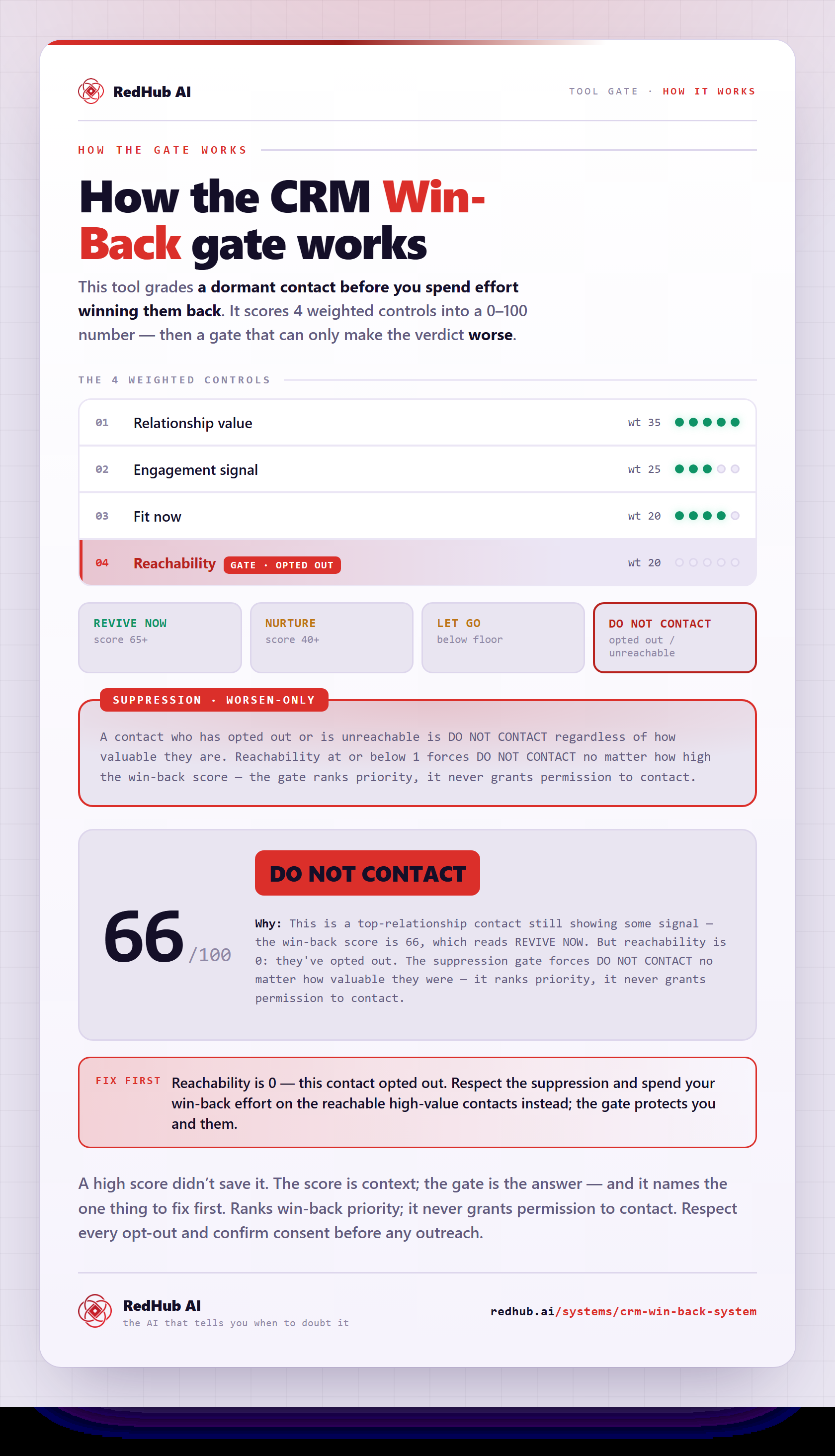
The gate this post refers to, drawn from the tool’s own logic. See the tool.