AI for Ecommerce: The Operator Jobs Worth Automating
RedHub AI Editorialupdated September 7, 20267 min read

Jump to a section9
TL;DR
- What it is: AI for ecommerce works best when it targets the repeatable operator jobs — writing listings, triaging returns, negotiating with suppliers, prioritizing inventory, briefing ads, and answering reviews.
- Who it's for: Shopify and Amazon operators running a catalog with more SKUs than hours in the week — see the Ecommerce Skills Pack.
- How it works: install a Claude skill tuned to each job, get a working draft on request, then review it before it goes live.
- Bottom line: automate the repeatable operator work first. Keep the judgment calls — final pricing, supplier commitments, which review to escalate — with a person.
What is AI for ecommerce?
AI for ecommerce, done well, is not a chatbot bolted onto your storefront. It's AI applied to the specific, repeatable jobs that eat an operator's week: writing variant-aware product descriptions, sorting return reasons, drafting supplier outreach, ranking SKUs by contribution, briefing ad creative, and responding to genuine customer reviews. Each of those jobs happens over and over, in roughly the same shape, which is exactly what a well-built AI skill is good at.
Best for: operators running a Shopify or Amazon catalog who are doing all six jobs themselves — see the Ecommerce Skills Pack ($89, one-time).
If you run an ecommerce store, you already know AI is supposed to help. What's less clear is where. Most "AI for ecommerce" advice points you at a chatbot for customer questions or a generic writing tool for blog posts. Neither one touches the work that actually eats your week: the catalog itself.
The highest-leverage place for AI in a small store is the repeatable operator jobs — the tasks you do the same way, over and over, for every SKU, every return, every supplier email. Automate those, and one person can run what used to take a small team.
The six operator jobs that eat a small ecommerce team's week
Across Shopify and Amazon stores, the same six jobs show up week after week. They look different from store to store, but the shape is always the same:
- Product descriptions. Writing (and rewriting) listing copy — especially when one product has ten or twelve variants.
- Return triage. Reading a pile of return reasons and figuring out which ones are actually costing you margin.
- Supplier negotiation. Drafting the email that asks for better pricing, faster lead times, or a defect-rate correction.
- Inventory prioritization. Deciding which SKUs deserve your attention this week and which ones can wait.
- Ad briefs. Turning a product and its reviews into a brief a creative team or freelancer can actually use.
- Review response. Replying to real customer reviews — good and bad — without letting a week's worth pile up unanswered.
None of these is glamorous. All six are recurring enough that a well-built AI skill can hold a consistent standard for each one, every time you ask.
Which of these is eating your week right now?
Before you decide what to automate first, it helps to see where your own hours actually go. This is a self-check, not a measured industry benchmark — it only sorts the numbers you enter.
Which ecommerce jobs are eating your week?
Whichever job came out on top is the one worth automating first — read the cluster post for that job (linked below) before you touch the rest.
Why "AI for ecommerce" usually means the wrong tool
Most AI writing tools were built for blog posts and marketing copy, not catalogs. Point one at a product with twelve color variants and it writes twelve near-identical paragraphs — because it treats every SKU as a fresh, unrelated writing task instead of one variant family that shares most of its copy.
Platform-built AI (Shopify Magic, Amazon's built-in tools) fixes part of that, but it's locked to one channel. If you sell on Shopify and Amazon and Etsy, you're re-learning three different tools instead of using one skill that already knows all three formats. And most of the subscription writing tools charge monthly for narrower output than a one-time, platform-aware skill delivers.
Key insight: the operator jobs above are not creative writing tasks. They're structured, repeatable decisions with a right shape and a set of guardrails. That's what a purpose-built AI skill is for — not a general chatbot.
What each job actually needs — and what stays human
AI can draft. A person still decides. Here's the split across all six jobs:
| Job | What AI does | What stays human |
|---|---|---|
| Product descriptions | Drafts variant-aware, platform-specific copy — see writing Shopify descriptions with AI | Final review before publish; verifying every factual claim |
| Return triage | Sorts return reasons into buckets and flags the biggest margin leaks | Deciding a supplier escalation or a refund exception — the Returns & Refund Profit Analyzer runs the per-SKU math |
| Supplier negotiation | Drafts a BATNA-framed outreach email using your data as leverage | Approving the ask and signing the final terms — see what to automate vs. keep human |
| Inventory prioritization | Ranks SKUs by revenue contribution and flags dead stock | Deciding what to discount, discontinue, or reorder — see ABC inventory analysis |
| Ad creative briefs | Turns product data and review language into a platform-ready brief | Approving creative direction and ad spend |
| Review response | Drafts responses to real reviews and flags recurring complaints — see AI for Amazon sellers | Deciding what a review reveals; never fabricating, incentivizing, or gating reviews |
That last row is worth saying plainly: AI should only ever help you respond to reviews you actually received. Using it to write fake reviews, pay for reviews, or hide bad ones violates platform policy — Amazon, Shopify app reviews, and most marketplaces all prohibit it — and it violates FTC guidance on endorsements. The honest lane is real reviews, real responses, faster.
The honest boundary: draft vs. decide
The pattern across all six jobs is the same. AI narrows the decision and writes the first draft. A person makes the call that has real consequences — money committed to a supplier, a claim published on a listing, a public reply to a customer.
That split is also why brand voice and pricing strategy stay out of this lane on purpose. Keeping every AI-drafted description sounding like your brand — not generic AI output — is its own layer, covered by the Brand Voice Engine ($59). And if you're also rethinking how your website presents pricing tiers (a separate problem from per-SKU pricing decisions), that's the Pricing-Page Performance Pack ($49).
Six operator jobs, six installable Claude skills
The Ecommerce Skills Pack covers all six jobs above: variant-aware descriptions, return triage, supplier negotiation, ABC inventory analysis, ad briefs, and review response — for Shopify and Amazon operators.
Get the Ecommerce Skills Pack — $89 →Where to start
- Run the self-check above. Find the job costing you the most hours right now.
- Read the deep-dive for that job. Each cluster post below covers one job in detail, honestly, with what to expect and what won't change.
- Install one skill and run it on a real task. Don't roll out all six at once — prove the value on the job that hurts most, then expand.
The four deep-dives: writing Shopify product descriptions with AI, AI for Amazon sellers, what to automate vs. keep human, and ABC inventory analysis.
Decision Guide
Use it if: you're running a Shopify or Amazon catalog and you personally write descriptions, sort returns, email suppliers, or answer reviews most weeks.
Skip it if: you sell a handful of SKUs and already have time to write every listing and reply by hand with room to spare.
Best first step: run the self-check above, then read the deep-dive for whichever job scored highest.
FAQ
What is AI for ecommerce, in one sentence?
Putting AI on the repeatable operator jobs — listings, returns, suppliers, inventory, ads, reviews — so one person can run what used to need several.
Do I need different AI tools for Shopify vs. Amazon?
No, if the tool is platform-aware. A well-built skill adapts structure per channel — Amazon's 200-character title and five bullets, Shopify's longer SEO-rich format — instead of forcing you to learn three separate tools.
Will AI-written product descriptions get flagged by Amazon or Shopify?
Not if the content stays accurate and original. Amazon's published 2026 policy permits AI-assisted listing content as long as the operator verifies every claim and the copy isn't copied from another listing. You stay responsible for accuracy either way.
Can AI respond to my reviews for me?
It can draft replies to reviews you actually received. It should never be used to fabricate reviews, pay for reviews, or hide negative ones — that breaks platform policy and FTC guidance on endorsements.
How is this different from a generic AI writer like Copy.ai or Jasper?
Generic writers treat every variant as a separate task and produce near-duplicate paragraphs for a multi-variant SKU. A purpose-built ecommerce skill treats the whole variant family as one job — shared copy stays shared, only the differentiators change.
How much time does this actually save?
It depends on your catalog size and how many of the six jobs you automate. Run the self-check above for a directional read on your own numbers — it's not a guaranteed or measured figure.
Where do I start if I only have time for one job?
Whichever job scored highest in the self-check above. For most operators, that's product descriptions or return triage.
What does RedHub sell for this?
The Ecommerce Skills Pack — six Claude skills covering all six jobs above, $89 one-time, 30-day refund.
Stop writing descriptions and sorting returns by hand
Six Claude skills, one purchase, no subscription: variant-aware product descriptions, return triage, supplier negotiation, ABC inventory analysis, ad creative briefs, and review response.
Get the Ecommerce Skills Pack — $89 →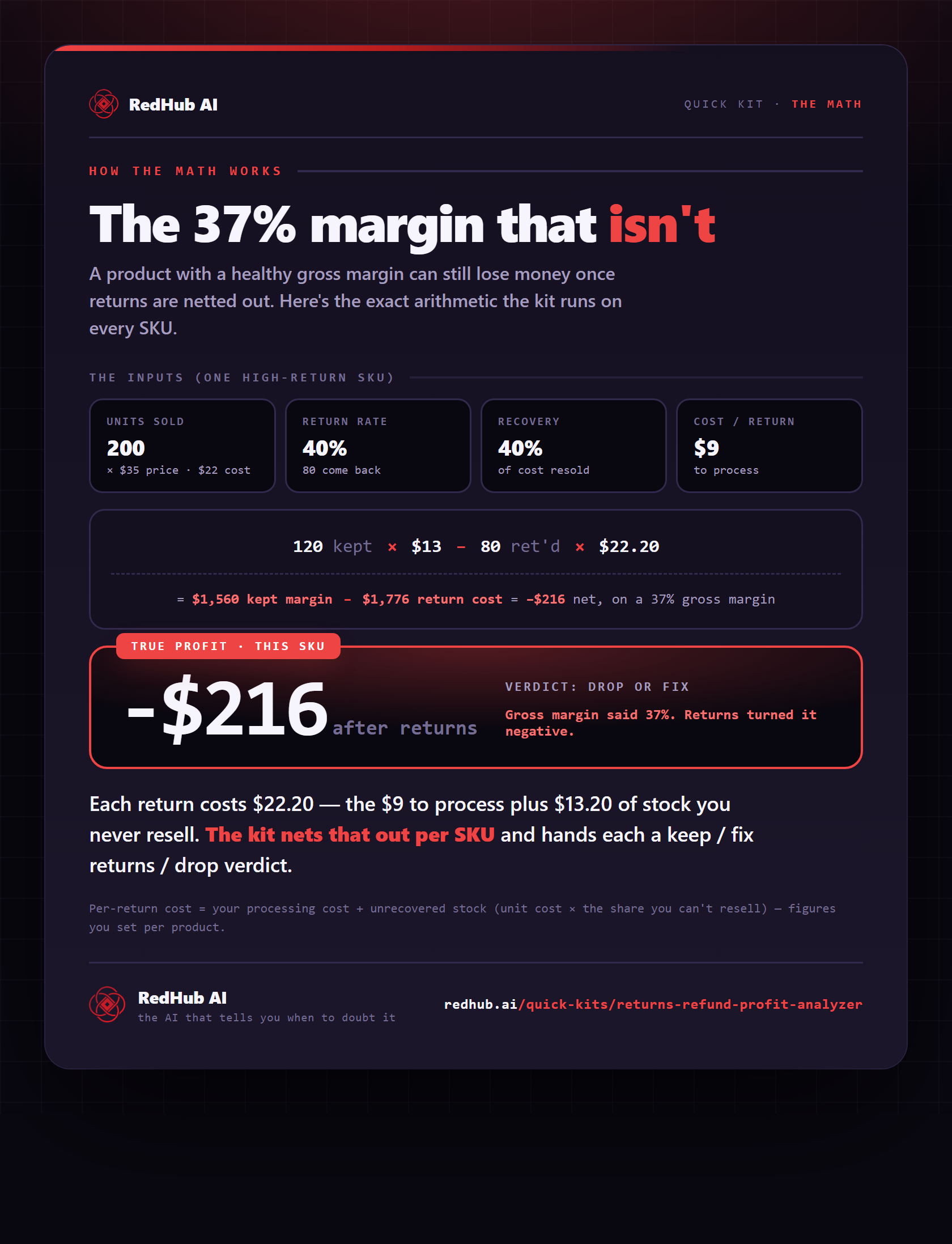
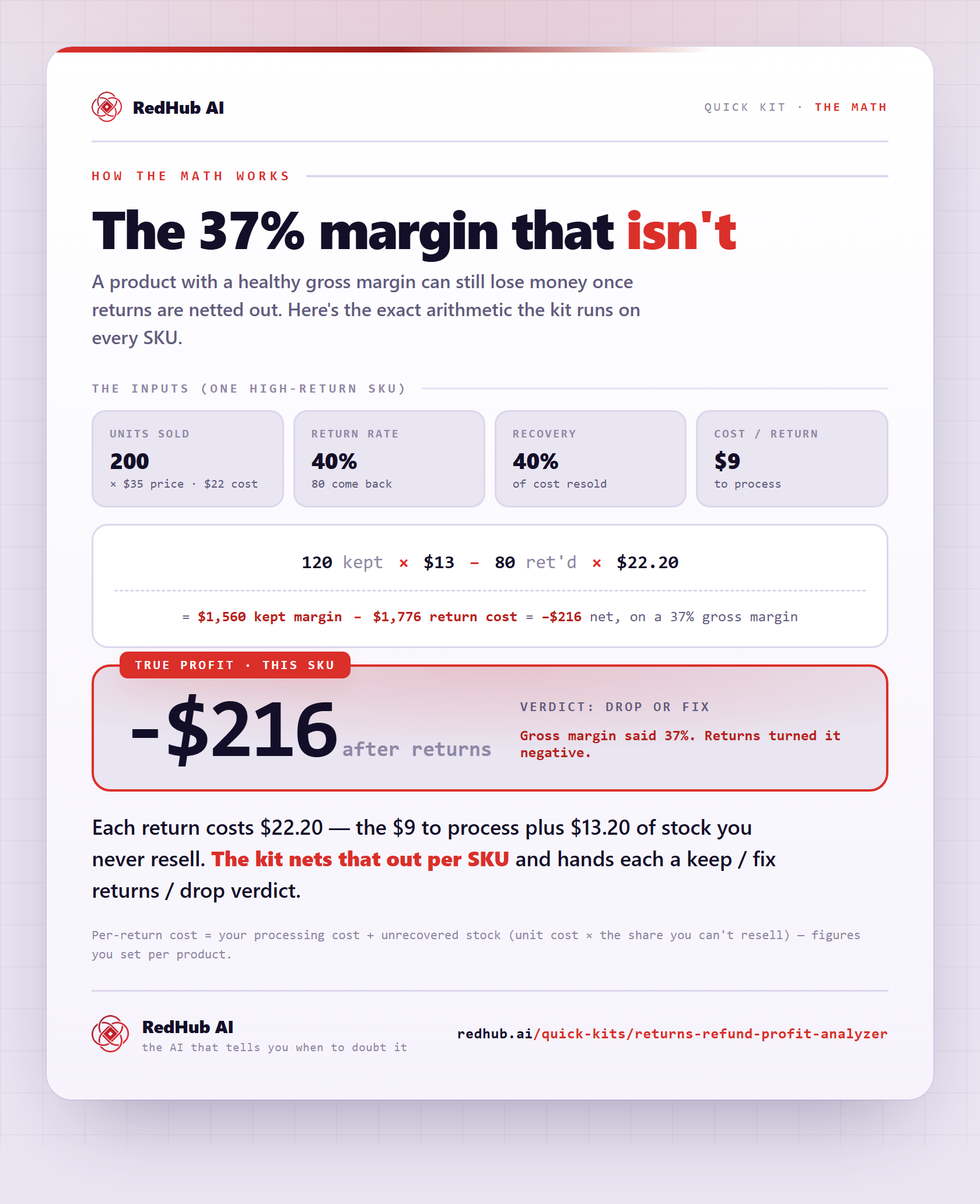
The gate this post refers to, drawn from the tool’s own logic. See the tool.