AI Safety in 2027: What Would Prove Real Progress
Todd Brooks, Founderupdated October 30, 202614 min read
Jump to a section12
- TL;DR
- What counts as AI safety progress?
- Why 2027 is the wrong unit
- What happened in October 2026
- Six claims that would prove progress
- Status as of 2026-10-29
- What researchers outside Goodfire are saying
- Three scenarios for 2027
- The inside view and the outside view
- What you can run this year
- A practical standard for optimism
- Who gets to steer: the rest of this set
TL;DR
- The claim on the table: in October 2026 a Goodfire essay argued that neurons in neural networks are far more legible than the field assumed. Other researchers published contrary tests within days. A separate Goodfire paper showed internal probes catching reward hacking that transcript monitors missed.
- What would prove progress: six specific things, each with a finish line: a companion paper, an independent replication, prediction of unseen behavior, interventions that survive retraining, monitoring that holds up under new behavior, and a cost result someone else can reproduce.
- Status as of 2026-10-29: none of the six is settled. The table below says where each one stands and when we last checked.
- The honest part: every one of those results needs access to a model's internals, and almost no business has that over a hosted API. The checks you can run on an AI decision from the outside are available today, and they do not wait on the research.
What counts as AI safety progress?
AI safety progress is a demonstrated capability, tested by someone who did not build it, that changes how much an AI decision can be trusted. A model whose internals can be described is a step. A description that predicts what the model will do on inputs nobody picked is a bigger step. A fix that still holds after the model is retrained, and a monitor whose miss rate is published after months in production, are the steps that would matter to a business. As of 2026-11-01, the research has shown the first and parts of the second.
Best for: leaders and risk owners who want one place to track the open claims, and who need to decide what to trust this year. The free Decision Fit check is the outside-view starting point: eight questions, two gates that can only send a task toward a person, nothing leaves your browser.
AI safety progress will not arrive as a date. It arrives as a set of capabilities, each one shown to hold by people who had no stake in the result. This post keeps the running record of what has been shown, what has not, and what each open claim would take to settle. It is the third pillar in RedHub's interpretability series. The first, AI's black box may be opening, explains the research. The second, AI oversight without reviewing everything, explains how to supervise AI without reading every output. This one explains what would count as progress, and it is built to be updated.
Why 2027 is the wrong unit
Prediction pieces about AI safety tend to pick a year. The year is a placeholder for a feeling. What matters is whether a short list of specific things has been demonstrated, and each of them could be demonstrated in 2027, or in 2029, or never. A date tells you when to check. It tells you nothing about what you will find when you do.
So this post is organized around claims instead of a calendar. Each claim names the evidence that would settle it. The status table records where each one stands and the day we last looked.
What happened in October 2026
Three things, kept separate, because the public conversation blended them into one headline.
The essay. On October 15, 2026, Goodfire published Nick Cammarata's Neural Networks Are Already Clean (opens in a new tab), which its own page labels "an informal research essay and working hypothesis". It argues that the cause of polysemanticity in early model organisms "wasn't superposition, but several ordinary, mostly fixable issues". Its headline number is a preliminary one: "In preliminary audits of Qwen3-32B, we estimate that roughly 90% of neuron poles have one main job", with the essay putting another 7% or so at two related jobs and only 2 to 4% not yet understood. The essay flags that the share moves with threshold choices, and it defers the method to a technical companion paper. Our full reading is in what the Already Clean essay says.
The rebuttal. Within days, Liv Gorton published her own tests (opens in a new tab) of the essay's flagship example, the neuron the essay reads as a V-shape detector. On synthetic V stimuli, she found, the neuron "only achieves about 25% of its max", and she warned that "Even random directions in mixed4e have top images that look interpretable." Her broader objection is definitional: "all the arguments in the essay only work for the highly non-standard definition of superposition in the essay." The two accounts sit side by side in the cat-and-car neuron: solved, or still open.
The probes. Separately, on September 17, 2026, Goodfire published a paper on catching reward hacking (opens in a new tab) with activation probes. The probes "catch instances of reward hacking that LLM chain-of-thought monitors miss". The comparison is mixed by model: "our probes catch 3.1% more hacks in Kimi K3 but 7.9% fewer hacks in GLM 5.2 on DeepSWE at a matched false positive rate." That is a complementary tool, not a winner. The business version of that story is in reward hacking: when AI passes the test, not the task.
Each is a reason for optimism and for patience at once. A field where one researcher publishes a hypothesis and another publishes contrary experiments within a week is a field that can be tested.
Six claims that would prove progress
These are the claims the research would need to establish before "the black box may be opening" becomes "the black box is open enough to rely on". Each has a finish line you could point at.
- The companion paper. The essay says "A technical companion paper will offer a more detailed account of language model neuron experiments", and that larger-model results, "like Kimi K3", are what "the companion paper will cover in more detail". Finish line: the paper is public, with thresholds and methods a third party can apply without asking the authors.
- Independent replication. A group with no connection to Goodfire runs the same audit on Qwen3-32B, or a comparable open model, and reports a comparable share of single-job neuron poles, or reports why it could not. Finish line: that report exists, from outside the lab.
- Prediction of unseen behavior. A description that only summarizes the examples it was written from is a label. One that predicts what the neuron does on inputs nobody chose is a finding. The essay reports its own check on 200 random neurons: an agent read only each explanation and wrote new examples and near misses before anything was measured. For the 183 whose explanations describe their positive side, the new examples fired their neurons strongly 76% of the time and the near misses 11%. Finish line: the same test, run by someone else, on neurons they picked.
- Durable interventions. Anthropic showed a one-off causal intervention in its circuit-tracing work (opens in a new tab): "By intervening in the model and activating the "known answer" features (or inhibiting the "unknown name" or "can't answer" features), we're able to cause the model to hallucinate (quite consistently!) that Michael Batkin plays chess". Causing a behavior once is the easy direction. Finish line: a representation-level fix that still holds after the model is updated or retrained, with the retest published.
- Monitoring under distribution shift. Goodfire reports that its probes "generalize well beyond the data they were trained on". Finish line: a probe deployed against live traffic, measured against behavior that did not exist when it was trained, with the miss rate published months later.
- Cost. The paper reports one figure: "On Kimi K3, a probe + LLM combined setup reduces the cost of LLM monitoring by 90% with only a ~1% drop in precision." One model, one setup. Finish line: the same cost curve, on a second model, from a second team.
Status as of 2026-10-29
Every row was checked against the primary page linked above. Where a row says "none found", that is a statement about our search on the date given, not a statement that nothing exists.
| Open claim | What would settle it | Status | Last checked |
|---|---|---|---|
| Companion paper | Public paper with methods and thresholds | Not released. The essay still describes it in the future tense, and Goodfire's research index lists nothing after the October 15 essay. | 2026-10-29 |
| Independent replication | An outside group reports a comparable audit | None found. Gorton's post tests one neuron in an older vision model and disputes the essay's reading of it. That is a check on an example, not a replication of the Qwen3-32B audit. | 2026-10-29 |
| Prediction of unseen behavior | Held-out test run by someone outside the lab | Goodfire reports its own check on 200 random neurons (for the 183 with positive-side explanations, new examples fired strongly 76% of the time, near misses 11%). No outside test found. | 2026-10-29 |
| Durable interventions | A representation-level fix that survives a model update, with the retest published | One-off interventions published by Anthropic (induced hallucination) and Goodfire (amplified reward-hacking signal). No durability result found. | 2026-10-29 |
| Monitoring under distribution shift | Production probe with a published miss rate on later behavior | Generalization reported inside the paper's own evaluation. Goodfire's index lists a separate production cyber-monitor paper (October 8, 2026) we have not assessed here. No reward-hacking probe with a published production miss rate found. | 2026-10-29 |
| Cost | The 90% figure reproduced on a second model by a second team | One reported figure, on Kimi K3, from the paper's authors. No reproduction found. | 2026-10-29 |
Last checked: 2026-10-29. This table is edited in place when a claim moves, and each edit is dated in this line. The update triggers are the companion paper's release, any independent replication, a Gorton follow-up, and any lab reporting probe monitoring in production.
What researchers outside Goodfire are saying
The outside reaction is the best calibration available, because the people reacting have the access a business does not.
Chris Potts of Stanford, speaking to MIT Technology Review (opens in a new tab), was blunt: "As far as I can tell, nothing about this blog post makes the problems any easier." Jacob Hilton of the Alignment Research Center, in the same piece, set the bar above neurons: "For a full understanding, we need to go beyond neurons, and explain how they connect together to form circuits."
Neel Nanda, who leads the mechanistic interpretability team at Google DeepMind, said in a response to the post, quoted by BankInfoSecurity (opens in a new tab), that he did not see the work as a significant update to the big picture of interpretability, while allowing that the approach might work for practical purposes and has some advantages over the standard alternatives. Andrew Yoon of CivAI, in the same article, called the findings informal and not yet peer reviewed, and said they would take time for the research community to vet.
Read together: interesting, possibly useful in practice, not yet a change to the big picture, not yet vetted. That is a fair summary of where a careful reader should sit on November 1, 2026.
Three scenarios for 2027
These are scenarios, not forecasts. We have no basis for a probability on any of them, and we are not going to invent one.
Scenario one: the paper lands and holds. The companion paper is published, an outside group reproduces the audit, and the single-job share holds within a reasonable band. Neuron-level auditing becomes a routine lab practice. Model vendors start publishing audit summaries the way they publish system cards today. Research interfaces for this already exist at Transluce, Anthropic and Goodfire, so the tooling is not the bottleneck. What does not change: a business renting a model over an API still cannot run the audit itself.
Scenario two: it holds for some models and not others. The result depends on architecture, training recipe, or the threshold choices the essay itself flags. Interpretability tooling becomes model-specific, and "which model" becomes a safety question as much as a capability question. This is the scenario where the vendor questions in the AI inspectability checklist earn their keep.
Scenario three: the illusions win. Gorton's warning that random directions look interpretable turns out to describe much of the 90%. The field returns to circuits, the way Hilton describes, and neuron-level descriptions are filed as a useful but unreliable first pass. Progress continues, but on a slower path.
In all three scenarios the thing a business can do this year is the same, and that is the part most coverage skips.
The inside view and the outside view
There are two ways to trust an AI decision. You can read it from the inside, which is interpretability: activations, probes, descriptions, interventions. Or you can gate it from the outside: a verdict on the decision, a record that someone not in the room could reconstruct, and a stop authority that has been shown to work. The inside view is improving fast, and every result above needs access to the model's internals. The outside view is available to every business today, on any model, including one you rent.
You need both. Only one of them is yours this year. The RedHub standard is explicit about which side its instruments sit on: a result is based solely on the inputs you supply, and RedHub does not independently verify the underlying facts. Nothing RedHub sells reads a model's internals, and this series will not pretend otherwise.
What you can run this year
None of the checks below waits on a row in the status table.
Free first
Decision Fit asks eight questions about one task and returns the level that should make the call: deterministic code, a decision model, a fast general model, a frontier reasoning model, or a person. Its two gates are worsen-only. They can move a task toward human judgment and never away from it. Nothing leaves your browser.
Two free self-assessments you answer yourself sit beside it. AI Compliance Assurance (opens in a new tab) asks whether the evidence behind a one-time check would still be there next quarter, which is the "does the fix survive" question at the level of an organization. AI Governance Gap Assessment (opens in a new tab) asks whether you have an inventory of the AI in use, a policy people follow, and a named human on each decision.
Pairs well with
Three instruments carry the outside view into a decision path that already exists.
- Deterministic Replay Warden grades whether a decision your systems already made could be produced again. It returns REPLAYABLE, RECONSTRUCTABLE or UNREPLAYABLE per path, with no partial credit. Its own standard says a model is an unpinnable source, so a path with a model in it reads RECONSTRUCTABLE at best. That is the honest ceiling for any AI-in-the-loop decision, and most paths should not be replayable at all.
- Audit Evidence Pack Assay grades whether somebody who was not there could assemble the account of an automated decision. It returns ANSWERABLE, NEEDS A WITNESS or NO RECORD, and it says nothing about whether the decision was right.
- Agentic Executive Harness reads the verdicts of your executive systems into one company status and reports the worst, not the average. It is orchestration only. It never runs the systems, moves money, or takes an action.
Two live posts set the sequence: the AI governance roadmap for the order of work, and why evidence goes stale for the reason a one-time check is not a standing one.
A practical standard for optimism
Optimism is warranted. Some of the darkness in the black box may have come from the tools used to look into it, and the debate is part of the good news. A reader who wants to be right in 2027, instead of early, holds three positions at once.
Do not demand that AI be mysterious. Do not assume a clear explanation makes it safe. Demand evidence that the explanation predicts behavior, and that the correction survives testing.
Until the status table above moves, trust the outside view you can run today, and read the inside view as what it is: promising, contested, and not yet yours.
Who gets to steer: the rest of this set
- Can AI explain AI? Agents now write descriptions of neurons. Why each one is a hypothesis until a causal test.
- Can you fix what the algorithm thinks about you? Three kinds of control, and only one needs interpretability.
- The security risk of editing an AI's behavior. The same lever that steers toward safety steers away from it.
- AI transparency is not AI accountability. Five governance questions a legible model still leaves open.
The other two pillars: AI's black box may be opening (the research) and AI oversight without reviewing everything (the business implementation). The soft landing for any vendor conversation is the AI inspectability checklist.
Decision Guide
Act now if: an AI system makes or shapes a decision that someone could later ask you to explain. The outside-view checks apply today, on any model.
Wait on the research if: your question is whether a specific model's internals can be audited. That answer depends on rows one and two of the status table, and neither has moved.
Best first step: run Decision Fit on one real task, then bookmark this page and check the table when the companion paper lands.
FAQ
What is AI safety progress?
AI safety progress is a demonstrated capability, tested by someone who did not build it, that changes how far an AI decision can be trusted. Describing a model's internals is one step. Predicting what it will do on new inputs, fixing a behavior in a way that survives retraining, and monitoring it in production with a published miss rate are the steps that would matter to a business.
Did Goodfire prove that neural networks are already understood?
No. The essay is labeled a working hypothesis by its own page, its headline number is a preliminary estimate for one model with stated caveats, and the technical companion paper had not been released as of 2026-10-29. Other researchers have published contrary tests of its flagship example. It is a serious claim under active dispute.
Has the Goodfire companion paper been released?
Not as of 2026-10-29. The essay still describes the paper in the future tense, and Goodfire's research index listed nothing after the October 15 essay when we checked. The status table on this page is updated when that changes.
Can activation probes replace transcript monitors for catching reward hacking?
Not on the published evidence. Goodfire's paper reports that probes catch some cases transcript monitors miss, but at a matched false positive rate the result went both ways: 3.1% more hacks caught on Kimi K3 and 7.9% fewer on GLM 5.2. The paper's own framing is a combined setup, with the cheap probe screening first and the costly monitor reviewing what it escalates.
Will businesses be able to inspect the models they use in 2027?
Only if they run the model themselves. Every result in this post depends on access to a model's activations, which a hosted API does not expose. The scenarios above differ on how the research develops, but in all of them a business renting a model is limited to the outside view: verdicts on decisions, records that can be reconstructed, and stop controls that have been shown to work.
Do RedHub instruments read a model's internals?
No. Every RedHub instrument grades inputs you supply about your own systems, and RedHub does not independently verify those inputs. Nothing RedHub sells scans a model, reads its activations, or certifies it. The products named in this post grade whether a decision could be replayed, whether its record could be reconstructed, and how a set of system verdicts rolls up.
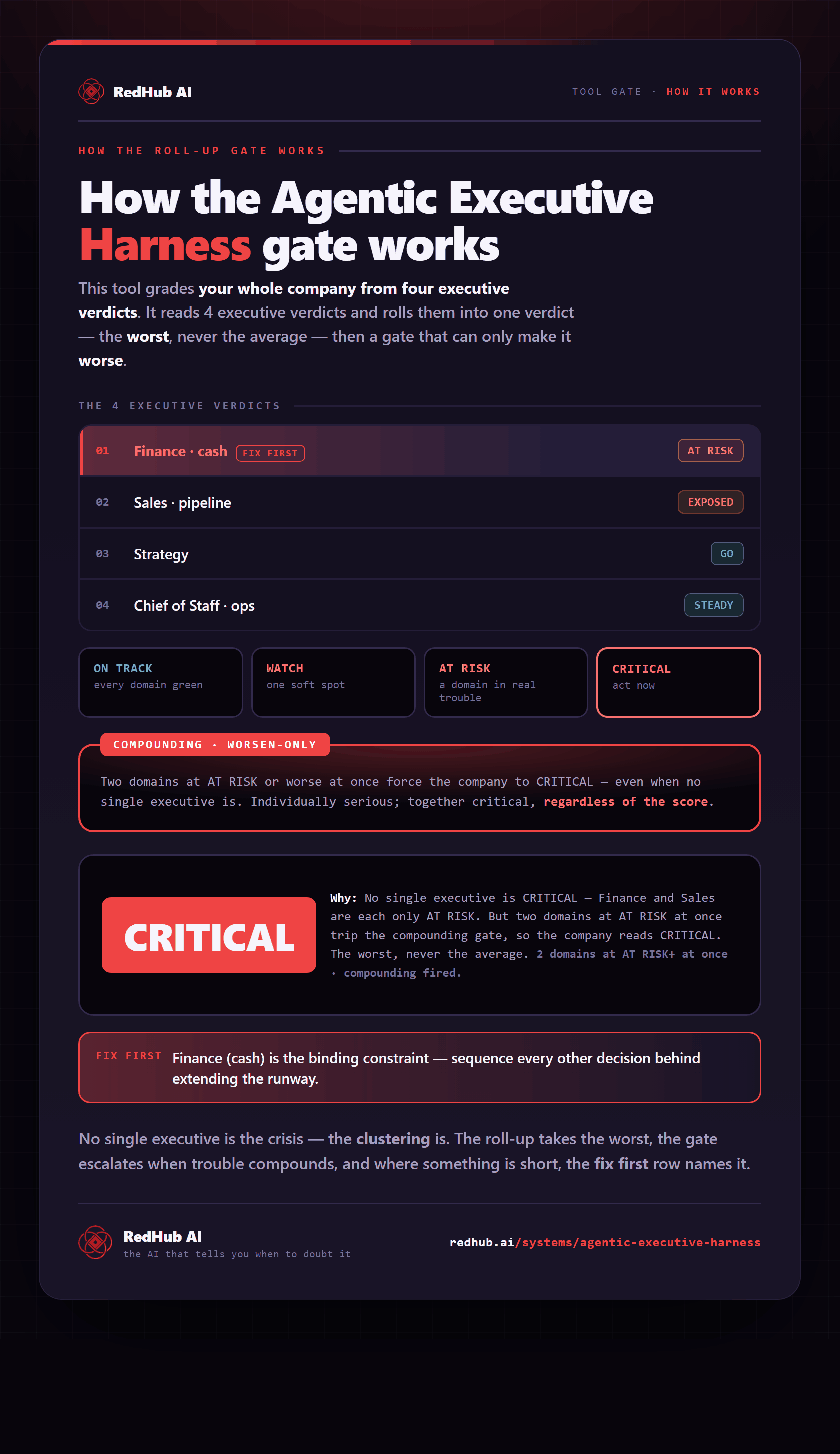
The gate this post refers to, drawn from the tool’s own logic. See the tool.