Enterprise AI Control Plane: When Agents Skip the Checkpoint
RedHub AI Editorialupdated October 2, 20268 min read

Jump to a section9
An enterprise AI control plane is the shared layer that decides which models, agents and tools a business runs, what each one may touch, and how each one is watched, tested, stopped and replaced. It answers a specific problem: AI arrives one team at a time, and each new agent connects straight to company data and systems without passing any central check. The term comes from networking, where the control plane makes decisions and the data plane moves traffic. Here, the models and agents do the work, and the control plane decides what they may do.
TL;DR: An enterprise AI control plane gives every model, agent and tool one route to data and actions, with the checks on that route. It spans nine layers, from a model registry to continuity plans, and sets controls by how much authority a workflow has: logging for a drafting assistant, approvals for an agent that writes to customers. Build it in phases, starting with identity, permissions, logging and a stop control for the riskiest systems. The AI Governance Starter Bundle ($399) covers the policy, training and proof program underneath it. Also see the AI capability-control gap, governance as an operating system, a 90-day governance roadmap, and why model retirement makes MCP matter.
How agents end up skipping the checkpoint
Take a company of about 300 people, invented for this example. In March, sales operations connects an agent to the CRM so it can write follow-up emails. To get it live by Friday, the agent runs on the admin API key the old CRM integration already used. In June, support adds an assistant that answers order questions inside the help desk. In August, engineering gives a coding agent access to the main code repository.
Each choice made sense inside its own team. None went past security, legal or IT, because there was nothing to go past: no shared register, no approval step, no common place for credentials.
Now ask three plain questions. Which of our agents can send an email to a customer? Which ones run on a key a person also uses? If one starts doing the wrong thing late on a Saturday, who can stop it, and how? In this company, nobody can answer any of them without a week of meetings. The agents never passed a point where those questions get asked.
What a control plane does, and what it does not
A control plane does not replace your models or agents, and it is not one product you buy. It is the shared rules and services that govern how AI systems are selected, connected, authorized, observed, tested and changed. Some of it is software, such as a gateway every model call passes through, or a vault that holds agent credentials so no agent keeps a raw key. Some of it is process: who approves a new agent, who owns it, and what must be true before it gets write access.
What matters most is whether a check sits in the path or beside it. A policy saying "agents need approval before emailing customers" sits beside the path. An agent that can only send email through a service that looks for that approval has the check in the path. An agent holding a raw API key can call that API whenever it likes, and every rule you wrote down becomes a request it can ignore.
The nine layers
The blueprint has nine layers. Each one covers a different kind of decision, and a missing layer is a place where a check can be skipped.
| Layer | What it covers |
|---|---|
| Model layer | Model registry, routing, fallback, price and lifecycle management |
| Identity layer | Named human and non-human identities with delegated authority |
| Permission layer | Least privilege, task scope, time limits and approval rules |
| Tool layer | Approved connectors, input validation, output validation and action policies |
| Data layer | Classification, access boundaries, retention and retrieval controls |
| Evaluation layer | Golden tasks, regression tests, release gates and outcome metrics |
| Observability layer | Prompts, versions, sources, tool calls, traces and state changes |
| Human-control layer | Escalation, review, overrides, kill switches and rollback |
| Continuity layer | Migration plans, vendor portability and operational fallback |
Least privilege means only the access a task needs. Golden tasks are real examples you re-run after every change to check that nothing got worse. Two layers carry the most weight early. The identity layer gives each agent a name of its own, so a log can say which agent acted, not just which key was used; our guide to non-human identity security covers how. The observability layer records the prompts, versions, sources and tool calls behind each action, which is what an audit trail needs beyond ordinary logs, as our audit-trail guide explains.
The continuity layer is easy to postpone. Any model you depend on can be retired by its provider, as our post on model deprecation explains, and our guide to the AI model lifecycle follows a model from release to retirement. Our post on MCP model portability covers how a shared tool standard makes that move smaller.
Same plane, different controls
A control plane matches controls to authority. Three systems in one company show the range.
- A marketing assistant drafts social posts from approved brand documents. It reads, it never publishes, and a person posts. It needs a low-risk model, read-only access to one folder, and logging.
- A customer operations agent updates CRM records and drafts replies. It needs its own identity, permissions down to the field (it can change a delivery address, not a credit limit), approved message templates, and a person's sign-off before anything leaves the company.
- A coding agent writes and tests changes. It works in a sandbox, a walled-off copy of the environment, with test gates and no production credentials. A finished change still goes through code review.
That avoids two bad outcomes: agents with unrestricted access, and one approval process so heavy that a drafting assistant waits as long as an agent that moves money. As models get more capable, the authority each workflow could take on keeps growing, and our post on the AI capability-control gap covers what happens when controls fall behind.
Build it in phases
Nobody builds nine layers at once. Do the cheap, revealing steps first.
- Inventory existing models, agents, tools and workflow owners. Include the ones nobody approved.
- Classify each workload by data sensitivity and action impact. "Reads public documents" and "moves money" should never share a tier.
- Put identity, permissions, logging and a stop control in place for the highest-risk systems first. Test the stop control by using it.
- Create a shared evaluation and model-change process, so an upgrade is tested on your own tasks before it ships.
- Add routing, portability and cost governance as the estate grows.
- Review the controls on a schedule, because capability and usage keep moving.
Steps 1 and 2 cost little and reveal where steps 3 to 6 matter. Spending a quarter on cost dashboards before you know which agent holds the admin key is work in the wrong order. Our 90-day AI governance roadmap turns the first four phases into a calendar, and AI governance as an operating system covers the routine that keeps the plane running.
When the checkpoint becomes the bottleneck
A control plane can fail in a way that looks like success. Send every request through a review board that meets every other Thursday, and sales waits six weeks to connect an agent to a spreadsheet. The next team will not wait. They will use a personal account or a free tool, and the agent skips the checkpoint again, this time on purpose. Slow controls produce shadow AI, meaning AI use the business has not approved and cannot see.
The opposite risk is concentration. If every model call passes through one gateway, that gateway must never go down, and it becomes the thing an attacker most wants. Tiering helps with the first problem, because low-risk work can clear in a day. Redundancy and tight access to the plane itself help with the second. Neither fix is complete on its own. Four read-only assistants can live with a light gateway and a weekly look at the logs. Forty agents that write to customers cannot, and an estate can cross from the first case to the second one approval at a time.
The number that matters is yours
You will not find a figure here for how many companies run agents nobody approved. We have not seen one built on a method we would stand behind, and someone else's survey says nothing true about your estate. Your number comes from step 1. If the inventory turns up an agent nobody approved, that agent tells you where to start.
Put the governance program under the plane
The AI Governance Starter Bundle runs three governance tools as one program with a 90-day playbook: the AI Acceptable Use Policy Builder, the AI Literacy & Workforce Training Kit, and the EU AI Act Readiness Kit. It covers policy, people and proof, the rules and records a control plane enforces. It does not build the technical layers for you. A working aid, not legal advice.
Get the AI Governance Starter Bundle — $399Pairs well with
The Stop-Authority Assay ($109) grades what each stop control has been shown to do rather than what it claims: STOPS, SLOWS or NAMED ONLY. The Agent Side-Effect & Blast-Radius Checkpoint ($89) grades whether an agent action is safe to run unattended, on reversibility and blast radius: RUN UNATTENDED, RUN WITH APPROVAL or DO NOT AUTOMATE. The AI Output Audit-Trail & Record-Keeping Kit ($79) audits your record of AI use for who generated each output, with what tool and who reviewed it: LOGGED, PARTIAL or NO TRAIL per entry.
More in this guide
What is an enterprise AI control plane?
It is the shared layer that decides which models, agents and tools a business runs, what each may access, and how each is monitored, tested, stopped and replaced. It governs the models and agents rather than replacing them.
Is an AI control plane a product I can buy?
Not as one product. Parts are software, such as a gateway for model calls, a credential vault and logging. Parts are process, such as who approves a new agent and who owns it.
What are the nine layers of an AI control plane?
Model, identity, permission, tool, data, evaluation, observability, human control and continuity. Together they cover which models run, who each agent is, what it may touch, how changes are tested, what gets recorded, how people step in, and how you survive a vendor change.
Where should a company start building one?
With an inventory of every model, agent, tool and owner, including the ones nobody approved. Then classify each by data sensitivity and action impact, and put identity, permissions, logging and a tested stop control on the riskiest systems first.
Does every AI tool need the same controls?
No. Controls should match a workflow's authority. An assistant that only drafts from approved documents may need little more than logging. An agent that changes customer records or sends outside messages needs its own identity, narrow permissions and a person's approval.
Can a control plane slow teams down?
Yes, if every request waits on the same heavy review. Teams then route around it with personal accounts and free tools. Tiering helps: low-risk uses clear quickly, and the heavy review is saved for agents that act on their own.
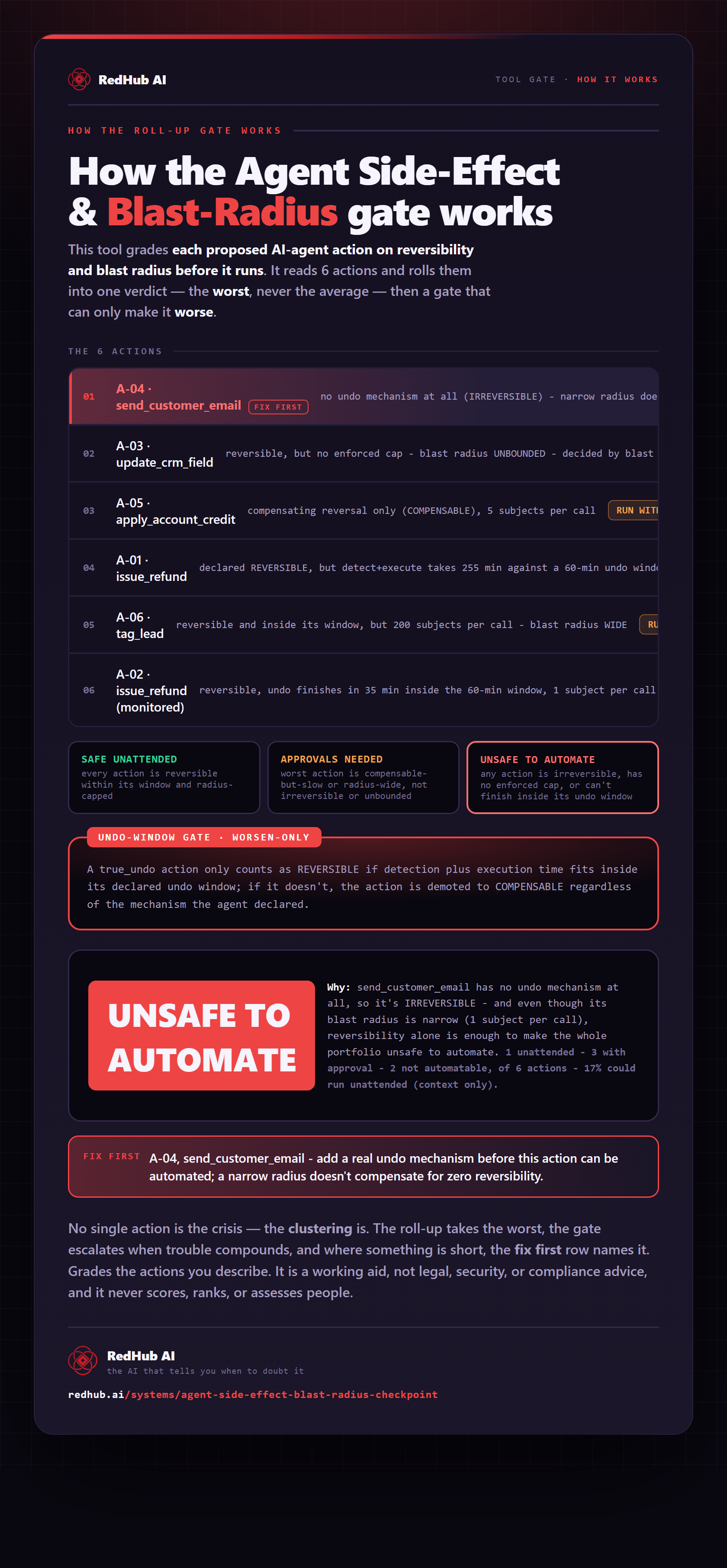
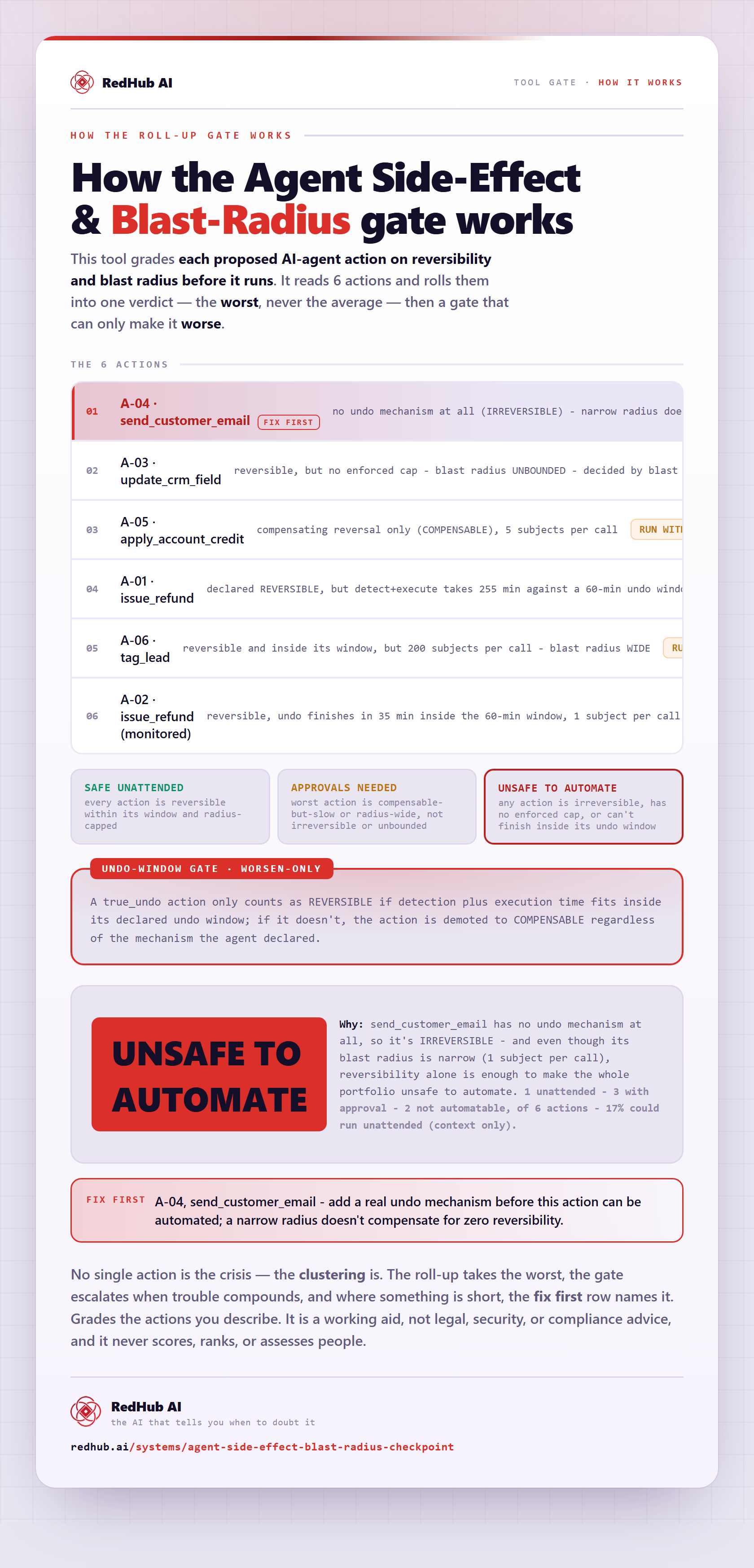
The gate this post refers to, drawn from the tool’s own logic. See the tool.