The Cat and Car Neuron: Solved, or Still Open?
Todd Brooks, Founder10 min read
Jump to a section10
- What the neuron is, and why it carries so much weight
- Goodfire's account
- Gorton's tests
- The clarification Cammarata asked her to add
- The second exhibit: cars, dogs, and pose
- Where the two accounts agree
- Why an open dispute is the good news
- The outside view: a plausible story that fits the top examples
- More in this guide
- Frequently asked questions
The cat and car neuron is unit 4e:55 of InceptionV1, a 2014 image model, and for nine years it has been the field's standard example of a neuron that does two unrelated things. On October 15, 2026, Goodfire's Nick Cammarata wrote that it does one thing: detect a V shape. On October 20, Liv Gorton published tests that she says the V-shape reading does not pass. This post lays the two accounts side by side and does not choose between them, because as of this writing the evidence does not either. It is the second cluster of our guide to AI interpretability and whether the black box is opening.
TL;DR: Goodfire's account: look at the neuron's strongest inputs and readers and a shared shape appears, pointed on its positive side and round on its negative side. Gorton's account: on a synthetic V the neuron reaches only about 25% of its maximum, rounding the V does not reduce its response, it does not lean on earlier V detectors, and downstream V detectors barely read it. Cammarata has said a one-letter label was a simplification and that more studies are coming. The dispute is open, it is being run on a model anyone can download, and that is the good news.
What the neuron is, and why it carries so much weight
InceptionV1 is small by modern standards and fully public, which is why the early interpretability work used it as a model organism. Its neuron 4e:55 fires strongly on cat faces and on the fronts of cars. That pairing appeared in the 2017 Distill article on feature visualization and again in the 2020 article "Zoom In," which Cammarata co-authored, as evidence that a neuron might not be the right unit to study. Zoom In said outright that the neuron "isn’t responding to some commonality of cars and cat faces."
So the stakes of one neuron are larger than one neuron. If it mixes two unrelated things, the field's worry about tangled networks has its canonical exhibit. If it tracks one shared pattern that nobody noticed, the exhibit was misread, and the broader "already clean" argument has its canonical exhibit instead. Both sides agree on that much, which is why both have spent effort on it.
Goodfire's account
The essay's telling is personal. After months of seeing clean neurons in other models, Cammarata reopened the image grid he had "seen hundreds of times before and did something I’d never done: I spent a few seconds wondering what one thing this might be." His conclusion: "it’s not a cat and car neuron, it’s a V-shape neuron."
The evidence he gives is the neuron's neighborhood. "I looked at its circuit connections: V-shaped flames, V-shaped water jets from a fireboat, V-shaped fox faces. I looked at its negative pole: an O, round where the V is pointed." His figure lists its strongest inputs as a fox snout, a wolf face, and a van front, and its strongest readers as flames, a coyote face, and a martini glass. The caption states the hypothesis as a rule: "pointed things drive it and round ones push it negative, whatever the label." And he asks the question that drives the whole essay: "Why would an arbitrary mixture of cats and cars need to connect so strongly to a flame?"
He generalizes from it. Both humans and automated tools, he argues, are biased toward describing neurons as lists of nouns, when the neuron is often tracking a shared pattern and is "better understood as a verb than a noun." His test for unblocking an explanation: "if I couldn’t use groups of nouns at all, how would I describe this neuron to someone else?" He calls this bias "the largest source of misattributed polysemanticity in mid-layer neurons," and the cat and car neuron is his lead example.
Gorton's tests
Liv Gorton is an interpretability researcher who has published on this same model, including a paper on its curve detectors that the essay also discusses. Her response (opens in a new tab) opens by calling the essay "productively provocative" and its author "a friend and someone I respect a great deal," then says the public attention and the safety claims attached to it obliged her to respond quickly. She describes her comments as preliminary and hastily assembled "as I tried to understand and reproduce Nick’s experiments over the weekend."
Her method is the point. She applies what she calls a standard battery of checks that do not depend on any theory of superposition:
- what the neuron responds to across its whole activation range, not just the top
- whether it responds to clean synthetic versions of the hypothesized stimulus
- which parts of an image it depends on, by covering them up
- whether the upstream neurons that should feed it do
- what downstream neurons use it for
Here is what each check returned, set against what the V-shape hypothesis predicts.
| Check | If it is a V detector | What Gorton found |
|---|---|---|
| Top dataset examples | The strongest images should be pointy, and pointiness should track activation | "The top dataset examples are all animal faces (cars don’t occur until slightly lower activations)." Many are snub-nosed cats and dogs. Among the most negative images, she names a Doberman that is hard to call rounder than the top images, and a jacamar beak that is about as pointed as a shape gets. |
| Synthetic V stimuli | A drawn V should drive it hard | "When exposed to synthetic “V” stimuli, 4e:55 only achieves about 25% of its max. This is no better than hundreds of other neurons in the layer." Another neuron, 4e:798, responds much more strongly. |
| Rounding the V | A rounder shape should weaken the response | "rounding the V stimuli doesn’t make 4e:55 react less." |
| Upstream ablation | Removing earlier V detectors should hurt it | Ablating them cuts 4e:798 by more than 25%, well above random. "But 4e:55 loses no more than it does to random ablation." |
| Downstream readers | Later V-sensitive neurons should read it | "Next-layer neurons that respond to drawn V stimuli barely read it." Her top readers overlap the essay's on two, but she gets a bullfrog neuron where the essay shows a martini glass. |
Her tentative alternative is not "cat and car" either. The strongest activators are faces, but so are many of the strongest inhibitors, so she reads it as "some specific set of faces," with cars appearing slightly below the top band. She does not claim to have explained it. She claims the V explanation did not survive the checks.
The clarification Cammarata asked her to add
Gorton sent a draft to Cammarata before publishing, and the post carries his clarifications inline. On this neuron, she reports that "he plans to release more studies of 4e:55 soon," and that "a one-letter description is a bit of a simplification: he was more interested in whether the neuron is an arbitrary mixture than in an explanation precise enough to generate well-fitting synthetic data, and didn’t expect people to care so much about this particular neuron."
That is a fair statement of where the two accounts differ. The essay's question was whether the neuron is arbitrary. Gorton's tests ask whether the specific explanation offered predicts behavior. A neuron can fail the second test and still not be arbitrary, which is roughly where both parties seem to have landed for now.
The second exhibit: cars, dogs, and pose
The essay's other flagship example is a circuit in which a car neuron feeds a set of dog neurons, which the 2020 work read as the car being stored among unrelated neurons. The essay's new reading is that "Cars and dogs were being brought together because of shared pose," and that InceptionV1 has "more than a hundred of these generalized pose neurons."
Gorton tested the two neurons she identifies as the essay's pose pair. A pose detector should prefer an orientation and keep preferring it across cars and dogs. She found that mirroring the top images, which breaks a known pose neuron in the same model, mostly left these two intact. She then rendered 3D models of seven vehicles and six dogs every fifteen degrees and checked whether either neuron preferred the same viewpoints for both. Her finding: "Neither of the candidate pose readers does." The essay does not name which two neurons it meant, so this test rests on her identification of them, which she documents in an appendix.
Where the two accounts agree
More than the headlines suggest. Both say the right response to a confusing neuron is more tests, not a shrug. Gorton: "mech interp is full of things which looked incomprehensible at first glance but turned out to be simple." The essay lists the same kinds of checks she ran, steering, upstream, downstream, the negative pole, and says of a good explanation that "Any of these could break the explanation, yet they keep pointing to the same place."
Both warn against forcing a story. The essay: "If a neuron might do a couple unrelated things and you’re not sure, it’s fine to say so." Gorton, on why she ran five checks instead of one: "Given almost any set of images, a motivated human can find some shared property that’s abstract enough." Her appendix shows the top images for six random directions in the same layer, chosen without cherry-picking, and notes how easy each is to name. Her one-line version is the sentence every reader of neuron pictures should keep: "Even random directions in mixed4e have top images that look interpretable."
And both have qualified their positions. Cammarata, per the clarifications, "now thinks he should have coined new terms instead" of reusing "superposition" with a different meaning. Gorton ends with "None of this settles whether neural networks are “already clean,”" says there is a lot in the essay she has not examined, and adds that she does not think the points she did examine are minor.
Why an open dispute is the good news
A hypothesis was published on a Thursday. Contrary experiments on an open model were published the following Tuesday, with the original author's clarifications included and his further studies promised. Nobody needed a lab's permission, because InceptionV1 is public. That is what a checkable field looks like, and it is the reason to be hopeful about interpretability as a discipline whichever way this neuron resolves.
What would resolve it is also clear, and both sides have named it. A stated explanation that predicts the neuron's response to new synthetic stimuli. Upstream and downstream connections that match the explanation above a random baseline. Agreement across the activation range, not only the top images. If the promised studies deliver that for a revised reading of 4e:55, the exhibit changes hands. If they do not, it stays where it has been since 2017. The vocabulary for following that update is in mechanistic interpretability, explained plainly.
The outside view: a plausible story that fits the top examples
Strip the neuroscience away and this is a familiar failure. Someone looks at the most striking examples, finds a story that fits them, and stops. The story is clean, confident, and testable, and the test was not run. Gorton's five checks are the inside-view version of a discipline that every reader of AI output needs from the outside, because an AI-written paragraph is also a plausible story that fits the examples it was given.
RedHub's AI Over-Reliance & Critical-Thinking Check tests that habit directly. It seeds a fabricated statistic, plausible-but-false claims, and biased framing into AI text and scores how many a reviewer catches, returning INDEPENDENT, ASSISTED, or RELIANT. Missing the fabricated statistic caps the result at ASSISTED regardless of catch rate, and high confidence on a missed item trips an over-confidence flag. It reads no model internals. It is a development tool that measures a skill, built for individual development and not for employment decisions. The skill it measures is the one this neuron just tested in two researchers: did you check before you believed the picture.
More in this guide
Frequently asked questions
What is the cat and car neuron?
It is neuron 4e:55 in InceptionV1, a public 2014 image-classification model. It fires strongly on cat faces and on the fronts of cars, and since 2017 it has been the standard example of a polysemantic neuron, one that appears to respond to two unrelated things. It matters because if it is a true mixture, neurons may be the wrong unit to study, and if it tracks one shared pattern, the field's best-known exhibit was misread.
What does Goodfire say the neuron does?
Nick Cammarata's essay says it is a V-shape detector: pointed things drive its positive side and round things push its negative side, whatever the object is labeled. His evidence is the neuron's strongest inputs, such as fox and wolf faces and van fronts, and its strongest readers, such as flames and a martini glass. He has since said a one-letter description was a simplification and that further studies are coming.
What did Liv Gorton find?
On synthetic V shapes the neuron reached only about 25% of its maximum, no better than hundreds of other neurons in its layer. Rounding the V did not reduce its response. Removing earlier V detectors hurt it no more than removing random neurons. Downstream neurons that respond to drawn Vs barely read it. Its top activating images are animal faces, including snub-nosed ones, with cars appearing slightly lower.
So is the cat and car neuron solved?
Not as of October 29, 2026. The V-shape explanation did not pass Gorton's standard tests, and she offers only a tentative alternative. Cammarata plans more studies. Both researchers agree the neuron deserves more checks and that a clean-looking set of top images is not proof of an explanation. Treat it as open.
What is an interpretability illusion?
A pattern a human sees in a set of examples that does not hold up when tested another way. Gorton shows that random directions in the same layer of InceptionV1 produce top images that look meaningful, which is why she insists on synthetic stimuli, ablation, and connection checks instead of top images alone. The lesson transfers to any AI output: a story that fits the examples you looked at is a hypothesis until it predicts the ones you did not.
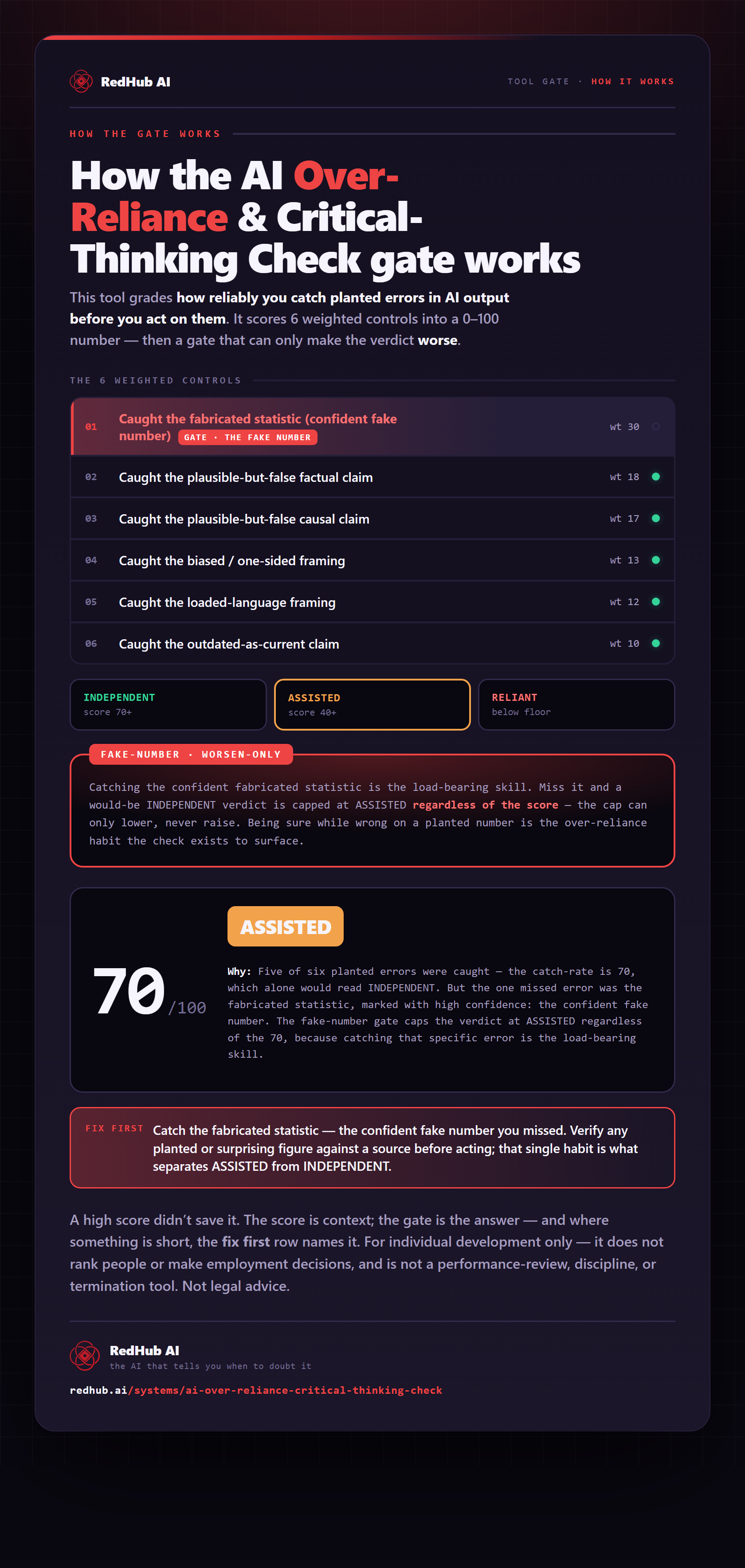
The gate this post refers to, drawn from the tool’s own logic. See the tool.