How to Estimate and Budget Your LLM Token Costs
RedHub AI Editorialupdated October 4, 20267 min read

Jump to a section8
To estimate your LLM token cost, multiply three numbers (monthly calls, tokens per call and your provider's rate) and do it once for input and once for output, because the two sides carry different prices. As of October 2026, Anthropic lists Claude Sonnet 5.5 at $2 per million input tokens and $10 per million output tokens, so a token the model writes costs five times a token you send. Do that math with production numbers before launch and the AI line on next month's invoice becomes a figure you can defend. Skip it and you learn the rates from the bill.
TL;DR: Token cost = calls × tokens per call × rate, done separately for input and output. The hidden multiplier is context: system prompts and chat history are re-sent, and re-billed, on every call. Price any introductory rate twice, at today's number and at the announced later one. Run your own numbers in the calculator below, or model several models and scenarios with the Token Economics Workbook ($59). The four deep dives: how LLM API pricing works, what a token is, why the output side costs more, and how to bring the number down.
Why the first real invoice surprises people
An AI feature usually gets its budget from the demo. A few dozen test calls, a short prompt, a short answer. Then it ships, and three numbers move at once. Volume climbs from dozens of calls to thousands. Prompts grow, because system instructions, retrieved documents and chat history ride along with every request. And answers get longer, because real users ask harder questions than the demo did. Illustrative math on Sonnet 5.5, using the calculator's defaults below: 40 demo calls cost about 32 cents, and 10,000 production calls a month cost $80.
Each of those multiplies the bill. None of them shows up until the invoice does. Budgeting token cost means modeling the bill before you turn the feature on, with your production guesses in place of the demo's numbers.
The three numbers that set the bill
Every token bill comes down to the same three inputs, and you can estimate all three before you write any forecasting math:
- Call volume. How many times a month the feature runs. Count per user, per day or per document, whatever triggers it, and multiply out to a month.
- Tokens per call. How much text goes in (your prompt, system instructions, retrieved context, chat history) and how much comes back. The two are rarely the same size.
- Your provider's current rates. The price per million tokens, listed separately for input and output. Pull it from the provider's own pricing page each time you forecast, because a rate you saw last quarter may already be wrong. On Anthropic's October 2026 sheet, Claude Sonnet 4.5 and Sonnet 5.5 sit a third apart on input, $3 versus $2 per million.
Multiply volume by tokens by rate for each side, then add the two. The math is the easy part. The hard part is step two, because prompts and context tend to run bigger than people assume.
Estimate your own number
Enter your call volume, average token sizes and your model's per-million rates. The calculator runs the same multiplication and returns a monthly and yearly figure you can hold up against last month's actual bill.
Estimate your monthly LLM token cost
At the defaults, 10,000 calls a month comes to $80: $30 of input and $50 of output, even though each call sends three times as many tokens as it gets back. The calculator is a planning tool, not a live meter and not financial advice. It projects a cost from what you type. It never reads your account usage, so confirm real pricing with your provider before a number goes into a budget.
Price an introductory rate twice
A forecast assumes the rate holds, and some rates are announced not to. Google lists Gemini 4 Argon, still limited to an early-access program, at an introductory $2 per million input tokens and $10 per million output tokens, and says those rise to $4 and $20. As of October 2026 it has not said when. Run the calculator's default workload at the later rate and $80 a month becomes $160. The same feature, doing the same work, costs twice as much on a date nobody has published. Our side-by-side of Gemini 4 Argon vs Claude Sonnet 5.5 covers the rest of that comparison.
The token count moves too. Anthropic says its Claude 4.7 and later models use a newer tokenizer that produces about 30% more tokens for the same text, so a count measured on an older model undercounts a newer one. And the token bill is only one line of what a feature costs. Tools, hosting, human review and rework sit on top of it, which our post on the true cost of an AI agent builds into one monthly figure.
So a token forecast is a range. You can pin down your own volume and your own prompts. You cannot pin down a vendor's next price, and we are not going to guess at one. What you can do is write down which rate you used and the date you looked it up, and re-run the forecast whenever either changes.
The line item that grows on its own: re-sent context
A common source of a surprise bill is context that gets re-sent, and re-billed, on every request. Anthropic's documentation puts it plainly: "The Messages API is stateless, which means that you always send the full conversational history to the API." A detailed system prompt, a stack of retrieved documents or a growing back-and-forth all count as input tokens on every call, even when none of it is new.
That is why a chat feature's cost per conversation climbs the longer the conversation runs, and why a single-turn demo badly underestimates a multi-turn product. Prompt caching can bill the repeated part at a lower rate, and input vs output tokens works through a 20-turn conversation with and without it. For the unit itself, start with what a token is in AI.
Turning one estimate into a budget
One calculator run gives you one scenario. A budget needs several: today's volume, the volume after a full launch, a bad-month spike, a version with a cheaper model on the easy calls, and a version at any announced price increase. Our AI intelligence costs post makes the case for pricing every workflow at both the current and the announced rate.
The Token Economics Workbook ($59) does that side by side. Its calculator prices one task against rate cards for up to three models, folds in a cache hit rate, and returns cost per task, cost per user, gross margin, break-even price and monthly and yearly spend. You enter every rate, so the Workbook stays as current as your last trip to the provider's pricing page.
Budget the bill before the feature ships
The Token Economics Workbook gives you a forecasting calculator, a model-routing matrix, caching patterns and 15 anonymized production teardowns, so you can price a feature across up to three models before the first invoice arrives.
Get the Token Economics Workbook — $59Pairs well with
The AI Burn-Rate & Budget Blowout Forecaster ($49) projects your AI spend across the budget year, names the month you would blow the budget, and returns ON BUDGET, TRIM NOW or BLOWOUT AHEAD. A forecast cannot stop a bill that spikes mid-month, so the AI Spend Runaway & Billing-Safeguard Gate ($49) grades whether a runaway would be cut off, and reads RUNAWAY RISK when there is no hard spend cutoff. The AI Cost-Per-Task Calculator ($29) puts each task's AI cost next to its human cost and returns Automate, Review or Skip.
More in this guide
How do I estimate my LLM token costs?
Multiply your monthly call volume by the average input tokens per call and by your provider's input rate, do the same for output tokens and the output rate, then add the two. The calculator on this page runs that math with your own numbers.
Why is my AI bill higher than I expected?
Often because context is re-sent and re-billed on every call. Anthropic's documentation says its Messages API is stateless, so the full conversation history goes back with each request, and a long system prompt counts as input every time.
Do input and output tokens cost the same?
No. As of October 2026, Anthropic lists Claude Sonnet 5.5 at $2 per million input tokens and $10 per million output tokens, and Google lists Gemini 4 Argon at the same introductory $2 and $10. Check your own model's current page before you budget.
How should I budget for a price that is introductory?
Price the workload twice, at today's rate and at the announced later rate. Google says Gemini 4 Argon's $2 and $10 rise to $4 and $20 without naming a date, which doubles the token bill for the same work.
Is a token-cost calculator the same as a live spend monitor?
No. A calculator projects a cost from numbers you type. It does not read your account usage or stop a bill in progress. For protection against a runaway bill, grade your hard spend cutoff with the AI Spend Runaway & Billing-Safeguard Gate.
Is this financial advice?
No. The calculator and the Workbook are planning and estimation tools, not financial, tax or accounting advice. Token prices and provider terms change, so verify current rates with your provider before you finalize a budget.
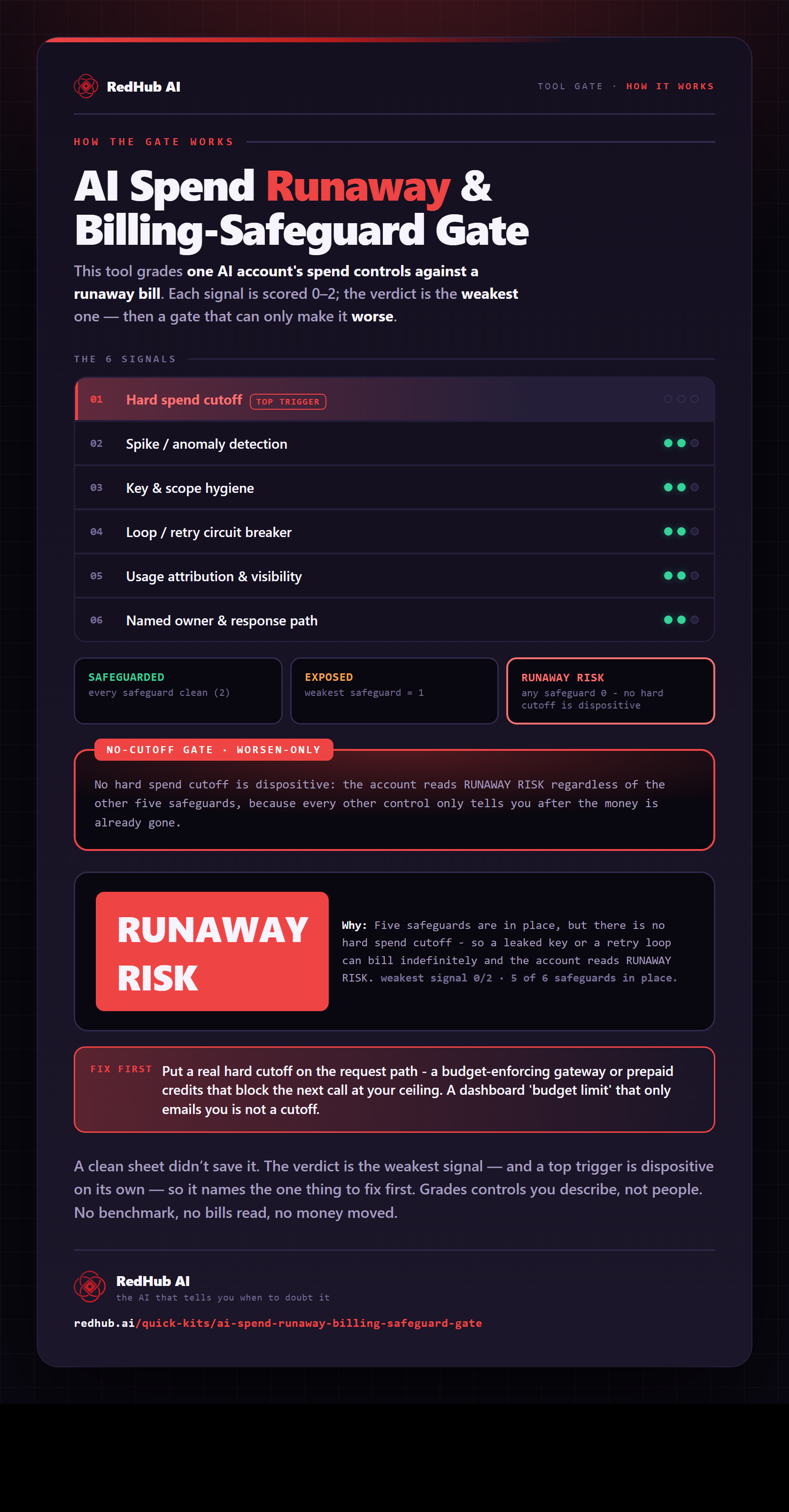
The gate this post refers to, drawn from the tool’s own logic. See the tool.