Does AI Art Have a Soul? The Truth About Human Creativity
Todd Brooks, Founderupdated July 23, 20263 min read
In short
An essay arguing the question is a mirror: what we notice missing in machine-made work tells us what we were actually valuing in human work, which we had mostly stopped articulating. It takes the philosophical objection seriously rather than dismissing it, and lands on intention and stakes rather than technique as the thing that was doing the work.
Jump to a section4
Does AI Art Have a Soul? The Truth About Human Creativity
You know that feeling when you’re staring at something beautiful and you can’t quite put your finger on why it moves you? That’s the soul speaking. Or at least, that’s what we’ve always told ourselves.
Now we’re facing a curious problem. Machines are making art. Beautiful, haunting, technically proficient art. And it’s forcing us to ask a question we thought we’d settled centuries ago: What exactly is a soul, anyway?
Can a Machine Create, or Only Simulate?
Harvard philosopher Sean Dorrance Kelly doesn’t mince words. He argues that AI can’t truly create-it can only simulate creation. It’s the difference between understanding a joke and reciting one you memorized. One comes from somewhere real. The other is just pattern recognition dressed up in clever clothes.
But here’s where it gets interesting. Maybe the question itself is wrong.
The Stoics had this idea: that virtue isn’t about the outcome, it’s about the intention.Marcus Aurelius didn’t care if his Meditations would be read by millions. He wrote them for himself, to be better, to think clearer, to live with purpose. The art was in the practice, not the product.
When an AI generates an image, where’s the intention? Where’s the struggle? It doesn’t wake up at 3 AM tormented by an idea it can’t quite capture. It doesn’t sacrifice anything. It doesn’t ‘want’ anything. It processes inputs and delivers outputs, no matter how impressive those outputs might be.
And yet—and this is the uncomfortable part—most human art doesn’t come from some pure wellspring of divine inspiration either. It comes from training, from copying masters, from trial and error, from pattern recognition. We’ve just been doing it with wetware instead of hardware.
What Your Own Reaction Reveals
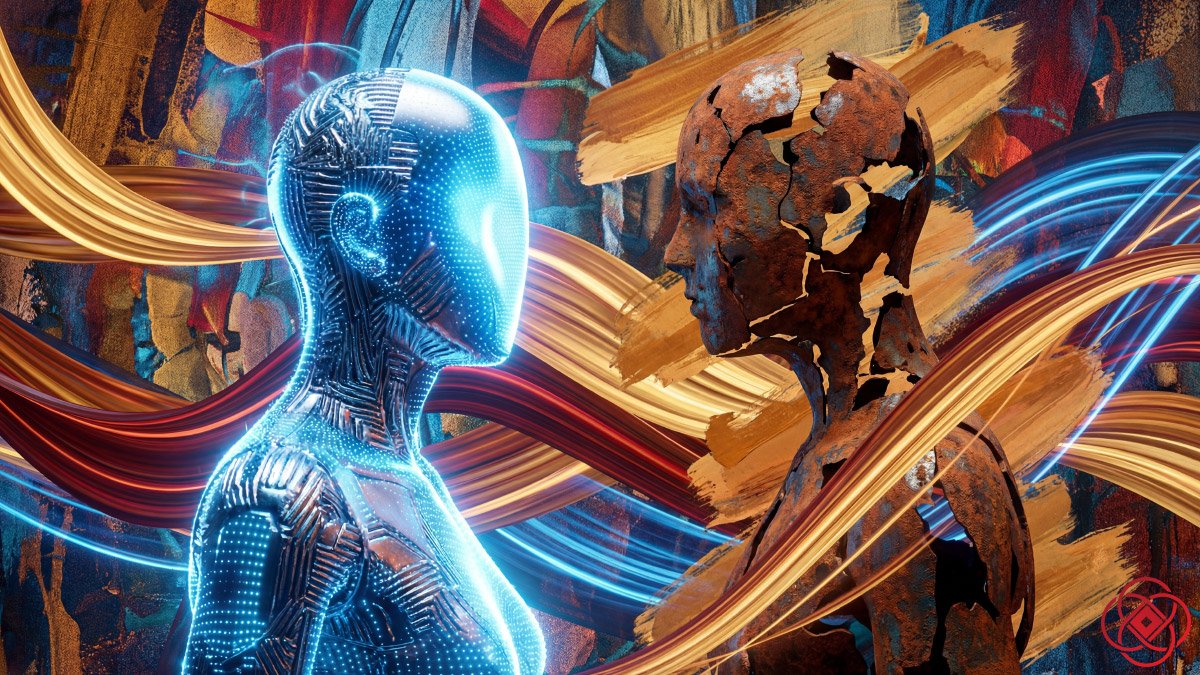
The real revelation isn’t whether AI has a soul. It’s what we learn about our own souls in the comparison.
When we look at AI art and feel nothing, or when we feel unsettled, or when we feel deceived—that reaction tells us something. It tells us that what we value in art isn’t just the final image. It’s the human struggle embedded in it. The late nights. The self-doubt. The breakthrough. The lived experience transformed into something visible.
James Bridle, in his explorations of non-human intelligence, suggests we’re asking the wrong questions entirely. We’re stuck in this binary: conscious or not conscious, soul or no soul. But consciousness might be a spectrum. Intelligence certainly is. And meaning? Meaning might be something we bring to art, not something inherent in it.
Why Human Creativity Gets More Valuable
Here’s what the Stoics would say: Stop worrying about whether the machine has a soul. Worry about whether you’re using yours.
Because in the age of AI art, human creativity becomes more valuable, not less. The very things machines can’t do—suffer, hope, yearn, transform pain into beauty—these become the defining features of art that matters. AI has accidentally given us the greatest gift: a mirror that shows us exactly what makes us irreplaceable.
The Better Question
The question was never “Does AI art have a soul?” The question is: “Will we recognize and honor the soul in human art now that we can see the difference?”
Every time you choose to create something—imperfect, personal, marked by your specific suffering and joy—you’re answering that question. You’re voting for what kind of world you want to live in. One where efficiency and output reign supreme, or one where the messy, inefficient, gloriously human process of making meaning still matters.
The machines can simulate a lot of things. But they can’t simulate caring about the answer to that question.
That’s your soul talking. Listen to it.
Frequently Asked Questions
What is this essay actually asking?
Not whether machines have souls. Its argument is that the comparison is a mirror — what we notice missing in AI output tells us what we were actually valuing in human work, which we had mostly stopped articulating.
What is the philosophical objection to AI creativity?
Harvard philosopher Sean Dorrance Kelly's position, quoted here: AI can simulate creation but not perform it. The essay's own analogy is the difference between understanding a joke and reciting one you memorized — one comes from somewhere, the other is pattern recognition in good clothes.
Does the essay accept that objection?
Not cleanly, and that is its most interesting move. It concedes that most human art also comes from training, copying masters, trial and error and pattern recognition — done with wetware rather than hardware. The easy answer is not allowed to stand.
Where do the Stoics come into it?
Through intention. Marcus Aurelius wrote the Meditations for himself, not for readers, so the value was in the practice rather than the product. Applied here, the question about an AI image is not how good it looks but where the intention, the struggle and the sacrifice were.
What does it conclude?
That the useful question is whether we will recognize and honour what is human in art now that the contrast makes it visible. It is a philosophical essay, not a claim about what models can or cannot do technically.