Brain-Computer Interface Art Explained
Todd Brooks, Founderupdated July 22, 202611 min read
Jump to a section10
TL;DR
- What it is: Artists use EEG sensors to translate brain activity into digital paintings, creating artwork directly from neural signals without physical tools.
- Who it's for: Artists exploring consciousness and creativity, researchers studying neural control, and anyone curious about the intersection of mind and technology.
- How it works: Machine learning algorithms map electrical brain patterns to artistic variables—focus intensity, mental states, and imagined movements become colors, textures, and forms.
- Bottom line: BCI art reveals that creative control is a collaboration between conscious intention and unconscious neural processes you can influence but never fully command.
What Is Brain-Computer Interface Art?
Brain-computer interface art explained: it's a creative practice where artists use electroencephalography (EEG) sensors to detect brain activity and translate neural signals into digital visuals in real time. The technology maps electrical patterns from millions of neurons to artistic variables like color, texture, and movement, allowing thought to directly shape visual output without brushes, styluses, or physical gestures.
Best for: Artists and researchers exploring the boundaries between consciousness, creativity, and control.
Not ideal for: Those seeking precise, fully controllable creative tools or photorealistic rendering.
Fast takeaway: Your brain paints best when your conscious mind lets go.
She's painting with her mind. Literally.
No brush glides across canvas. No stylus traces digital paths. Just pure thought, translated into color and form. Electrodes rest quietly against her scalp, listening to the electrical symphony of her brain. Software processes these neural signals and transforms them into brushstrokes on a digital canvas. She thinks "blue" and cobalt spreads across the screen. She imagines flowing movement, and the paint seems to dance.
This is brain-computer interface art, and it's quietly revolutionizing our understanding of consciousness, creativity, and control.
How Thoughts Become Art
The technology sounds like science fiction, but it builds on decades of established neuroscience. Electroencephalography (EEG) sensors detect the tiny electrical changes on your scalp produced by millions of neurons firing in coordinated patterns. These raw signals are noisy and chaotic on their own, but machine learning algorithms can be trained to recognize consistent signatures within the electrical storm.
The system learns that this particular pattern tends to emerge when you're imagining movement. This signature appears during intense concentration. This rhythm indicates a state of relaxed, open attention. Once these neural fingerprints are mapped, they can be linked to artistic variables.
Focus intensely, and thick, bold strokes appear on screen. Let your mind drift into a meditative state, and soft, watercolor-like textures emerge. Engage specific mental tasks—like imagining colors or movement—and watch the palette shift or forms flow across the digital canvas.
The first time you experience this, it feels genuinely magical. You think, and reality responds. Your most private mental states become visible, external facts. The boundary between "inside your head" and "out in the world" seems to dissolve entirely.
Then something unsettling happens.
Watch the quick explainer below:
When Your Brain Doesn't Obey Your Mind
You begin to notice the gaps. The system doesn't quite do what you consciously intend. You think "red" but get orange. You imagine a smooth curve, but jagged lines appear. You try to will a specific effect, and the output stubbornly refuses to cooperate.
The interface is absolutely responding to your brain activity—it's just not responding cleanly to your conscious intentions.
This reveals something profound: EEG-based systems don't read "thoughts" in the way we usually understand them. They can't decode your internal monologue or know you're remembering your childhood bedroom. Instead, they detect electrical patterns emerging from the complex dance of millions of neurons—some related to what you're consciously doing, much of it operating entirely outside your awareness.
Your brain is constantly buzzing with activity: sensory processing you never notice, background maintenance that keeps memory and perception running, automatic emotional responses, spontaneous neural fluctuations that may never reach consciousness. When you "paint with your mind," the system sees all of it—the whole electrical storm, not just the lightning bolts of conscious thought.
So whose art is it, really? The "you" that forms sentences and makes decisions? Or the vastly larger neural system humming quietly in the background?
Learning to Control What You Can't Control
Artists who work with brain-computer interfaces describe a learning curve unlike any other creative tool. When you master a traditional instrument—a paintbrush, a piano, a camera—you develop precision through repetition. Your body learns to translate conscious intention into physical action with increasing accuracy.
BCI art works almost in reverse.
The more you try to force specific outcomes, the more erratic and uncooperative the system becomes. The harder you grip for control, the more the output drifts from your intentions. Artists who persist with the technology eventually discover a counterintuitive strategy: you have to let go.
Set a gentle intention, then step back. Stop micromanaging every neural impulse. Allow whatever wants to emerge to simply appear.
One artist described it as "learning to think without thinking." Another said it felt like "watching my brain paint while I observe from the sidelines." The conscious self shifts from director to witness, watching creative processes unfold in neural territories it cannot directly govern.
What Neuroscience Reveals About Creative Control
This subjective experience aligns with what researchers are discovering in laboratories around the world. Neuroscientists collaborating with BCI artists consistently find that the brain activity producing the most compelling artwork differs markedly from the patterns recorded when artists are consciously straining for specific results.
The most successful sessions tend to emerge from states of relaxed, open attention—where the conscious mind establishes a broad direction, then allows deeper processes to take over.
This matches broader research on creativity and what neuroscientists call "flow states." Studies using brain imaging have repeatedly implicated networks involved in internally generated thought—often grouped under the term "default mode network (opens in a new tab)"—in creative tasks like brainstorming and artistic ideation. These networks become most active during mind-wandering and daydreaming, when you're not focused on external goals.
Critically, you cannot consciously activate these creative networks. Trying to force them into action tends to suppress them, because goal-directed thinking engages competing neural systems that work against spontaneous idea generation.
BCI art makes this neuroscientific paradox viscerally real. To guide your brain's creative output, you must release the very control you came seeking. The technology doesn't just tell you this—it shows you, stroke by digital stroke, the difference between forcing and allowing.
When Multiple Minds Paint Together
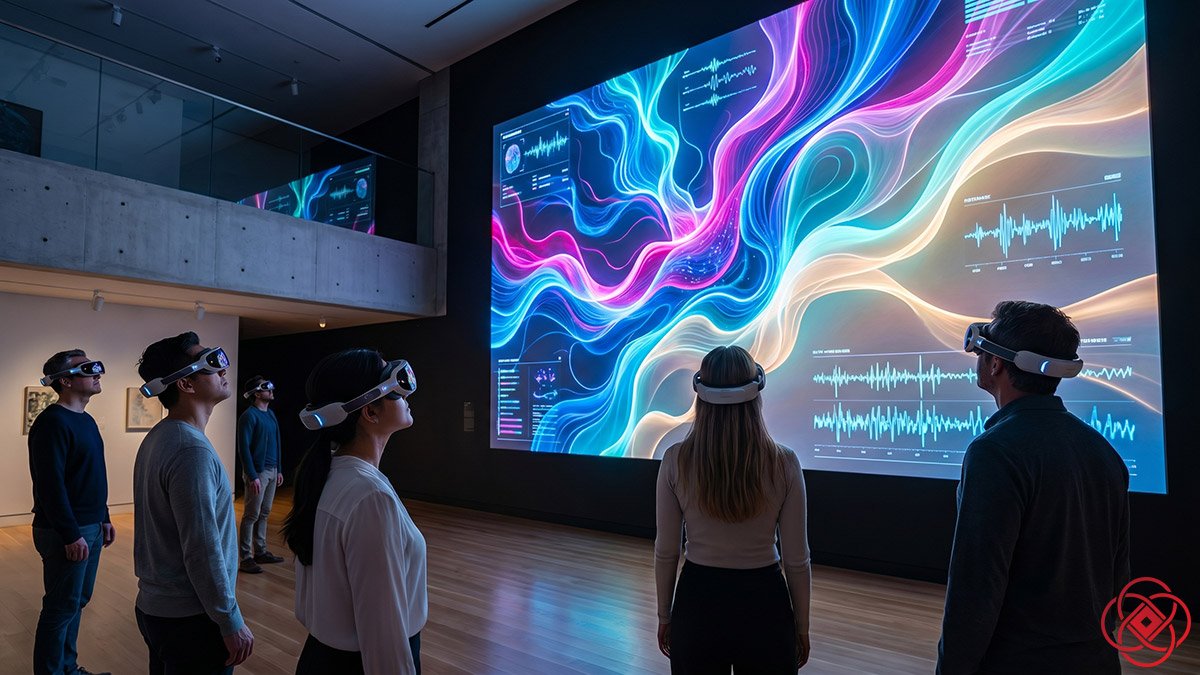
Some artists are pushing the technology further, creating collective installations where multiple people's brain activity combines in real time to generate shared artworks. These experiments produce genuinely emergent results—no individual controls the outcome, yet everyone influences it. The visuals become a live map of collective neural activity, a window into what happens when separate minds attempt to coordinate without words.
The patterns that emerge are extraordinary. Sometimes the group synchronizes, their brain waves moving in rough harmony, and coherent, flowing forms appear on screen. Other times, individual neural patterns clash, creating digital chaos and fractured imagery. Occasionally, something materializes that no single person intended, yet feels mysteriously meaningful to everyone watching.
It's like seeing the social nature of human consciousness made visible. We know from decades of research that individual brains are profoundly shaped by their relationships with other brains—that we are, at the biological level, wired for connection and mutual influence. Collective BCI art makes this literal: your neural activity is measurably affecting others and being affected by theirs, mediated through technology in real time.
But these installations also highlight the limits of that connection. Even when participants are synchronized—even when their brain waves are moving together—each person experiences something entirely different. You can see the same colors flowing across the shared screen, but you cannot access what it feels like to be the person beside you, generating those patterns from their unique neural architecture, their particular history, their private inner world.
The Stubborn Privacy of Experience
This points to a crucial distinction that BCI art makes impossible to ignore: while brain activity can be measured, shared, and visualized, the subjective experience of consciousness—what philosophers call "qualia (opens in a new tab)"—remains fundamentally private.
Brain-computer interfaces can turn neural activity into spectacle, but they cannot let you inhabit another person's inner life. Even if future technology develops far more precise ways to decode neural signals, we still don't know whether that would ever allow genuine sharing of experience, rather than just more detailed correlations and predictions.
Some researchers argue that if we could fully map the information structure of brain activity, we might eventually reconstruct aspects of subjective experience in shareable ways. Others remain skeptical, noting that every technological advance has given us better models and correlations, but never direct access to anyone else's felt experience.
BCI art doesn't resolve this debate, but it dramatizes the puzzle beautifully: thought can be made visible, but the inner feel of thinking remains locked away.
Where Agency Actually Lives
For artists working in this space, the most profound discovery isn't about decoding colors from brainwaves or synchronizing with other people. It's about agency itself—who or what is actually acting when you act.
Over and over, they encounter the same unsettling realization: the boundary between conscious intention and automatic process is far blurrier than they assumed. Some aspects of their creative work clearly connect to deliberate choices. Other aspects arise from opaque, unconscious processes they can neither see nor directly influence. The border between these two territories shifts constantly and unpredictably.
The brain-computer interface makes this visible in ways few other tools can. You watch your neural system produce forms you never consciously chose. You notice that your best work emerges when your sense of actively "trying" fades into the background. You see, in real time, the gap between what you meant to create and what actually appears.
This doesn't mean free will is an illusion or that you're just a passenger in your own life. But it does suggest a more nuanced picture: the "self" that narrates your experience and claims ownership of decisions is part of a much larger, more complex system. That system includes learned patterns, emotional responses, and spontaneous activity that never passes through deliberate thought. What you experience as "deciding" may often be your conscious mind taking partial credit for a distributed process involving multiple neural networks operating largely outside awareness.
The Art of Letting Go
How you respond to this depends partly on how tightly you need to control every aspect of your creative process. If you require the feeling that every mark comes from direct conscious command, BCI art can be disturbing. It highlights all the places where that story breaks down.
But many artists find something liberating in the technology. Once you accept that you don't fully control how ideas arise, that creativity emerges from processes you can influence but not command, a different kind of creative relationship becomes possible.
Instead of issuing orders to your brain, you learn to set intentions and create conditions. Rather than forcing specific outcomes, you shape the environment and allow possibilities to emerge. You treat your neural system less like a machine to be driven and more like a creative partner to be listened to.
In practice, this often means deciding on general directions—mood, color families, emotional tone—then allowing your broader neural system to generate possibilities without constant conscious interference. The final artwork may not match your original mental blueprint, but it reflects something more honest: what your complete nervous system produces when it's not being overruled at every step.
The Canvas Doesn't Judge
A digital canvas doesn't distinguish between marks produced by careful conscious intention and those triggered by unconscious neural fluctuations. It simply records whatever signals reach it, reflecting patterns without judgment about their source.
In that space between intention and outcome—between what you meant and what actually happened—something genuinely interesting emerges. Neither fully controlled nor entirely random, but a collaboration between the narrator in your head and the vast, largely silent neural processes that support it.
Brain-computer art serves as a mirror, reflecting not your face but your cognitive architecture. It reveals a basic truth that technology is making harder to ignore: "you" are not a single, unified entity steering the ship with perfect authority. You're a dynamic collection of processes—some conscious, many not—temporarily coordinated into something that feels like a person.
When your thoughts paint the canvas, you get to watch that coordination in real time. You see the interplay between intention and emergence, control and surrender, the self you think you are and the vastly larger neural system you actually inhabit.
Whose thoughts are painting, really? That depends on what you mean by "who."
You can think your way toward an answer. Or you can put on the electrodes, stop trying so hard to be in charge, and see what wants to appear.
The canvas is waiting. Your brain is ready to paint.
The only question is whether you're prepared to discover what that really means.
Should You Explore BCI Art?
Use it if: You're curious about consciousness, comfortable with uncertainty, and interested in creative processes that challenge traditional notions of control and authorship.
Skip it if: You need precise, predictable creative tools or prefer maintaining the illusion of complete conscious control over your artistic output.
Best first step: Research accessible EEG headsets designed for creative applications, explore emerging BCI art installations (opens in a new tab), or connect with artists already working in the space to understand the learning curve.
FAQ
What is brain-computer interface art in simple terms?
Brain-computer interface art uses EEG sensors to detect electrical brain activity and translates those neural signals into digital visuals in real time. Artists "paint" by thinking—mental states like focus, relaxation, or imagined movement become colors, textures, and forms on screen without any physical tools.
How does BCI art differ from traditional digital art?
Traditional digital art relies on physical input devices you consciously control with learned muscle movements. BCI art responds directly to brain activity, including unconscious neural processes. The result is less predictable and requires learning to guide rather than command your creative output.
Can anyone create BCI art, or do you need special training?
Anyone can start with consumer-grade EEG headsets, but creating meaningful BCI art requires practice. The learning curve involves developing awareness of your mental states and learning to work with—rather than against—unconscious neural processes. Most artists report weeks or months before feeling comfortable with the medium.
What equipment do you need to start making BCI art?
You need an EEG headset with decent signal quality, compatible software that maps brain signals to visual output, and a computer capable of processing real-time data. Entry-level consumer headsets start around $200-$500, while research-grade equipment costs significantly more but offers better signal precision.
Does BCI art reveal my private thoughts to others?
No. EEG-based systems detect broad patterns of electrical activity, not specific thoughts or memories. The technology can map general mental states like focus or relaxation to artistic variables, but it cannot decode your internal monologue, personal memories, or detailed conscious intentions.
Why is it harder to control BCI art than a paintbrush?
Physical tools respond directly to learned muscle movements you can consciously refine through practice. BCI systems respond to overall brain activity, much of which operates outside conscious awareness. The more you try to force specific outcomes, the more competing neural activity interferes—making "letting go" paradoxically more effective than tight control.