Why Post-Internet and Post-Digital Aren't the Same Thing
Todd Brooks, Founderupdated July 23, 202612 min read
In short
An essay separating two terms people conflate: post-internet art knows it is digital and comments on that from inside, while post-digital work stops treating digital as a separate category at all. The distinction is about whether you still remember the boundary — which is why it reads as a claim about consciousness rather than about aesthetics.
Jump to a section12
- The Birth of Post-Internet Art
- When Infrastructure Becomes Invisible
- Two Different Relationships to Reality
- Consciousness and Adaptation
- Examples from the Art World
- The Philosophical Implications
- Finding Humanity in Computational Existence
- Capitulation or Honesty?
- The Post-Digital Project
- Weird and Hybrid: Post-Digital Aesthetics
- Where Do You Stand?
- Frequently Asked Questions (FAQ)
There's a moment in technological adoption when the shock wears off. When the new stops being new. When what was revolutionary becomes infrastructure. That moment has a name, or rather, it has two names that people keep confusing: post-internet and post-digital.
They're not the same thing. And the difference tells you everything about where consciousness is heading.
The Birth of Post-Internet Art
Post-internet art emerged in the 2000s, when artists realized the internet wasn't a separate space anymore. It wasn't something you "went on." It was the environment. The air you breathed. Your social life, your work, your relationships—all fundamentally mediated by networks you couldn't opt out of.
Artists like Jon Rafman (opens in a new tab), Amalia Ulman (opens in a new tab), and Hito Steyerl (opens in a new tab) started making work that acknowledged this. Not art about the internet, but art that lived in the weird space where online and offline had become impossible to separate. Where your Instagram feed was as real as your physical experience. Where your digital identity mattered as much as your embodied one.
The key insight of post-internet art (opens in a new tab) was: The shock is over. Stop treating the internet as novel. Stop making art that points at digital culture from the outside. You're inside. Make art from that position.
When Infrastructure Becomes Invisible
But then something shifted. The internet became infrastructure so completely that it disappeared. Like electricity or plumbing, it faded into the background. Nobody talks about being "online" anymore—you just are. The distinction itself became meaningless.
That's when post-digital emerged. Not just accepting that digital is everywhere, but recognizing that the digital-physical distinction has collapsed entirely. There is no digital realm separate from physical reality. There's just reality, which happens to include computational layers.
The Stoics would recognize this pattern. Marcus Aurelius wrote about how we adapt to circumstances until they become our nature. How external changes eventually transform into internal realities. The internet was external—a tool we used. Then it became internal—part of how we think, relate, exist. The transition from post-internet to post-digital is that internalization becoming complete.
Two Different Relationships to Reality
Post-internet art is about navigating a world saturated with digital culture. Post-digital art is about what happens after you stop distinguishing digital from non-digital at all.
Look at the aesthetics. Post-internet art often has this knowing, ironic quality. It's aware of being digital. It references meme culture, glitch aesthetics, the specific visual languages of online platforms. It's smart about digital culture—commenting on it, playing with it, revealing its contradictions.
Post-digital art doesn't have that ironic distance. It's not commenting on digital culture because it doesn't see digital culture as separate from culture. It just makes work that assumes computational reality as baseline. Not celebrating it, not critiquing it, just operating within it as the new normal.
Consciousness and Adaptation
This matters for consciousness because it represents different relationships to technology. Post-internet consciousness is still negotiating the digital-physical split. Still aware of the tension. Still able to remember when things were different. It's adaptation, but adaptation that knows it's adapting.
Post-digital consciousness has completed the adaptation. It doesn't remember the before. Or if it does, that memory is academic, not felt. The computational layer is just how reality works. Like asking a fish to comment on water—it doesn't have the outside perspective necessary for commentary.
Epictetus taught that we should accept what we can't change and focus on our responses. Post-internet art is still responding—to digital culture, to algorithmic life, to networked existence. Post-digital art has accepted. It's moved past response into inhabitation.
Examples from the Art World
You can see this in specific artists. Rafman's work is clearly post-internet—he's excavating Google Street View, finding accidental poetry in surveillance infrastructure, showing us the weird sublime of digital detritus. He's commenting. Revealing. Showing us ourselves through the lens of digital systems.
Compare that to contemporary artists working with AI, biofeedback, or hybrid physical-digital installations. They're not commenting on the digital. They're using computational tools as naturally as earlier artists used paint. The medium isn't the message because the medium is just reality now.
The Philosophical Implications
This shift has philosophical implications. Post-internet thought maintains a kind of critical distance. It can still ask "What is the internet doing to us?" because it remembers an us that existed before the internet. It can critique digital culture because it has a non-digital perspective to critique from.
Post-digital thought has lost that distance. Not because it's uncritical, but because the critical framework itself is computational. You can't step outside the system to critique it when the system is constitutive of thought itself. You can only work within it, making whatever space for agency and meaning you can find inside computational reality.
Marcus Aurelius understood this about empire. He couldn't step outside being emperor. That was his reality. He couldn't critique empire from some neutral position—he could only try to be a good emperor from within the constraints of empire. His philosophy was about finding freedom inside unfreedom, meaning inside systems he couldn't escape.
Finding Humanity in Computational Existence
Post-digital consciousness is similar. You can't escape computational reality. You can only learn to live within it wisely or foolishly. The question isn't "How do we resist the digital?" but "How do we maintain humanity inside computational existence?"
This is why the aesthetics differ. Post-internet art often has this oppositional quality—it's showing you the weirdness, the violence, the absurdity of digital culture. It wants you to see what's happening so you can resist it, or at least be aware of it.
Post-digital art doesn't bother with resistance. Not because it's complacent, but because resistance implies an outside to resist from. There is no outside. There's only inside, and the question of how to be human there.
Capitulation or Honesty?
Some critics argue post-digital is just capitulation. That it's given up on critique. That by accepting computational reality as baseline, it's surrendered the possibility of imagining alternatives.
Others argue it's more honest. That post-internet art's critical distance was always partly illusory—you can't really stand outside the system you're embedded in. Post-digital just admits what was always true: We're inside. We've always been inside. The question is what we do from here.
The Stoics would probably side with post-digital. They were big on accepting reality as it is rather than as you wish it were. They didn't waste energy resisting the unchangeable. They focused on what was actually in their power—their judgments, their responses, their character.
If computational reality is unchangeable—and it seems to be—then the Stoic response is acceptance. Not passive acceptance, but active engagement with reality as it actually is. Finding freedom within constraints. Creating meaning inside systems you didn't choose.
The Post-Digital Project
That's the post-digital project. Not resisting the digital, but figuring out how to be fully human within it. Not mourning the past, but building the future from the materials available, which happen to be computational.
For artists, this means different things than it does for theorists. Artists are making physical objects, staging embodied experiences, creating spaces for human encounter—all while acknowledging that computation is part of the substrate of these experiences. Not the enemy of the physical, but interwoven with it.
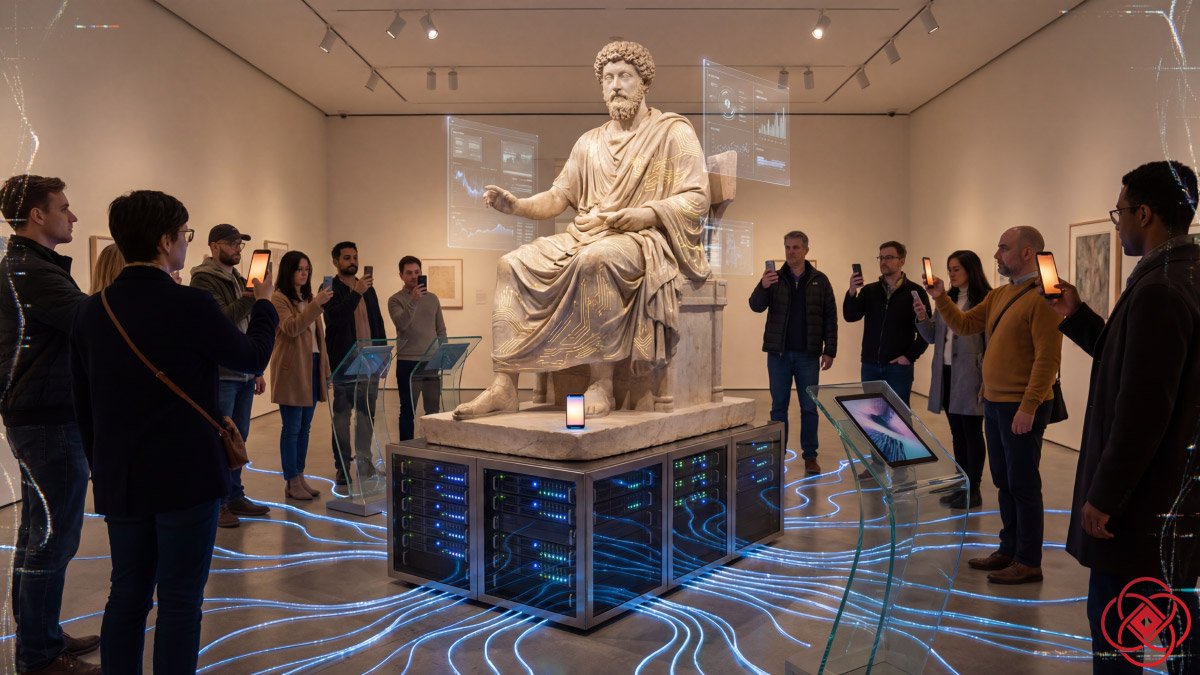
Gallery spaces have Wi-Fi. Bodies have smartphones. Physical presence is documented digitally and shared on networks. The experience isn't purely physical or purely digital—it's both, inseparably. That's the post-digital condition.
Weird and Hybrid: Post-Digital Aesthetics
And the art that emerges from this condition is weird and hybrid. Sculptures that incorporate screens. Paintings that exist simultaneously as physical objects and NFTs. Performances designed to work both in-person and streaming. Installations that respond to your biometric data in real-time.
None of this makes sense from a pre-digital framework. It barely makes sense from a post-internet framework. But from a post-digital perspective, it's just art. Using the materials and possibilities available. No more strange than oil painting was when it first emerged.
Epictetus taught that we should use what's available to us. That we don't get to choose our circumstances, only our responses. Post-digital artists are doing exactly this—making art with the reality they have, which is computational, networked, hybrid.
Where Do You Stand?
The question for everyone else is: Are you still post-internet, trying to maintain critical distance from the digital? Or are you post-digital, accepting that the digital-physical distinction is over and the question is what you build from that recognition?
There's no wrong answer. But there's definitely a difference. Post-internet consciousness is still negotiating. Still aware of the transition. Still able to imagine digital-less existence as a meaningful possibility.
Post-digital consciousness has moved on. The transition is complete. Digital-less existence isn't a possibility, it's a fantasy. The question isn't whether to engage with computational reality but how.
Marcus Aurelius accepted that he was emperor. He didn't waste time wishing he wasn't. He focused on being the best emperor he could be given the reality he inhabited. That's the post-digital stance.
Where are you? Still post-internet, maintaining awareness of the distinction? Or already post-digital, operating from inside computational reality as the only reality there is?
The art you make, the way you think, the consciousness you develop—it all depends on the answer.
Welcome to after the shock. Whatever that means for you.
Frequently Asked Questions (FAQ)
What is the difference between post-internet and post-digital?
Post-internet art emerged in the 2000s when artists realized the internet wasn't a separate space anymore—it had become the environment itself. Post-internet consciousness is about navigating a world saturated with digital culture while maintaining awareness of the digital-physical distinction.
Post-digital, however, represents a more complete transformation where the digital-physical distinction has collapsed entirely. There is no digital realm separate from physical reality—there's just reality, which includes computational layers. Post-digital consciousness has completed the adaptation and no longer maintains critical distance from the digital because the critical framework itself is computational.
What is post-internet art?
Post-internet art emerged in the 2000s from artists like Jon Rafman, Amalia Ulman, and Hito Steyerl who recognized that the internet was no longer a separate space you 'went on' but had become the environment itself.
The key insight was: stop treating the internet as novel. Post-internet art is not about the internet, but art that lives in the weird space where online and offline have become impossible to separate. It acknowledges that your digital identity matters as much as your embodied one and often has a knowing, ironic quality that:
- Comments on digital culture
- References meme aesthetics and glitch aesthetics
- Reveals the contradictions of networked existence
- Maintains critical distance while acknowledging embeddedness
What is post-digital art and consciousness?
Post-digital art and consciousness represent the stage after the digital-physical distinction has collapsed completely. The internet has become infrastructure so completely that it disappeared—like electricity or plumbing, it faded into the background.
Post-digital art doesn't have the ironic distance of post-internet work because it doesn't see digital culture as separate from culture. It makes work that assumes computational reality as baseline—not celebrating it, not critiquing it, just operating within it as the new normal.
Post-digital consciousness has completed the adaptation and doesn't maintain critical distance because you can't step outside the system to critique it when the system is constitutive of thought itself.
How does Stoic philosophy relate to post-digital consciousness?
The Stoics, particularly Marcus Aurelius and Epictetus, would recognize the post-digital stance. They taught:
- Accepting reality as it is rather than as you wish it were
- Not wasting energy resisting the unchangeable
- Focusing on what's actually in your power
Marcus Aurelius understood he couldn't step outside being emperor—that was his reality. He could only try to be a good emperor from within those constraints. Similarly, post-digital consciousness recognizes you can't escape computational reality. You can only learn to live within it wisely.
The question isn't "How do we resist the digital?" but "How do we maintain humanity inside computational existence?" This is active engagement with reality as it is, finding freedom within constraints, creating meaning inside systems you didn't choose.
What are examples of post-internet vs post-digital artists?
Jon Rafman's work is clearly post-internet—he excavates Google Street View, finds accidental poetry in surveillance infrastructure, and shows us the weird sublime of digital detritus. He's commenting, revealing, showing us ourselves through the lens of digital systems.
In contrast, contemporary artists working with AI, biofeedback, or hybrid physical-digital installations represent post-digital work. They're not commenting on the digital—they're using computational tools as naturally as earlier artists used paint. The medium isn't the message because the medium is just reality now.
Post-digital artists make:
- Sculptures that incorporate screens
- Paintings that exist simultaneously as physical objects and NFTs
- Performances designed for both in-person and streaming
- Installations that respond to biometric data in real-time
Why does the distinction between post-internet and post-digital matter?
This distinction matters because it represents fundamentally different relationships to technology and consciousness.
Post-internet consciousness is still negotiating the digital-physical split, still aware of the tension, still able to remember when things were different. It maintains critical distance and can ask "What is the internet doing to us?"
Post-digital consciousness has completed the adaptation and operates from inside computational reality as the only reality there is.
This affects how we make art, how we think, and the consciousness we develop. The question shifts from whether to engage with computational reality to how we maintain humanity inside it. Understanding where you stand—post-internet or post-digital—shapes your entire approach to technology, creativity, and existence.
Is post-digital consciousness just capitulation to technology?
Some critics argue post-digital is capitulation—that by accepting computational reality as baseline, it surrenders the possibility of imagining alternatives. However, others argue it's more honest.
Post-internet art's critical distance was always partly illusory—you can't really stand outside the system you're embedded in. Post-digital just admits what was always true: we're inside, we've always been inside. The question is what we do from here.
It's not passive acceptance but active engagement with reality as it actually is, finding freedom within constraints. If computational reality is unchangeable, the Stoic response is acceptance while focusing on what's in our power—our judgments, responses, and character. It's about figuring out how to be fully human within computational existence, not resisting it.
What does post-digital art look like aesthetically?
Post-digital art is weird and hybrid, reflecting the inseparable nature of physical and digital reality. It includes:
- Sculptures that incorporate screens
- Paintings that exist simultaneously as physical objects and NFTs
- Performances designed to work both in-person and streaming
- Installations that respond to biometric data in real-time
- Works that acknowledge gallery spaces have Wi-Fi and bodies have smartphones
Unlike post-internet art's knowing, ironic quality that references meme culture and glitch aesthetics, post-digital art doesn't maintain ironic distance. It doesn't bother with commentary or resistance because resistance implies an outside to resist from. There is no outside—only inside, and the question of how to be human there.
It's art using the materials and possibilities available in computational reality.
What is the post-digital condition?
The post-digital condition is when the digital has become so ubiquitous that the digital-physical distinction is meaningless. Nobody talks about being 'online' anymore—you just are. The distinction itself has collapsed.
Physical presence is documented digitally and shared on networks. Experiences aren't purely physical or purely digital—they're both, inseparably. Gallery spaces have Wi-Fi, bodies have smartphones, and computational layers are interwoven with physical reality, not the enemy of it.
It's reality that happens to include computation as a fundamental substrate. The post-digital condition means accepting this as baseline and focusing on how to build meaningful human experiences within this hybrid reality rather than resisting or critiquing it from an imagined outside position.
How do I know if I'm post-internet or post-digital?
Ask yourself these questions:
- Are you still negotiating the digital-physical split?
- Are you aware of the distinction between online and offline?
- Can you imagine digital-less existence as a meaningful possibility?
- Do you maintain critical distance from digital culture and ask "What is the internet doing to us?"
If yes, you're likely post-internet—still adapting, still aware of the transition.
Post-digital consciousness has moved on. The transition is complete. You don't distinguish digital from non-digital at all. Digital-less existence isn't a possibility, it's a fantasy. You operate from inside computational reality as the only reality there is. The question isn't whether to engage with computational reality but how.
Like Marcus Aurelius accepting he was emperor and focusing on being the best emperor he could be—that's the post-digital stance.