How to Write a Freelance Proposal That Gets a Yes
RedHub AI Editorialupdated October 7, 20267 min read
Jump to a section9
How to write a freelance proposal comes down to five jobs, done in order: open on the client's specific problem, show proof that matches this job, lay out an approach another bidder would not send, state the price plainly, and close with one clear next step. A proposal can do four of those well and still lose on the fifth. So the useful work before you send is finding the weak one. Rewriting the whole document rarely finds it.
TL;DR: A proposal has five jobs: a specific opening, proof that fits, a distinct approach, a plainly stated price, and one clear ask. Four deep dives cover the detail: why proposals get rejected, the proposal structure that works, the mistakes that cost you the job, and how to present the price. Before you send, the Proposal Quality Probe ($79) scores the draft on a five-criterion rubric and returns SUBMIT, REVISE, DO NOT SEND or START OVER. No rubric can promise the client says yes.
Why a proposal that looks fine still gets deleted
You wrote the proposal slowly, start to finish, weighing each sentence. The client will not read it that way. Picture a job post with a few dozen bids under it and a client going through them between meetings. That client is looking for three signals: this was written for me, this person understands the job, and I know what happens if I say yes.
A proposal with clean grammar and no typos can miss all three. That is why "write more" and "write better" are weak fixes. The repair is narrower: find the one signal that is missing and add it.
The five jobs a proposal has to do
Take away the formatting and the logo, and a proposal has five jobs.
- Open with something specific. "I'm excited about this opportunity" could go to anyone. A line that restates the client's actual problem, in their words, could only go to them.
- Show proof that fits. A portfolio link asks the client to do the sorting. Proof is the one past result or sample that maps onto this job.
- Take a distinct approach. If your process section could be pasted into a proposal for a different client, it is a template, and it reads like one.
- State the price plainly. One number, tied to the scope, said once. Not three options with no recommendation.
- End with one clear ask. A call, a start date or an agreement to sign. The client should not have to write back to find out which.
What each one looks like when it goes wrong is in why your proposals get rejected.
The order that carries all five
The same five sections read differently in a different order. Proof that arrives before the client knows which problem you are solving reads as bragging. A price that arrives before the approach reads as a quote, a number with nothing to judge it against. Opening, proof, approach, price, ask is the order where each section sets up the next one. The step-by-step version is in the freelance proposal structure that works.
The slips that undo good sections
A proposal can do all five jobs and still go out with the last client's name in paragraph two. These are execution slips, and they are a different problem from a weak section: a leftover detail from a copied draft, a price the client has to hunt for, a close that says "let me know if you have any questions" and nothing else. The recurring ones, with a quick fix for each, are in the proposal mistakes that cost you the job.
Presenting your price without guessing
Price is where a confident proposal often goes soft. The freelancer knows the number. What wobbles is how it is said: tucked into a paragraph, wrapped in an apology, or split into three tiers so the client has to choose for you. A hedged number reads as doubt, and the client cannot tell whether the doubt is about the price or the work.
The write-up on presentation is in how to present the price in a proposal without guessing.
What a good proposal cannot fix
Some rejections have nothing to do with the document. The budget was cut. The client's cousin does web design. They hired the first person who replied. You will rarely be told which, so a "no" by itself tells you very little about the proposal you sent.
That cuts both ways. It is a reason not to tear up a sound proposal after one loss, and it is also the excuse that lets a weak opening survive ten losses in a row. Checking the draft against a fixed standard, the same way every time, is how you separate the two. It still leaves the client's side of the decision out of view.
Score it before you send it
The Proposal Quality Probe ($79) is a companion to The AI Proposal System. You mark one proposal 1 to 5 on the book's five criteria: Opening Specificity, Proof Relevance, Approach Differentiation, Call to Action Clarity, and a Bot Risk Score, where you mark how many machine-generation signals the draft carries. Bot Risk runs the other way from the rest. A mark of 1 is clean and 5 is heavy, so it counts as 6 minus your mark. The five add up to a score out of 25.
Notice what the rubric leaves out. It has no price criterion, so it will not tell you whether your number is presented well, and it adds a check this guide's five jobs do not have. Four of its criteria line up with the opening, proof, approach and ask.
| Verdict | Score band | What can also put you here |
|---|---|---|
| SUBMIT | 20–25 | Nothing. It takes the band and no gate firing. |
| REVISE | 15–19 | Any one criterion below 3, even when the total is 20 or more |
| DO NOT SEND | 10–14 | A Bot Risk mark of 4 or 5, whatever the total |
| START OVER | 5–9 | Nothing. Only the total puts you here. |
The two gates can only lower a verdict. Mark a proposal 5 on all four content criteria and 4 on Bot Risk, and the total is 22 out of 25, well inside the SUBMIT band. The verdict is DO NOT SEND. Mark it 5, 5, 5 and a 2 for the call to action, with a clean Bot Risk mark of 1, and it also totals 22. That one reads REVISE, with Call to Action Clarity named as the thing to fix first.
The verdict comes from your own marks, so it is only as honest as they are. The Probe scores the proposal, not you as a writer, and it does not write the proposal for you. A SUBMIT means the draft cleared the rubric. It does not predict a yes.
Score one proposal before it goes out
The Proposal Quality Probe takes your five marks and returns the book's verdict: SUBMIT, REVISE, DO NOT SEND or START OVER. Where a criterion is short, it names the one to fix first. It ships as a Python engine with no dependencies and a workbook that reproduces it. It grades the draft you enter and guarantees no win.
Get the Proposal Quality Probe — $79Pairs well with
The Proposal Funnel Map ($79) looks at the whole pipeline instead of one proposal: you enter your own 30-day numbers (proposals sent, responses, interviews, wins) and it returns HEALTHY, LEAKING or BLEEDING and names the earliest stage that is below healthy. The Bid Sprint Drill ($69) scores six readiness controls for bidding fast on a fresh posting and returns READY, TIGHTEN or NOT SPRINT-READY. If the problem starts before any proposal is requested, with a first email nobody answers, the Cold Email Reply-Rate Optimizer ($39) scores A/B variants on positive reply rate.
More in this guide
What's the best way to open a freelance proposal?
Open with a line that restates the client's specific problem in their own words. "I'm excited about this opportunity" could go to any client. A line about their actual problem shows you read the brief.
How long should a freelance proposal be?
Long enough to do the five jobs: a specific opening, fitting proof, a distinct approach, a clear price and one ask. Past that, added length gives the client more to skim. Do not pad a proposal to look thorough.
Does a proposal template guarantee I'll win the job?
No. A sound structure and a clean score remove the problems you can fix. They do not control the client's budget, timing or other options, and a strong proposal sent to a bad-fit lead can still lose.
What's the biggest reason freelance proposals get rejected?
There is no single one you can name from outside. On the document's side, the checkable causes are a generic opening, mismatched proof, a templated approach, an unclear ask, or language that reads machine-generated. Each is covered in why your proposals get rejected.
How do I know if my proposal is ready to send?
Score it against a fixed rubric, because rereading your own draft gives you one overall impression. The Proposal Quality Probe ($79) takes your marks on five criteria and returns SUBMIT, REVISE, DO NOT SEND or START OVER and, where a criterion is short, the one to fix first.
Should I use AI to draft my proposal?
You can, and the draft needs a real edit before it goes out. The check is whether any line could be sent to a different client unchanged. In the Probe's rubric, a Bot Risk mark of 4 or 5 holds the proposal at DO NOT SEND whatever the other four criteria score.
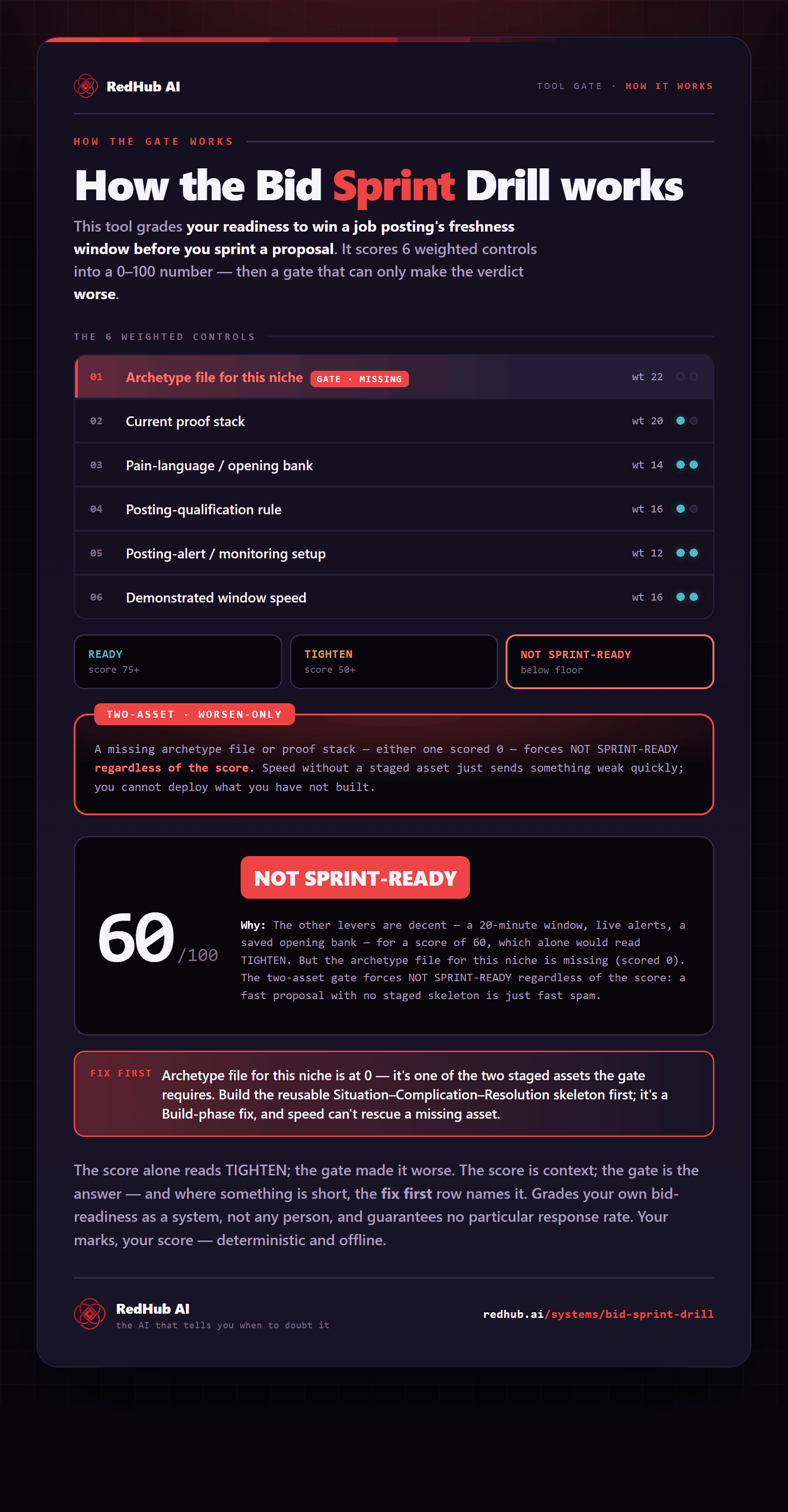
The gate this post refers to, drawn from the tool’s own logic. See the tool.