The Proposal Mistakes That Cost You the Job
RedHub AI Editorialupdated October 7, 20266 min read
Jump to a section5
Common proposal mistakes are small. The wrong client name left in from the last bid. A price buried mid-paragraph. A close that never says what happens next. AI phrasing nobody edited, and no final read before sending. None of these is a strategy problem, and each one can undo a proposal whose strategy is sound, because the client sees the slip before they see the thinking.
TL;DR: Five slips recur: leftover copy-paste details, a buried price, a vague close, unedited AI phrasing, and a skipped final read. Reading the draft out loud turns up the first three. It does not tell you whether your proof fits the job or whether the draft reads machine-generated. For that, the Proposal Quality Probe ($79) scores the proposal on a fixed five-criterion rubric. Start with the pillar: How to Write a Freelance Proposal That Gets a Yes.
A slip is a different problem from a weak section
A proposal can be weak in its bones: a generic opening, proof that does not match the job. That is covered in why your proposals get rejected. This post is about the other kind, the proposal that is strong and goes out with something small wrong in it. The two need different checks. A weak section needs a rewrite. A slip needs a sweep.
Five mistakes that keep showing up
1. Leftover details from a copy-paste
"Hi Dana" at the top of a proposal to a client named Marcus. A reference to "your Shopify store" sent to someone on a different platform. A deliverable this client never asked for. To the client, each one reads as proof the same document went to everyone.
The tempting lesson is "never reuse a proposal," and it is the wrong one. Reuse is how a busy freelancer answers a posting the same day, and a section that worked once is worth keeping. The reuse is fine. The unswept leftovers are the mistake.
2. A price that's hard to find
Some freelancers put the number in the middle of a paragraph, hoping it will land more gently there. It lands the same, only later, after the client has gone looking for it. Give the price its own line, tied to the scope you described. More on this in how to present the price in a proposal without guessing.
3. A close that doesn't say what happens next
"Let me know if you have any questions" hands the next step back to the client. It feels polite. It also means nothing happens until they invent one themselves. A working close names the action: a call on Thursday, a start date, an agreement to sign.
4. Unedited AI phrasing
Drafting a first pass with an AI tool is a reasonable way to start. Sending that pass untouched is the slip. An unedited draft tends to carry phrasing that fits any job and no detail beyond the posting, and a client who reads it that way has no way to know real thought went in. The edit that matters is specific: for each paragraph, ask whether it could be sent to a different client unchanged. If so, cut it or rewrite it around this job.
5. No final read before sending
This one gets skipped on exactly the proposals written against a deadline. A stray typo is the least of what it costs. The final read is the last point where the other slips can be caught, and skipping it sends the leftover name and the soft close out with everything else.
| Mistake | Why it's easy to miss | The quick fix |
|---|---|---|
| Copy-paste leftovers | You read for meaning and skip over names | Search the document for the last client's name, company and platform |
| Buried price | Softening it in a paragraph feels less awkward | Give it its own line, stated once |
| Vague close | Leaving the next step open feels polite | Name the action: call, start date or agreement |
| Unedited AI phrasing | It sounds fine on a quick read | Cut any paragraph that could go to a different client unchanged |
| Skipped final read | Deadline pressure, or "I know what it says" | Read it once, out loud, before you send |
What a read-through won't catch
Reading the draft aloud for five minutes is the cheapest check there is, and it suits the first three slips: your ear trips on the wrong name, the price you cannot find, the ending that trails off. It is much weaker on the fourth. Generic phrasing sounds smooth when spoken, which is part of why it survives.
It also cannot tell you whether your proof fits the job or whether your approach reads as distinct. Those are judgments against a standard. The Proposal Quality Probe ($79) has you mark a finished proposal 1 to 5 on five criteria, one of which is a Bot Risk Score for machine-generation signals. A Bot Risk mark of 4 or 5 holds the verdict at DO NOT SEND, whatever the other four criteria score. The Probe does not check names, typos or where the price sits. Those stay with the read-through.
Score the draft after the read-through
The Proposal Quality Probe scores one proposal on Opening Specificity, Proof Relevance, Approach Differentiation, Call to Action Clarity and Bot Risk, and returns SUBMIT, REVISE, DO NOT SEND or START OVER. Where a criterion is short, it names the one to fix first. The marks are yours. It grades the draft and does not predict a win.
Get the Proposal Quality Probe — $79Pairs well with
Most of these slips happen in a hurry, and the Bid Sprint Drill ($69) is about being prepared before the hurry starts: it scores six readiness controls for bidding fast on a fresh posting and returns READY, TIGHTEN or NOT SPRINT-READY. If the first email never gets a reply, the Cold Email Reply-Rate Optimizer ($39) scores A/B variants on positive reply rate. If the trouble starts earlier still, on the page that describes your offer, the AI Offer & Landing-Page Conversion Kit ($79) includes a claim-honesty linter that returns Launch, Tune or Rework.
More in this guide
What are the most common freelance proposal mistakes?
Leftover copy-paste details like the wrong client name, a price buried in a paragraph, a close that doesn't say what happens next, unedited AI phrasing, and a skipped final read. All five are avoidable, and all five turn up in proposals that are otherwise sound.
Is it a mistake to use AI to write a proposal?
Using AI for a first draft is not the mistake. Sending that draft without a real edit is. For each paragraph, ask whether it could go to a different client unchanged, and rewrite the ones that could.
Is it a mistake to reuse an old proposal?
No. Reusing sections that worked is how you reply quickly. The mistake is not sweeping the copy afterward. Search for the last client's name, company and platform before you send.
Why do small mistakes matter so much?
A client reading cold has only the page. A leftover name says the proposal was not written for them, and a soft close leaves them without a next step. You know what you meant; they don't.
Can proofreading catch all these mistakes?
It catches some: typos, a leftover name, a price that is hard to find. It is weak on generic phrasing, which sounds smooth read aloud, and it cannot tell you whether your proof matches the job.
How do I check a proposal before sending?
Read it aloud once, then score it against a fixed rubric for what a read-through misses. The Proposal Quality Probe ($79) takes your marks on five criteria, including Bot Risk, and, where a criterion is short, names the one to fix first.
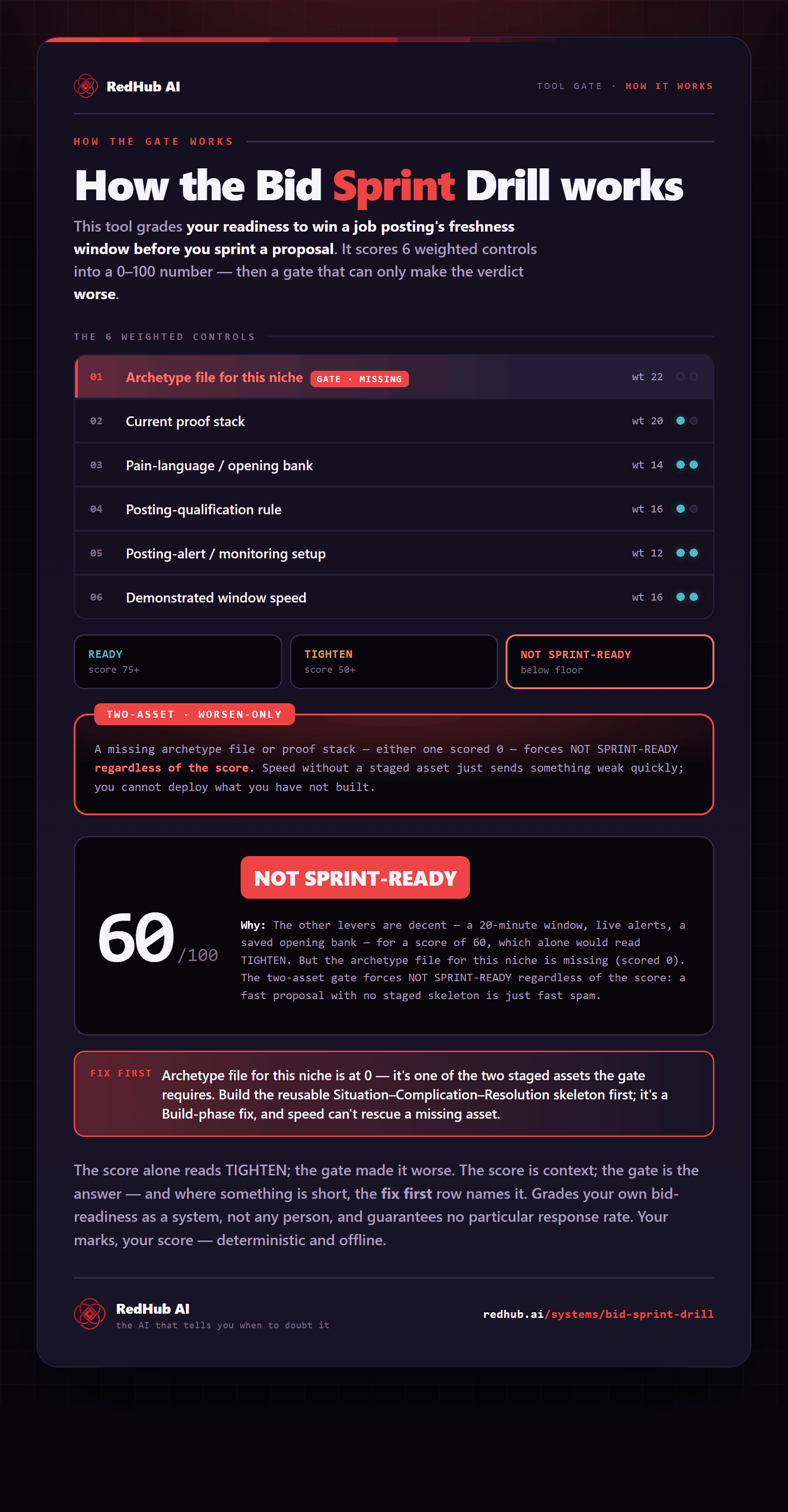
The gate this post refers to, drawn from the tool’s own logic. See the tool.