2-Way vs. 3-Way vs. 4-Way Matching: Which Does Your AP Need?
RedHub AI Editorialupdated October 5, 20265 min read

Jump to a section8
The choice between 2-way vs 3-way matching comes down to one document. 2-way matching checks the invoice against the purchase order. 3-way adds the receiving record, so you confirm the goods arrived before you pay for them. 4-way adds an inspection or acceptance record on top of that. Each extra document closes a gap and adds work. Pick the level by what can actually go wrong with a given kind of purchase, and expect to use more than one level in the same business.
TL;DR: 2-way = invoice vs PO. 3-way = invoice vs PO vs receipt. 4-way = adds an inspection or acceptance record. 2-way suits low-risk subscriptions and services, 3-way is the usual default for physical goods, and 4-way belongs where a delivery can arrive and still fail inspection. Services are the awkward case: they have no packing slip, but someone can still sign off that the work was done. The Invoice-PO-Receipt 3-Way Match ($79) automates the 3-way check. Part of the guide on 3-way matching.
The three levels side by side
| Level | Documents compared | Catches | Misses |
|---|---|---|---|
| 2-way | Invoice, PO | Wrong price, items nobody ordered | Short or missing deliveries |
| 3-way | Invoice, PO, receipt | All of the above, plus billing for more than arrived | Goods that arrived but are defective |
| 4-way | Invoice, PO, receipt, inspection record | All of the above, plus goods that failed inspection | Little, at the cost of the most process |
2-way matching: invoice vs PO
Two-way matching compares the invoice to the purchase order on item, quantity and price. It confirms you were billed for what you agreed to buy. It cannot confirm that anything showed up. That makes it a fair fit for spend where receipt is automatic or meaningless, such as a software subscription that is either running or not. The cost of that lightness is specific: an order for 200 label rolls with 150 delivered, billed for all 200, passes a 2-way check, because the invoice agrees with the PO line for line.
3-way matching: invoice vs PO vs receipt
Three-way adds the receiving record and closes that gap. The same 200-roll invoice now fails, because the receipt says 150. This is the usual default for businesses buying physical goods. It catches short deliveries billed in full, bills for goods that never arrived, and quantity padding. The added work is logging every receipt, promptly and accurately, because a 3-way match is only as good as the receiving record behind it.
4-way matching: adds inspection
Four-way adds an inspection or acceptance record confirming the goods passed a quality check, not just that they arrived. It matters where receiving and accepting are different events: manufacturing inputs, regulated materials, or equipment that can be delivered intact and still not work. Two hundred bolts can arrive on time, match the PO and fail a hardness test. Four-way stops payment on those. It is the most control and the most overhead, so most small and mid-size businesses keep it for the few categories where inspection matters.
Services do not fit the tidy rule
The common advice is 2-way for services, because there is no box to count. That advice skips a real gap. A contractor billing 40 hours for a website rebuild matches its PO perfectly under 2-way, whether the work was finished or not. You can 3-way match a service by treating a sign-off as the receipt: the person who owns the work records that it was delivered before the invoice is matched. The cost is that someone has to own that sign-off. For a monthly retainer with no clear deliverable, it is not obvious who that person is or what they are confirming, and each business answers that differently.
Mixing levels by category
One business rarely needs one level everywhere. A practical setup runs 2-way on subscriptions and low-value services, 3-way on physical goods and on services with a clear deliverable, and 4-way only on the categories that get inspected. Whichever level a category gets, every mismatch still needs a person to decide it. More documents catch more problems, and they also produce more exceptions to work, so budget the review time before you tighten a category. Our post on how to do a 3-way match walks the steps for the middle level.
Automate the level most businesses need
The Invoice-PO-Receipt 3-Way Match compares each invoice line with its PO and receipt and returns APPROVE, HOLD or BLOCK PAYMENT. It is a general AP match for any business paying vendors, services included. It does not run a quality inspection, so 4-way categories need their own acceptance record.
Get the Invoice-PO-Receipt 3-Way Match — $79Pairs well with
For manufacturers and distributors, the Manufacturing & Distribution Ops Pack ($89) includes a receiving discrepancy checker that flags shorts, overages, damage and price mismatches, plus a nonconformance report writer for the inspection side. Every level depends on reading the invoice correctly, which is the job of the AI Document Extraction Kit ($99). And when the month ends, the Finance & Reporting Automation Kit ($129) gives each tie-out one of three labels: Ties out, Review, or Does not reconcile.
More in this guide
What's the difference between 2-way and 3-way matching?
2-way compares the invoice to the purchase order, so it checks you were billed for what you agreed to buy. 3-way adds the receiving record, so it checks you were billed for what actually arrived. The extra document catches a short delivery billed in full.
What is 4-way matching?
It adds an inspection or acceptance record confirming the received goods passed a quality check. It is used where receiving is not the same as accepting: manufacturing inputs, regulated materials or equipment. It gives the most control and takes the most work.
Which matching level does my business need?
Match it to the risk. 2-way suits low-risk subscriptions and services, 3-way is the usual default for physical goods, and 4-way fits categories where inspection matters. Many businesses mix levels by category instead of applying one everywhere.
Can you 3-way match a service invoice?
Yes, if someone records that the work was delivered before the invoice is matched. That sign-off plays the role of the goods receipt. Without it, a 2-way check pays for unfinished work as readily as finished work.
Is 3-way matching always better than 2-way?
Not always. It is better where you pay for physical goods or a deliverable someone can confirm. For a subscription that is either on or off, 2-way can be the right, lighter choice.
Does a higher matching level remove the need for a human?
No. Every level produces exceptions a person has to judge, and more documents usually mean more exceptions. Software can do the comparisons at any level, but a person still decides each mismatch.
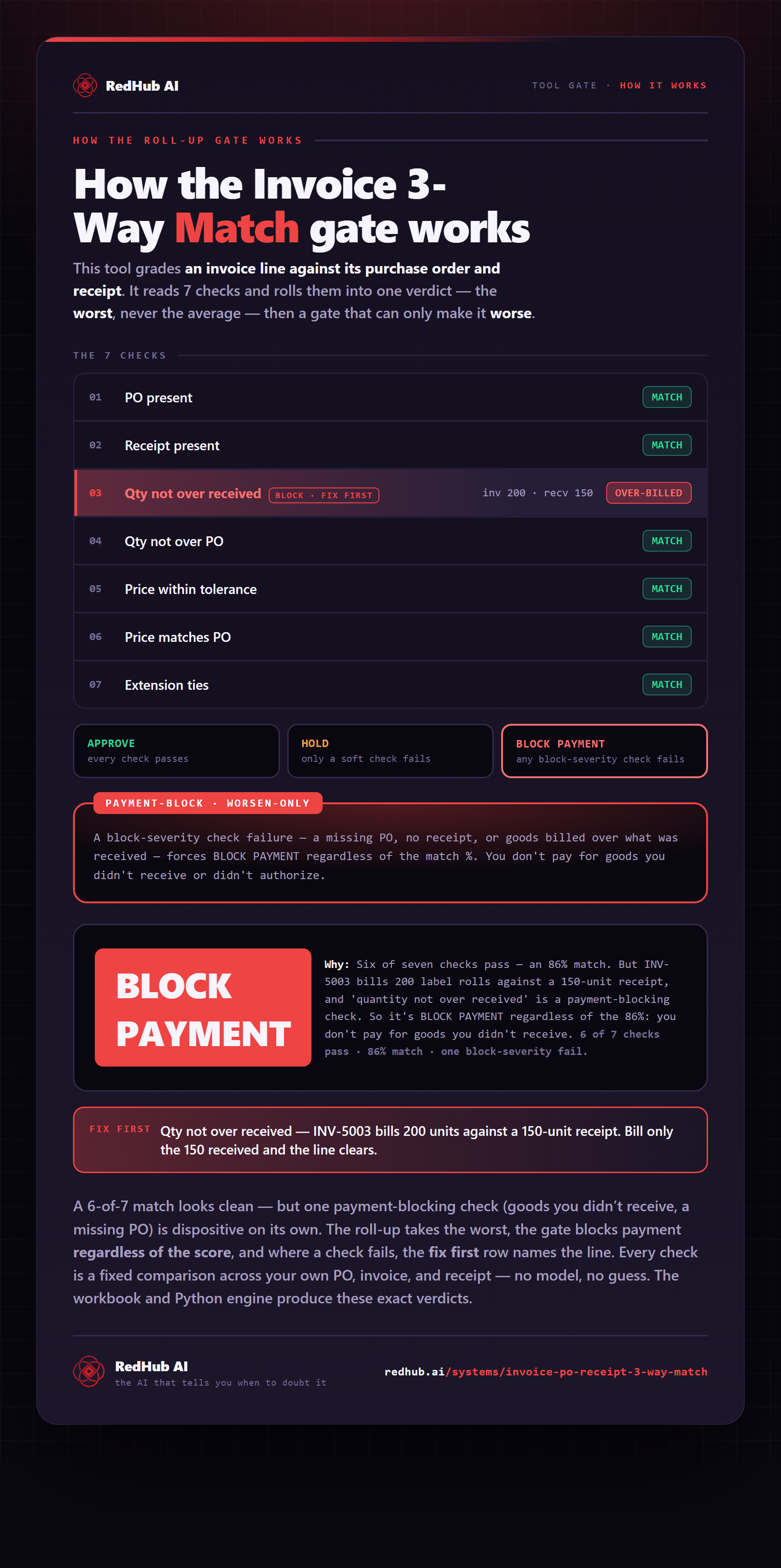
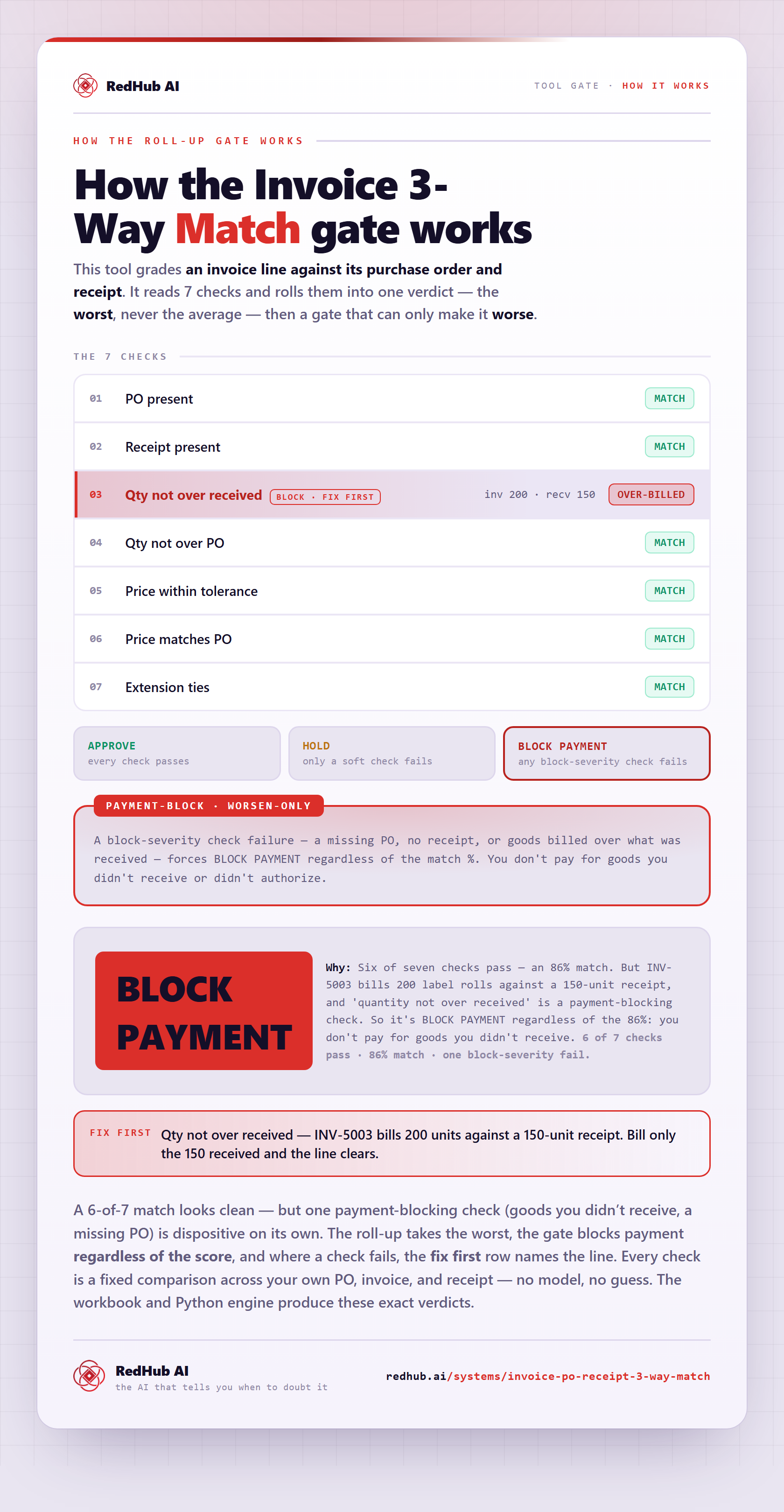
The gate this post refers to, drawn from the tool’s own logic. See the tool.