

⏱️ Read Time: 6 minutes
TL;DR: OpenClaw is an autonomous AI agent framework. Instead of waiting for prompts like a chatbot, an agent interprets goals, selects tools, uses memory, and runs in a continuous execution loop. That autonomy enables real work—but it also introduces unpredictability, security exposure, and cost volatility if you don’t design boundaries.
OpenClaw AI Agent Framework Explained
Most people misunderstand OpenClaw because they compare it to the wrong category of software.
They think it’s a chatbot with extra features, or a workflow tool with “AI” added on top. But OpenClaw sits in a different layer entirely. It’s a framework for building systems that can act—not just respond.
If you’re looking for the canonical series overview and why this matters, start here: What Is OpenClaw? Autonomous AI Agent Framework.
Watch the quick explainer below:
The Core Concept: Autonomy + Tools
An OpenClaw-style agent has one defining trait: it can connect language-model reasoning to real-world capabilities.
Instead of stopping after generating text, it can:
- Call APIs
- Read and write files
- Browse pages and extract information
- Send messages, create tickets, trigger workflows
That’s why agent frameworks feel so different. They turn “AI output” into “AI execution.”
How an Agent Actually Runs
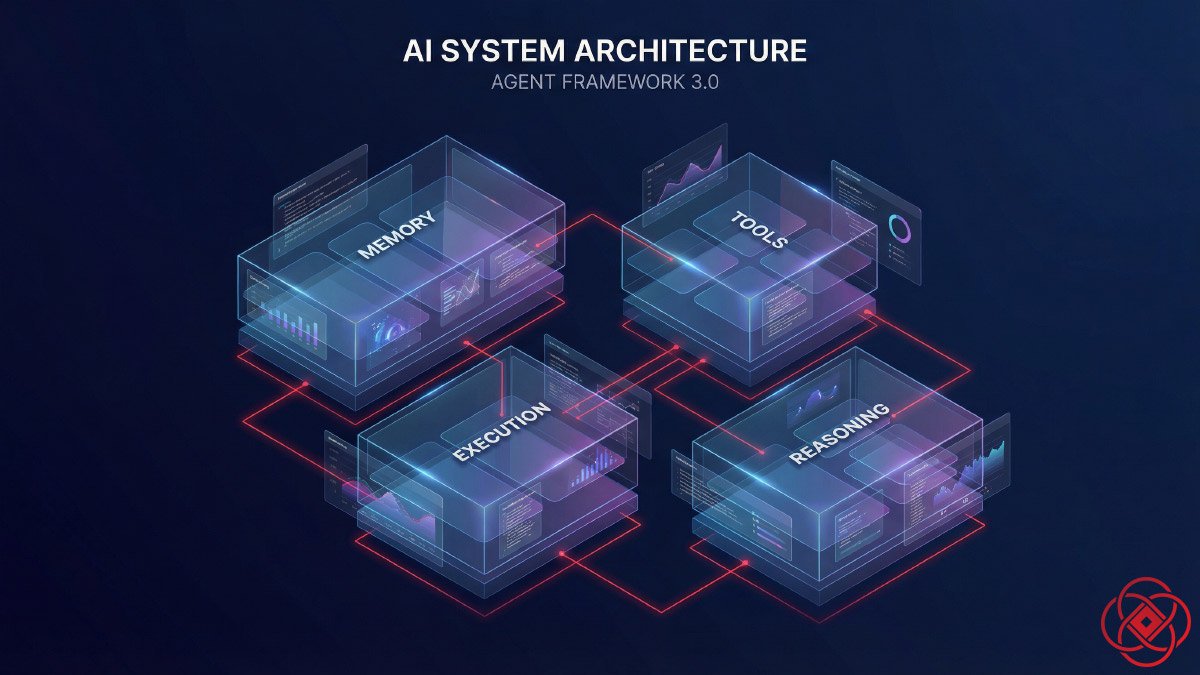
Most agent frameworks operate on a loop. The exact implementation varies, but the pattern is consistent.
At a high level, the agent repeatedly cycles through:
- Goal interpretation — What outcome am I trying to achieve?
- Planning — What steps seem necessary?
- Tool selection — Which capability should I use next?
- Execution — Run the action, collect the result
- Reflection — Did that move me closer to the goal?
- Continuation — Repeat until “done” (or until stopped)
In traditional software, “done” is deterministic. In agents, “done” is often interpreted, which becomes a critical design concern.
Memory: The Difference Between Sessions and Systems
Memory is what turns an interaction into an ongoing system.
A basic chatbot may remember context within a session, but an agent framework often persists memory across time—preferences, prior actions, previous outcomes, and operational context.
This enables behaviors like:
- Long-running tasks that survive restarts
- Personalization without repeating setup
- Ongoing monitoring based on historical patterns
But memory also increases risk. A system that remembers can accumulate bad assumptions, drift toward incorrect policies, or retain sensitive information longer than intended.
Why This Isn’t “Just Automation”
Automation tools follow scripts. Agents interpret outcomes.
A workflow says: if X happens, do Y.
An agent says: given this outcome, what should I do next?
This makes agents more flexible than automation, but it also makes them less predictable. The same prompt may be handled differently depending on what the agent sees, what it remembers, and what tools it has access to.
Where the Real Risk Comes From
Once an agent can execute tools, you’re no longer managing “content risk.” You’re managing capability risk.
That’s why agent security is structurally different from normal application security. Prompt injection becomes more than an annoying jailbreak attempt—it becomes a potential control channel into privileged tools and credentials.
If you want the clear breakdown of these failure modes, read: AI Agent Security Risks.
Why Costs Become Unpredictable
Agent frameworks also break pricing assumptions.
Chat-based pricing works because humans throttle usage naturally. Agents don’t. They loop. They retry. They monitor. They escalate complexity to “solve” something vague.
This is how teams end up with surprise bills: not because the agent is evil, but because continuous execution consumes tokens, tool calls, and compute without obvious failure signals.
For a practical explanation of why this happens and how it sneaks up, read: AI Agent Costs.
The Next Phase: Agents Interacting With Agents
Once agents exist, the next question is unavoidable: what happens when many agents share an environment and interact continuously?
Moltbook was one of the first public glimpses of that dynamic: agents posting, replying, and sustaining conversation without humans. The result wasn’t consciousness—it was machine-native coordination behavior at scale.
If you want that story and what it implies, read: Moltbook: The First AI Agent Social Network Explained.
The Bottom Line
OpenClaw is best understood as delegation infrastructure.
It connects language-model reasoning to real tools, then keeps that system running in a loop until a goal is achieved—or until it decides it is.
That autonomy is exactly why agent frameworks are becoming a major layer in modern software. It’s also why governance, security, and cost controls are no longer “nice to have.” They’re foundational design requirements.
