How to Run a Profit Leak Audit in One Afternoon
RedHub AI Editorial6 min read

Jump to a section9
TL;DR
- What it is: A profit leak audit is a structured pass over your client book that ranks every account by true profit after the cost to serve.
- Who it's for: Service businesses with named clients — see the Profit Leak Finder.
- How it works: Three numbers per client, two global settings, one sort. The shape of the result tells you where the money goes.
- Bottom line: You can run the whole audit in an afternoon. The hard part isn't the math — it's deciding to look.
What is a profit leak audit?
A profit leak audit is a one-pass review that computes true profit per client — revenue minus direct cost minus the cost to serve — then sorts the book and gives every account a verdict: keep, reprice, fix the cost to serve, or fire-or-reprice. It needs only three numbers per client and takes an afternoon, because it's a ranking exercise, not a bookkeeping project.
Best for: agencies, consultancies, and service firms with a handful to a few dozen clients — the Profit Leak Finder runs this exact audit as a pre-built .xlsx.
A profit leak audit answers one question with numbers instead of feelings: which of my clients actually make me money? Most owners can name their biggest client. Very few can name their most profitable one. Those are usually different clients — and the gap between them is where the leak lives.
The good news: this audit is small. It is not a month-end close, not a time-tracking rollout, not a new accounting system. It's three numbers per client, two settings, and a sort. Here's the whole thing.
What you need before you start
- Per client — revenue. What they paid you over the last 12 months. Your invoices have this.
- Per client — direct cost. Contractors, media spend, software you buy for that account, cost of goods. If a cost only exists because that client exists, it's direct.
- Per client — servicing hours. A yearly estimate of the hours the account eats: meetings, support, revisions, email, "quick questions."
- Two global settings: your blended cost per servicing hour, and the margin you consider healthy (your target margin).
Don't stall on the hours. Nobody has perfect servicing-hour data, and the audit doesn't need it. A calendar scan plus a gut check per client gets you within range — and a client losing $2,000 a year doesn't become profitable because your estimate was 10% off. Precision changes the decimals. It rarely changes the verdicts.
The audit, step by step
- List every client in one sheet. One row per account. If you have more than a few dozen, group the small transactional ones and audit the named accounts.
- Fill in revenue and direct cost per client. Last 12 months. Round numbers are fine.
- Estimate servicing hours per client per year. Scan three typical months of calendar and inbox, then multiply by four. Flag the estimates you're least sure of.
- Set your blended cost per hour. A simple version: total team cost for the people who service clients, divided by their total working hours. One number for the whole book.
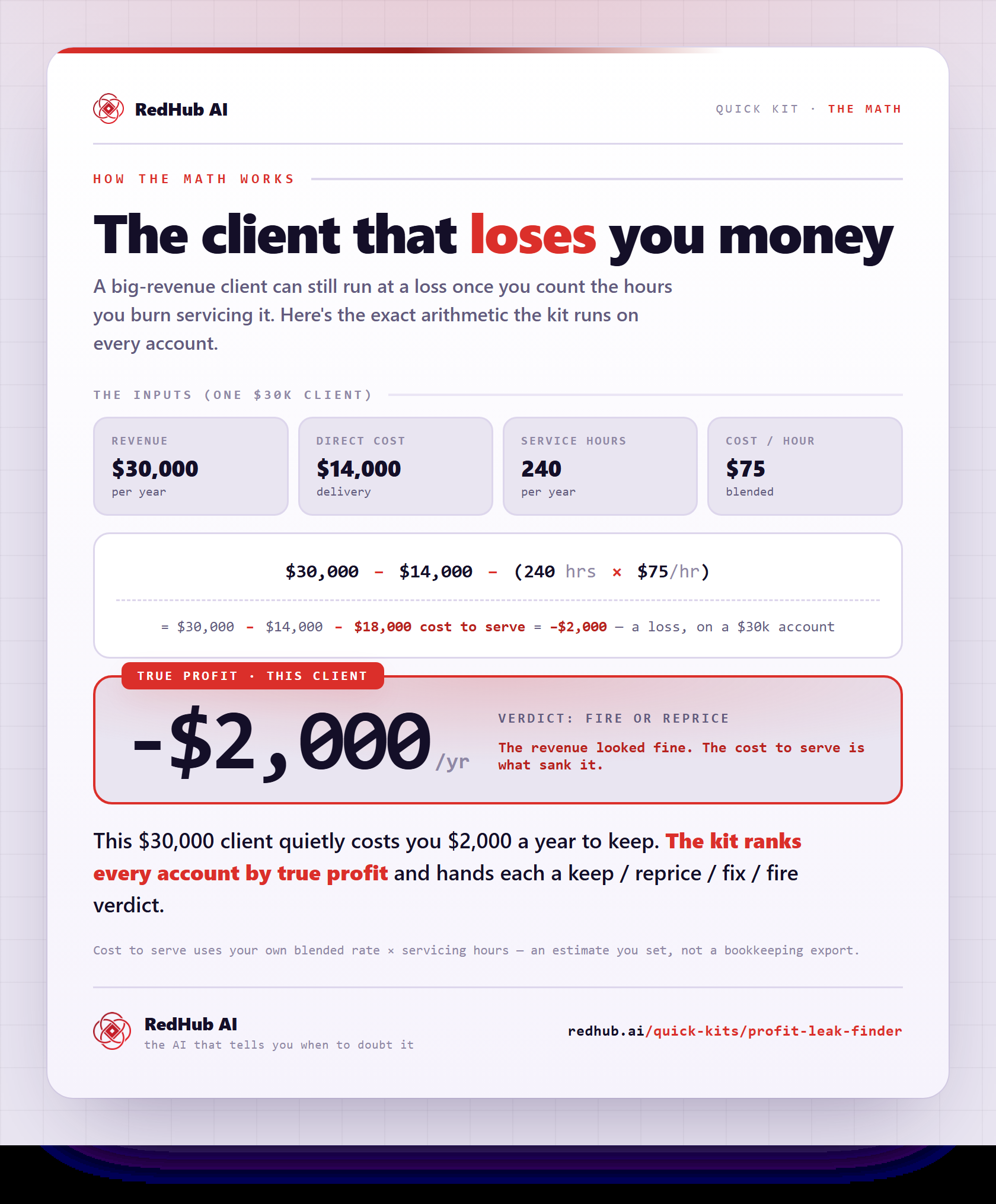
- Compute true profit and margin per client. True profit = revenue − direct cost − (servicing hours × cost per hour). Margin = true profit ÷ revenue.
- Sort by true profit and read the shape. Then give every client one of four verdicts — keep, reprice, fix cost-to-serve, or fire-or-reprice — using the table below.
How to read what you find
Sorted by true profit, almost every service book shows the same shape: a few accounts carry nearly everything, a flat middle roughly breaks even, and a tail dips below zero. In the Profit Leak Finder's built-in ten-client example, the top three clients produce 86% of the profit, and the tail leaks $5,500 a year — including a $30,000 client running at a $2,000 loss.
Figures from the kit's built-in example book — not a claim about yours. But if your book doesn't show some version of this curve, you'll be the exception.
The four verdicts
| Verdict | The pattern | The move |
|---|---|---|
| Keep | Margin at or above your target | Protect them. These carry the book. |
| Reprice | Profitable but thin; servicing is reasonable | The price is too low for the value. Raise it at renewal. |
| Fix cost to serve | Thin because servicing hours eat the margin | Tighten scope and meeting cadence before touching price. |
| Fire or reprice | Losing money outright | Reprice hard. If they won't move, offboard gracefully. |
Note the order: firing is the last verdict, not the first. Most thin accounts are fixable — the deeper playbook for each verdict is in unprofitable clients: how to spot and fix them. And if the servicing-hours idea is new, cost to serve, explained covers the number that drives the whole audit.
Do it yourself, or use the pre-built version
Everything above works in a blank spreadsheet. What you'd be rebuilding is the verdict logic, the profit map, and the sorted whale curve — plus what to say to each client afterward. The Profit Leak Finder ships all of it: 4 tabs, 164 formulas, a pre-loaded ten-client example so it makes sense the moment you open it, and copy-paste scripts for the reprice, the scope fix, and the graceful offboarding. It runs in Excel, Google Sheets, or Numbers. No subscription, no login.
Run the audit today, not "someday"
The Profit Leak Finder is a one-time $49 spreadsheet that ranks your book by true profit and hands every client a keep / reprice / fix / fire verdict — with the scripts to act on it. 30-day guarantee.
Get the Profit Leak Finder — $49 →This audit covers the biggest leak. For the full map of where service businesses lose money — receivables, subscriptions, stale pricing — start at the pillar: where is my business losing money?
Decision Guide
Use it if: you have named clients, you bill time or retainers, and you can estimate servicing hours per account even roughly.
Skip it if: you sell thousands of small transactions — audit product margin and channel cost instead of client cost-to-serve.
Best first step: block two hours this week, list the clients, and fill in the three numbers. The sort takes seconds. The clarity lasts a year.
FAQ
How long does a profit leak audit take?
One afternoon for most books. Gathering revenue and direct cost is fast; estimating servicing hours is the slowest part, and a calendar scan gets it done in an hour or two.
Do I need time-tracking data first?
No. Reasonable estimates are enough, because the audit is a ranking. If a verdict sits on a knife's edge, refine that one client's estimate — don't roll out time tracking for the whole team first.
What is a blended cost per hour?
One average number for what an hour of client servicing costs you — total cost of the people who do servicing work, divided by their working hours. It keeps the audit simple: one rate for the whole book, not a rate card per person.
What if almost every client comes out thin?
Then the leak isn't one bad client — it's the pricing or the delivery model. Look at your target margin and your blended cost first. A book that's uniformly thin usually needs a reprice across the board, not a firing spree.
How often should I re-run the audit?
Twice a year is plenty for most firms, plus a quick re-check whenever a client's scope visibly grows. The first run finds the leak; the re-runs keep it from re-opening.
Does the Profit Leak Finder do this automatically?
It does the math and the verdicts for you. You still enter the three numbers per client — revenue, direct cost, servicing hours — and the sheet returns true profit, margin, the profit map, and a keep / reprice / fix / fire call per account. It's a decision tool, not financial advice.
Three numbers per client. One honest read on your book.
The Profit Leak Finder is pre-loaded with a ten-client example that surfaces $5,500 a year leaking — clear it, enter your own book, and see where you stand this afternoon.
Get the Profit Leak Finder — $49 →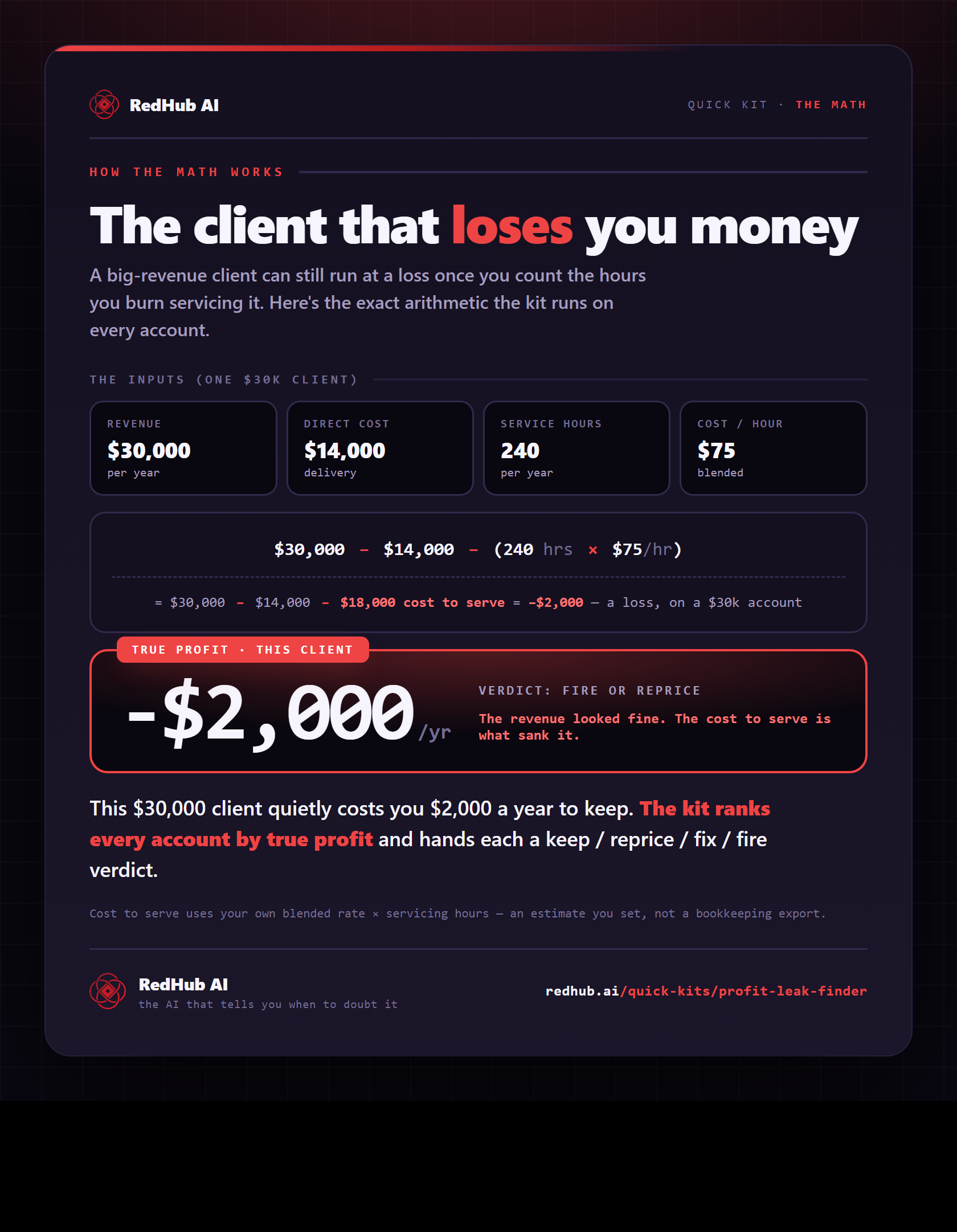
The gate this post refers to, drawn from the tool’s own logic. See the tool.