Hidden Business Costs: 7 Quiet Margin Killers
RedHub AI Editorial6 min read

Jump to a section12
TL;DR
- What it is: Hidden business costs are the costs that never get their own line on the P&L — so nobody manages them.
- Who it's for: Owners of agencies, consultancies, and service firms — see the RedHub Quick Kits.
- How it works: Seven costs do most of the damage. The biggest is the cost to serve — the unpriced hours inside each client relationship.
- Bottom line: A cost you can't see is a cost you can't cut. Naming these seven is half the fix.
What are hidden business costs?
Hidden business costs are real costs that don't appear as a distinct expense line, so they never get reviewed or cut. In service businesses the big seven are: the cost to serve each client, scope creep, the "quick question" tax, slow-paying invoices, subscription creep, stale pricing, and unpriced founder hours. Most of them hide inside relationships and habits — not inside the expense report.
Best for: finding the largest of the seven — the client-level cost to serve — with the Profit Leak Finder.
Hidden business costs share one trait: no line item. Rent has a line. Payroll has a line. But the 240 hours a year one client absorbs? The retainer that hasn't moved since 2022? The invoice aging at 75 days? None of those appear anywhere as a cost — which is exactly why they survive year after year.
Here are the seven that do the most damage in service businesses, roughly biggest first, with the first move for each.
1. The cost to serve
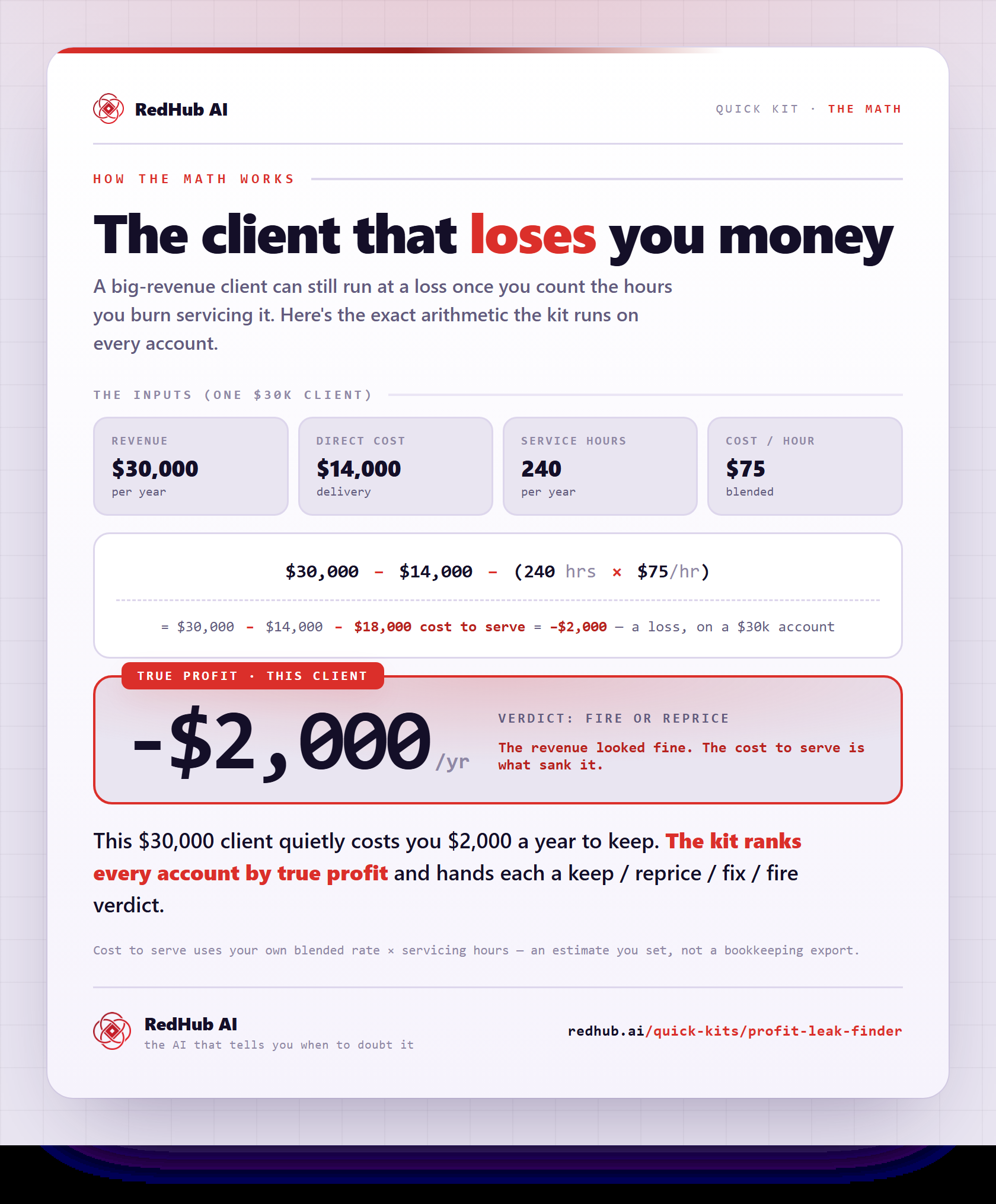
Every client costs you hours after the work is delivered — meetings, check-ins, support, revisions, email. Price those hours at what an hour of your team actually costs, and some healthy-looking accounts flip to losses. In the Profit Leak Finder's built-in example, a $30,000 client loses $2,000 a year on servicing hours alone. This is the largest hidden cost in most books, and it gets its own deep dive: cost to serve, explained.
First move: estimate servicing hours for your three busiest clients. Multiply by your blended hourly cost. Compare to what each pays.
2. Scope creep
Scope creep is work you deliver but never agreed to bill. One extra deliverable here, one "small addition" there, and a year later the engagement covers half again what was quoted — at the original price. It rarely arrives as one big ask. It arrives as fifty small ones, each too minor to renegotiate over.
First move: for one client, write down today's actual scope next to the original agreement. The gap is the unbilled work.
3. The "quick question" tax
Cousin to scope creep, but sneakier: the Slack message, the fifteen-minute call, the "while I have you." Each interaction is small. The pattern is not — a client who asks four quick questions a week costs you an unbudgeted hour or more, every week, forever. It also fragments your team's focus, which costs more than the minutes themselves.
First move: count one week of unscheduled interactions per client. The distribution is rarely even — a few accounts generate most of it.
4. Slow-paying invoices
An invoice at 75 days isn't just annoying — it's you financing your client's business interest-free, while your own payroll doesn't wait. The cost hides because the revenue is already booked; the P&L says you were paid even when the bank says you weren't. Collections is its own discipline with its own tool — the Accounts Receivable Recovery Kit covers the follow-up sequences — so we won't rebuild it here.
First move: total every invoice past terms. Just seeing the number usually changes behavior.
5. Subscription creep
AI tools, SaaS seats, plugins, plans sized for a team you had two years ago. Each charge is small enough that nobody questions it; together they're a standing monthly leak with no owner. This is the lane of the AI & SaaS Subscription Auditor, which grades every subscription against actual use.
First move: pull one month of card statements and mark every recurring charge no one has touched in 60 days.
6. Stale pricing
Your costs rose. Your scope grew. Your price stood still. Stale pricing is a hidden cost because it looks like loyalty, not loss — "we've never raised prices on them" sounds like a virtue right up until you compute the margin. The thin-but-profitable accounts a client audit surfaces are almost always the stale-priced ones.
First move: find your longest-standing client and check when their price last changed. Then check what your costs have done since.
7. Unpriced founder hours
The owner's time is the most commonly stolen input in small business. If you spend ten hours a week servicing one demanding account and value those hours at zero, that account will always look profitable. Your time has a market rate. Leaving it out of the math doesn't make it free — it just makes the books lie to you.
First move: include your own hours, at a real rate, when you estimate any client's cost to serve.
Putting numbers on all seven
| Hidden cost | Where it hides | Tool for the job |
|---|---|---|
| Cost to serve | Inside "healthy" client revenue | Profit Leak Finder |
| Scope creep | The gap between agreement and delivery | Profit Leak Finder (fix cost-to-serve verdict + scope scripts) |
| "Quick question" tax | Unscheduled interactions | Counted inside servicing hours |
| Slow payment | Booked revenue, missing cash | AR Recovery Kit |
| Subscription creep | Small recurring charges, no owner | AI & SaaS Subscription Auditor |
| Stale pricing | "We've never raised prices on them" | Profit Leak Finder (reprice verdict + scripts) |
| Founder hours | Valued at zero by default | Priced into the cost-to-serve math |
Key insight: five of the seven live inside your client relationships, not your expense report. That's why cost-cutting exercises miss them — you can't cut a cost that was never written down. Rank the clients first, and most of the hidden costs surface on their own.
Surface the biggest hidden cost first
The Profit Leak Finder ($49) prices the servicing hours inside every client relationship and gives each account a keep / reprice / fix / fire verdict — with copy-paste scripts for the reprice, the scope fix, and the graceful offboarding. One .xlsx, one afternoon.
Get the Profit Leak Finder — $49 →Want the full picture of where the money goes — and the order to fix it in? Start at the pillar: where is my business losing money? Then run the one-afternoon profit leak audit.
Decision Guide
Use this list if: margins feel thinner than your revenue says they should be, and your expense report has already been squeezed.
Skip it if: your problem is top-line — no leads, no sales. Fix demand first; leak-hunting won't fill an empty pipeline.
Best first step: tackle cost number one. It's the biggest, and pricing it makes three of the other six visible at the same time.
FAQ
What are the most common hidden business costs?
In service businesses: the cost to serve each client, scope creep, unscheduled "quick questions," slow-paying invoices, unused subscriptions, stale pricing, and unpriced founder hours. The client-side costs are usually the largest.
Why don't hidden costs show up in my accounting?
Because accounting records transactions, and most hidden costs aren't transactions. Nobody invoices you for scope creep or a client's meeting habit. The cost is real, but it only becomes visible when you price the hours involved.
Which hidden cost should I measure first?
The cost to serve. It's typically the biggest, and measuring it — hours per client times your blended hourly cost — automatically exposes scope creep, the quick-question tax, and stale pricing along the way.
Are unused software subscriptions really worth auditing?
Yes, because they recur. A forgotten $80/month tool is nearly $1,000 a year, and most businesses carry several. It's rarely the biggest leak, but it's the easiest to close — one audit, one afternoon.
Should I count my own time as a cost?
Always. Your hours have a market value whether or not you pay yourself for them. Valuing founder time at zero is the single most common way a losing client stays invisible.
How do I turn this list into action?
Run a client-level audit first — the Profit Leak Finder handles the math and the verdicts. Then close the two mechanical leaks with the AR Recovery Kit and the Subscription Auditor.
Stop paying costs you've never seen
One $49 spreadsheet prices the hidden hours inside every client relationship and tells you — honestly — which accounts to keep, reprice, fix, or let go. 30-day guarantee.
Get the Profit Leak Finder — $49 →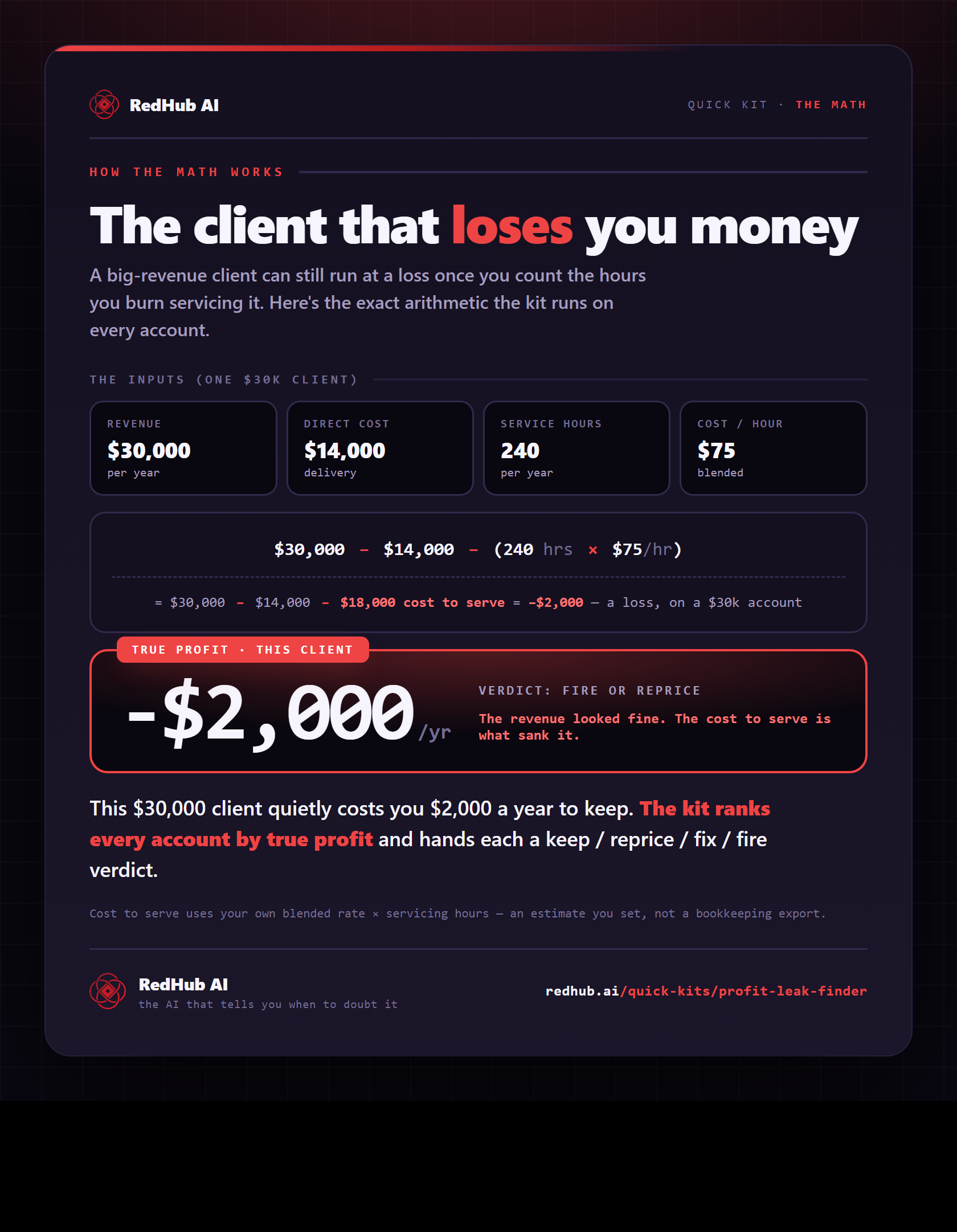
The gate this post refers to, drawn from the tool’s own logic. See the tool.