

Autonomous SOC: AI Security Operations in 2026
⏱ 9 min read
TL;DR
- What it is: An autonomous SOC uses AI security operations to detect, investigate, and contain threats in seconds without human intervention.
- Who it's for: Enterprise security teams drowning in alerts, facing AI-driven attacks, and struggling with analyst burnout.
- How it works: Behavioral analytics learn normal activity patterns, automated systems isolate compromised hosts and revoke sessions, and predictive models stop attacks before they land.
- Bottom line: Manual triage cannot keep pace with machine-speed attacks. Autonomous SOC AI security operations turn analysts into hunters and cut response times from hours to seconds.
What Is Autonomous SOC AI Security Operations?
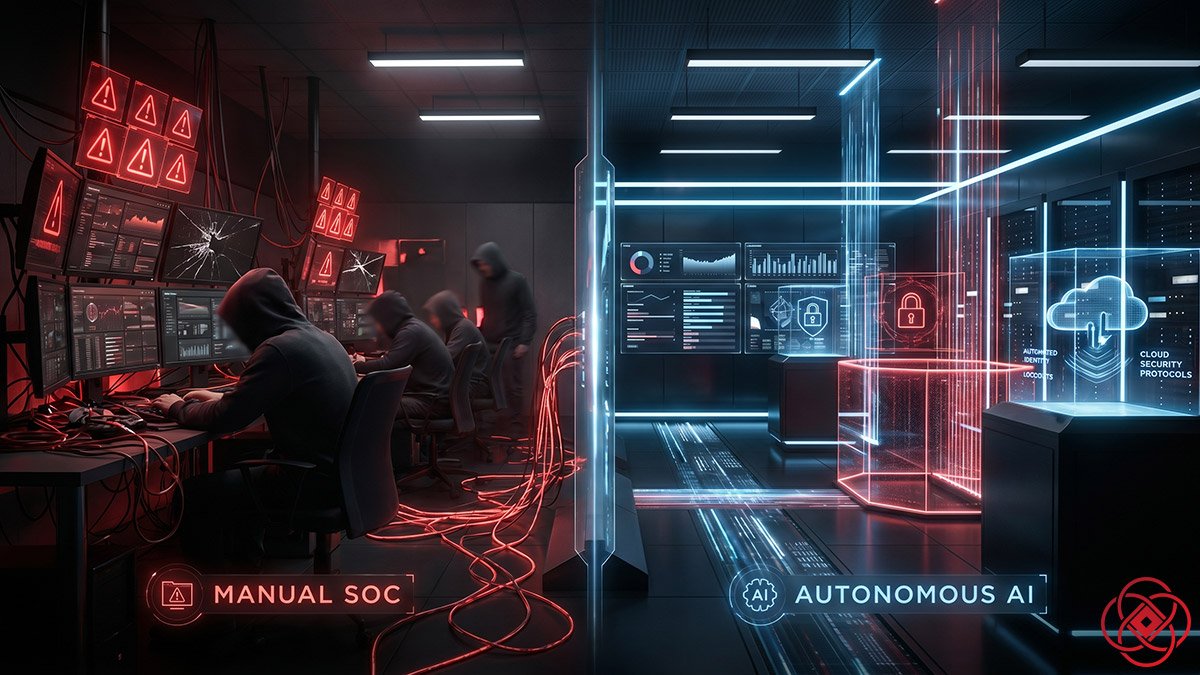
Autonomous SOC AI security operations replace manual alert triage with machine-speed detection, correlation, and containment. Instead of analysts clicking through thousands of daily alerts, AI systems automatically investigate threats, isolate infected hosts, revoke compromised sessions, and neutralize attacks in under four seconds—freeing security teams to focus on predictive threat hunting and strategic defense.
Best for: Enterprises facing alert fatigue, AI-driven attacks, and collapsing response windows. Not ideal for: Small teams with fewer than 100 daily alerts or limited cloud infrastructure. Fast takeaway: If your analysts spend more time triaging noise than hunting threats, you need automation now.
Your security team is drowning. They are not lazy. They are not stupid. They are simply outnumbered by machines that never sleep and never slow down.
If your analysts still review every alert by hand, you have already lost the race. The question is not whether you can afford to build an autonomous security operations center. The question is whether you can afford not to.
The Tempo Changed Overnight
For years, a cyber attack moved at human speed. A hacker broke in, poked around, and spent days or weeks stealing data. That gave your team time to detect, investigate, and respond.
Those days are gone.
In 2026, attackers use artificial intelligence to automate reconnaissance, social engineering, and lateral movement. They can scan your network, find a weak account, craft a personalized phishing message, and start moving toward your crown jewels in minutes. The time between initial access and business impact has collapsed from weeks to hours. In some cases, minutes.
This means your response window has collapsed too. A decision that used to take a day now needs to happen in seconds. You cannot send an alert up the chain and wait for a manager to approve action. By the time someone reads the email, the attacker owns your domain.
The old model assumed human speed. The new model demands machine speed.
Manual Triage Is the Bottleneck
The average enterprise security operations center receives thousands of alerts every day. Many receive tens of thousands. The numbers are so large that they become meaningless.
Analysts sit in front of dashboards and try to separate the real threats from the noise. They fail. Not because they lack skill, but because they lack time. They can only investigate a fraction of the alerts. The rest sit in a queue. Some of those ignored alerts are the breach you will read about tomorrow.
Traditional security tools make the problem worse. They fire off alerts based on signatures and rules. Every new tool adds more noise. The result is alert fatigue. Analysts start clicking through notifications without real thought. They miss the subtle signal because it is buried under a hundred false alarms.
You cannot hire your way out of this problem. There are not enough security professionals on Earth to manually review every event in a modern cloud environment. Even if you could hire them, humans cannot correlate data across email, identity, network, and cloud workloads fast enough to stop an AI-driven attack.
The bottleneck is not talent. It is architecture.
Predictive Becomes the New Standard
Reactive defense is a losing strategy. Waiting for an attacker to show up, then trying to catch them, gives them the first move. In 2026, the best teams play chess while the attackers are still setting up the board.
Predictive threat modeling uses artificial intelligence to analyze historical attack data and synthetic scenarios. It learns what an attack looks like before it reaches your network. It models how your specific infrastructure might be targeted, where the weak points are, and what an adversary would do next.
This is not magic. It is pattern recognition at scale. If a new vulnerability drops in a piece of software you use, predictive systems immediately simulate how an attacker might chain it with other weaknesses in your stack. They flag the risk before an exploit even exists in the wild.
You stop playing whack-a-mole. You start building traps.
The Four-Second Response
When an attack lands, speed is everything. The autonomous SOC does not just detect faster. It acts faster.
Modern AI-driven security platforms collect signals across your entire environment. They watch your network traffic, your cloud workloads, your email gateways, and your identity logs. They do not treat these as separate systems. They stitch them into one story.
If an employee clicks a phishing link, the system sees the email, the login, the unusual IP address, and the first lateral movement—all as one event. It does not wait for a human to connect the dots. It correlates the data automatically, assigns a risk score, and decides whether to act.
In many cases, it neutralizes the threat in under four seconds. It isolates the infected host. It revokes the compromised identity session. It blocks the outbound connection. Then it writes a summary for your analysts.
Some platforms have cut phishing incidents by over ninety-nine percent using this automated containment. Not because they blocked every email, but because the moment a malicious link led to an action, the system killed the session before damage could spread.
That is not an alert. That is a response.
Learning What Normal Looks Like
Signature-based defense is a dictionary of known badness. If the attacker uses a new word, the dictionary fails.
The autonomous SOC in 2026 relies on behavioral analytics. It learns what normal looks like for your organization. It knows that your finance team usually logs in from the east coast between eight and six. It knows that your engineering servers rarely talk to the internet. It knows that your CEO does not download the entire customer database at midnight.
When an AI-driven attack tries to blend in, it still deviates from this baseline. Maybe it moves laterally using an account that has never accessed those systems. Maybe it queries data at a volume the real user never reaches. The system flags the anomaly immediately, even if the attacker uses a brand-new tool with no known signature.
This is the difference between looking for a specific burglar and noticing that someone is in your house who does not belong. The second approach catches the unknown threat. In 2026, the unknown threat is the only one that matters.
Freeing Humans to Hunt
The autonomous SOC does not replace your security team. It upgrades them.
AI-driven automation removes the ninety percent of alerts that are noise. It handles the routine investigation, the log correlation, the initial containment, and the ticket writing. Your analysts stop clicking through false positives and start hunting for the real threats.
Threat hunting is creative. It requires human intuition. An analyst might notice a subtle pattern that no algorithm has learned yet. They might run an adversary emulation exercise to test your defenses. They might redesign your cloud architecture to remove a weak path.
These are high-value activities. They are also impossible when your team is chained to a dashboard reviewing the same ten thousand alerts every week.
The autonomous SOC turns analysts into strategists. It turns the security function from a cost center that reacts into a capability that predicts. If you want to retain top security talent, give them interesting work. Let the machines handle the boredom.
Architecture for 2026
Not every tool with artificial intelligence on the label can build an autonomous SOC. When you evaluate your stack, demand three specific capabilities.
First, automated host isolation. When a device is compromised, the system must be able to pull it off the network instantly without waiting for a human to click a button.
Second, identity-layer session revocation. Credentials are the new perimeter. If an account is hijacked, the system must kill every active session and force re-authentication across all apps.
Third, unified cloud workload visibility. Your attack surface is no longer just laptops and servers. It is containers, serverless functions, and API endpoints. If your tool cannot see and protect cloud-native workloads, it is blind to half your environment.
If your current platform lacks any of these three features, you are running 2023 infrastructure against 2026 attacks. That is a mismatch you will feel.
Transformation does not require a three-year roadmap. It requires honest diagnosis and quick action.
Map your alert volume against your analyst hours. If you generate more alerts in an hour than your team can review in a day, you need automation. The math is that simple.
Run a response-time drill. Simulate a compromised credential or a phishing click. Measure how long it takes your current system to detect, investigate, and contain the activity. If the answer is measured in minutes or hours, you are leaving the window open.
Audit your tools against the three criteria: host isolation, session revocation, and cloud visibility. Do not accept vendor promises. Test the features in a sandbox. If they fail, replace them.
Finally, retrain your team. Shift their focus from alert triage to threat hunting. Give them time to think like attackers. The autonomous SOC handles the volume. The humans handle the cunning.
Speed is not a feature. It is the foundation. If your defense moves slower than the offense, the scoreboard does not care how hard you tried.
Decision Guide
Use it if: Your security team generates more alerts per hour than they can investigate per day, you face AI-driven attacks with sub-hour response windows, or your analysts spend over 70% of their time on manual triage instead of threat hunting.
Skip it if: You operate a small network with fewer than 100 daily alerts, lack cloud infrastructure or complex identity systems, or have a single security analyst who can manually review every event without backlog.
Best first step: Map your current alert volume against analyst capacity. Run a simulated phishing drill and measure detection-to-containment time. If the gap is measured in hours instead of seconds, prioritize platforms with automated host isolation and session revocation—then audit for unified cloud workload visibility.
FAQ
What is an autonomous SOC in simple terms?
An autonomous SOC is a security operations center where AI systems automatically detect, investigate, and contain cyber threats without waiting for human approval. Instead of analysts manually reviewing thousands of alerts, machine learning identifies anomalies, correlates events across your network, and neutralizes attacks in seconds—freeing your team to focus on strategic threat hunting.
How does autonomous SOC AI security operations differ from traditional SIEM tools?
Traditional SIEM tools collect logs and fire alerts based on signatures and rules, requiring human analysts to investigate and respond. Autonomous SOC platforms use behavioral analytics to learn normal activity patterns, automatically correlate events across cloud, identity, and network layers, and take immediate action like isolating hosts or revoking sessions—all without manual intervention.
How fast can an autonomous SOC respond to a threat?
Leading autonomous SOC platforms can detect, investigate, and contain threats in under four seconds. This includes correlating signals from email gateways, identity logs, network traffic, and cloud workloads, assigning risk scores, isolating infected hosts, revoking compromised sessions, and generating incident summaries—faster than any human-led process.
Does an autonomous SOC replace security analysts?
No. Autonomous SOC AI security operations eliminate the repetitive work of manual alert triage, freeing analysts to focus on high-value activities like threat hunting, adversary emulation, and strategic defense architecture. The automation handles the ninety percent of alerts that are noise, while humans tackle creative investigations and complex attack scenarios.
What are the three essential capabilities for an autonomous SOC in 2026?
First, automated host isolation to instantly remove compromised devices from the network. Second, identity-layer session revocation to kill hijacked account sessions across all applications. Third, unified cloud workload visibility to monitor containers, serverless functions, and API endpoints—not just traditional laptops and servers.
Can small businesses benefit from autonomous SOC technology?
Small businesses with fewer than 100 daily alerts and limited cloud infrastructure may not see immediate ROI from full autonomous SOC platforms. However, targeted automation like AI-driven phishing containment or behavioral anomaly detection can still reduce alert fatigue and improve response times without requiring enterprise-scale deployment.
How do I know if my organization needs autonomous SOC AI security operations?
Run two tests. First, map your hourly alert volume against daily analyst capacity—if you generate more alerts in one hour than your team can investigate in a full day, you need automation. Second, simulate a phishing attack and measure detection-to-containment time. If the response takes minutes or hours instead of seconds, your current architecture cannot match the speed of AI-driven threats.