

AI Longevity: Can AI Really Slow Aging?
⏱ 9 min read
TL;DR
- What it is: AI longevity uses machine learning to accelerate drug discovery, decode proteins, predict disease, and target the biological mechanisms of aging.
- Who it's for: Researchers, biotech companies, and patients waiting for breakthrough treatments — especially for diseases with no existing cures.
- How it works: AI models analyze massive biological datasets to design drugs, predict protein structures, and identify disease patterns years before symptoms appear.
- Bottom line: AI isn't just improving healthcare — it's rewriting the timeline for medical discovery and raising serious questions about how long humans can live.
What Is AI Longevity in Simple Terms?
AI longevity is the application of artificial intelligence to extend human lifespan and healthspan by accelerating drug discovery, predicting disease onset, mapping protein structures, and targeting the biological processes that cause aging. Instead of treating diseases after they appear, AI systems aim to prevent, reverse, or slow aging at the cellular level.
Best for: Organizations and individuals seeking breakthrough treatments for aging-related diseases, rare conditions, and preventive care strategies driven by predictive analytics.
AI might not just change how we work. It might change how long we live.
That's not a prediction from a sci-fi novel. It's the direction the biggest AI companies in the world are already moving — and it's moving faster than most people think.
For years, AI was all about productivity. Write faster. Code faster. Make better ads. Now something else is happening. The same companies building language models and image generators are pointing their technology at biology — at the proteins inside your cells, at the diseases that have no cures, at the fundamental science of why we age.
The question is no longer whether AI can help medicine. The real question is: can AI eventually change the speed at which we age?
The Drug Problem AI Is Solving
Most people think of drug development as a lab science. It is — but it's also a math problem.
There are roughly 10,000 known diseases. We have approved treatments for about 500 of them. The rest? No cure. No treatment. Just waiting.
Why? Because creating a drug takes 10–15 years and costs upward of $2 billion. Most drugs fail. The ones that succeed still take more than a decade to reach patients.
AI doesn't eliminate the process. But it's compressing it.
Instead of testing millions of chemical compounds one by one in a lab, AI models can simulate how those compounds behave inside the body. They predict which molecules will bind to which proteins. They predict toxicity, side effects, and efficacy — all before a single test tube is opened.
Companies like DeepMind, Insilico Medicine, and Recursion Pharmaceuticals are already using AI to cut drug discovery timelines from years to months. Some are reporting candidate drugs identified in under 18 months — a timeline that would have been impossible five years ago.
This isn't theoretical. It's happening now. And it's laying the foundation for something bigger.
How AlphaFold Changed Biology Forever
In 2020, DeepMind released AlphaFold — an AI system that predicts the 3D structure of proteins based only on their amino acid sequences.
That might sound abstract. But in biology, structure is everything. If you don't know the shape of a protein, you can't design a drug that targets it. For decades, scientists spent months or years determining a single protein structure using expensive lab equipment.
AlphaFold does it in minutes.
As of 2025, AlphaFold has mapped over 200 million protein structures — nearly every known protein in the human body and beyond. It's one of the most significant scientific breakthroughs of the 21st century, and it happened because of AI.
Why does this matter for aging?
Because aging is a protein problem. Proteins misfold. They accumulate. They stop working. Diseases like Alzheimer's, Parkinson's, and ALS are all linked to protein dysfunction. If AI can map and predict protein behavior at scale, it can also help design interventions that prevent or reverse those failures.
AlphaFold isn't just a tool. It's a new kind of biology — one where AI sees patterns humans can't, at speeds humans never could. For more on how AI is transforming medicine at the genetic level, see AlphaGenome by Google: The Future of DNA Prediction.
Predictive Medicine Is Already Here
AI isn't just helping scientists discover new drugs. It's also predicting who will get sick — and when.
Take cancer. Traditionally, cancer is diagnosed after symptoms appear. By that time, the disease has often progressed. AI is changing that. Machine learning models trained on millions of patient records, imaging scans, and genetic sequences can now predict cancer risk years before a tumor forms.
Google's AI has been used to detect breast cancer from mammograms more accurately than radiologists. Similar systems are being trained to predict heart disease, diabetes, kidney failure, and even mental health crises.
This is predictive medicine — and it's not about reacting to illness. It's about intercepting it before it starts. AI systems like these are already being deployed in hospitals and clinics around the world. For a look at how AI is reshaping surgical precision, explore AI Surgery Robots.
But the bigger question is: if AI can predict disease, can it also predict aging?
When AI Targets Aging Itself
Aging used to be considered inevitable. You get older. Your cells deteriorate. Eventually, something breaks.
But a growing number of scientists don't see aging as inevitable anymore. They see it as a disease — one that can be treated, slowed, or even reversed.
AI is becoming central to that effort.
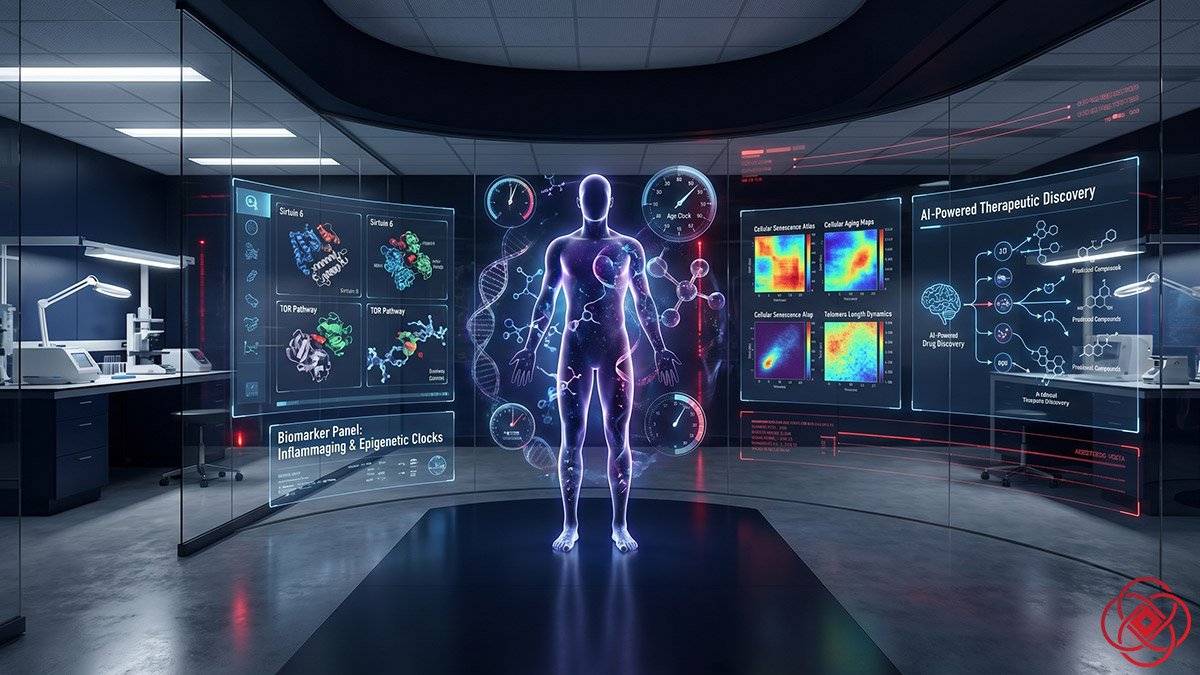
There are already AI-driven platforms analyzing the biological markers of aging: DNA methylation patterns, telomere length, mitochondrial function, cellular senescence. These are the molecular clocks inside your body, and AI is learning to read them.
Entrepreneurs like Bryan Johnson are using AI-guided protocols to track and optimize their biological age in real time. His "Blueprint" program involves daily monitoring, supplements, exercise, diet — all adjusted based on data and machine learning models designed to slow his rate of aging.
Does it work? The jury's still out. But the fact that it's even possible to try is new. Five years ago, this kind of personalized, AI-optimized longevity plan didn't exist outside research labs.
Now it's becoming a business model.
Why AI Longevity Research Is Exploding Now
So why is all of this happening now?
Three reasons:
1. We have the data. Medicine generates an enormous amount of information — patient records, genomic sequences, clinical trials, imaging, lab results. AI doesn't work without data, and now we finally have enough of it in digital, usable formats.
2. We have the compute. Training an AI model to predict protein structures or simulate drug compounds requires serious computational power. That used to cost millions. Now, cloud infrastructure and specialized AI chips have made it affordable — and fast.
3. We have the incentive. Aging is the biggest unsolved market in the world. If you can extend healthy lifespan by even a few years, the economic and social impact is massive. Governments, venture capital, and Big Tech are all paying attention.
The result? A Cambrian explosion of AI-driven longevity startups, research labs, and clinical trials. It's not just hype. It's a new category of science.
What It Means for You
So what does all this mean for the average person?
In the short term, it means faster access to better treatments. Drugs that would have taken 15 years might take 5. Diseases that had no cure might suddenly have options. Diagnostics that were expensive and slow will become cheap and instant. Cancer therapies powered by AI are already showing results — learn more at AI Cancer Treatment: 72-Hour Breakthrough.
In the medium term, it means personalized medicine becomes the norm. Your treatment won't be based on averages. It'll be based on your genetics, your lifestyle, your biology — analyzed by AI in real time.
In the long term? That's where it gets speculative.
Some researchers, like biomedical gerontologist Aubrey de Grey, believe we're approaching "longevity escape velocity" — the point where medical advances extend lifespan faster than we age. In other words: you gain more than a year of life for every year you live.
If that sounds impossible, consider this: global life expectancy has more than doubled in the last century. In 1900, the average human lived to about 31. Today, it's over 72. Most of that gain came from vaccines, antibiotics, sanitation, and surgery — technologies that didn't exist 150 years ago.
AI might be the next leap.
Whether you think that's exciting or terrifying probably depends on your relationship with mortality. But one thing is clear: the conversation is no longer academic. It's scientific. It's funded. And it's moving fast.
AI won't make anyone immortal. But it might change the terms of the debate. And for the first time in human history, aging isn't just something that happens to you. It's something you — and your AI — might be able to negotiate with. However, as these technologies advance, questions around data privacy and ethics become critical — see Your AI Doctor Is Leaking Secrets and AI Ethics and Safety.
Should You Pay Attention to AI Longevity?
Use it if: You're involved in biotech, healthcare, drug development, or preventive medicine — or if you're personally interested in optimizing healthspan and tracking biological aging metrics.
Skip it if: You're looking for immediate, proven anti-aging solutions available today. Most AI longevity breakthroughs are still in research or early clinical trials.
Best first step: Follow developments in AI drug discovery platforms, monitor FDA approvals for AI-designed drugs, and explore wearable health tech that uses predictive analytics to assess disease risk.
FAQ
What is AI longevity in simple terms?
AI longevity refers to using artificial intelligence to extend human lifespan and healthspan by accelerating drug discovery, predicting diseases before symptoms appear, and targeting the biological processes that cause aging at the cellular level.
How is AI different from traditional drug discovery?
Traditional drug discovery involves manually testing millions of compounds in labs over 10–15 years. AI simulates molecular interactions digitally, predicting which compounds will work before physical testing begins — cutting timelines from years to months.
What is AlphaFold and why does it matter?
AlphaFold is an AI system by DeepMind that predicts 3D protein structures in minutes instead of months. Since protein shape determines drug targets, AlphaFold has mapped over 200 million proteins and accelerated research into diseases caused by protein dysfunction like Alzheimer's and Parkinson's.
Can AI really predict when you'll get sick?
Yes. AI models trained on patient data, imaging, and genetics can now predict cancer, heart disease, diabetes, and other conditions years before symptoms appear — enabling early intervention and preventive treatment strategies.
Is aging really a disease that can be treated?
A growing number of researchers believe aging is a treatable condition caused by cellular damage, protein dysfunction, and genetic changes. AI is helping identify biological markers of aging and designing interventions to slow or reverse those processes.
Who is using AI for longevity right now?
Biotech companies like Insilico Medicine and Recursion Pharmaceuticals, tech giants like Google DeepMind, and individuals like Bryan Johnson are using AI to design drugs, predict disease risk, and optimize personal health protocols based on biological age data.
What is longevity escape velocity?
Longevity escape velocity is the theoretical point where medical advances extend lifespan faster than we age — meaning you gain more than one year of life for every year you live. Researcher Aubrey de Grey argues AI-driven breakthroughs could bring this closer to reality.
