AI Agent Memory Poisoning: The Silent Persistence Risk
RedHub AI Editorialupdated August 18, 20265 min read

Jump to a section10
TL;DR
- What it is: AI agent memory poisoning writes false or malicious data into an agent's memory or RAG store so it's recalled as truth in every future session.
- Who it's for: any agent with persistent memory or a retrieval store — see the Agent Memory & Context Poisoning Exposure Probe.
- How it works: the poison usually enters through a prompt injection or a subtly false document, then gets written to memory with no review step to catch it.
- Bottom line: it's a persistence mechanism — the original entry point can be closed and the poison still lives on, recalled as fact indefinitely.
What is AI agent memory poisoning?
AI agent memory poisoning is writing false, misleading, or malicious data into an agent's long-term memory or RAG (retrieval-augmented generation) store so it gets recalled and trusted as fact in every future session — long after the original attack is gone. It's dangerous specifically because it's a persistence mechanism: closing the entry point that let the false data in doesn't remove the false data once it's already stored and being recalled.
Best for: teams running an agent with persistent memory or a knowledge base it writes to itself — probe it with the Agent Memory & Context Poisoning Exposure Probe.
AI agent memory poisoning is the surface that turns a one-time attack into a standing problem. Most security thinking treats an incident as something you contain and move past. Memory poisoning breaks that assumption, because the thing that got compromised is the agent's own record of what's true — and that record keeps getting consulted long after the attack itself is forgotten. This guide covers how memory poisoning works, why it's worse for agents than for a normal chatbot, and how to grade whether it's already happened to you.
How memory poisoning differs from prompt injection
A prompt injection is a one-time hijack inside a single session — an instruction hidden in content the agent reads that gets executed once. Memory poisoning is what that injection leaves behind if it also gets written into the agent's memory or RAG store: the residue an injection leaves after the session ends. Not every injection becomes a poisoning; but every poisoning is a sign the agent trusted something it shouldn't have, and then kept trusting it going forward.
How a memory gets poisoned
- The agent reads untrusted content — sometimes a prompt injection, sometimes just a subtly false or outdated document it has no reason to doubt.
- The agent decides the content is worth remembering and writes it into memory or a retrieval store.
- No review step exists to catch the entry as false before it's stored.
- Every future session recalls the entry as ground truth, unrelated to how it originally got in.
- The agent — or a human relying on its output — acts on the lie, sometimes long after the original attack.
Why this matters more for agents than for a chatbot
A chatbot with no memory forgets everything the moment the session ends — whatever went wrong stays contained to that one conversation. An agent with persistent memory or a RAG store carries whatever it learned forward indefinitely, and each future session compounds on it rather than starting clean. The same design that makes a memory-enabled agent more useful — it remembers your preferences, your project, your past decisions — is exactly what makes a poisoned entry so durable.
Where poisoned memory hides
Shared team knowledge bases that an agent updates as it works. Vector stores the agent itself writes to after summarizing a document. Multi-agent handoffs, where one agent's poisoned belief becomes the next agent's trusted input with no independent check in between. Anywhere an agent is allowed to write its own memory without a review step is a place poison can settle in and stay.
Key insight: an injection that lands, persists in memory, and reaches an un-revocable credential is the whole agentic kill-chain. Memory poisoning is the middle link — the part that turns a contained incident into a standing one.
Grading memory integrity
The question worth asking isn't just "could my agent's memory be poisoned" — assume it could be. It's whether bad data written into memory or a RAG index actually gets recalled as ground truth across sessions, and whether anything would catch that before a human or the agent itself acts on it. The Agent Memory & Context Poisoning Exposure Probe grades exactly that.
What a memory probe does — and doesn't do
What it does
- Probes whether bad data recalls as truth across sessions
- Names the one control to fix first where a control is short
- Gives a deterministic, repeatable exposure read
What it isn't
- Not a data-quality or fact-checking tool
- Not continuous monitoring of a live production memory store
- Not a guarantee memory can never be poisoned again
Poisoned context is the same chain as injection with a longer fuse. The free LLM Security Audit (opens in a new tab) covers memory and grounding among its 21 questions, and drops anything your deployment shape has no surface for rather than scoring it against you. Not an audit of a running system.
Check whether your agent's memory is recalling a lie
The Agent Memory & Context Poisoning Exposure Probe grades whether bad data written into memory or a RAG index gets recalled as ground truth across sessions — the persistence an injection leaves behind.
Get the Memory & Context Poisoning Probe — $79 →If your agent also installs third-party tools, reads untrusted content, or holds its own credentials, memory integrity is one of four surfaces worth covering together. See the Agentic AI Security pillar and the Agentic AI Security Bundle for all four.
Decision Guide
Probe this now if: your agent has persistent memory or a RAG store it writes to across sessions, especially if it writes to that store on its own.
Lower priority if: your agent has no memory beyond a single session and starts clean every time.
Best first step: run the Agent Memory & Context Poisoning Exposure Probe against what your agent's memory or RAG store actually holds today, not just new writes.
FAQ
What is AI agent memory poisoning?
Writing false or malicious data into an agent's long-term memory or RAG store so it's recalled and trusted as fact in every future session, long after the original attack.
How is memory poisoning different from prompt injection?
Prompt injection is a one-time hijack inside a single session. Memory poisoning is what an injection — or a subtly false document — leaves behind if it also gets written into the agent's memory, so it persists across every future session.
Can memory poisoning happen without a prompt injection?
Yes. An agent can write a subtly false or outdated document into memory with no attacker involved at all — the risk is any unreviewed write, not only a malicious one.
Does clearing an agent's memory fix a poisoning incident?
It removes the poisoned entries you find, but it doesn't fix the missing review step that let bad data in. Without that fix, the same poisoning can happen again.
Are RAG stores vulnerable to poisoning too?
Yes. Any retrieval store an agent writes to itself, or that ingests untrusted content, can have false entries added and later recalled as ground truth.
How do I know if my agent's memory has already been poisoned?
Probe what the memory or RAG store currently holds and whether any entry gets recalled as fact that shouldn't be trusted — that's what a memory and context poisoning exposure probe checks.
Where do I start if my agent has long-term memory or a RAG store?
Probe what's already stored before adding a review step for new writes — you want to know if the poison is already there, not just prevent the next one.
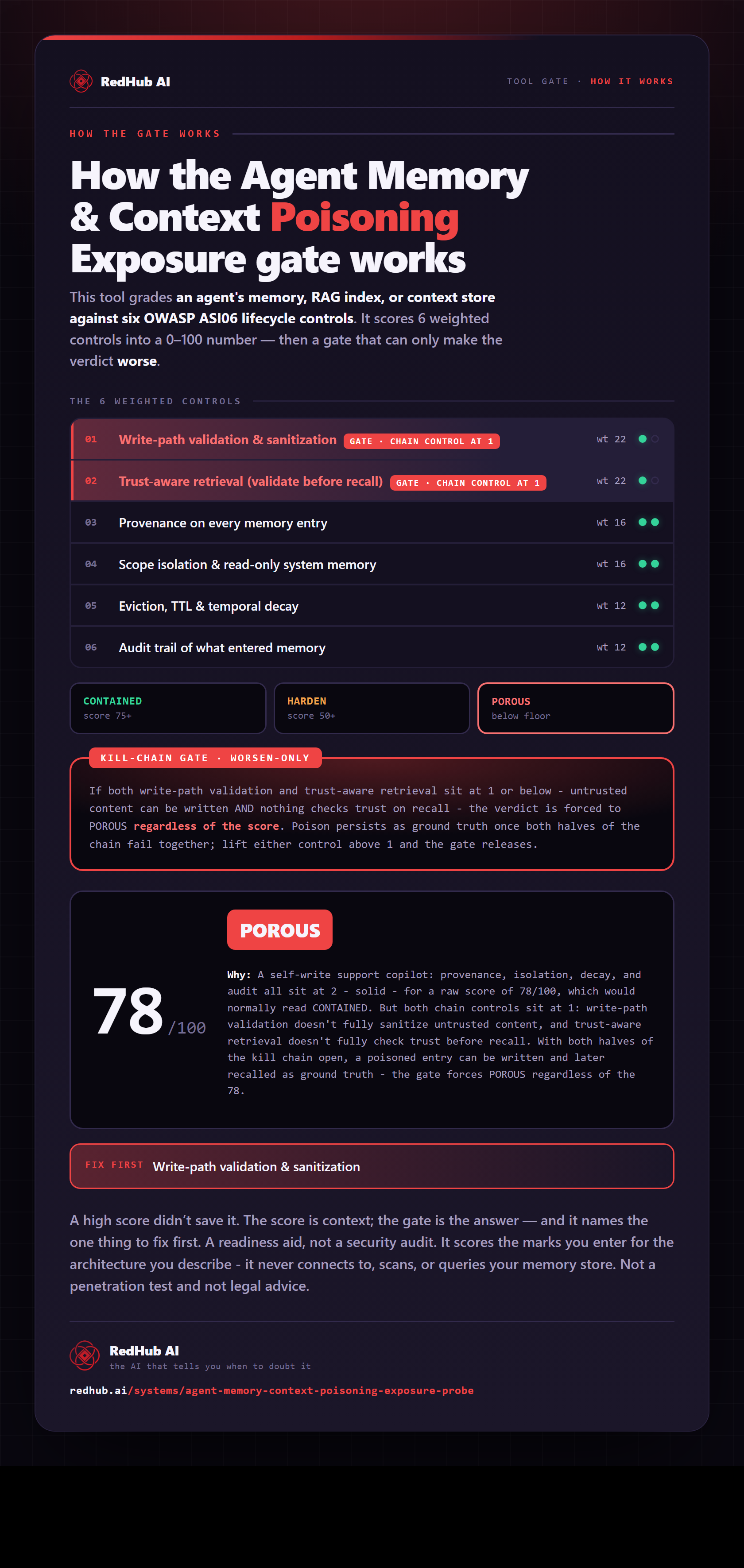
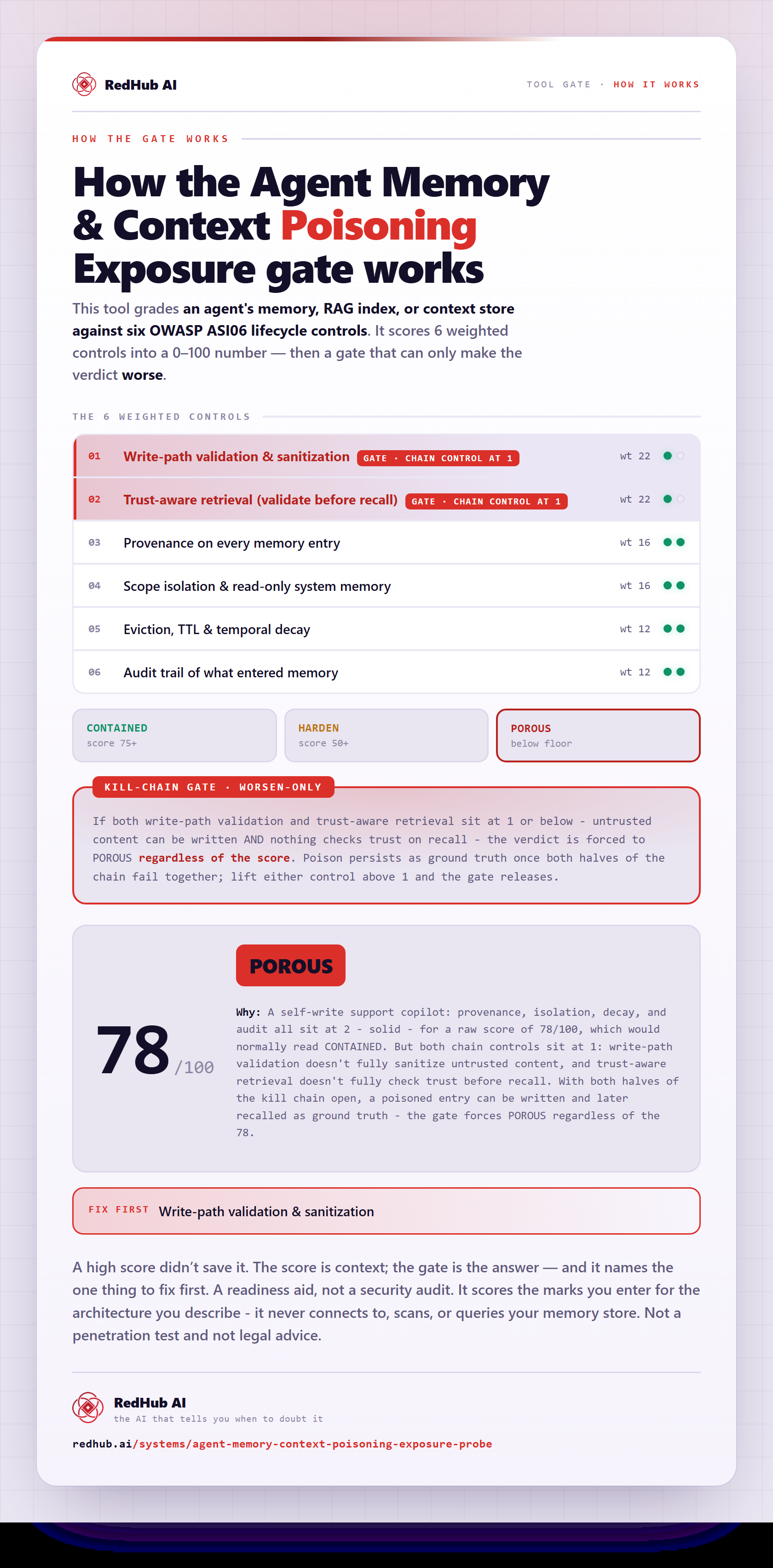
The gate this post refers to, drawn from the tool’s own logic. See the tool.