Agentic AI Security: Securing Autonomous Agents
RedHub AI Editorialupdated August 18, 20267 min read

Jump to a section9
TL;DR
- What it is: agentic AI security means gating an autonomous agent across the four surfaces attackers actually use — what it installs, what it reads, what it remembers, and what it can reach.
- Who it's for: teams shipping agents to production — see the Agentic AI Security Bundle.
- How it works: four deterministic gates, one per surface — where a surface is short, the gate names the single control to fix first.
- Bottom line: an agent that works isn't the same as an agent that's safe — grade all four surfaces before you trust it in production.
What is agentic AI security?
Agentic AI security is the practice of gating the four attack surfaces an autonomous AI agent exposes: the tools and servers it installs, the untrusted content it reads, the memory it keeps across sessions, and the credentials it holds. Unlike a normal app, an agent with tool use and memory can be attacked indirectly — through a poisoned MCP server, a hidden instruction in a web page, a lie written into its memory, or an orphaned API key — because the agent acts autonomously on whatever it perceives.
Best for: teams that already have an agent reading content, remembering things, calling tools, and holding credentials — the Agentic AI Security Bundle gates all four surfaces in one buy.
Agentic AI security is a different job than securing a normal app, and most teams don't realize it until something goes wrong. A chatbot that only answers questions has a small attack surface. An agent that reads your inbox, remembers what it learns, calls third-party tools, and holds its own API keys has four. This guide walks through all four surfaces — what you install, what the agent reads, what it remembers, and what it can reach — and how to gate each one before you trust an agent in production.
Why an AI agent has a bigger attack surface than an app
A normal app does what its code tells it to do. An autonomous agent decides what to do based on what it perceives — a page it reads, a memory it recalls, an instruction it's handed — and then acts on that decision using tools and credentials you gave it. That gap between "perceives something" and "acts on it" is where agentic AI security lives. Firewalls, input sanitization, and role-based access were built for code that follows fixed logic. An agent's logic is a model's judgment call on unstructured content, and that judgment can be manipulated in ways a traditional security control was never built to catch.
The four attack surfaces of an AI agent
Strip any agent down and it gets compromised the same four ways every time. Cover these four and the agent has a real security baseline; miss one and it's a live gap.
| Surface | What it means | The failure mode |
|---|---|---|
| What you install | The MCP servers and skills you connect the agent to | A clean tool ships a poisoned update, or was never trustworthy |
| What it reads | Any untrusted content the agent processes | A hidden instruction in a page, email, or document hijacks the agent |
| What it remembers | The agent's memory or RAG store | False data gets written in and recalled as truth every future session |
| What it can reach | The credentials and machine identities behind it | A leaked, orphaned, or over-scoped key does damage no one can undo fast |
Surface 1 — what you install (MCP and skill trust)
Most agents today connect to the world through MCP (Model Context Protocol) servers and installed skills — the plug-ins that give an agent new abilities. Each one you install is code you didn't write, running with your agent's trust. A server can pass review clean and ship a poisoned update later, which is why this surface needs an ongoing check, not a one-time approval. See the MCP Server & Skill Trust Gate and read MCP Security: How to Vet a Server Before You Install It for the full breakdown.
Surface 2 — what it reads (indirect prompt injection)
An agent that reads a web page, an email, or a shared document can be hijacked by an instruction hidden inside that content — a prompt injection the agent never got from its actual user. This is serious enough that OWASP lists prompt injection as LLM01 in its Top 10 for LLM Applications (opens in a new tab). See the Indirect Prompt-Injection Exposure Gate and read Prompt Injection: What It Is and How to Stop It.
Surface 3 — what it remembers (memory and context poisoning)
An agent with persistent memory or a RAG store can have false data written into it — sometimes by a prompt injection, sometimes just by a bad document it trusted. Once that lie is in memory, it gets recalled as fact in every future session, long after the entry point is closed. See the Agent Memory & Context Poisoning Exposure Probe and read AI Agent Memory Poisoning: The Attack That Outlives the Session.
Surface 4 — what it can reach (non-human identity and credentials)
An agent runs on service accounts, API keys, and tokens — non-human identities that rarely get the scrutiny a human's login does. If the agent is compromised anywhere else, its credentials decide how much damage that compromise can do, and how fast you can shut it down. See the Non-Human Identity & Credential Sprawl Gate and read Non-Human Identity Security: Why AI Agents Need Their Own Credential Rules.
How the four surfaces chain into one breach
These four surfaces aren't independent risks — in a real incident they chain. A poisoned MCP server or a hidden instruction in a document gets an injection into the agent's context. If that injection persists by getting written into memory, it's no longer a one-time event; it's recalled as truth going forward. And if the agent's credentials are broadly scoped and hard to revoke, that persistent, trusted lie now has the reach to do real damage. One weak surface is a risk. Four weak surfaces in sequence is a breach.
Key insight: an injection that lands, persists in memory, and reaches an un-revocable credential is the whole agentic kill-chain. Gate any one link and you break the chain — but you only know which link is weak by grading all four.
What agentic AI security tools do — and don't do
Honest framing matters here, because "AI security" gets sold as a magic guarantee more often than it should be. A gate is a decision aid, not a shield.
What a gate does
- Surfaces exposure before you ship, not after an incident
- Names the one control to fix first where a control is short, deterministically
- Grades the design and posture you describe, offline
What it isn't
- Not a penetration test or red-team engagement
- Not a runtime firewall, scanner, or certification
- Not a guarantee the agent can't be compromised
The useful thing about this layer is that it is indifferent to cause: a correct agent working from a stale premise, a retry loop and a successful injection all produce the same morning. The free AI Agent Security Audit (opens in a new tab) asks what the agent can reach and what happens when it is wrong — 24 questions, about ten minutes, and it never reaches or calls an agent. Not a penetration test.
Four gates for the four ways an agent gets compromised
MCP/skill trust, indirect prompt injection, memory poisoning, and non-human identity — one deterministic gate for each, $47 less than buying them separately.
Get the Agentic AI Security Bundle — $269 →Where to start if you're shipping your first agent
- Map which of the four surfaces apply to your agent today — most agents that read content, remember state, and use tools hit all four.
- Grade the weakest surface first, not the flashiest one.
- Fix the single control the gate names before moving to the next surface.
- Re-grade all four before the agent goes into production, and again after any material change.
Decision Guide
Gate your agent now if: it reads any untrusted content, keeps memory or a RAG store across sessions, calls third-party tools, or holds its own credentials.
Hold off if: your agent has no tool use, no memory, and no credentials of its own — a pure single-turn chatbot has a much smaller surface.
Best first step: grade all four surfaces at once with the Agentic AI Security Bundle, or start with whichever single surface worries you most.
FAQ
What is agentic AI security?
Gating the four attack surfaces an autonomous agent exposes — what it installs, what it reads, what it remembers, and what it can reach — before you trust it in production.
How is agentic AI security different from regular AI security?
Regular AI security often focuses on the model's outputs. Agentic AI security also covers what the agent does autonomously — installing tools, reading untrusted content, keeping memory, and holding credentials — surfaces a non-agentic system doesn't have.
What is prompt injection in the context of AI agents?
A hidden instruction planted in content the agent reads — a page, email, or document — that the agent executes as if its real user asked. See Prompt Injection: What It Is and How to Stop It.
What is MCP security?
Vetting a Model Context Protocol server or agent skill before you install it, because it runs with your agent's trust and access. See MCP Security: How to Vet a Server Before You Install It.
What is non-human identity (NHI) security?
Grading the API keys, tokens, and service accounts an agent runs on — credentials that rarely get the review a human login does. See Non-Human Identity Security.
What is AI agent memory or context poisoning?
Writing false data into an agent's memory or RAG store so it's recalled as fact in every future session. See AI Agent Memory Poisoning.
Does gating these four surfaces guarantee my agent is secure?
No. Each gate is a deterministic decision aid that surfaces exposure and names a control to fix first — not a penetration test, a runtime scanner, or a certification. Human judgment still acts on the findings.
Where should I start?
Map which of the four surfaces your agent actually has, then grade the weakest one first. Most production agents have all four and benefit from gating the full set at once.
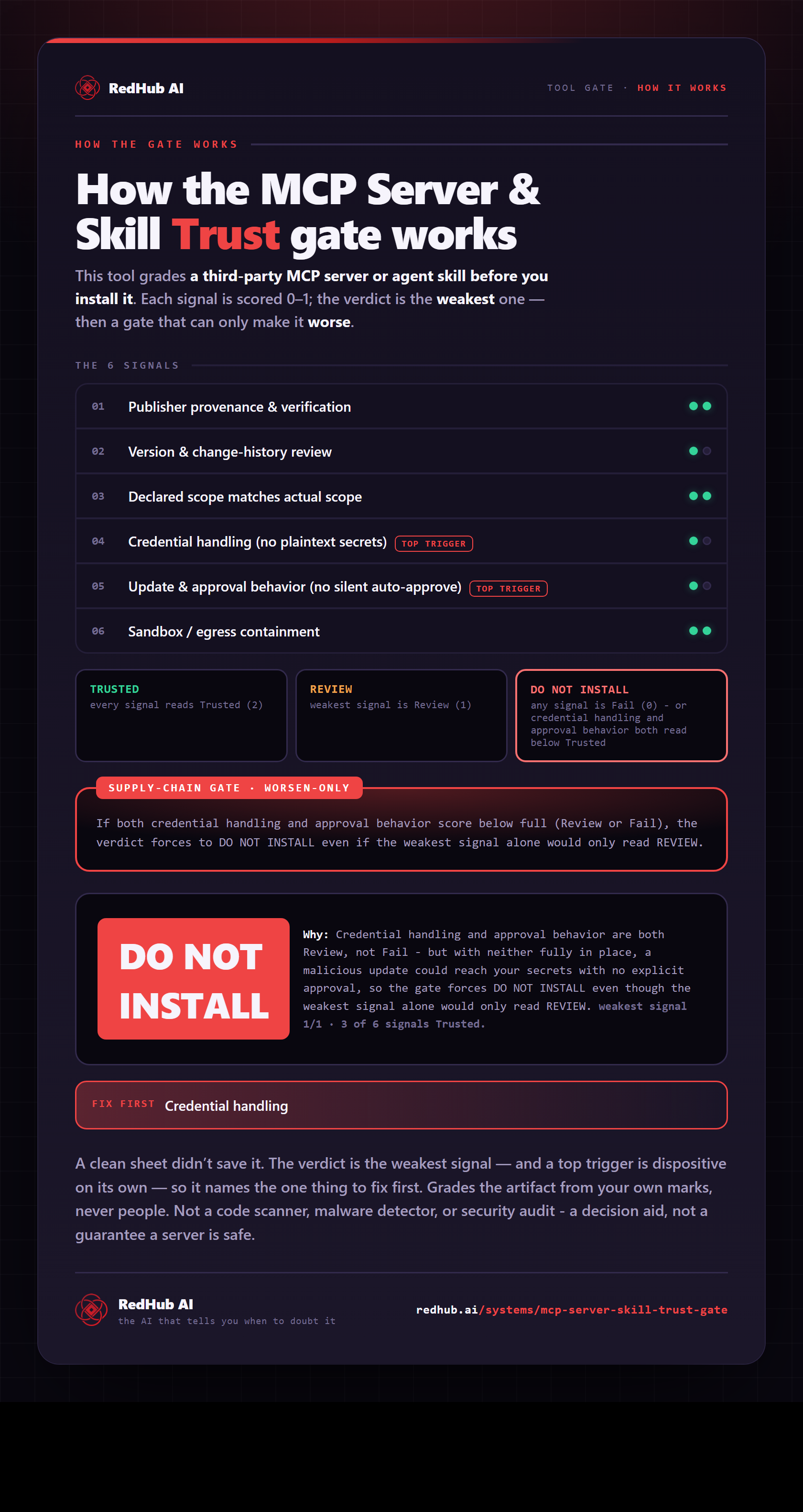
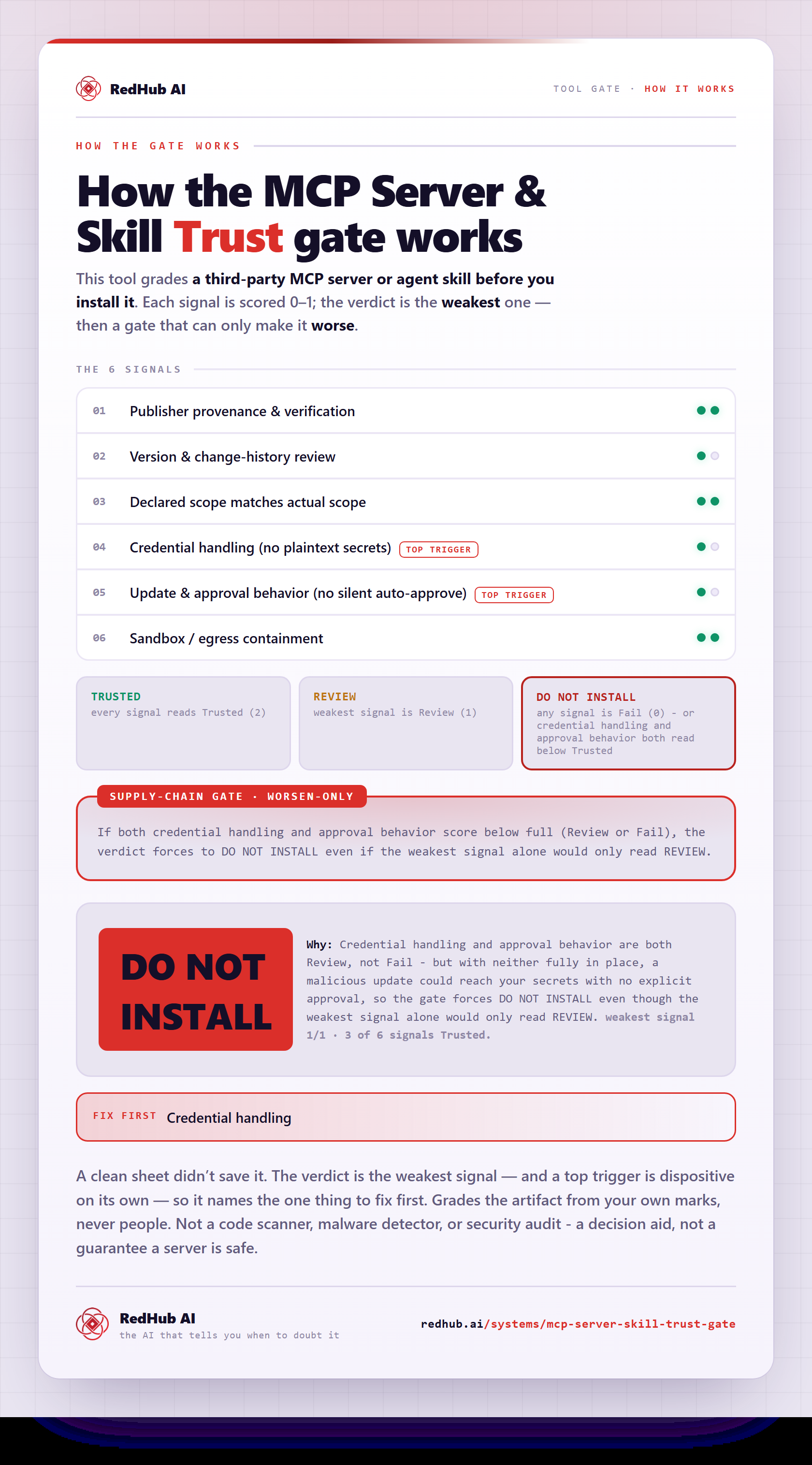
The gate this post refers to, drawn from the tool’s own logic. See the tool.