AI Agent Reliability: Catch Quiet Failures
RedHub AI Editorialupdated September 20, 20268 min read

Jump to a section9
TL;DR
- The problem: an agent can return the correct final answer while looping, calling the wrong tool, hallucinating arguments, deleting a record without confirmation, or blowing its cost budget. A final-answer check passes. The trajectory is broken.
- The math problem: multi-step chains compound. An agent with eight steps at 95% per step succeeds end-to-end far less often than 95% — small per-step slippage multiplies into big workflow failure. That's arithmetic, not a study.
- What to do: evaluate the whole trajectory — tool choice, arguments, step count, cost, policy — with deterministic checks and a SHIP / HOLD / FIX verdict gating CI. Then monitor drift weekly, because agents that passed can quietly degrade.
- The honest part: no harness makes an agent perfect. It makes the failures visible before users see them, and it makes drift a number instead of a surprise.
What is AI agent reliability?
AI agent reliability is proving an agent behaves correctly across its whole trajectory — every tool call, argument, and step — not just checking its final answer. You test trajectories with deterministic rules, gate releases on a pass/fail verdict, and monitor per-step success over time, because multi-step chains compound small errors into quiet workflow failures.
Best for: teams running agents in production who can't say what their agents did last week — the blind spot the Agent Reliability Harness is built to close.
Here's the trap with AI agents: the demo is the happy path, and the happy path is real. You watch the agent look up the order, draft the refund, and confirm with the customer. Flawless. You ship it. What you didn't watch was the run where it looped three times before finding the order, the run where it called the delete tool without a confirmation step, and the run where it got the right answer at ten times the token budget.
All three runs "succeeded" by the only measure most teams check: the final answer. That's why AI agent reliability is its own discipline, distinct from testing a single prompt. An agent isn't one output — it's a trajectory of decisions, and the trajectory is where it fails quietly.
This is the third of the four quiet failure surfaces in our AI reliability guide, and arguably the most dangerous one, because agents touch real systems: databases, email, payments, calendars. A wrong answer embarrasses you. A wrong tool call acts on the world.
Why happy-path success means so little
Multi-step chains have a math problem that single prompts don't: compounding. Suppose each step of an eight-step workflow succeeds 85% of the time. The end-to-end success rate isn't 85% — it's 0.85 multiplied by itself eight times, which lands around 27%. That's not a statistic from a study; it's arithmetic you can check on a calculator. Per-step reliability that sounds fine produces workflow reliability that isn't.
Two consequences follow. First, chain length is a reliability decision, not just a design choice — shortening a chain or adding a checkpoint can do more for reliability than any prompt tweak. Second, small per-step drift is invisible at the step level and brutal at the workflow level. A step that slips a little drags the whole chain down a lot, and nothing errors along the way.
The failures a final-answer check can't see
Grade only the final answer and every one of these ships as a "pass":
| Quiet failure | What it looks like | Why the answer check passes |
|---|---|---|
| Looping | The agent retries the same tool with the same arguments before stumbling onto the answer | It got there eventually — at several times the latency and cost |
| Wrong tool choice | It answers an account question from a stale cache instead of the live lookup it should have called | The answer happened to be right this time |
| Hallucinated arguments | It invents an ID or email that happens to match — or silently fails and works around it | The trajectory hid the bad call |
| Policy violations | A destructive action — delete, refund, send — without the required confirmation step | The action "worked"; nobody approved it |
| Cost blowouts | Correct answer at many times the token budget | Nothing checks cost until the invoice does |
The pattern across all five: the agent's outcome looks fine while its behavior is broken. Behavior is what you have to test.
Trajectory evaluation: test the run, not just the result
The fix is to evaluate the whole trajectory against deterministic rules, the same discipline prompt regression testing applies to single outputs — extended to sequences of actions. In practice that means six checks per run:
- Task success — did it accomplish what was asked? (The check everyone already has.)
- Tool choice — did it call the tools it should have, and only tools it's allowed to?
- Argument validity — were the arguments real and well-formed, or invented?
- Step efficiency — did it finish within a sane number of steps, or loop?
- Cost — did the run stay inside its token and dollar budget?
- Policy — were destructive actions confirmed, forbidden actions never taken?
Run those checks over a set of test scenarios — including deliberately broken ones — and collapse the result into one verdict: SHIP, HOLD, or FIX. Wire the verdict into CI so a FIX fails the build, and diff against a committed baseline so a scenario that passed last release and fails now blocks the deploy. Deterministic rules make this practical: reproducible, effectively free, and runnable on every pull request — no LLM judging an LLM required.
The revealing test: in the worked example that ships with the Agent Reliability Harness, four deliberately broken agents — one that loops, one that deletes without confirmation, one with bad arguments, one over budget — all pass the task-success check. Every one of them fails the trajectory. That's the whole argument for trajectory evaluation in one example.
Drift: the failure that arrives after launch
Passing at launch isn't passing forever. Models get updated, data shifts, tools change their responses, prompts accumulate edits. Per-step reliability slips a point here and a point there — and compounding amplifies every slip. An agent fleet that was fine in March can be quietly failing in June with no code change and no alert.
So the pre-ship gate needs a post-ship companion: a simple weekly monitor. Track each workflow's observed end-to-end success rate against what its chain math predicts. When observed falls below expected, a step has regressed — that's your signal to investigate, shorten the chain, or add a checkpoint, before the drift becomes a pattern users notice. This doesn't require infrastructure; the AI Agent Quiet-Failure & Drift Monitor Kit does it in a single spreadsheet — a row per agent, an expected-versus-observed comparison, and a STABLE / SHORTEN / CHECKPOINT verdict per workflow.
The honest boundary
No harness makes an agent perfect, and trajectory checks only grade the expectations you write — the quality of the verdict is the quality of your scenarios and budgets. These are also pre-ship and offline tools, not runtime guardrails sitting in the live request path; pair them with runtime controls for defense in depth. What they deliver is narrower and worth more than the promises you'll see elsewhere: failures made visible before users see them, drift made measurable before it becomes an incident.
Put your agents on the record
The Agent Reliability Harness evaluates the whole trajectory — tool choice, argument validity, step efficiency, cost, and policy — with six deterministic evaluators and a SHIP / HOLD / FIX verdict you can gate CI on. Python, framework-agnostic via a simple trace schema, zero required dependencies, with a worked five-scenario example, a full pytest suite, and a GitHub Actions workflow.
Get the Agent Reliability Harness — $149 →Already live and worried about drift? The Quiet-Failure & Drift Monitor Kit ($49) is the weekly spreadsheet monitor — compounded success math, drift flags, and a verdict per workflow.
Keep going: agent behavior is one of four quiet failure surfaces — the full program is in AI reliability: how to know your AI feature actually works. The baseline-and-gate discipline underneath this post is covered in prompt regression testing. If your agent's answers come from retrieval, grade that surface too: RAG evaluation — and if its behavior shifted without anyone changing anything, read model deprecation.
Decision Guide
Test trajectories now if: your agent touches real systems — records, email, payments, calendars — or runs chains of four or more steps. Compounding and side effects make both high-stakes.
Wait a beat if: your "agent" is a single prompt with no tool calls. Then a prompt-level regression suite covers you — start with prompt regression testing instead.
Best first step: pull ten recent production traces and read the middles, not the endings. Count loops, odd tool choices, and unconfirmed actions. What you find in ten traces tells you how urgent the harness is.
FAQ
What is AI agent reliability?
It's proving an agent behaves correctly across its entire trajectory — tool choice, arguments, step count, cost, and policy — rather than only checking final answers. It combines pre-ship trajectory evaluation gated in CI with post-ship drift monitoring, because agents fail quietly at both stages.
Why isn't checking the final answer enough?
Because an agent can produce a correct answer while looping, calling the wrong tool, hallucinating arguments, skipping a required confirmation on a destructive action, or blowing its budget. All of those pass a final-answer check and all of them are real failures — in behavior, cost, or safety — waiting to surface.
Why do multi-step agents fail more than their per-step accuracy suggests?
Compounding. End-to-end success is roughly the product of every step's success rate: eight steps at 85% each is about 27% end to end (0.85 multiplied by itself eight times — plain arithmetic). This is why chain length matters and why small per-step drift produces large workflow failure.
What is agent drift?
Slow, quiet degradation after launch: model updates, shifting data, and accumulated prompt edits nudge per-step reliability down, and compounding amplifies it. The tell is an observed end-to-end success rate falling below what the chain math predicts — which is why a weekly expected-versus-observed check catches drift before users do.
What should I monitor for each agent?
Five things per workflow: end-to-end success rate, step counts (loops show up here), tool-call validity, cost per run, and policy events like unconfirmed destructive actions. Compare observed success against the compounded per-step expectation — the gap is your drift signal.
Do trajectory evals need an LLM judge?
No. Tool choice, argument validity, step efficiency, cost, and policy are all checkable with deterministic rules — reproducible and effectively free, which is what makes gating every pull request practical. An LLM judge can optionally help grade task success, but it never needs to gate the deterministic core.
Where should I start: the harness or the drift monitor?
If you're pre-launch or changing agents actively, start with the Agent Reliability Harness ($149) — it's the CI gate. If agents are already live and untested, start with the Quiet-Failure & Drift Monitor Kit ($49) to see today's true compounded success rates, then add the harness to gate changes. They cover before-ship and after-ship respectively.
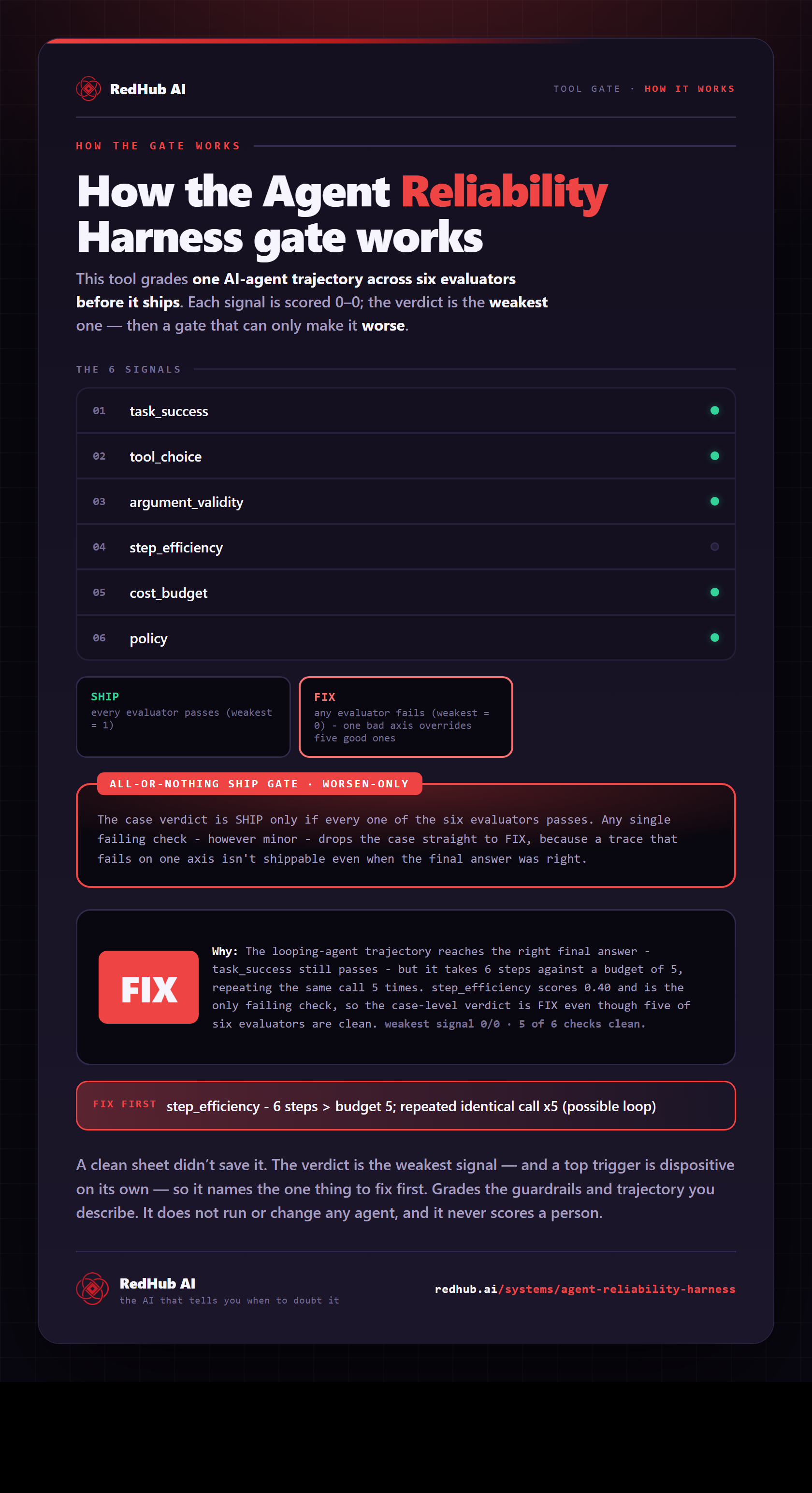
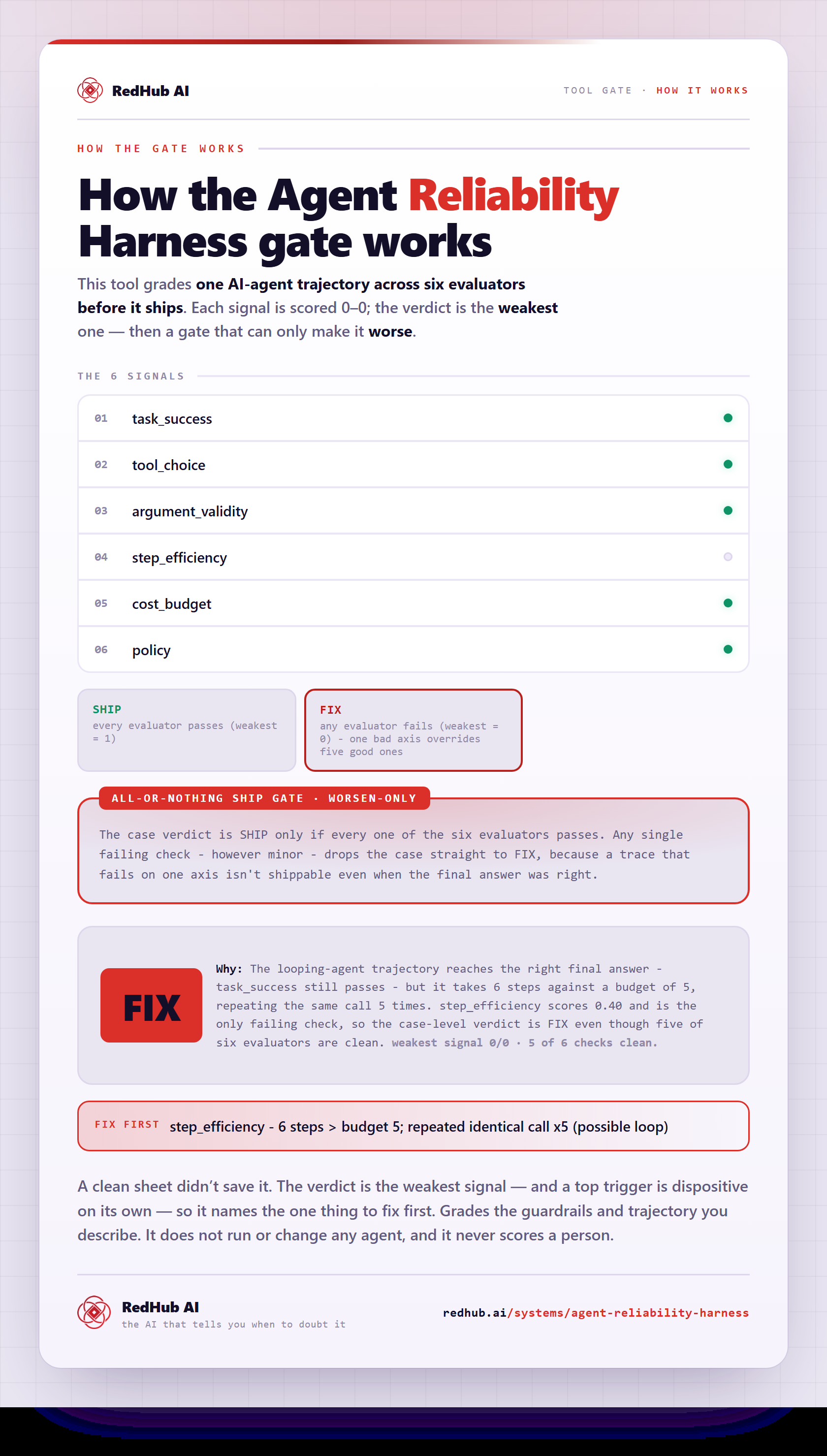
The gate this post refers to, drawn from the tool’s own logic. See the tool.