AI Skill Atrophy: The Slow Version, Explained
RedHub AI Editorialupdated November 5, 20266 min read

Jump to a section7
AI skill atrophy is the worry that relying on AI over months or years dulls a judgment skill you used to exercise on your own. It is a fair question, and the evidence on it is early and contested. Nobody has settled findings worth repeating, so this post will not pretend otherwise. It will name one signal you can watch in yourself without waiting for a research consensus.
TL;DR: Whether AI use erodes judgment over time is unresolved, and no honest post should hand you a number for it. What you can watch now is your confidence on the errors you miss. If atrophy is happening, it would show up first as feeling just as sure while checking less, not as doing less work. A seeded test, repeated on fresh material, gives you a reading of that. RedHub's $69 AI Over-Reliance & Critical-Thinking Check scores such a test, on a passage you or a facilitator write. The response to atrophy is a habit, not a panic.
Say the honest thing about the research first
Long-run effects of relying on any tool are hard to study cleanly, and AI is new. The honest summary of the evidence is: contested and early. You will see confident claims both ways. One says AI makes people sharper by freeing attention for harder work. The other says it makes people duller by removing the practice that built judgment.
Neither has the settled backing that would earn a number in a blog post. A post that offers one anyway does the thing this whole guide warns against: it states a certainty that sounds better than the unresolved truth. So you will get no percentage here, no study name, and no claim about what AI does to your brain. You will get the mechanism, meaning what would have to be true for atrophy to be happening to you, and a way to watch for it.
Why atrophy would not look like doing less work
The intuitive model goes like this: you use AI more, you do less of the task yourself, and you get worse at it, the way a muscle weakens from disuse. That model is not wrong, but it points at the wrong skill. The skill that matters here is judgment, the ability to read something and tell whether it holds up.
Judgment would not fade in an obvious way. It would fade by being exercised less often, without you noticing that the frequency dropped, because each skipped check feels reasonable at the time. If that is the shape of it, the signal is not "am I doing less work." The signal is "am I checking less while feeling just as sure as before."
Confidence that holds steady while checking erodes is what atrophy would look like from the inside. You would not feel yourself getting worse. You would feel as capable as ever until a miss surfaced in something that mattered.
A habit, not a panic
The sensible response to a contested, slow-moving risk is not to swear off AI or rebuild how you work. It is one small habit that gives you a periodic check on yourself, the way you might step on a scale now and then without treating one reading as a crisis. For this risk, the habit is: get a reading of how you do on planted errors, including how sure you were about the ones you missed, and repeat it later on new material.
- Take a baseline on purpose. Read a seeded passage that someone else wrote, flag what looks wrong, and rate your confidence on each planted item. Look at: what you caught, and how sure you felt about the misses.
- Repeat on a schedule with a fresh passage. A passage you have already seen tells you nothing, because you know where the errors are. Look at: whether your misses come with high confidence more or less often than last time.
- If the confident misses grow, add checking back on purpose. The fix is a small, specific change, such as tracing one number per document to its source, not a reversal of how you work. Look at: the smallest habit that would have caught the item you missed.
Measuring the gap, not the trend
RedHub's AI Over-Reliance & Critical-Thinking Check ($69) was not built to prove or disprove skill atrophy, and no single test could settle a long-run question. What it gives you is a reading you can act on. It scores six planted errors, weighted by type with a fabricated statistic worth 30 of 100 points, and returns INDEPENDENT, ASSISTED or RELIANT. For this question, the useful part is the confidence rating from 1 to 5 on every item. A 4 or 5 on an item you missed raises an OVERCONFIDENT flag, and the engine names which items tripped it. The flag never changes the verdict. It shows you, on a concrete item, where your confidence ran ahead of your checking.
Two practical points before you rely on it. First, the kit does not include the seeded passage. You or a facilitator write it from the error types in its guides, and someone other than the reader should do the writing. Second, a repeat needs new material. The kit's Facilitator's Guide suggests re-running every 4 to 8 weeks with fresh seeded outputs.
Because each run uses a different passage, two readings are not a precise measurement of change. One passage can be harder than another. Treat a series of readings as a rough trend you observed in yourself, which is still more useful than a fear inferred from a headline.
What this is not saying
This post does not claim AI use degrades judgment. It does not claim the opposite either. It says the answer is unresolved, and that a small, repeatable habit beats both denial and alarm. Training programs, skills assessments and fluency benchmarks are separate questions covered elsewhere on RedHub. This post covers the one thing you can watch in yourself, starting now.
More in this guide
Frequently asked questions
Is AI skill atrophy a proven effect?
No. It is a contested, early question, and no study or percentage in either direction is settled enough to state as fact. The mechanism can be described and watched for, but the outcome is not proven.
What would AI skill atrophy look like day to day?
Not visibly doing less work. The more likely early sign is confidence staying steady while the checking habit erodes, so you miss more while feeling just as sure.
Should I stop using AI to avoid skill atrophy?
No. The reasonable response to an unresolved, slow-moving risk is a small habit, such as periodically testing yourself on planted errors, not avoiding the tool or reacting with alarm.
How often should I test myself for this?
On a regular schedule, with a new passage each time. RedHub's AI Over-Reliance & Critical-Thinking Check suggests re-running every 4 to 8 weeks with fresh seeded material, because a passage you have seen before no longer tests anything.
Can a single test prove whether my judgment has atrophied?
No. One test gives a baseline: what you caught on one seeded passage and how sure you were about what you missed. It becomes useful when compared with later readings on new passages, and even then it is a rough trend, because passages differ in difficulty.
Is this the same as measuring AI skill or fluency levels?
No. This is about your checking habit and how your confidence tracks it over time, not a general skills assessment or fluency benchmark.
What does the over-confidence flag have to do with atrophy?
In RedHub's AI Over-Reliance & Critical-Thinking Check, a confidence rating of 4 or 5 on an item you missed raises an OVERCONFIDENT flag. Watching how often that happens across repeated tests on fresh passages is a direct way to watch for confidence drifting away from checking.
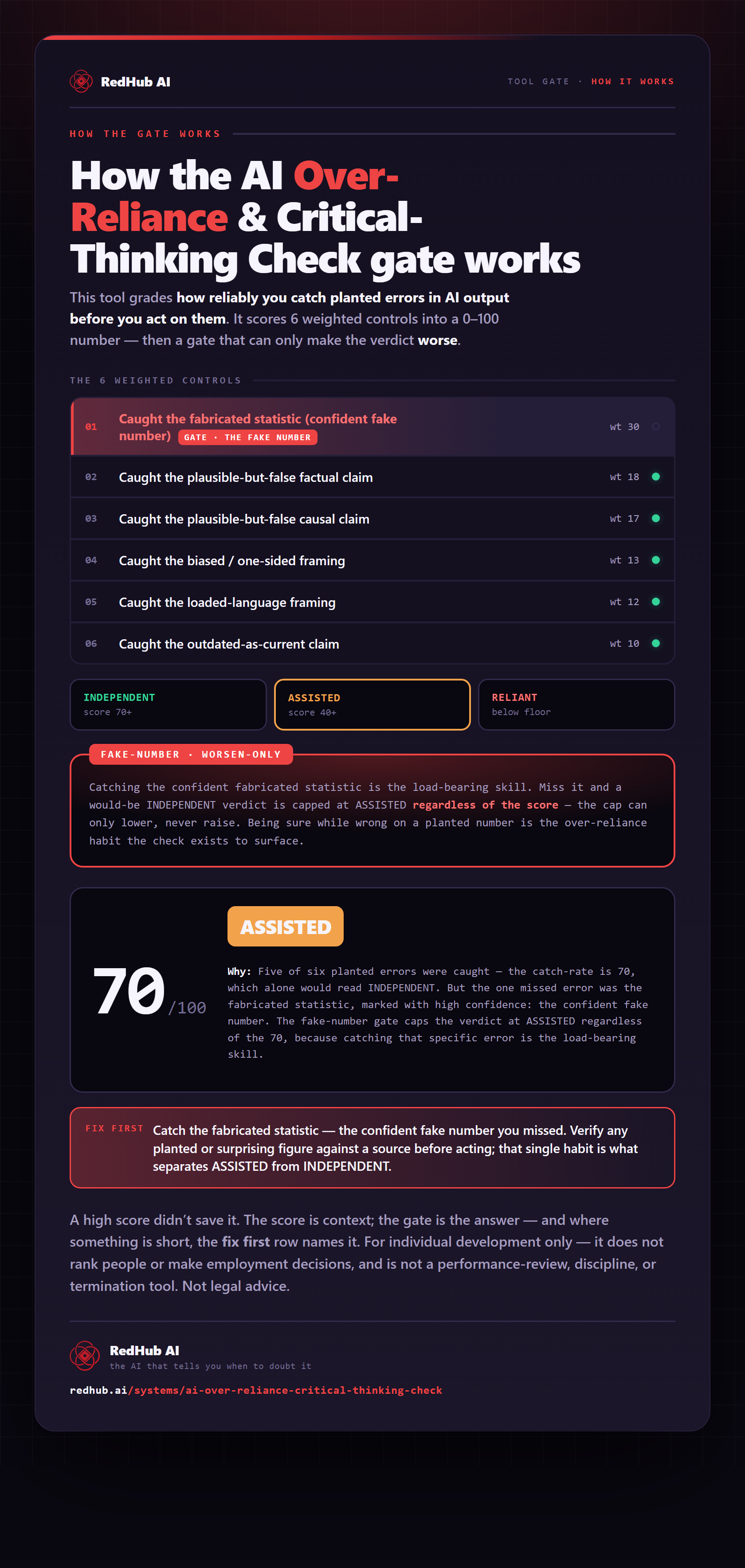
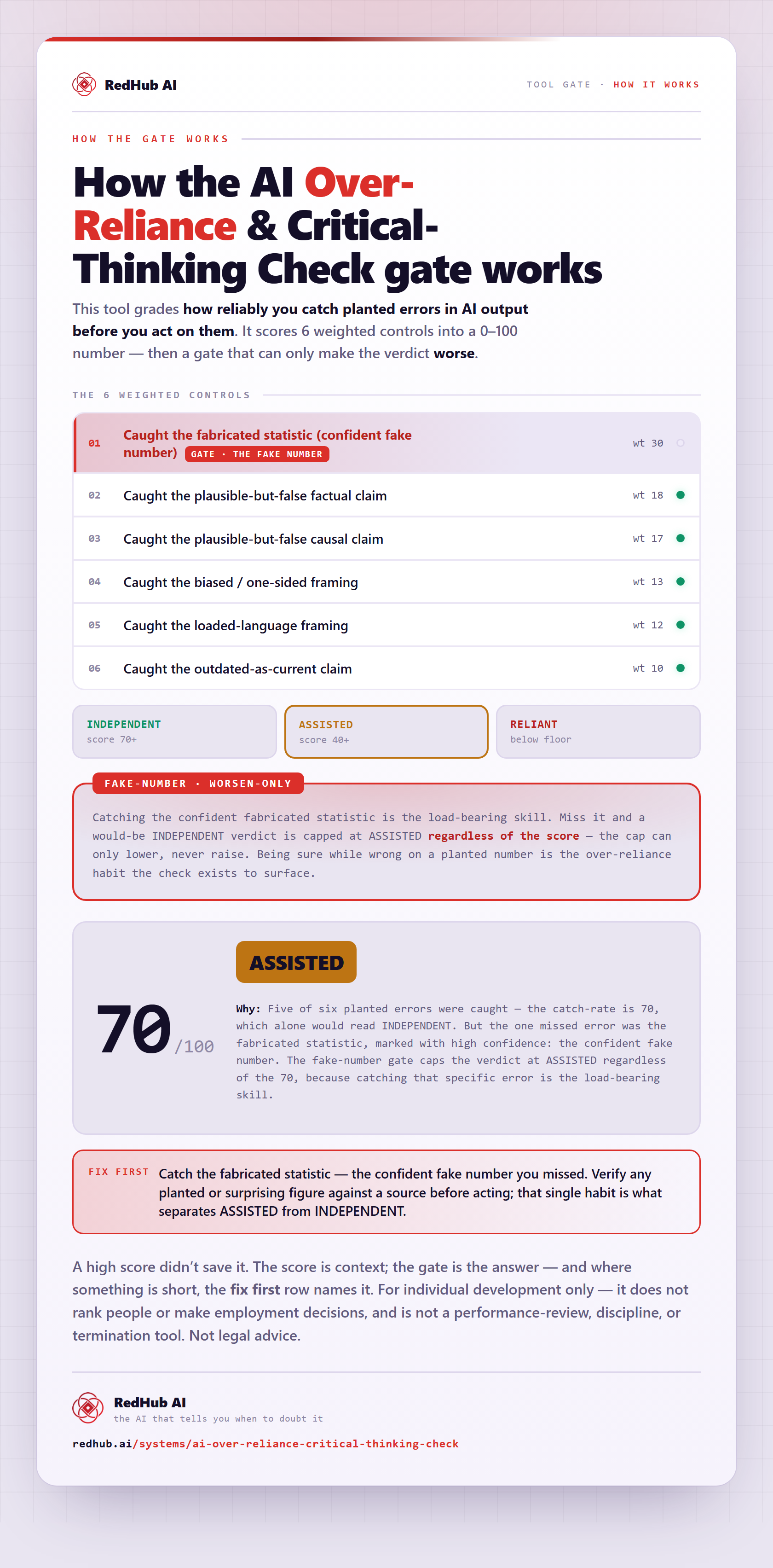
The gate this post refers to, drawn from the tool’s own logic. See the tool.