When Not to Use AI: A Decision Rule, Not a Blanket Rule
RedHub AI Editorialupdated November 5, 20267 min read

Jump to a section8
Deciding when not to use AI starts with a better question. "Should I use AI here" gets a yes on most tasks, because AI is fast and the task usually tolerates a small error. The question that protects you is narrower: if this output is confidently wrong and nobody catches it, what does that cost? Ask that, and the few tasks where AI needs a harder check, or no role at all, stand out.
TL;DR: This is not an anti-AI post. The decision rule weighs the time AI saves against what a confident, uncaught error would cost you on this specific task. When that cost is high and hard to reverse, skip AI for that step or verify it harder than usual. The rule also depends on how reliably you catch errors, which most people have never tested. RedHub's $69 AI Over-Reliance & Critical-Thinking Check scores that on a seeded passage you or a facilitator write.
Why "should I use AI" is the wrong question
Asked as a yes-or-no about the tool, most tasks clear the bar. For drafting, summarizing, brainstorming and restructuring, the usual worst case of a small error is a quick edit. Ask task by task and you will say yes nearly every time, and for most tasks that is fine.
The trouble is the few tasks that are not like the others. A blanket yes treats them the same as everything else. The better question isolates them: what happens if this particular output is wrong and nobody catches it before it matters? The answer changes by task, even when the AI performs the same on all of them.
The two variables that matter
Two things put a task in the careful category, and neither is how capable the AI is:
- How likely an error is to go uncaught. A draft a colleague reads and edits has a catch built in. A number that goes straight into a client document with no other reviewer has none.
- How costly an uncaught error would be. A wrong word in an internal note costs almost nothing. A wrong figure in a proposal, a false claim in something published, or a wrong summary you act on can cost time, credibility or money to unwind.
Put those two together, roughly, and you have the risk of using AI on a given task. The cost is a property of the task, not of the tool: how likely a miss is to slip through, times how bad it is if it does.
Where this plays out
| Situation | Cost if wrong and uncaught | What that suggests |
|---|---|---|
| Internal draft another person will read and edit | Low. A check already exists | Use AI freely and edit normally |
| A specific number going into a client document | High. Wrong figures are hard to walk back | Trace the number to a real source before it ships, every time |
| A first pass at brainstorming options | Low. You will weigh the options yourself | Use AI freely |
| A summary you will act on without reading the source | High. The summary becomes your only version of the facts | Open the source too, or read the summary as critically as the source |
| A decision that is expensive or slow to reverse | Very high. The error compounds before anyone notices | Do not let AI output be the last check before you commit |
AI quality is not a column in that table. The same model, performing the same way, sits at the use-freely end for one task and the verify-hard end for another, purely because of what happens downstream if it is wrong.
A three-question filter before you rely on AI output
- Will another person or process catch an error before it matters? If yes, the safety net exists and you can move faster. Look at: whether that check is a real habit on your team or something everyone assumes someone else does.
- Can this be reversed if it turns out wrong? A wrong sentence in a draft takes seconds to fix. A number quoted to a client, or a decision already acted on, does not. Look at: how long a walk-back would take and who would need to be told.
- Does it contain a specific fact, figure or claim someone could repeat? That is the category most likely to travel if wrong, so it gets the most scrutiny however confident it reads. Look at: every number and every attribution, before anything else in the draft.
If the answers come back as no catch, hard to reverse, and a specific claim, that is the task to treat differently. Skip AI for that step, or verify its output the way you would verify a claim from any unvetted source, because that is what it is.
The rule only works if you know your own catch rate
The filter assumes you can estimate how likely you are to catch an error when you look. That estimate is usually a guess, because few people have ever read material with known errors in it and counted what they caught. The way to replace the guess is a seeded test: someone plants errors in an AI-style draft, you review it without knowing where they are, and you count.
RedHub's AI Over-Reliance & Critical-Thinking Check ($69) scores that test. It names six errors to plant, including a fabricated statistic weighted at 30 of 100 points, and turns your catches into INDEPENDENT, ASSISTED or RELIANT. A confidence of 4 or 5 on anything you missed adds an OVERCONFIDENT flag. The kit does not include the seeded passage. You or a facilitator write it from its guides, and someone other than the reader should write it.
The result feeds straight back into the filter. If you caught less than you expected, or missed something you felt sure about, move more tasks toward the verify-hard end of the table. One passage is one reading, so treat it as a calibration point rather than a final word on your judgment.
This is not an argument against AI
None of this means avoiding AI broadly. Most tasks are cheap to fix if AI gets something wrong, and for those, using it and moving fast is the right call. The point is narrower. A small number of tasks carry real cost if a confident, wrong answer slips through, and those deserve a deliberate decision instead of the default yes. If you are writing team rules on where AI is and is not appropriate, RedHub's AI Governance & Acceptable Use Starter Kit ($39) has editable starting templates for an acceptable use policy and employee usage guidelines. That is a separate job from the individual habit this post is about.
More in this guide
Frequently asked questions
When should you not use AI?
When an error would likely go uncaught and would be costly or hard to reverse. The deciding factor is what happens downstream if this specific output is wrong, not how capable the AI is in general.
Is this a case against using AI?
No. Most tasks are cheap to fix if AI gets something wrong, and for those, using it and moving fast is the right call. The rule is for the smaller set of tasks where an uncaught error is expensive.
What is the decision rule?
Ask what it costs you if this output is confidently wrong and you do not catch it. If the answer is expensive, hard to reverse, or involves a specific claim someone could repeat, verify hard or skip AI for that step.
How do I know how good I am at catching AI errors?
Test it with a seeded passage: someone plants known errors in an AI-style draft and you count what you catch. RedHub's AI Over-Reliance & Critical-Thinking Check scores six planted errors from your marks. The kit does not include the passage. You or a facilitator write it.
What kinds of AI output deserve the most scrutiny?
Anything with a specific, quotable fact or figure, and anything that goes out without another person reviewing it. Those combine the highest chance of an error slipping through with the highest cost if it does.
Does a reversible mistake still matter?
Less than an irreversible one, but fixing it still takes time. The rule weighs relative cost: how hard something is to walk back against how much time AI saved you on it.
Is this the same as writing a company AI policy?
No, though they are related. This is an individual decision rule for one task at a time. A written team policy on where AI is and is not appropriate is a separate document, such as the templates in RedHub's AI Governance & Acceptable Use Starter Kit.
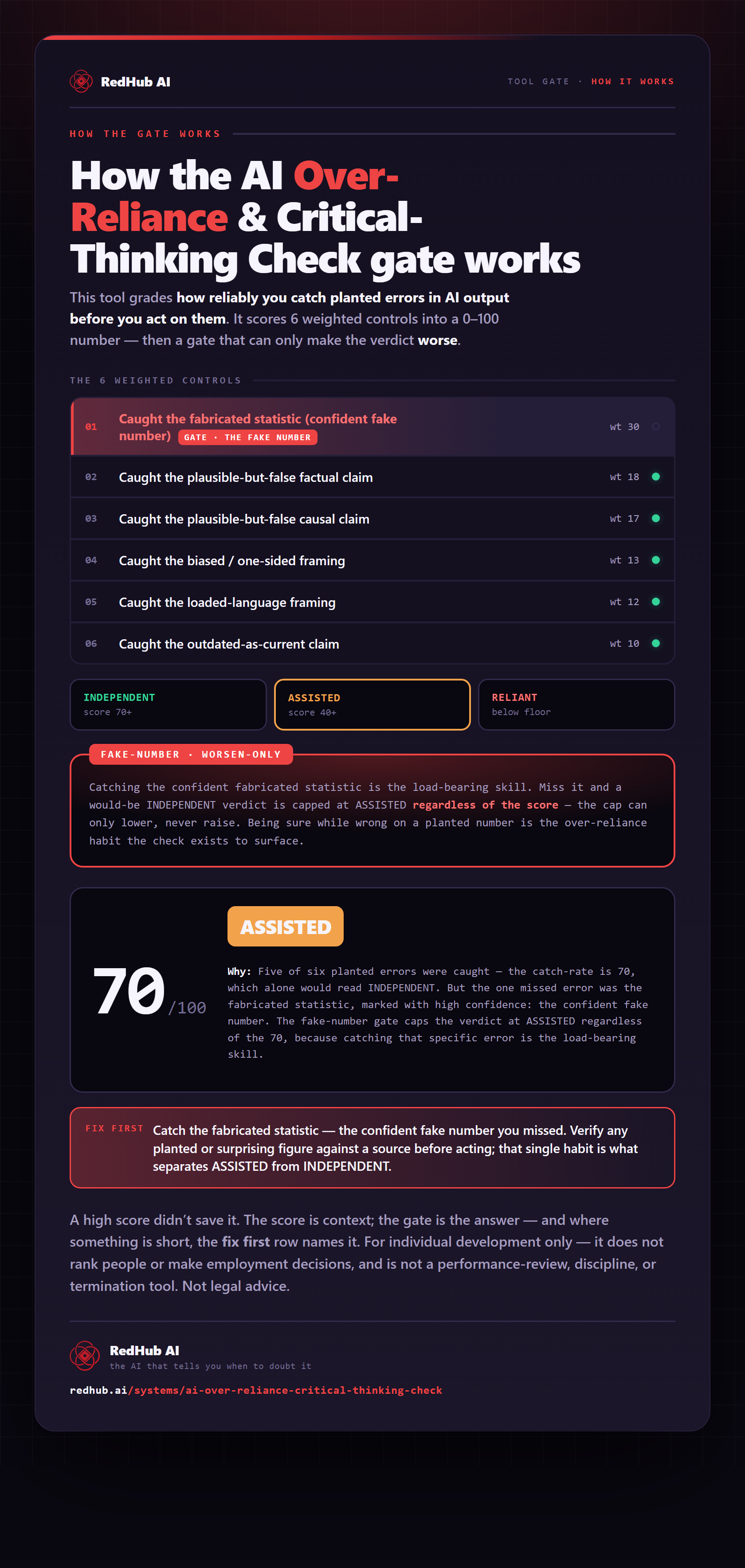
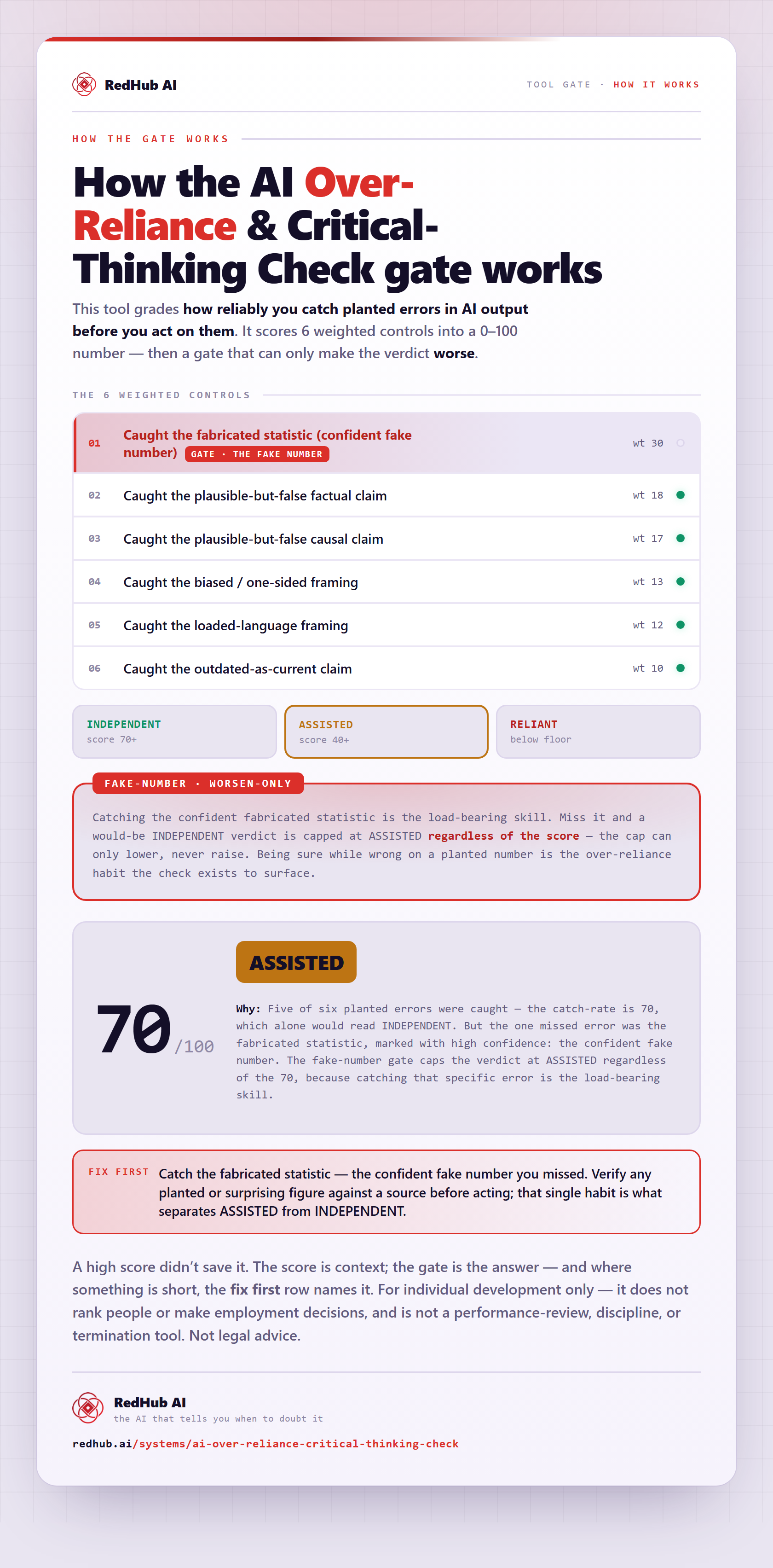
The gate this post refers to, drawn from the tool’s own logic. See the tool.