AI Over-Reliance: What It Actually Looks Like
RedHub AI Editorialupdated November 5, 20269 min read

Jump to a section9
AI over reliance is accepting AI output you never checked. You asked for a draft, skimmed the first line, liked the tone, and sent it with your name on it. How much you use AI has little to do with it. Two people can use the same tool all day, and only the one who skips the check is over-relying. The way to find out which one you are is to read a draft with errors planted in it and count what you catch.
TL;DR: AI over-reliance is a missing check, and heavy use alone does not cause it. The test for it is a passage of AI text with errors planted on purpose, read by someone who does not know where they are. The error that matters most is a fabricated statistic, because it is the line most likely to be copied forward. The pattern worth watching is being sure about an error you missed. RedHub's $69 AI Over-Reliance & Critical-Thinking Check scores that test from your own marks. You or a facilitator write the seeded passage, and the kit supplies the scoring, the guides and the method. It is for individual development and training planning only.
Over-reliance is a reading problem
Ask people whether they over-rely on AI and most answer with a usage number: hours a day, tools, tasks handed off. That measures the wrong thing. Two people can use AI the same way, with the same prompts and the same volume of output. One reads every draft as if a stranger wrote it. The other treats the first version as close enough. The difference never shows up in usage logs. It shows up in the minutes between the AI producing text and the human sending it.
That gap is where the risk sits. AI output reads fluent whether or not it is accurate. A wrong number, an invented quote and a cause-and-effect claim nobody tested all arrive in the same clean sentences as the true material. Nothing on the surface warns you. The only thing between a fabrication and a sent document is a person who checked it.
Where it shows up
From the outside, over-reliance looks like speed. A few common shapes:
- The stat that made the deck. The AI produces a percentage or a market size that fits the point, and it lands on a slide because it fit, not because anyone traced it.
- The summary nobody compared to its source. A long document becomes three bullets. The bullets get used. Nobody reopens the original to see whether the compression was fair.
- The framing that rode along. The draft leans toward the more dramatic reading or the more confident conclusion, and it passes as neutral because the voice is neutral.
- The clean email with one wrong fact. The writing was good enough to lower everyone's guard, including the sender's.
None of these need heavy AI use. All of them share one missing step: someone read the output for tone and moved on.
The one test that separates over-reliance from ordinary use
You cannot measure over-reliance by watching someone use a tool. You have to hand them output with known errors in it and see what they catch. That is the design of RedHub's AI Over-Reliance & Critical-Thinking Check ($69, one-time). It scores six planted errors, each with a fixed weight. The weights add to 100, so your weighted catches are your score.
| Item | What is planted | Weight |
|---|---|---|
| S1 | A fabricated statistic: a confident, invented number | 30 |
| S2 | A plausible but false factual claim | 18 |
| S3 | A plausible but false causal claim | 17 |
| S4 | Biased, one-sided framing | 13 |
| S5 | Loaded-language framing | 12 |
| S6 | An outdated fact stated as current | 10 |
One thing to know before you buy: the kit does not include the seeded passage. Its Facilitator's Guide describes the three error types you seed and tells you to give every reader the same seeded output without saying how many errors it holds. The product page shows one example line for each of the six items. Someone who is not the reader has to write the passage, because a test you planted yourself has no surprises left in it.
How the score turns into a verdict
| Verdict | Score | What it says about that read |
|---|---|---|
| INDEPENDENT | 70 and above, with S1 caught | Most planted errors were caught, including the fake number |
| ASSISTED | 40 to 69, or 70 with S1 missed | Some errors were caught and others went through. Verify before acting |
| RELIANT | Under 40 | Most planted errors went through |
The fabricated statistic carries 30 of the 100 points, and it also works as a gate: miss it and the verdict cannot be INDEPENDENT. Do the arithmetic and you see when the gate matters. The other five items weigh 70 together. Miss S1 and miss anything else, and you are already under 70. The gate decides exactly one case: a reader who caught all five other errors and waved the fake number through. That reader scores 70 and gets ASSISTED. The cap only lowers a would-be INDEPENDENT. It never lifts a RELIANT.
Confidence is the second variable
Missing something is ordinary. The Check also asks for a confidence rating from 1 to 5 on every one of the six items. Rate a 4 or 5 on an item you missed and the result carries an OVERCONFIDENT flag. The engine names the items that tripped it, and the workbook shows how many there were.
The flag never changes the verdict. It sits beside it. It separates an ordinary miss from a confident one, and sure-and-wrong is the over-reliance pattern. It is what lets a wrong number reach a client: the person who missed it felt no reason to look again.
The kit's sample file shows how the two signals combine. One of its six example learners caught five of the six errors, missed only the fabricated statistic, and rated that miss a 5. The engine prints 70%, ASSISTED, the gate note, and an OVERCONFIDENT flag on S1. A 70 that reads as a pass is a reader who trusted the most dangerous line on the page.
- Have someone else write the seeded passage. One AI-style draft on a topic the reader knows, with the six planted items in it. Look at: whether each plant is checkable by the reader with the time and sources they normally have.
- Read it cold and flag what looks wrong. Do not say how many errors are in it. Look at: what the reader flags, and how sure they were about each of the six items.
- Mark each item and read the verdict, then the flag. Enter caught yes or no and a confidence from 1 to 5 per item in the workbook. Look at: whether the fake number was caught, and whether any miss was rated 4 or 5.
- Pick one habit to change. Not a training plan. One thing you will check on the next AI draft before you accept it. Look at: the Over-Reliance Field Guide in the kit for a starting list, such as demanding a source for every AI-supplied number.
What ships in the kit, and its limits
The download holds a self-scoring Excel workbook that grades one person, a Python scoring engine with no dependencies beyond Python 3.8, a sample file of six example learners' marks, a Facilitator's Guide for running it with a group in about 30 minutes, and the Over-Reliance Field Guide on catching each error type. The engine reads a CSV of everyone's marks. It refuses a blank or malformed mark and names the learner and column, rather than reading a blank as a miss.
For a group, the engine adds a team line. The team verdict is the weakest individual verdict, not the average, and it names the error type the group missed most often so you know what to train next. In the kit's sample, the mean catch score is 70% and the team verdict is TEAM RELIANT, because one of the six readers caught only 27%. The team line exists to choose what to practice next.
The limits are worth stating plainly. The score covers six planted items in one passage, so it describes that read and nothing broader. The caught marks are entered by hand, so the score is only as honest as the marking. And the result depends on the passage: the weights are fixed by error type, not by how hard each plant was to spot, so two passages can grade the same reader differently.
What this does not measure
The topic invites overreach, so here is the boundary. This is not a test of general skill with AI tools. That is a fluency question, covered below. It is not a content-quality or AI-detection tool. It does not measure how much time AI saves or costs you. The hours spent checking and fixing AI output are the subject of the AI verification tax. It does not test prompt writing. This one question is narrower: when the output in front of you is wrong, do you notice?
The research picture deserves an honest line too. How AI use changes human thinking over the long run is contested and early, and nobody has settled numbers worth quoting. The mechanism is easier to describe: handing off the checking along with the typing. That is the subject of the next post in this guide.
How this fits with AI fluency
The AI Fluency Diagnostic ($79) scores six AI skills, and verification is one of them. If it shows verification as your weak spot, this Check is the deeper look at that one skill. For the wider picture of measuring AI skill across a team, read how to measure AI fluency on your team.
More in this guide
Frequently asked questions
What is AI over-reliance, in one sentence?
It is accepting AI output without checking it. The failure is the missing check, not the amount of AI you use.
Is using AI a lot the same as over-relying on it?
No. Volume of use and the habit of checking are separate. Someone can use AI constantly and catch most of what is wrong in it, and someone can use it rarely and still pass along a fabricated number.
Why does a fabricated statistic matter more than other planted errors?
A confident, specific, wrong number is the most quotable line in a draft. It is the part most likely to be repeated and built on by people who never saw where it came from. In RedHub's AI Over-Reliance & Critical-Thinking Check it carries 30 of 100 points, and missing it rules out the top verdict, INDEPENDENT.
Does RedHub's over-reliance check include the AI text with planted errors?
No. The AI Over-Reliance & Critical-Thinking Check ships the scoring workbook, a Python engine, a Facilitator's Guide and a Field Guide. You or a facilitator write the seeded passage, planting a fabricated statistic, false claims and biased framing, and someone other than the reader should write it.
Does a low score on the check mean someone is bad at their job?
No. The AI Over-Reliance & Critical-Thinking Check scores how many of six planted errors were caught in one passage, for individual development and training planning. It does not certify anyone, rank people against each other, or make employment decisions, and it is not a hiring, promotion, performance-review, discipline, or termination tool.
What is the over-confidence flag, and does it change the verdict?
In RedHub's AI Over-Reliance & Critical-Thinking Check, a confidence rating of 4 or 5 on an item you missed raises an OVERCONFIDENT flag. The flag sits beside the verdict and never changes it.
Does an AI grade the check?
No. The AI Over-Reliance & Critical-Thinking Check is scored by fixed rules in a workbook or a Python script, from the caught and confidence marks entered for each planted item. No model judges the answers.
How is this different from the AI Fluency Diagnostic?
RedHub's AI Fluency Diagnostic scores six AI skills, with verification as one of them. The AI Over-Reliance & Critical-Thinking Check measures that one skill on a seeded passage.
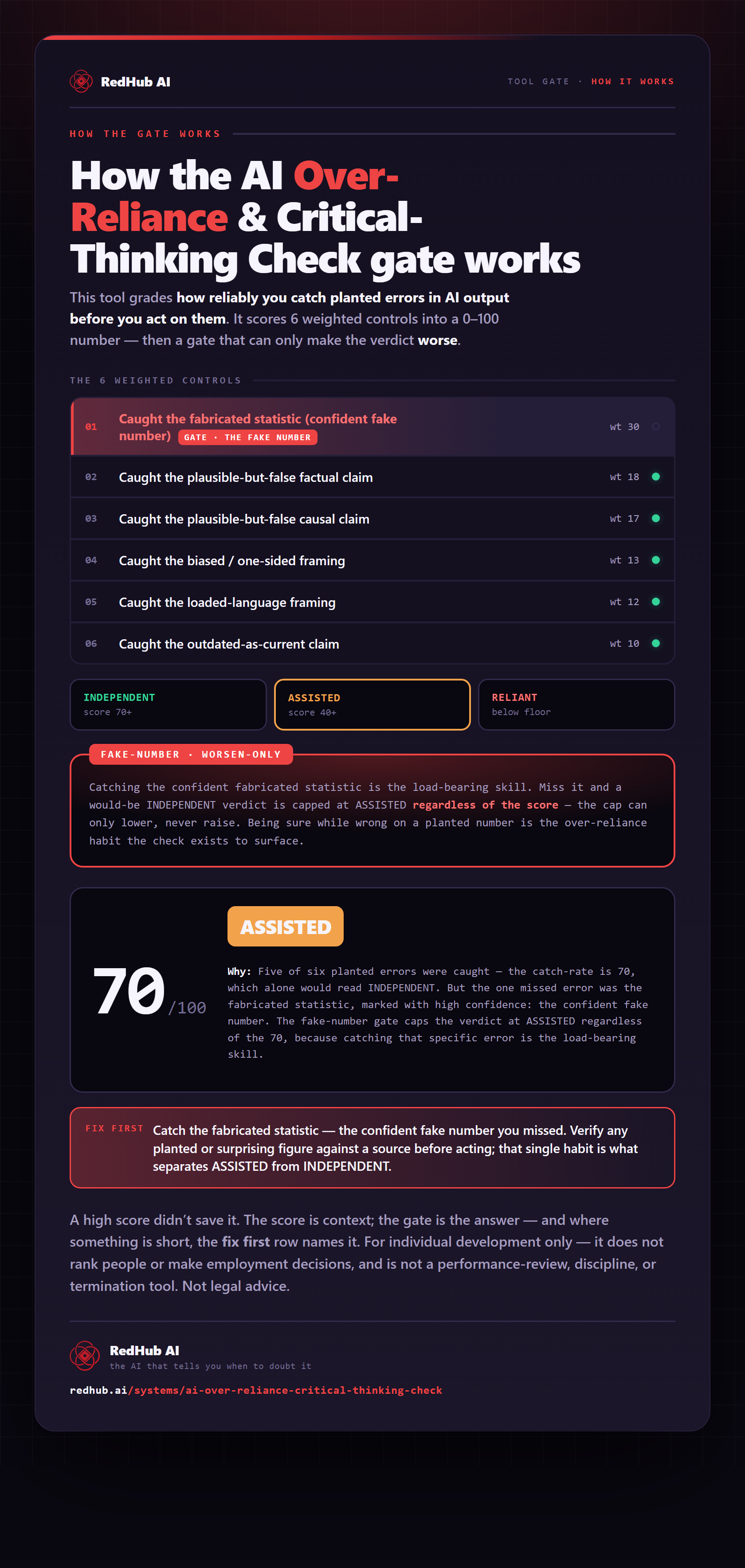
The gate this post refers to, drawn from the tool’s own logic. See the tool.