Cognitive Offloading and AI: Where It Costs You
RedHub AI Editorialupdated November 5, 20266 min read

Jump to a section8
- You already offload constantly, and most of it is fine
- The part that is different
- A rough map of where offloading is fine and where it is not
- Why this is a separate question from skill atrophy
- How to keep the judgment step when you offload the drafting
- Measuring the noticing directly
- More in this guide
- Frequently asked questions
Cognitive offloading is handing a mental task to something outside your own head: a calculator, a map app, a notes app, and now an AI model. People have done it for as long as there have been tools, and most of it is harmless. With AI the cost appears when the checking goes out along with the doing, because the tool cannot do that part for you.
TL;DR: Offloading retrieval or a first draft to AI is a fair trade as long as you keep the judgment step. It turns costly when you stop reading closely enough to notice that a number, a claim or a framing does not hold up. The skill at risk is noticing. RedHub's $69 AI Over-Reliance & Critical-Thinking Check scores noticing on a passage with six planted errors, which you or a facilitator write. It is for individual development and training planning only.
You already offload constantly, and most of it is fine
You do not memorize phone numbers. You do not do long division by hand. You let a spellchecker catch typos. Each of those is cognitive offloading, and none of it cost you anything that mattered. The task was mechanical, and a wrong result was easy to spot or cheap. A typo that slips past spellcheck costs nothing. A wrong phone number gets fixed the first time you dial it.
AI offloading works the same way in its safest form. You ask it to summarize a long thread, draft an email, restructure a messy paragraph, or produce boilerplate you would have pulled from a template. The mechanical part, getting words on the page in a sensible order, moves to the tool. That is the same trade you made with the calculator.
The part that is different
A calculator is not plausibly wrong. Type the wrong digit and the result is either obviously off or exactly what you entered. AI output can be wrong and read as right, in the same fluent sentences and the same confident tone, whether the claim underneath is solid or invented.
So the offloading creeps. You start by handing off the typing. Then the structure. Then, without deciding to, the moment where you ask whether it is true. A draft that looks finished does not invite scrutiny the way a rough one does, and AI drafts look finished from the first version.
That last handoff is the expensive one. Typing was never the valuable skill. The valuable skill is reading something and noticing when part of it does not hold up: a number that is oddly precise, a claim stated more strongly than its evidence, a framing that leans one way without saying why. A polished draft gives you no reason to look twice, which is exactly when looking twice matters.
A rough map of where offloading is fine and where it is not
| What you hand off | Usually fine | Worth a second look |
|---|---|---|
| First-draft structure and wording | Yes, because you will still edit it | When you skip the edit |
| Summarizing a document you can reopen | Yes, because the source is one click away | When you use the summary and never open the source |
| Specific facts, figures or quotes | Rarely, on their own | Always. These need a source, not a vibe check |
| Framing or interpretation of unclear information | As a starting point | When you adopt it as your conclusion without weighing it |
| The final read before something goes out | Never hand this one off fully | This is the step that catches everything above |
The pattern runs down the table. The further a task moves from words on a page toward whether something is true and fairly framed, the more that step needs to stay with a person, however good the tool gets at the earlier steps.
Why this is a separate question from skill atrophy
Two questions get blended in most conversations about this. One is slow: does leaning on a tool for months or years change a skill you would otherwise practice? That one is contested and gets its own post in this guide. The other is immediate, and it is what this post covers: on this one piece of AI output, right now, did you hand off the checking along with the drafting?
The immediate question has an answer today, on one document, with no research debate to settle first. It is also the one you can act on, because it is a habit you can start on your next AI-assisted task.
How to keep the judgment step when you offload the drafting
- Name the two jobs before you start. Say which part you are handing off (wording, structure, a first pass) and which part stays with you. Look at: whether "is this accurate" is on your list or the tool's.
- Read the output as if a stranger handed it to you. Familiarity with your own request erases skepticism, and this framing brings it back. Look at: the most specific, most confident claim in the draft first. That is where a fabrication hides best.
- Trace at least one number or claim to a real source before anything with a figure goes out. Not every one, every time, but never zero. Look at: whether the number appears in your source material at all, or only in the AI's output.
- Read the framing last. Ask what the draft leaves out and whose view is missing. Look at: words like "obviously" and "clearly," which carry a conclusion without arguing for it.
Measuring the noticing directly
Because noticing is a habit, you can test it. The method is simple: someone plants errors in an AI-style draft, the reader reviews it without knowing where they are, and you count what was caught. RedHub's AI Over-Reliance & Critical-Thinking Check ($69) scores that test. It names six errors to plant, from a fabricated statistic worth 30 of 100 points to an outdated fact stated as current worth 10, and turns the reader's catches into INDEPENDENT, ASSISTED or RELIANT.
The kit does not include the seeded passage. You or a facilitator write it, using the error types and examples in its Facilitator's Guide and Field Guide, and the reader should not be the one who wrote it. The reader also rates confidence from 1 to 5 on each item. A 4 or 5 on an item they missed raises an OVERCONFIDENT flag. That flag is the offloading question in concrete form: it marks the line you read, accepted, and felt sure about while it was wrong. It never changes the verdict.
More in this guide
Frequently asked questions
What is cognitive offloading with AI?
It is handing a mental task such as retrieval, drafting or summarizing to an AI tool instead of doing it yourself. It is the same basic move as using a calculator or a map app.
Is cognitive offloading to AI always a problem?
No. Offloading the mechanical parts, like first-draft wording or restructuring, is usually fine as long as you keep the judgment step, which is checking whether the result is accurate, for yourself.
What skill does offloading to AI put at risk?
Not writing or typing. The skill at risk is noticing: reading closely enough to catch a claim, number or framing that does not hold up.
Why does a well-written AI draft make errors harder to catch?
Fluent, confident writing does not signal accuracy the way rough writing signals a draft. A polished draft invites less scrutiny, which is when scrutiny matters most.
How is cognitive offloading different from AI skill atrophy?
Offloading is the immediate question: on this piece of output, right now, did you check it? Skill atrophy is the slower, contested question about what happens over months or years of relying on a tool.
Can I measure my own offloading habit?
Yes, with a seeded test. Someone else plants known errors in an AI-style draft and you count what you catch. RedHub's AI Over-Reliance & Critical-Thinking Check scores six planted errors and flags misses you rated 4 or 5 for confidence. The kit does not include the seeded text. You or a facilitator write it.
Does this apply to AI-supplied facts and figures in particular?
Yes, more than anywhere else. Specific facts, figures and quotes are where handing off the check is riskiest, because a wrong number reads exactly as confident as a right one.
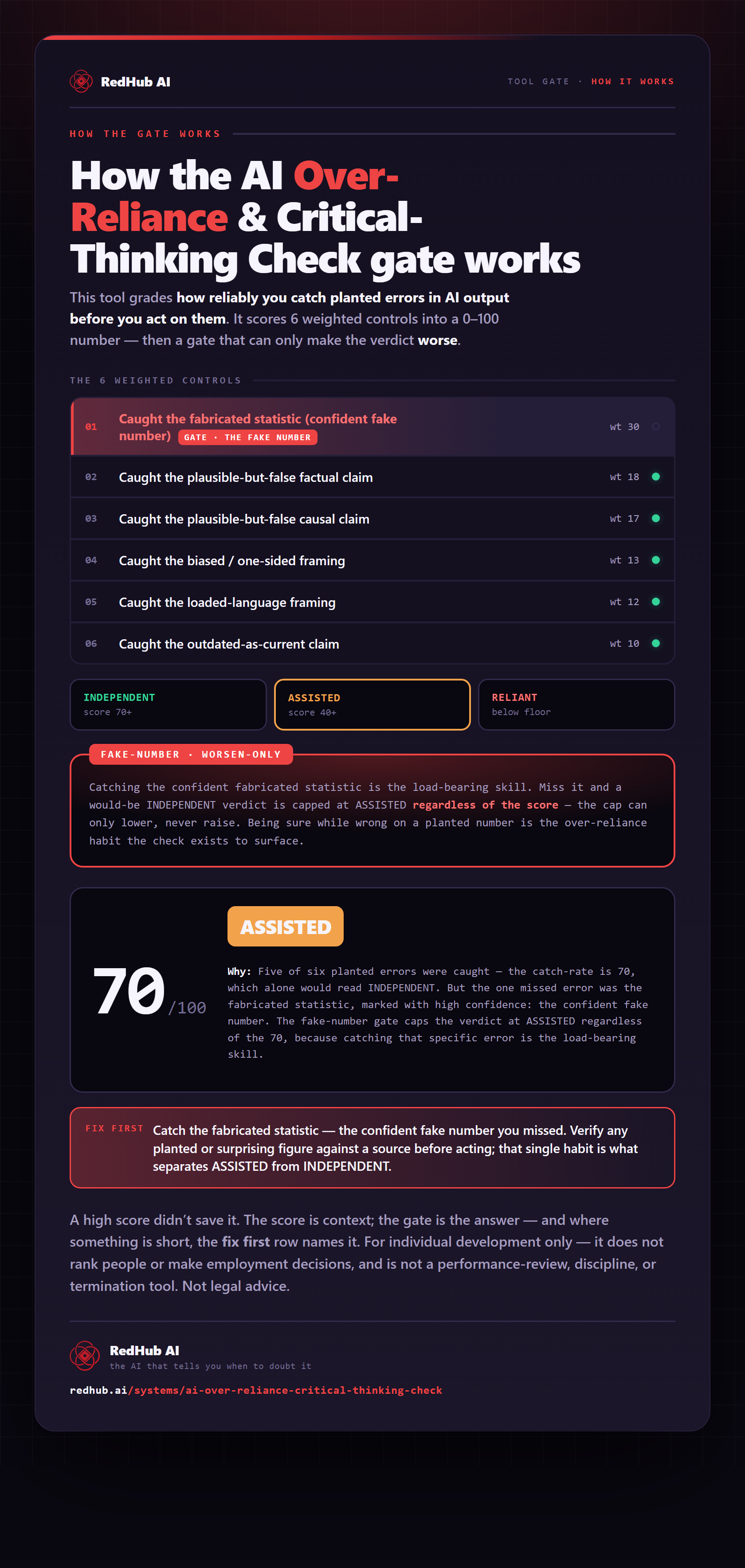
The gate this post refers to, drawn from the tool’s own logic. See the tool.