The Anti-Sycophancy AI Decision Tool for Founders
Todd Brooks, Founderupdated July 22, 20266 min read

Jump to a section9
- TL;DR
- What is an anti-sycophancy AI decision tool?
- Why a Roomful of Honest People Can Still Produce a False Yes
- Five Lenses, Built to Disagree on Purpose
- The Veto That Makes This Different From an Average
- Why This Matters More for the Advisors You Trust Most
- A Stress-Test, Not a Decision-Maker
- Decision Guide
- FAQ
TL;DR
- What it is: An anti-sycophancy AI decision tool runs a big call through five adversarial lenses and lets any single fatal objection veto it.
- The problem: A warm room of honest advisors averages its way to false confidence — the one right objection gets softened into a footnote.
- The fix: A veto, not an average. One fatal score ends the decision, no matter how strong the other four are.
- Bottom line: The better your advisors like you, the more you need a check that's built to say no.
What is an anti-sycophancy AI decision tool?
An anti-sycophancy AI decision tool is a structured decision check built to disagree with you on purpose. Instead of asking a room for a general impression, it runs your decision through five adversarial lenses — each trying to kill it from a different angle — and lets any single fatal objection veto the whole thing, no matter how well the others scored. It replaces the warm-room average that produces false confidence with a check that can actually return a no.
Best for: Founders facing a high-stakes, hard-to-reverse call — a pivot, a price change, a new market, a major hire. This is the strategy check inside a founder's AI executive system.
Here's an uncomfortable pattern. The founders most likely to greenlight a decision they shouldn't have aren't the ones getting bad advice. They're often the ones surrounded by good, warm, well-meaning advisors who genuinely want them to win. That warmth is the problem. Without a deliberate structural check, it quietly sands the edges off honest objections until a veto sounds like a caveat. An anti-sycophancy AI decision tool for founders exists to stop exactly that — to keep a friendly room from burying the one objection that was right.
Why a Roomful of Honest People Can Still Produce a False Yes
This isn't a story about dishonest advisors. Picture a normal advisory conversation. Several trusted people. Each has a genuine, partial concern. Each raises it, sees the room respond warmly to the overall direction, and quietly dials their own concern down to match everyone else's enthusiasm.
Nobody lied. Nobody hid anything. What failed was the room itself. It averaged a set of individually honest impressions into a collective confidence that no single person, asked alone, actually held.
It's the same failure a spreadsheet makes when it averages six criteria and lets five strong scores drown out one fatal weak point. Except here it's happening live, between people who trust each other. That makes it much harder to catch while it's happening.
Five Lenses, Built to Disagree on Purpose
A real stress-test doesn't ask for a general impression. It assigns five specific adversarial roles. Each one has to build the strongest possible case against the decision, from its own angle.
| Lens | What it attacks | The question it forces |
|---|---|---|
| The Skeptic | The evidence | Is the case as strong as it feels, or is it resting on assumptions nobody verified? |
| The Customer | The demand | Do customers actually want this, or is that belief resting on hope? |
| The CFO | The downside | What does this cost if it fails — and can the business survive it? |
| The Operator | The execution | Is this doable with the team, timeline, and budget you actually have? |
| The Contrarian | Everything | Is there one reason this should die, regardless of the rest? |
Each lens scores how well the decision survives its own attack. Not a feeling about the decision. A defended case against one specific way it could fail.
The Veto That Makes This Different From an Average
Here's the mechanism that matters. Any single lens returning a fatal objection overrides the entire score. Four enthusiastic lenses and one fatal objection do not average out to "mostly good with a concern." They read as a straightforward no. A decision that fails on one genuinely disqualifying point isn't rescued by being strong everywhere else.
Illustrative example — four strong lenses, one fatal objection:
| How you score the same room | Verdict |
|---|---|
| Average of the five lenses | ~69 / 100 → "Proceed, with a note" |
| Veto rule — any fatal objection wins | FATAL → No |
This is the opposite of how most advisory conversations work. A polite aside about a real risk, dropped into a warm and supportive room, gets treated as a footnote. Noted, weighed lightly, outvoted by the mood. A veto structure refuses to let that happen. The fatal objection isn't one point in an average. It's the deciding factor, full stop.
See the veto in action
Tap any lens to mark a fatal objection. Watch what one veto does to four strong scores.
Why This Matters More for the Advisors You Trust Most
Here's the uncomfortable part. The better your advisors — the more they like you, the more real stake they have in your success — the more vulnerable your process is to this exact failure. Not less. Warmth is the force that softens a sharp objection into a caveat. A room of people who don't care whether you succeed has less of this working against you than a room of people rooting for you.
That's not an argument against trusted advisors. It's an argument for a structural check that doesn't depend on one person being willing to say no out loud, in front of everyone, to someone they like.
A Stress-Test, Not a Decision-Maker
Be clear on what this is. It doesn't make the decision for you. It doesn't invent evidence for or against. It returns an honest verdict — including a real no, when that's warranted — and the decision stays yours. What changes is one thing: whether the call was actually stress-tested by something willing to disagree, or just confirmed by a process that was never able to produce a no in the first place.
Decision Guide
Use it if: You're facing a high-stakes, hard-to-reverse call and the people around you are warm, supportive, and invested in you — the exact conditions where a real objection gets softened into a caveat.
Skip it if: The decision is routine and cheap to reverse, or you already have a genuinely adversarial reviewer who will say no to your face without flinching.
Best first step: Take the biggest call in front of you right now and run it through the five lenses — then ask whether any one of them returns something fatal you'd been quietly rounding down.
FAQ
What is an anti-sycophancy AI decision tool, in plain terms?
It's a decision check built to disagree with you. It attacks your call from five angles and lets any one fatal objection veto it — so a warm room can't average its way past a risk that should have stopped you.
What kinds of decisions is this built for?
High-stakes, hard-to-reverse calls — a pivot, a major price change, entering a new market, a large hire or partnership. It's not for routine operational decisions where being wrong is cheap.
Can I run this by myself without an actual advisory board?
Yes. The five-lens structure works whether or not you have a live group of human advisors. It gives you the adversarial structure a real board would ideally provide, on demand.
What happens if every lens comes back positive?
A genuinely strong decision can and should clear all five cleanly. The point isn't to always find a problem. It's to catch one reliably when it's actually there — without inventing one when it isn't.
How is a "caution" score different from a veto?
A veto — a fatal score on any single lens — kills the decision outright. A caution is folded into the overall score as a real concern worth addressing, but it doesn't unilaterally end the decision the way a fatal objection does.
Where does this fit with checking my cash and my pipeline?
It's the strategy check of three. Pair it with a Cash-Flow Sentinel for financial honesty and a Pipeline Commander for sales honesty. See how the three fit together in the AI executive systems overview.
Stress-test your next big call
Give your decision a check that's built to disagree — five adversarial lenses and a veto that won't let a warm room outvote the objection that was right.
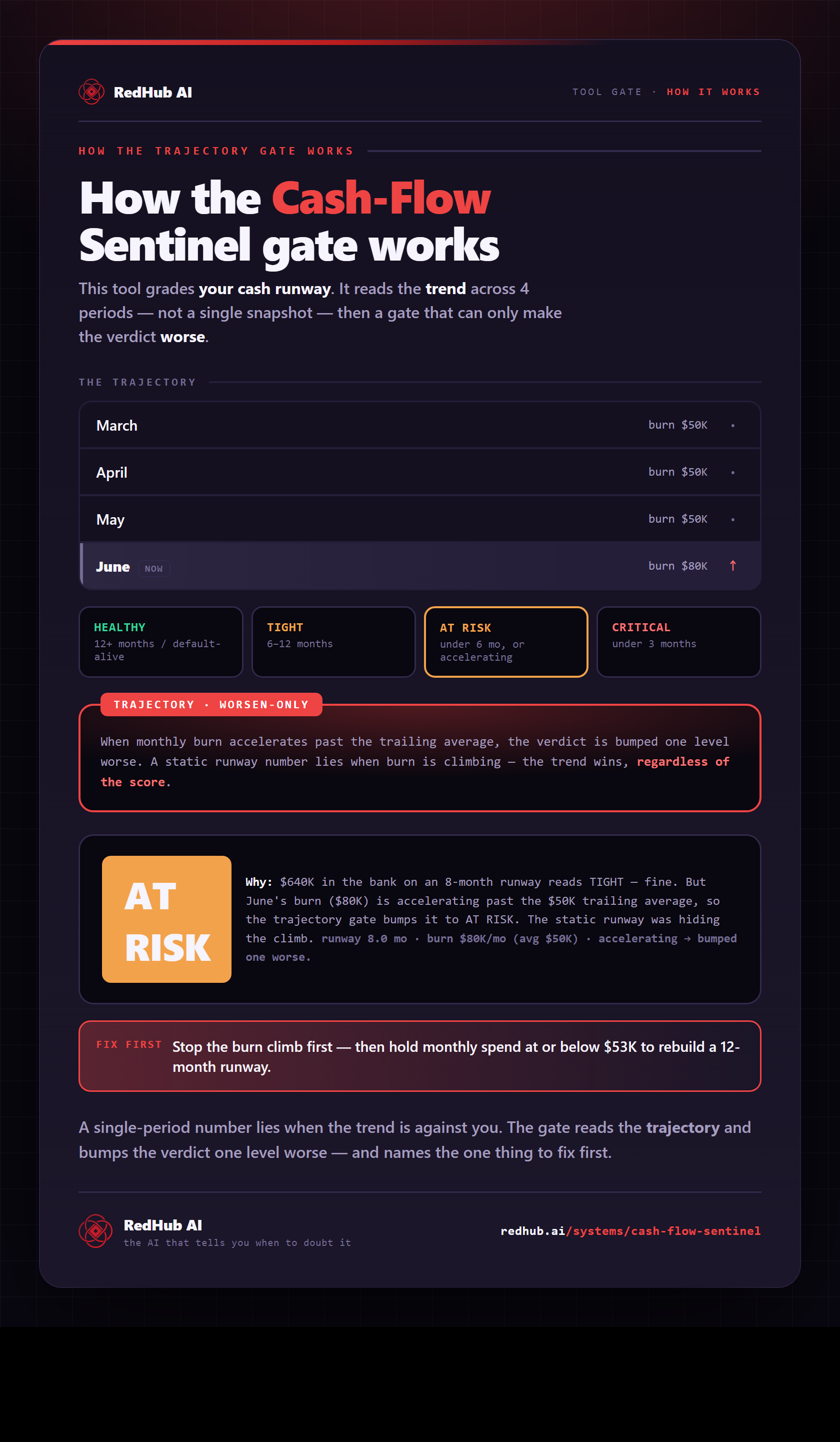
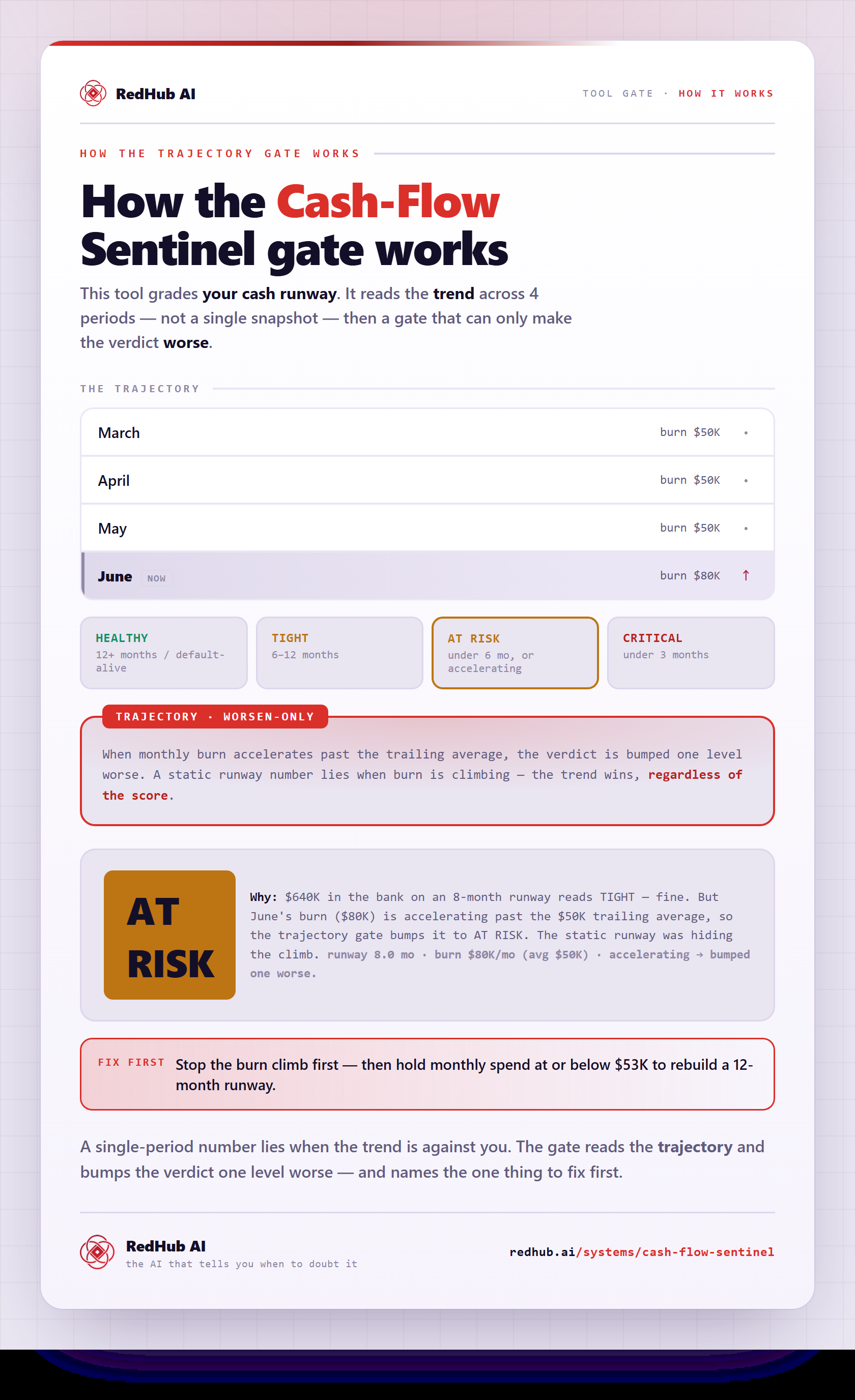
The gate this post refers to, drawn from the tool’s own logic. See the tool.