AI SOPs: How to Turn Any Process Into a Documented System (Fast)
RedHub AI Editorialupdated October 4, 20266 min read

Jump to a section10
- The process exists. The document doesn't.
- Why the documentation day never happens
- How an AI SOP gets made
- The five stages, at a glance
- Three outputs, three different readers
- The automation map is a blueprint, not a verdict
- A documented broken process is still broken
- Where to start, depending on where you're stuck
- Pairs well with
- More in this guide
An AI SOP is a standard operating procedure that AI drafts from a recording of someone doing the real task, instead of from a blank page and a good memory. You narrate the task once, paste the transcript into Claude, and get back numbered steps a new hire can follow. The speed is real. So is the limit: the draft is only as true as the recording, and someone who knows the job still has to check it before anyone relies on it.
TL;DR: Record the task once, talking through each step as you do it. Turn the transcript into a written SOP, then check every step against what you did, because AI can invent a step or drop one. Fix a broken process before you document it; a clean write-up of a bad process makes the mess official. The AI-First SOP Engine ($79) runs this as a prompt chain inside Claude and returns three things from one transcript: a written SOP, a Claude skill and an automation map.
The process exists. The document doesn't.
Every business already runs on procedures: onboarding a client, paying contractors, publishing a post, handling a refund. Most of them live in someone's head or in a Slack thread from the spring. The bookkeeper knows that one client gets invoiced on the 3rd instead of the 1st. Nobody else does, and nothing written down says so.
A new hire can't pick that up. Neither can a contractor or an AI assistant. You can't hand off unwritten work, which is why "I can't delegate this" so often turns out to mean "I never wrote this down."
Why the documentation day never happens
The standard advice is to block out a day, open a template and write every SOP from memory. It loses to the calendar almost every time. Writing from memory is slow, and it fails in a predictable way: you skip the steps you do automatically, because those are the ones you stopped noticing years ago. The second login for the bank portal, the check for a duplicate contact before you create a new one. Those are the steps a new hire misses first.
How an AI SOP gets made
You record yourself doing the task the way you would for a new hire sitting beside you, talking through each click and each judgment call. Any recording you can get a transcript from works: a Loom, a Zoom call, a voice memo run through a transcription app. The transcript becomes the source of truth, because it holds the real order and the real calls you made that day.
The five stages, at a glance
| Stage | Input | Output |
|---|---|---|
| 1. Record | You, doing the task, narrated | A recording and its transcript |
| 2. Structure | The transcript | A numbered SOP with a trigger, an owner and decision branches |
| 3. Check | The draft, beside the recording | An SOP someone who does the job has confirmed |
| 4. Package | The checked SOP | A Claude skill: a SKILL.md folder Claude can load |
| 5. Map | The checked SOP and your tool stack | An automation map: the flows the SOP could trigger, as a blueprint |
If the skill format is new to you, our explainer on Claude Agent Skills covers what a skill is and where it loads.
Three outputs, three different readers
The written SOP is for a person. The Claude skill is for Claude. The automation map is for whoever builds your automations in n8n, Zapier, Make, GoHighLevel or HubSpot. Each reader fails differently when a step is vague. A person improvises. A builder asks you. An AI agent has nobody to ask, so it guesses, loops or keeps going.
That last gap is easy to miss, because a step that works fine for your team can strand an agent. The sample refund SOP that ships with RedHub's Agent-Executable SOP Readiness Gate scores 96 out of 100 and still fails. The step that issues the refund gives an agent no way to stop and escalate if the payment fails. A trained employee would walk over and ask. So an SOP your staff follows well has not yet shown that Claude can run it. The only real evidence is running the skill on past cases and reading what it did.
The automation map is a blueprint, not a verdict
For each flow, the map names the trigger, the steps, the field mappings and the failure handling, routed to the tools you said you use. It does not build the flow. It also does not decide whether a step should be automated at all. That call is yours, and some steps are cheap to automate and expensive to get wrong: a refund that fires twice costs more than the minutes it saved. Our guide to delegate, automate or eliminate walks through how to sort them.
A documented broken process is still broken
Writing a process down does not fix it. Say client onboarding has seven steps, and three exist only because of a tool you dropped last year. A clean SOP makes those three steps look official, and the next hire will follow them faithfully. Fix the process, then record it. An AI SOP speeds up the writing. It has no opinion on whether the process is any good.
The check after drafting matters just as much. AI can add a step that never happened in the recording, or fold two steps that matter into one. The person who does the task should read the draft with the transcript open, line by line, before it reaches a new hire or a client.
Where to start, depending on where you're stuck
- Stuck on what a good SOP looks like: How to Write an SOP That People Actually Follow
- Stuck on the time it takes: How to Document a Process Without Spending Days on It
- Want a format to fill in: SOP Templates vs AI: Why a Template Alone Doesn't Get Used
- Have SOPs but the work still comes back to you: How to Turn SOPs Into Real Delegation
One transcript in, three artifacts out
The AI-First SOP Engine is a structured prompt chain you run inside Claude. Paste a transcript and it returns a written SOP (trigger, owner, time to complete, numbered steps with decision branches, escalation criteria), a Claude skill as a SKILL.md folder, and an automation map for n8n, Zapier, Make, GHL or HubSpot. The map is a build plan; you build the flows.
Get the AI-First SOP Engine — $79Pairs well with
Before you hand a documented process to an agent, the Agent-Executable SOP Readiness Gate ($79) grades the SOP step by step on whether an agent could run it unattended and returns RUNNABLE, TIGHTEN or NOT EXECUTABLE. The Agent Use-Case Fit & Proof-of-Value Gate ($99) asks the earlier question, whether that agent is worth building at all, and returns BUILD, PILOT FIRST or DON'T BUILD. Once the processes behind your numbers are written down, the Operating Cadence Engine ($299) sends a one-page operating report to your own inbox every Monday and grades each tracked area ON TRACK, WATCH or OFF TRACK.
More in this guide
What is an AI SOP?
A standard operating procedure that AI drafts from a recording or transcript of someone doing the task. A person then checks the draft against the recording before anyone uses it.
Do I need a template before I start?
No. You start by recording the task, and the AI applies the structure. A template gives you a blank shape; the recording gives you the content that goes in it.
How long does the recording need to be?
As long as the task takes once through. Coverage counts for more than length: if the task has a common exception, record a run where it happens, or talk through it at the end. The AI-First SOP Engine's own sample is a 90-second recording of a front-desk no-show call.
Will the AI catch mistakes in my process?
No. It documents what you show it, including habits and extra steps you would be better off without. Fix the process first, then record it, or you get a well-formatted record of a broken workflow.
What is the difference between the SOP and the Claude skill?
The SOP is the document a person reads. The Claude skill is a SKILL.md folder Claude can load to follow the same procedure. Test the skill on real cases before you trust it, because a step a person can work around can stop an agent.
What do I need to run the AI-First SOP Engine?
Its product page lists Claude Pro as the minimum; Claude Team and the API also work. You also need a transcript of the task, from Loom, Zoom or any transcription tool.
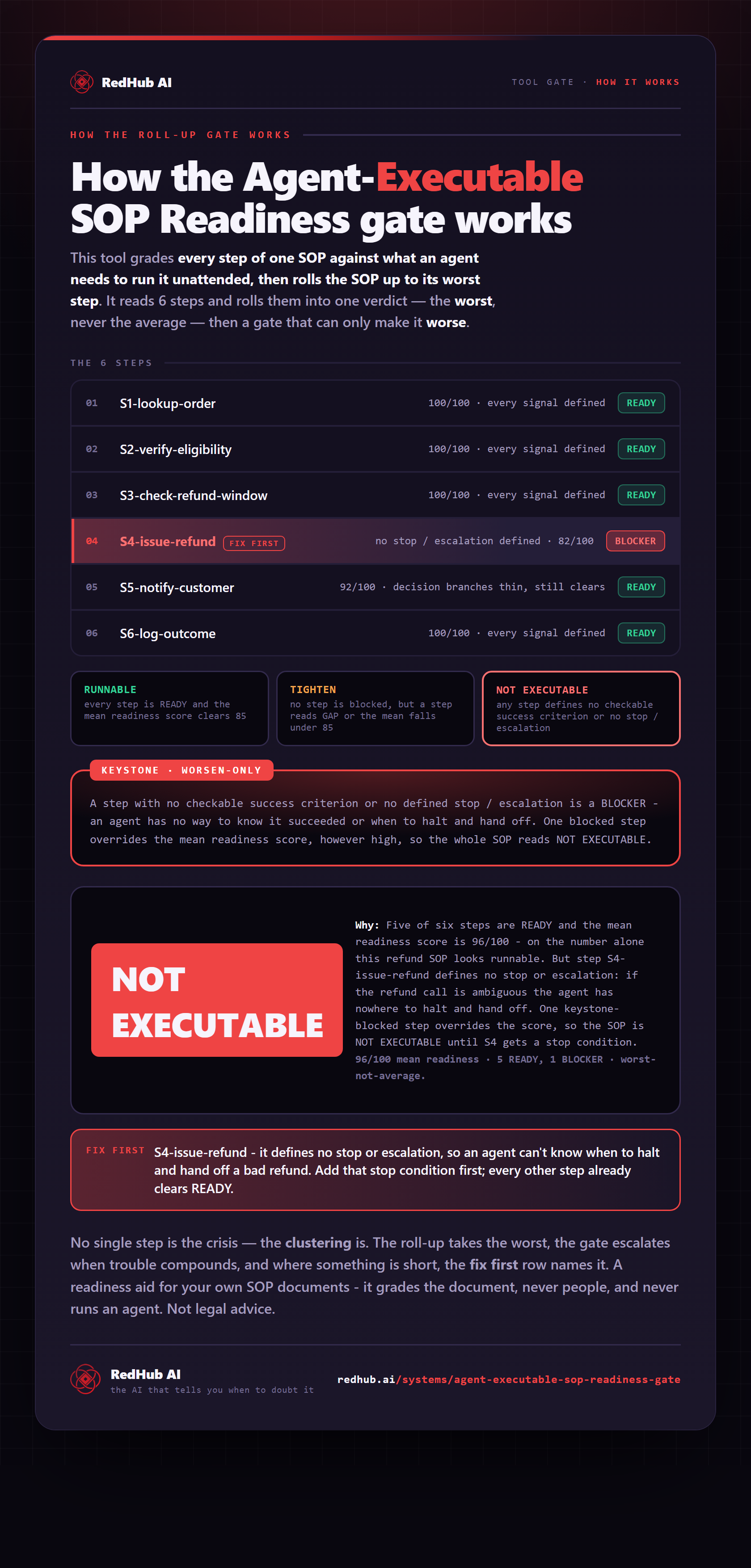
The gate this post refers to, drawn from the tool’s own logic. See the tool.