Can AI Agents Buy From You? The Five-Step Path
Todd Brooks, Founderupdated October 31, 202611 min read

Jump to a section12
TL;DR
- General information, not legal, security or payment advice. RedHub is not affiliated with or endorsed by the companies and organizations named in this post. Product, protocol and availability descriptions are based on the cited public materials as of October 31, 2026 and may change. Confirm current documentation and obtain qualified advice for your implementation.
- The path: for an AI agent to buy from you it has to find you, understand the offer, get permission to act, complete the purchase, and confirm it happened. Five steps, in that order.
- The rule: the weakest step decides. A perfect product feed behind a robots.txt block is invisible. A clean checkout with no record of what the user approved leaves a gap if the order is questioned.
- The surprise: being cited in an AI answer is step one of five. Most of the "AI visibility" conversation stops there.
- The honest part: the payment rails for steps three and four are pilots and previews, not products you can switch on. What you control today is steps one, two, and five, plus the decision about which agents you want at all.
What does AI agent checkout require?
AI agent checkout requires an agent to clear five steps: find your site (crawler access), understand the offer (a feed it can read and trust), get permission to act (from its user, from the payment side, and from you), complete the purchase (a payment path built for agents), and confirm the result exists. The weakest step decides whether the sale happens. Today the first two and the last are in a seller's hands, while the payment steps run on rails that are still pilots and previews.
Best for: anyone who sells online and has been told their products are "visible to AI," and wants to know what has to be true after that. This is cluster one of the agentic internet: who decides what AI agents do.
Getting your product named in an AI answer feels like crossing a finish line. It is the starting line. Between "the agent mentioned us" and "the agent bought from us" there are four more steps, and a sale that fails at any one of them looks the same from your side: nothing happened, and no dashboard told you why.
RedHub is not affiliated with the companies named here. This post summarizes cited public documentation and reporting and is not legal, security or payment advice.
This is the first cluster in our guide to the agentic internet, where the thesis is that an agent's authority, not its intelligence, decides what it may do. Here the question is narrower and more commercial: what has to be true, step by step, for an AI agent checkout to complete on your site, and which of those steps you control.
The five steps
- Find you. The agent's crawler can fetch your pages and read what is on them.
- Understand the offer. The agent can read a feed that says what the item is, what it costs, and whether it is in stock, and the feed agrees with the page.
- Get permission to act. Its user approved this purchase, the payment side scoped what it may spend, and your site allows this operator to take this action.
- Complete the purchase. A payment path exists that accepts an agent-initiated payment with the right limits attached.
- Confirm it. The order exists in your system, and the agent's report matches it.
The steps are in dependency order. An agent that cannot fetch your page never reads your feed. An agent with no record of user approval has nothing to present at checkout. The weakest step decides.
Step one: can the agent fetch you at all
Shopping agents and the answer engines they ride on reach your site through crawlers, and crawlers are blocked by the most boring things on the internet. A robots.txt rule written years ago for a different bot. A WAF challenge page that a human clicks through and a crawler cannot. JavaScript-only rendering that leaves the fetched page empty. None of these produce an error you would see. They produce silence.
This is a per-engine fact, not a per-site one, because each engine's crawler has its own name and your rules name specific bots. The AI Crawler Access and Render Audit Kit grades six access signals per engine from marks you record out of your own robots.txt, WAF console, page source, and logs, and returns CRAWLABLE, PARTIALLY BLOCKED, or INVISIBLE TO AI per engine. Its access gate is worsen-only: a robots.txt disallow or a WAF block on an engine's crawler forces INVISIBLE TO AI regardless of the weighted score, because content that is never fetched cannot be cited. It fetches nothing, scores no people, and guarantees no citation.
Step two: can the agent read the offer and trust it
An agent does not browse your store the way a shopper does. It ingests a feed, recommends the items it can read and trust, and skips the rest. This is the step where a sophisticated catalog loses to a basic one with clean data, and it is the step most sellers have never audited because the feed was built for an ad platform years ago and has quietly drifted since.
Two faults do more damage than a missing field. A feed that contradicts your live page, with one price in the feed and another on the product page, makes an agent distrust the item. So does a missing identifier, because an agent cannot reconcile an item it cannot name. The Agentic-Commerce Product-Feed Readiness Gate grades seven signals per item from a feed you describe and returns AGENT-READY, GAPS, or UNREADABLE per item with a catalog rollup, and it carries two dispositive gates on exactly those distrust faults. It submits nothing, reads no live feed or platform, grades the feed and never a person, and promises no surfacing or sale, because placement is earned, not bought.
Step three: who has to say yes
This is the step the "AI visibility" conversation skips, and it is three permissions, not one.
The user's permission. Somewhere there has to be a record that the person asked for this. The Agent Payments Protocol (AP2) (opens in a new tab), an open protocol whose standardization is continuing in FIDO working groups, names two signed objects for this: a Checkout Mandate that captures the items and purchase details and is shared with the merchant, and a Payment Mandate that represents authorization against a specific instrument. For purchases the user is not present for, the specification says "The Agent must repeat back to the User what they think they are expected to purchase." A mandate is a signed protocol record of represented approval or authorization. It does not by itself determine legal consent, customer understanding or transaction correctness.
The payment's permission. On Stripe's rails, the agent hands the seller a shared payment token, which the seller documentation (opens in a new tab) defines in one sentence: "An SPT is a scoped grant to use the customer’s payment method." The agent sets a currency, a maximum amount, and an expiration. The integration is in preview, and the documentation says so on its API version.
Your permission. Your site decides whether this operator may take this action. Cloudflare's verified-bot taxonomy (opens in a new tab) classifies a bot's behavior and lists "Transact" as its own class, defined as "Checkout or other transaction actions on behalf of users." The A2WF proposal (opens in a new tab) for a siteai.json file would let a site declare per-action permissions, and its own worked example allows addToCart while setting checkout to require human verification. It is a proposal, not an adopted standard. The decision it describes is yours to make with or without a file, and it is the subject of why websites block AI agents.
Step four: the payment path
Here is where the honest boundary sits. As of October 31, 2026, the rails that let an agent pay with scoped credentials are pilots and previews. Stripe's shared payment tokens carry a preview API version and are offered under preview terms. Visa's pilot with BILL and Billtrust, announced October 20, 2026, is live with participating buyers and suppliers and pays approved B2B invoices through supplier portals, with "Tokenized payment credentials rather than shared supplier-portal logins." Its release does not disclose volume or a rollout plan, and this post makes no forecast about either.
Hypothetical example: a shopper tells an agent to reorder the dog food they bought last month when it drops below a set price. The agent finds the item on your site (step one), reads your feed and matches the identifier to the last order (step two), holds a Checkout Mandate with the price condition and a scoped payment token with a maximum amount (step three), hits a checkout that accepts the token (step four), and reports the order placed. Whether that report is true is step five, and it is the step most teams never build.
Step five: the order has to exist
An agent's "order placed" is a sentence the agent produced. The order in your system, the payment event from the processor, and the confirmation email your platform sent are evidence. For an agent-initiated purchase there are two records to reconcile: yours and the agent's, and they disagree more often than anyone building a demo expects. Stripe's design sends webhook events to both the agent and the seller when a token is used, which is a destination record both sides can check. The six tests for an agent's report, and the one rule that outranks them, are in the agent said it's done, did it happen.
The weakest step decides
We are not going to give you a conversion rate for agent-initiated purchases. We have not found one with a method we could check, and a number borrowed from someone else's catalog would tell you nothing true about yours. What we can say is structural: an agent that fails at step one never reaches step two, so the order of work is the order of the steps. Fix fetchability, then the feed, then decide who may act, and only then worry about rails you cannot switch on yet.
The complication worth sitting with is that you may not want steps three through five for every agent. A wholesaler with negotiated pricing may want agents to read the catalog and stop. A retailer with a loyalty program may want agent checkout only from operators it has agreed terms with. "Let agents buy" is not one switch. It is a decision per operator and per action, and the case where a site decided no is the next post.
Pairs well with
AI agent readiness: what we learned scoring our own site is what step one and two looked like when we ran them on ourselves. Web Bot Auth vs. AP2 vs. payment tokens separates the three layers inside step three. Why websites block AI agents is the decision you make before you let any of this run. To grade the whole path from your own marks, the Agent Purchase Relay scores all five stages and, when one falls short, names the weakest.
A paid RedHub product.
Find out how much of your catalog an agent would skip today
The Agentic-Commerce Product-Feed Readiness Gate grades seven signals per item from a feed you describe and returns AGENT-READY, GAPS, or UNREADABLE per item with a catalog rollup and, where a signal is short, the fix-first fault per item. A runnable engine, a workbook that reproduces it, a playbook, and a fix-it runbook. Deterministic, offline, and not a connection to any platform.
Get the Feed Readiness Gate →Keep going: the full map is in the agentic internet: who decides what AI agents do. The next cluster is why websites block AI agents (and what to do).
Decision Guide
Work the five steps if: you sell online and your products already appear in AI answers, or you want them to. Steps one and two are yours to fix this month.
Stop at step two if: you do not want agents completing purchases on your site yet. That is a legitimate decision, and it still requires that agents can read your catalog correctly, because a wrong price in an AI answer costs you either way.
Best first step: pick your ten best-selling items and check whether the feed price matches the page price for each. A mismatch is the distrust fault that makes an agent skip the item, and it is the cheapest thing on this list to fix.
FAQ
Can AI agents buy from my website today?
Only if five steps all hold: the agent's crawler can fetch your pages, it can read a feed that agrees with your site, it has permission from its user, the payment side, and you, a payment path accepts an agent-initiated payment, and the order can be confirmed. The payment rails are pilots and previews as of October 2026, so for most sellers the honest answer is that agents can find and read you, and checkout depends on which platform and operator you are dealing with.
Is being cited in ChatGPT or Perplexity enough to get agent sales?
No. A citation is step one of five. The agent still has to read a feed it trusts, hold a record of what its user approved, be allowed to act on your site, find a payment path, and confirm the order. A citation with a wrong price behind it can cost a sale instead of winning one.
What is an AP2 mandate?
In the Agent Payments Protocol, a Checkout Mandate is a signed object that captures the items and purchase details and is shared with the merchant, and a Payment Mandate represents authorization against a specific payment instrument. A mandate is a signed protocol record of represented approval or authorization. It does not by itself determine legal consent, customer understanding or transaction correctness. As of October 31, 2026, AP2 is an open protocol under standardization.
What is a Stripe shared payment token?
Stripe's seller documentation defines it as a scoped grant to use the customer's payment method, issued by the agent to the seller with usage and expiration limits such as a maximum amount and an expiry. As of October 31, 2026, the integration carries a preview API version. This post describes the documentation and makes no claim about availability for any particular seller.
Which of the five steps can a seller fix without waiting on anyone?
Steps one, two, and five. Crawler access is your robots.txt, WAF, and rendering. Feed quality is your data. Confirmation is your order system. Step three is partly yours, since you decide which operators may act, and step four depends on platforms and rails outside your control.
Does the Feed Readiness Gate connect to my store or submit my feed anywhere?
No. It grades a feed you describe from marks you enter, item by item, and prints AGENT-READY, GAPS, or UNREADABLE with a catalog rollup. It submits nothing, reads no live feed or platform, scores no person, and promises no surfacing or sale.
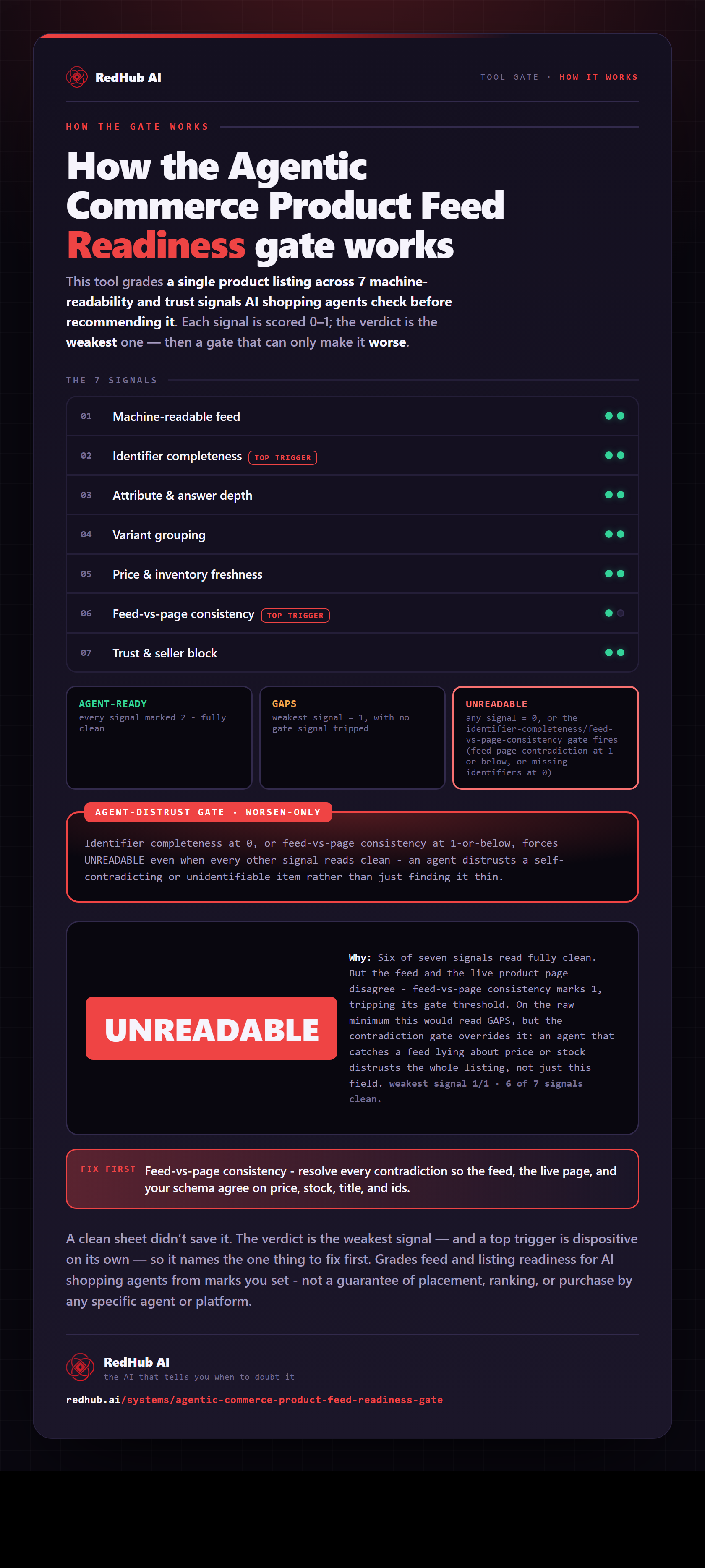
The gate this post refers to, drawn from the tool’s own logic. See the tool.