Web Bot Auth vs. AP2 vs. Payment Tokens
Todd Brooks, Founderupdated October 31, 202612 min read

Jump to a section10
TL;DR
- General information, not legal, security or payment advice. RedHub is not affiliated with or endorsed by the companies and organizations named in this post. Product, protocol and availability descriptions are based on the cited public materials as of October 31, 2026 and may change. Confirm current documentation and obtain qualified advice for your implementation.
- Three layers, three questions: Web Bot Auth addresses which registered operator’s key signed a request. An AP2 mandate records the approval or payment authorization represented in the mandate. A scoped payment credential, such as a Stripe shared payment token or the tokenized credentials described in Visa’s pilot, constrains specified uses of the payment credential.
- The trap: these layers are often grouped under “agent trust,” but they answer different questions. A valid request signature does not by itself establish that an end user approved the purchase. A mandate does not independently verify that the approving person understood the purchase or had legal authority to approve it. A spending limit does not establish that the merchant permits the requested action.
- What none of the three establishes alone: that the destination system recorded the intended outcome, that the action occurred exactly once, or that the site permits the agent to take it.
- Status as of October 31, 2026: Cloudflare documents Web Bot Auth as a verification method built on IETF drafts. AP2 describes itself as an open protocol whose standardization will continue within FIDO working groups. Stripe’s cited integration uses preview terms and a preview API version. Visa describes its BILL and Billtrust work as a live pilot with participating parties. Availability, terms and technical behavior may change; confirm the current vendor documentation before implementation.
What is Web Bot Auth, and how is it different from AP2 and payment tokens?
Web Bot Auth is documented as a method for verifying that an HTTP request was signed using a private key corresponding to a published key associated with a registered operator. AP2’s Checkout and Payment Mandates are signed protocol records representing specified purchase details and payment authorization. Scoped payment credentials constrain specified payment uses according to their limits and the systems enforcing them. These are separate technical layers; no one layer substitutes for the others.
Best for: engineers and operators who have been handed "we support agent payments" and need to know which of the three questions that answers. This is cluster three of the agentic internet: who decides what AI agents do.
Ask three vendors how their agent is "trusted" and you will get three different answers that sound like the same one. One signs its requests so sites can verify who sent them. One carries a mandate the user signed. One pays with a credential capped at a dollar amount. Each supplies evidence for a different part of the transaction. Treating one as evidence of the others creates an avoidable control gap.
RedHub is not affiliated with the companies named here. This post summarizes cited public documentation and reporting and is not legal, security or payment advice.
This is the third cluster in our guide to the agentic internet, and it covers the first two of the pillar's four checks, authenticate and authorize, by separating the three layers that get lumped together. It starts with Web Bot Auth because identity comes first: you cannot authorize an agent you cannot name.
In this post, “establishes” means that the named protocol or system provides technical evidence of the stated fact under its documented verification process. It does not by itself establish legal identity, agency authority, valid consent, contractual permission, transaction correctness or the outcome of a payment dispute.
Layer one: who sent the request
For most of the web's history, a site knew who a bot was by its user-agent string, which is text anyone can send, or by its IP address, which changes and is shared. Web Bot Auth (opens in a new tab) offers a cryptographic alternative. Cloudflare documents Web Bot Auth as an authentication method using HTTP message signatures to verify that a request comes from an automated bot associated with the registered key. It is built on two IETF drafts: one for a key directory and one for how the keys attach a crawler's identity to its requests.
The mechanics are short enough to state. The operator generates an Ed25519 key pair and hosts the public key in a directory at /.well-known/http-message-signatures-directory, served over HTTPS and itself signed. Cloudflare says signing the directory “ensures no one else can mirror your directory and attempt to register on your behalf.” That is Cloudflare’s description of this control, not a guarantee by RedHub against impersonation, key compromise, replay or implementation error. Each request the bot sends carries three headers: a Signature-Input naming what was signed, a Signature over those components, and a Signature-Agent pointing at the key directory. The site, or a CDN in front of it, fetches the key and checks the signature. Cloudflare recommends short-lived expires values to reduce replay risk. Implementers should confirm the current treatment of nonces and replay protection in Cloudflare’s documentation before relying on it.
A successfully verified signature gives the site cryptographic evidence that the request was signed with the corresponding private key. The association between that key, the registered operator and the current request still depends on registration, key protection and correct implementation. Cloudflare's verified-bots page lists it first among the ways a bot clears the honest self-identification bar: "it declares who it is deterministically, through a cryptographic Web Bot Auth signature, a published IP list with a stable user-agent, or reverse DNS." The same page adds that as of July 1, 2026 the difference between a verified bot and a signed agent is a metadata field, Direct versus Intermediary, that records who can operate it. Cloudflare describes experimenting with a Forwarded header to carry identity through intermediaries, and says plainly: "Transitive trust and the Forwarded header are experimental and may change."
What a signature does not establish: A valid Web Bot Auth signature does not by itself establish that the operator’s end user approved the action, that the operator is permitted to take the action under the site’s terms or policies, or that the action succeeded. That is RedHub’s analysis of the scope of the technical check, and it is the whole of logging in is not permission, applied to software.
Layer two: what the user approved
An identified agent now has to show that its user wanted this. The Agent Payments Protocol (AP2) (opens in a new tab) is the open protocol built for that question, and its stated principle is "Verifiable Intent, Not Inferred Action." The current documentation names two mandates. The Checkout Mandate captures the reference to the specific items and purchase details negotiated between the agent and the merchant and is shared with the merchant. The overview is explicit about why: "It is shared with the Merchant so they can use this as evidence in case of disputes." The Payment Mandate is separate, and the documentation defines it as one that "Authorizes a payment against a specific payment instrument," shared with the credential provider, the networks, and the merchant's payment processor for transaction authorization.
Each mandate exists in an open and a closed state. Open captures the user's constraints before a cart is final, which is how an agent can be told "buy these when the price drops" and carry a signed record of that instruction. Closed captures the authorization for a specific, finalized checkout. For a purchase the user is not present for, the specification requires the agent to repeat back what it believes it is expected to buy and have the user confirm before proceeding.
Two things to keep straight about mandates. First, AP2 documentation describes mandates as signed, tamper-evident protocol credentials representing specified intent or authorization. A mandate is evidence of what the signed record states. It is not, by itself, a determination that consent was legally valid, that the approving person understood the transaction, that the purchase was advisable or correct, or that a merchant will prevail in a dispute. AP2 states that the Checkout Mandate is shared with the merchant for use as evidence in disputes. The evidentiary weight, legal effect and treatment by an issuer, network, processor, court or other decision-maker depend on the applicable rules and facts. Second, you will see older coverage naming three mandates with different labels. The AP2 repository's current documentation names the Checkout Mandate and the Payment Mandate, and those are the names this post uses. AP2 says its standardization will continue within FIDO working groups, and we make no claim about when any merchant platform will support it.
Layer three: what the payment may be used for
The third layer is the credential itself, and the design idea in both examples here is the same: give the seller something scoped instead of the customer's card or portal login.
Stripe's version is the shared payment token. Its seller documentation (opens in a new tab) defines it in a sentence: "An SPT is a scoped grant to use the customer’s payment method." Stripe documents SPTs with usage and expiration limits, including currency, maximum amount and expiration. Its Resolve API for retrieving credentials for a third-party processor may be used only once. Stripe also documents recurring SPT configurations for direct PaymentIntent use. The cited API version and terms are preview materials as of October 31, 2026.
Visa’s October 20, 2026 release (opens in a new tab) says the pilot uses a registered BILL Payment Agent, tokenized payment credentials, payment controls aligned with approved buyer instructions, and a payment path tied to a specific invoice. Visa describes the agent as executing eligible payments already approved by the buyer. These are the companies’ descriptions of the pilot; RedHub did not independently test the implementation. The release discloses neither volume nor a rollout schedule, and this post forecasts neither.
Three layers, side by side
The affirmative descriptions in this table summarize the cited vendor or protocol documentation. The limitations column is RedHub’s analytical comparison, not a quotation from or warranty by those vendors.
| Layer | The question it answers | Evidence or constraint described by the documentation | What RedHub concludes it does not establish alone | Status as of October 31, 2026 |
|---|---|---|---|---|
| Web Bot Auth | Which operator's key signed this request? | The request was signed using a private key corresponding to the published key used for verification. | That the end user approved anything. That your site permits the action. That the action succeeded. | Documented by Cloudflare as a verification method built on IETF drafts. |
| AP2 mandates | What did the user approve? | Signed protocol records representing specified checkout details and payment authorization. | Legal consent, or that the purchase was correct. Who is presenting it is a separate identity check. | AP2 says standardization will continue within FIDO working groups. |
| Scoped payment credentials | What may this payment be used for? | Technical usage limits enforced according to the token configuration and processing path. | Who the agent is. That the user wanted this item. That your site allows agent checkout. | Stripe: preview. Visa, BILL, Billtrust: live pilot with participating parties. |
Read the limitations column twice. A merchant that relies on a mandate without its own identity check is trusting one layer to answer two questions. A site that admits a signed agent without a per-action policy has set no limit on what a known operator does. A seller that charges a scoped token without confirming the order exists may be paid for a sale it cannot find. They function like three different controls on three different questions—not three interchangeable proofs.
The two checks none of these layers make
Nothing above tells a site whether it wants this agent doing this action. That decision is the site's, per agent and per action, and it is covered in why websites block AI agents. And nothing above confirms the action happened. A request signature, mandate and payment credential may all validate while the destination system fails to record the intended order, records it incorrectly or receives a repeated request. Separate outcome and idempotency checks are still needed. That is the fourth check, covered in the agent said it's done, did it happen.
There is also a complication inside layer one worth naming. Web Bot Auth concerns the operator associated with the signing key. Where an intermediary acts for end users, that operator is not necessarily the person for whom the action is taken. A mandate may carry signed transaction intent or authorization associated with the user-side flow, but it does not by itself establish the person’s legal identity or agency relationship. Cloudflare describes its Forwarded-header work for transitive trust as experimental.
Turn all of this around and the same three questions apply to the agents, MCP servers, and OAuth connectors your own company has granted access to: who is each one, what was it approved to do and by whom, and what can it write. Most businesses can answer the first and not the other two, because the grants were clicked through months ago and nobody owns them.
Pairs well with
Authentication vs authorization is the distinction every layer above sits on one side of. Non-human identity security and MCP security cover the credential and server side of your own grants. Cloudflare agent stack is the builder's view of the platform whose Web Bot Auth docs this post reads. Can AI agents buy from you places all three layers inside the five-step checkout path.
A paid RedHub product.
Grade the grants you have already given
The AI Agent and Connector Access Auditor grades an inventory you enter of agents, MCP servers, and OAuth connectors on scope breadth, data sensitivity, write capability, and staleness. It returns LEAST-PRIVILEGE AS DESCRIBED, OVER-SCOPED, or UNGOVERNED per connector and rolls the fleet to GOVERNED, DRIFTING, or EXPOSED from the worst connector, never the average, with an unowned regulated-write connector reading UNGOVERNED whatever its score. Deterministic and offline. It does not connect to your systems and scores no people.
What this product does not do: the AI Agent and Connector Access Auditor inventories and grades access grants from the buyer’s own records. It does not connect to agents, verify HTTP signatures, validate AP2 mandates, inspect payment credentials, authorize payments or confirm transaction outcomes.
Get the Connector Access Auditor →Keep going: the full map is in the agentic internet: who decides what AI agents do. The last cluster takes the fourth check: the agent said it's done, did it happen.
Decision Guide
Check all three layers if: an agent can complete a purchase or a payment on your site, or your own agent does so elsewhere. Identity, approval, and scope are separate questions and each needs its own answer.
Start with identity if: you cannot name the operators hitting your site today. Until you can, there is nothing to attach a policy or a mandate to.
Best first step: for each agent-initiated transaction path you have or plan, write down which artifact answers each of the three questions. A blank cell is a door with no lock.
FAQ
What is Web Bot Auth?
Web Bot Auth is an authentication method, documented by Cloudflare and built on IETF drafts, in which an automated client signs its HTTP requests with a private key and publishes the matching public key in a well-known directory, so a site can verify the signature against the published key. It provides technical evidence of which key signed a request. It does not by itself establish that the operator's end user approved an action or that a site permits it.
What are the AP2 mandates?
AP2’s current documentation describes a Checkout Mandate, shared with the merchant and representing specified items and checkout details, and a Payment Mandate, shared with payment-side participants and representing authorization against a specified payment instrument. AP2 describes each as having open and closed states. A mandate is a signed protocol record of represented approval or authorization; it does not by itself determine legal consent, customer understanding, transaction correctness or the result of a dispute.
What is a shared payment token?
Stripe's seller documentation defines a shared payment token as a scoped grant to use the customer's payment method, issued by an agent to a seller with usage and expiration limits. Its Resolve API for retrieving credentials for a third-party processor may be used only once. Stripe also documents recurring SPT configurations for direct PaymentIntent use. The cited API version and terms are preview materials as of October 31, 2026.
Does a signed agent request mean the purchase is authorized?
No. A successfully verified signature provides technical evidence that the request was signed using the private key corresponding to the published key used in verification. End-user approval, site permission, payment authority and outcome verification are separate questions.
Is Visa's trusted agent pilot generally available?
Not as of October 31, 2026, according to its October 20, 2026 release, which describes a live pilot with BILL and Billtrust processing approved B2B invoice payments with participating buyers and suppliers. It does not disclose volume or a rollout plan, and this post makes no forecast about either.
Does the Connector Access Auditor connect to my agents or verify their signatures?
No. It grades an inventory you enter of the agents, MCP servers, and OAuth connectors you have granted, on scope, data sensitivity, write capability, and staleness, and returns a per-connector verdict and a fleet posture. It does not connect to any system, reads no traffic, and scores no person.
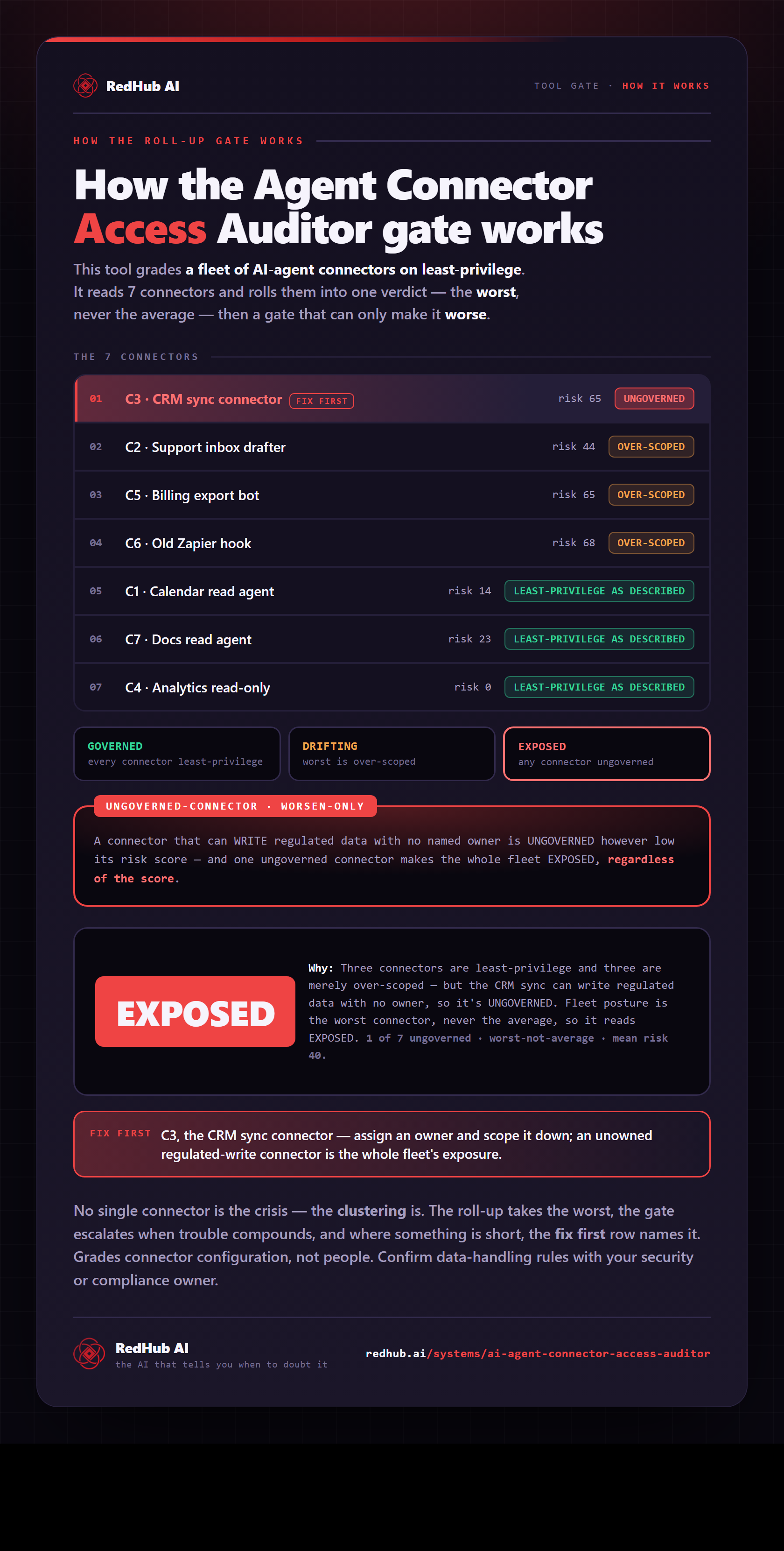
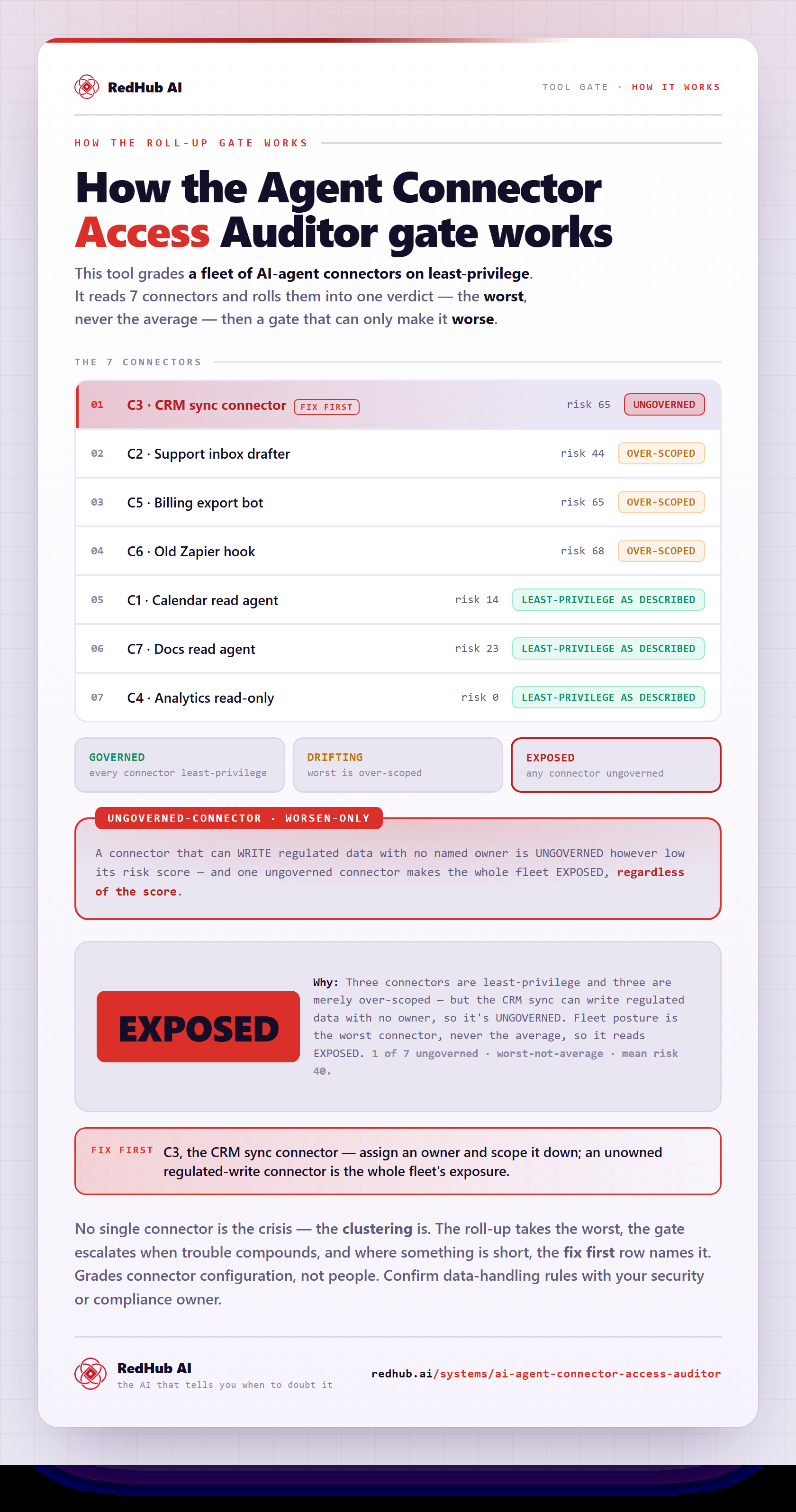
The gate this post refers to, drawn from the tool’s own logic. See the tool.