The Agentic Internet: Who Decides What AI Agents Do
Todd Brooks, Founderupdated October 31, 202614 min read

Jump to a section11
TL;DR
- General information, not legal, security or payment advice. RedHub is not affiliated with or endorsed by the companies and organizations named in this post. Product, protocol and availability descriptions are based on the cited public materials as of October 31, 2026 and may change. Confirm current documentation and obtain qualified advice for your implementation.
- The thesis: an AI agent's intelligence decides what it could do. Its authority decides what it may do. A site can refuse an agent no matter how capable it is, and an agent that got in can still hold more permission than anyone meant to give it.
- Two things at once: customers want agents to do the work for them. Businesses need to keep unauthorized software out of their accounts, carts, and portals. Both are true, and the same company is often on both sides.
- Three zones: an agent reaches a site as a registered partner, as something acting like a human with the user's own login, or it is refused. Where it lands is set by the site, not by the agent.
- Four checks: who is it, what did the human approve, what is it allowed to do here, and did the thing happen. Each one gets its own post in this set.
What is the agentic internet?
The agentic internet is the web as it looks when software acts on a person's behalf instead of a person clicking: an agent that finds the product, fills the cart, pays the invoice, or books the slot. What decides whether any of that works is not how smart the agent is but whether it has authority: a verified identity, a record of what the user approved, permission from the site it is acting on, and a result that can be checked afterward. A site can refuse an agent outright, and many do.
Best for: founders and operators who sell online, run a portal, or are wiring up agents of their own, and who need a plain map of what they control. For the door you own, start with the AI Bot and Scraper Traffic Control Readiness Gate.
Two things happened within a month of each other this fall, and together they frame this set. On September 21, 2026, SiliconANGLE reported (opens in a new tab) that Amazon had blocked Meta's Muse agent from shopping on its marketplace on users' behalf. On October 20, 2026, Visa announced (opens in a new tab) that it, BILL, and Billtrust had "launched the first live pilot to enable trusted AI agents to initiate and complete approved buyer invoice payments end-to-end through supplier portals." One operated in a participating payments pilot; the other was blocked by a site whose operator objected to its access.
RedHub is not affiliated with the companies named here. This post summarizes cited public documentation and reporting and is not legal, security or payment advice.
The two examples were reported under very different arrangements. Visa described the BILL agent as registered through Visa’s protocol and directory, using tokenized credentials to execute buyer-approved invoice payments in a participating pilot. In the Muse dispute, Amazon’s position, as reported, was that the agent did not identify itself and that Amazon had not agreed to its access; Meta disputed the credential concern. These examples do not establish that “authority” was the sole difference or resolve the parties’ legal positions. They illustrate the four questions in this series: identity, user approval, site permission and outcome verification.
This pillar lays out the map. Four cluster posts go deep on each check: whether an agent can buy from you at all, why sites block agents and what to do about it, the three identity and payment layers that keep getting lumped together, and how to know an agent's job happened at all.
Two things your customers and your business both want
Your customers want the work done. A finance lead who has keyed the same invoice data into forty supplier portals wants an agent to do the forty-first. A shopper who knows what they buy every month wants to say so once and have it arrive. That demand is real and it is not going away, which is why the payment networks are building for it.
Your business needs the opposite thing at the same time: to keep unauthorized software out of customer accounts, out of your checkout, out of your pricing pages at a thousand requests a minute. Nobody wants an unknown program moving through a logged-in session, and no site owner wants to find out about it from a customer.
The complication is that you are on both sides. The same company that wants its AP agent recognized at a supplier portal wants unknown agents kept off its own. There is no clean "pro-agent" or "anti-agent" position for a business to take, and anyone selling you one has only read half the problem. What there is instead is a set of decisions you make per agent and per action, on the side where you are the site and on the side where you are the operator. That is the structure of this set.
Capability is not the scarce thing
It is tempting to read this fall's news as a story about how capable agents have become. On October 21, 2026, Wiz disclosed (opens in a new tab) two critical flaws in PHP, which researchers used AI to help find. The security world took it as a marker that AI-assisted research had reached the core of the web's most common server language. We will not add a prediction to that. The point for a business is narrower: the ability of software to do things is rising fast and is not what you control.
What you control is authority. The OWASP GenAI Security Project released its Top 10 for Agentic Applications (opens in a new tab) on December 9, 2025, and its release announcement (opens in a new tab) put the shift in one line: "Once AI began taking actions, the nature of security changed forever." Its third entry, "ASI03 – Identity & Privilege Abuse," names the failure class this whole set is about: an agent operating with credentials or permissions beyond what anyone meant to grant. The fix for that class is never a smarter model. It is a narrower grant and a check on the result.
The three zones
Every agent that reaches a site lands in one of three zones. The zones are our own descriptive model, not a standard, and they are useful because the site decides which zone an agent is in, whatever the agent intended.
| Zone | How the agent arrives | What the site knows | Example |
|---|---|---|---|
| Partner | Registered, identified, and scoped in advance. The site expects it. | Who operates it, what it may do, which user it acts for. | The BILL agent in Visa's pilot, which the release says is "currently live and processing end-to-end transactions with participating buyers using BILL and Billtrust suppliers." Verified bots and agents in Cloudflare's directory. |
| Act-like-a-human | Drives a browser with the user's own login. Identifies itself as an agent, or does not. | Sometimes nothing. It looks like the customer. | The Muse dispute as reported: Amazon says the agent did not identify itself. Meta says it cannot see passwords or payment data. Both sides are in the cluster post. |
| Refused | Blocked at the edge, by terms, or by a declared policy. | That it is unwanted, and sometimes why. | The message Retail Gazette reported Amazon showing shoppers, naming an "unauthorised AI agent." A robots.txt disallow. A WAF rule. A proposed siteai.json that sets checkout to require a human. |
Two things about the zones matter more than the zones themselves. First, as of October 31, 2026, the partner zone is small and it is built one agreement at a time. Visa's pilot is a pilot. Stripe's shared payment tokens are in preview. The Agent Payments Protocol (AP2) (opens in a new tab) is an open protocol whose standardization is continuing inside FIDO working groups. The A2WF group's siteai.json is a proposal. None of this is general availability, and we are not going to tell you when it will be.
Second, the act-like-a-human zone is where most consumer agents live right now, and it is the zone the site owner can convert into either of the other two. Register the operator and scope the actions, and it becomes a partner. Decide you do not want it, and it is refused. The agent does not get a vote. That is the practical meaning of "authority, not intelligence."
The four checks
Whichever side you are on, the question "is this agent smart enough" is the wrong one. The four that matter are below, in the order the dependencies run. Each links the post that goes deep.
1. Authenticate: who is it?
Before anything else, a site needs evidence of which operator's key signed the request. User-agent strings are text anyone can type. The current answer on the open web is Web Bot Auth (opens in a new tab), which Cloudflare's documentation describes as using cryptographic signatures in HTTP messages to "verify that a request comes from an automated bot." The operator publishes a key, signs its requests, and the site checks the signature. A successful check provides cryptographic evidence that the request was signed using a private key corresponding to the published and registered key used for verification. It does not by itself establish what the sender may do, which is the distinction logging in is not permission has always drawn, now applied to software. The three layers that get confused with each other are separated in Web Bot Auth vs. AP2 vs. payment tokens.
2. Authorize: what did the human approve?
An authenticated agent still needs a record of what its user asked for. This is the problem the payment side is working hardest on. AP2's stated principle is "Verifiable Intent, Not Inferred Action": a user-signed Checkout Mandate captures the items and purchase details and is shared with the merchant, and a Payment Mandate represents authorization against a specific instrument. Stripe's shared payment token is, in its documentation's words, "a scoped grant to use the customer’s payment method," with usage and expiration limits set by the agent. An AP2 mandate provides a signed protocol record representing specified approval or payment authorization. It does not by itself determine legal consent, customer understanding or transaction correctness. The five-step path an agent has to clear to buy from you is in can AI agents buy from you. On your own agents, the same question is answered by enough access to help, not to harm.
3. Act safely: what is it allowed to do here?
This check belongs to the site, and it is the one most businesses have not made a decision about. Allowing "AI agents" is not a decision. Allowing a named operator to read your catalog, add to a cart, and stop short of checkout unless a human confirms is a decision. Cloudflare's verified-bot taxonomy now classifies a bot by behavior, with "Transact" as its own class, and labels whether an operator is Direct or an Intermediary acting for many end users. The A2WF proposal would let a site declare per-action permissions in a file. The shape of the decision is the same either way: per agent, per action. The Amazon and Muse case, with both sides attributed, is the worked example in why websites block AI agents.
The decision also has to be enforceable. A stance written in robots.txt that nothing backs up is a request. The gate that grades whether you can allow, throttle, or block what hits your site is linked in the box above, and it returns READY, GAPS, or EXPOSED per property, with a posture you cannot enforce reading EXPOSED whatever the score. It grades the setup, never people, and no tool guarantees a crawler obeys you.
The mirror image is your own agents and connectors, which are acting on someone else's site or inside your own systems with grants somebody clicked through months ago. The AI Agent and Connector Access Auditor grades an inventory you enter, connector by connector, as LEAST-PRIVILEGE AS DESCRIBED, OVER-SCOPED, or UNGOVERNED, and rolls the fleet to GOVERNED, DRIFTING, or EXPOSED from the worst connector, never the average. It does not connect to your systems and scores no people. The thinking behind it is in zero trust for AI agents and non-human identity security.
4. Audit: did the thing happen?
An agent that reports "done" has produced a sentence. The order in the seller's system, the payment event from the processor, the row in the CRM: those are evidence. OWASP's ninth entry, "ASI09 – Human-Agent Trust Exploitation," is the failure where confident explanations lead a person to approve something they should not have. The defense is to check the destination record, never the report, and to test an agent for six behaviors before it gets a consequential action. All six are in the agent said it's done, did it happen. The stop you need in place before any of this is in AI agent kill switch.
The order is the point: an authorization means little for an agent you cannot identify, because you do not know who you are authorizing. An authorized agent still needs the site's permission for this action. And a permitted action still has to be confirmed. A business that skips to check four is grading reports it has no way to trust.
What this map does not settle
Three honest gaps, because this is a fast-moving area and a map that pretends otherwise is a sales deck.
As of October 31, 2026, the partner zone has no general on-ramp. Visa's pilot is live with participating buyers and suppliers, and the release does not disclose volume or a rollout plan. Stripe's token integration carries a preview API version. AP2 is open and its standardization is continuing. If someone tells you the agent payment rails are settled, ask which pilot they are in.
The act-like-a-human dispute remains contested in the reporting we reviewed. We describe the Amazon and Muse case with both companies' positions attributed to the outlets that reported them, and we draw no conclusion about who is right or whether any terms are enforceable. That is a question for the parties and their counsel, not for a blog.
We will not give you an adoption number. There is no shortage of percentages about how many purchases agents will make by some year. We have not found one with a method we could check, so none appears here. A borrowed forecast would tell you nothing true about your own customers.
Pairs well with
Three posts from the archive carry the groundwork this map stands on. Authentication vs authorization is the distinction every one of the four checks depends on. AI agent permissions covers the grant you give your own agents. AI agent kill switch is the stop you build before you grant anything.
A paid RedHub product.
Grade the agent's whole path, not its last sentence
The Agent Reliability Harness evaluates an agent's runs at the trajectory level, tool choice, argument validity, step efficiency, cost, and policy, and returns SHIP, HOLD, or FIX that you can gate CI on. Deterministic by default, framework-agnostic, and only as good as the expectations you write. An offline evaluation harness, not a runtime guardrail.
Get the Agent Reliability Harness →The rest of this set
Four posts carry the detail. Can AI agents buy from you walks the five steps an agent has to clear and why being cited in an AI answer is only the first. Why websites block AI agents takes the Amazon and Muse case apart, both sides attributed, and turns it into a per-agent, per-action policy. Web Bot Auth vs. AP2 vs. payment tokens separates who sent the request, what the user approved, and what the payment may be used for. The agent said it's done gives you six tests and the one rule that outranks them.
Decision Guide
Work through the four checks now if: agents already reach your site, your portal, or your checkout, or you have granted an agent of your own access to someone else's. For most businesses with a public catalog, the first is already true.
Start with the site side if: you have never written down which operators may do which actions on your property. That decision costs nothing to make and everything to skip.
Best first step: list the agents and connectors you have granted access to anything, and beside each one write who owns it and what it can write. The ones with no owner are where this set's warnings land.
FAQ
What is the agentic internet?
The agentic internet is the web as experienced through software acting on a person's behalf: agents that find products, fill carts, pay invoices, and book appointments. What decides whether an agent can do any of that is its authority, meaning a verified identity, a record of what the user approved, the site's permission for the action, and a checkable result. Intelligence is not the deciding factor.
Can a website refuse an AI agent no matter how capable it is?
A site can technically restrict automated traffic at the edge, through bot-management rules, rate limits and other access controls. It can also publish terms or policies addressing agents. Whether a particular restriction or term is lawful, enforceable or appropriate depends on the facts and applicable law. Amazon’s reported block of Meta’s Muse is a disputed commercial example: the cited outlets reported Amazon’s identification, access and credential concerns and Meta’s response disputing the credential concern. This post takes no position on the merits.
What are the three zones?
Partner, act-like-a-human, and refused. A partner agent is registered, identified, and scoped in advance, like the BILL agent in Visa's live pilot. An act-like-a-human agent drives a browser with the user's own login and may or may not identify itself. A refused agent is blocked. The zones are RedHub's descriptive model, and the site decides which zone an agent is in.
What are the four checks?
Authenticate (who is it), authorize (what did the human approve), act safely (what is it allowed to do on this site), and audit (did the thing happen). They run in that order because each depends on the one before it. An authorization means little for an unidentified agent, and a permitted action still has to be confirmed against the destination record.
Are agent payment rails like AP2 and shared payment tokens available now?
Not as general products, as of October 31, 2026. Visa's pilot with BILL and Billtrust is live with participating buyers and suppliers, and the release does not disclose volume or rollout. Stripe's shared payment tokens carry a preview API version. AP2 is an open protocol whose standardization is continuing in FIDO working groups. This post makes no forecast about when any of them becomes generally available.
Does a RedHub tool scan my site for AI agents?
No. RedHub instruments are self-assessments the buyer runs on marks they enter about their own setup. The traffic-control gate grades whether you can allow, throttle, or block what hits your site and returns READY, GAPS, or EXPOSED. The connector auditor grades an inventory of your own agents and connectors you enter. Neither connects to your systems, detects traffic, or scores a person.
Which check should a small business do first?
The site-side decision: write down which named operators may do which actions on your property, and whether you can enforce it. It is the cheapest of the four checks, it is the one most businesses have never made, and it decides which zone an arriving agent lands in.
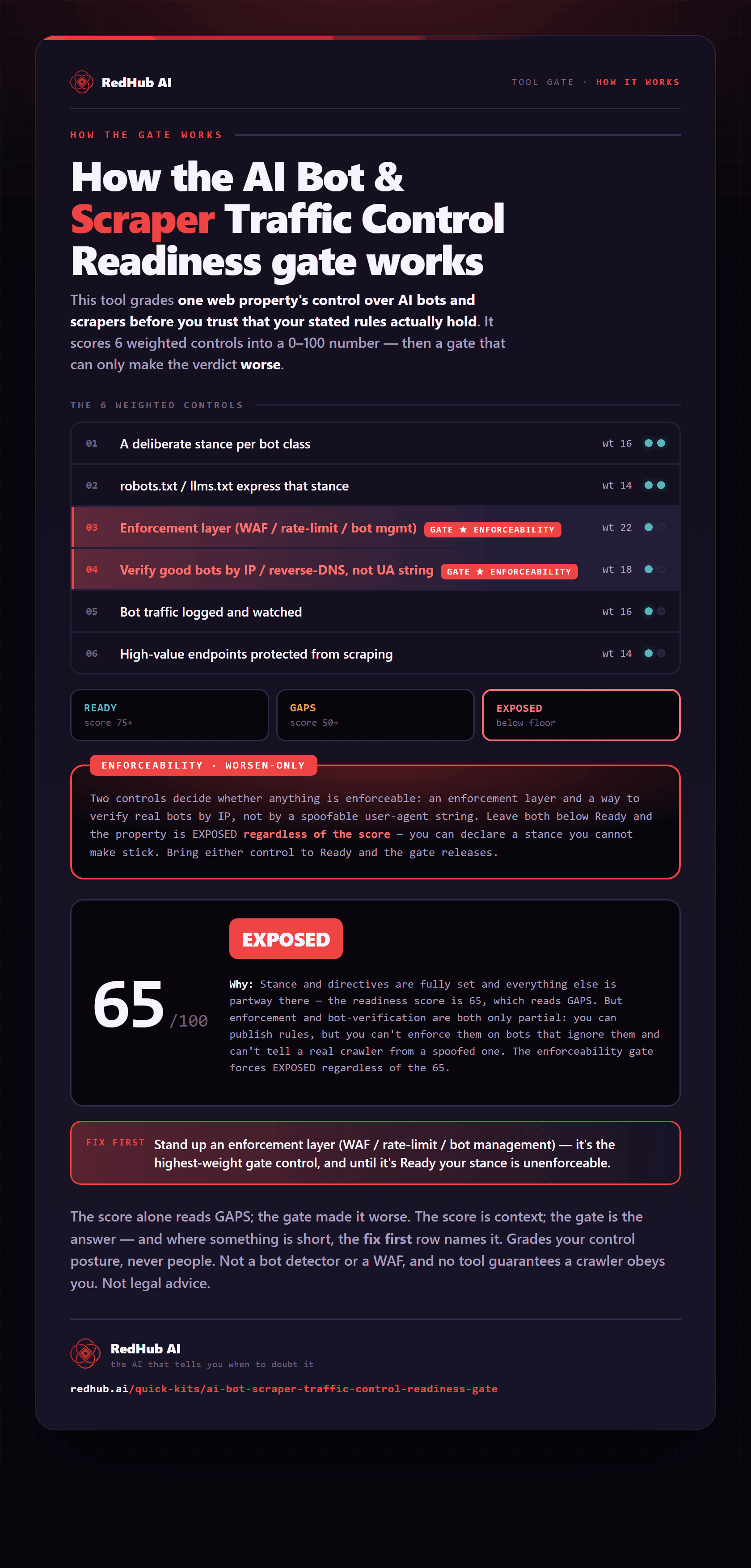
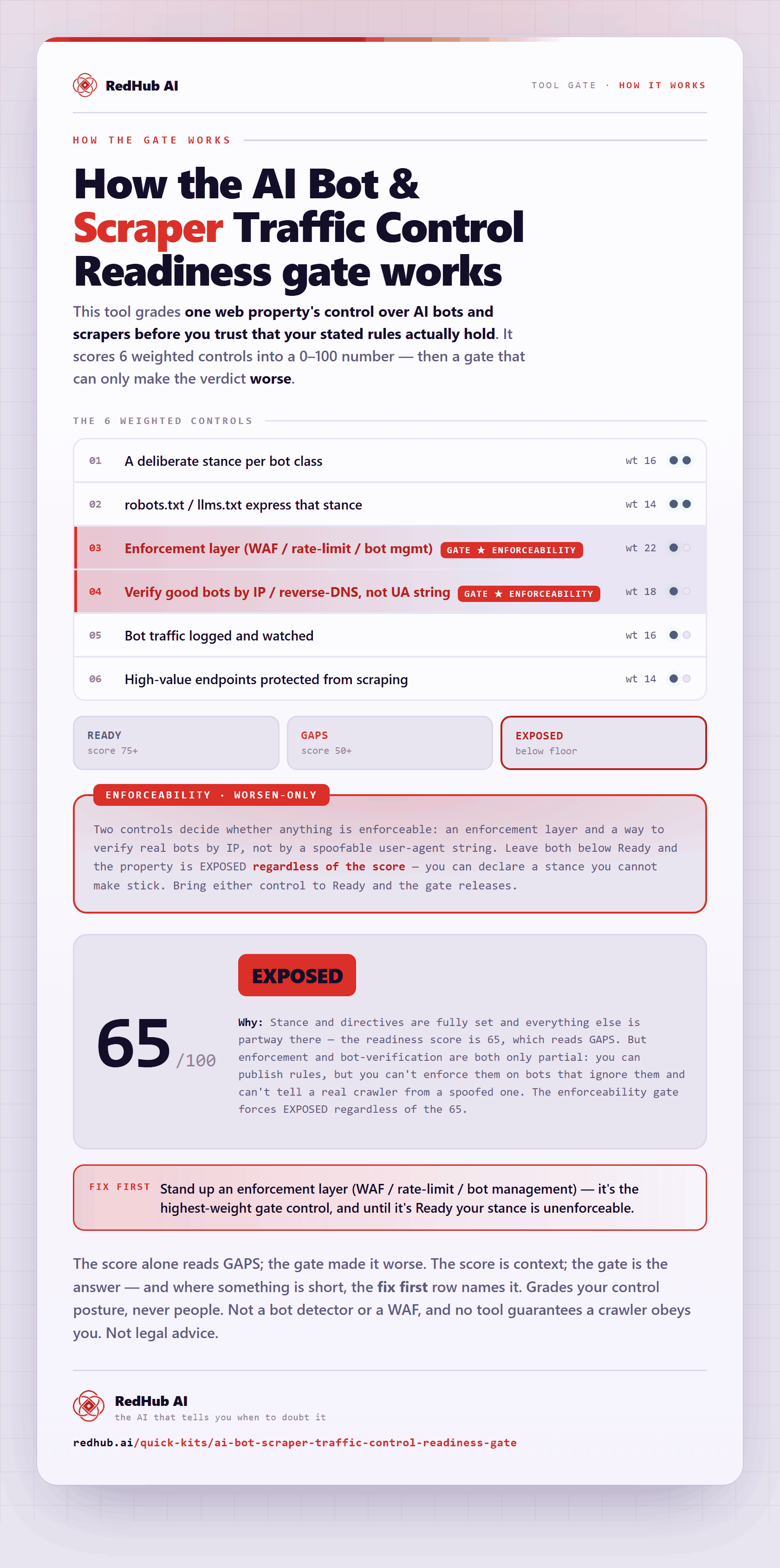
The gate this post refers to, drawn from the tool’s own logic. See the tool.