Confidently Wrong AI Is the Real Failure Mode
Todd Brooks, Founderupdated July 22, 20267 min read
Jump to a section10
- Your AI Isn't Broken. It's Confidently Wrong.
- TL;DR
- What is confidently wrong AI?
- Why confidently wrong AI costs more than broken AI
- Three ways confidently wrong AI slips through
- Confidence is not the same as being right
- The fix: reward AI that flags its own doubt
- How to spot confidently wrong AI this week
- Decision Guide
- FAQ
Your AI Isn't Broken. It's Confidently Wrong.
TL;DR
- What it is: Confidently wrong AI is output that sounds sure but is false or incomplete — and it ships because nothing flagged the doubt.
- Who it's for: any team running AI in front of customers or decisions — the kind of work RedHub systems are built to gate.
- How it works: a fluent tone reads as truth, so a wrong answer passes the review a broken answer never would.
- Bottom line: stop judging AI by how confident it sounds. Judge it by whether it flags its own doubt.
What is confidently wrong AI?
Confidently wrong AI is an output stated with full confidence that is factually wrong or missing something that matters. It is the most expensive failure mode because it does not look like a failure. A broken answer gets caught and thrown out. A confident, well-written, wrong answer gets approved and sent — and the cost shows up later, after someone acted on it.
Best for: operators who put AI output in front of customers and want it screened before it ships — see the Customer-Facing AI Output Risk Triage.
Most people worry about AI that obviously fails. The chatbot that returns an error. The tool that spits out nonsense. That fear is misplaced. Broken output is loud, and loud problems get fixed fast.
The real danger is quiet. It is confidently wrong AI: an answer that is clean, fluent, and sure of itself — and wrong. It reads like the work of someone who knows what they are talking about. So it slips past review, gets sent to a customer, or becomes the basis for a decision. Nobody notices until the bill arrives.
Why confidently wrong AI costs more than broken AI
A broken answer carries its own warning label. You see it, you distrust it, you delete it. It never reaches a customer. Its blast radius is close to zero.
A confidently wrong answer carries the opposite signal. It looks finished. It looks reviewed. It looks correct. So it travels. It gets pasted into an email, quoted in a proposal, or spoken by a support bot. By the time the error surfaces, it has already done its damage — a refund, a lost deal, a compliance flag, a customer who no longer trusts you.
Key insight: the price of a wrong AI output is not set by how wrong it is. It is set by how far it travels before someone catches it. Confidence is what lets it travel.
Three ways confidently wrong AI slips through
These are not rare edge cases. They are the ordinary Tuesday version of the problem. Every one of them is fluent, confident, and wrong.
The confident summary. You ask AI to summarize a long contract or call. It hands back a clean paragraph. It reads perfectly. It also quietly dropped the one clause that changes the deal. Nothing in the summary told you a clause was hard to read or left out. The gap is invisible because the summary looks complete.
The confident email. AI drafts a reply to a customer and states a price, a date, or a policy as fact. The number is wrong. But the sentence is so well-written that the person sending it never questions it. The tool never said "I am not sure about this figure." It just stated it, the same way it states everything.
The confident bot. A support bot gets a question it has no answer for. Instead of saying "I don't know, let me route this," it invents a plausible policy and delivers it with total confidence. The customer believes it. Now you are bound to a promise you never made.
Notice the shared thread. In every case the tool had a choice: flag the doubt, or stay smooth and silent. It stayed smooth. That silence is the failure — not the model, not the task.
Confidence is not the same as being right
Here is the trap. People read fluency as truth. When a sentence is clear, grammatical, and sure of itself, our brains score it as more likely to be correct. It is a shortcut we use with humans, and it usually works, because a confident human has usually earned that confidence.
AI breaks the shortcut. A language model can produce a flawless, confident sentence about something it has no real basis for. The confidence is a feature of the writing, not a measure of the truth. So the very thing that makes AI output feel trustworthy — its smooth, certain tone — is exactly what makes confidently wrong AI so hard to catch.
This is why "the output looked great" is not a quality check. Looking great is the problem. The wrong answers look just as great as the right ones.
The fix: reward AI that flags its own doubt
The answer is not a smarter model. It is a different standard. A trustworthy AI tool does one thing the confident one refuses to do: it tells you when it is unsure, and it tells you when it should not answer at all.
That single behavior flips the risk. An uncertainty flag turns an invisible problem into a visible one. Now the weak spot in the summary is marked. Now the shaky number in the email is called out before it sends. Now the bot says "I don't know" instead of inventing a policy. You cannot fix a risk you cannot see. Flagging is what makes it seeable.
| Two kinds of AI tool | What it does when it's unsure | What you get |
|---|---|---|
| Confident and silent | Answers anyway, in the same sure tone it uses for everything | Speed now, hidden risk later — you find the errors after they ship |
| Flags its doubt | Marks the weak spot, or says "I don't know" and stops | A visible risk you can check before it reaches anyone |
This reframes what a "good" AI tool even is. The best tool is not the one that always has an answer. It is the one that knows the difference between an answer it can stand behind and a guess dressed up as one — and tells you which is which.
How to spot confidently wrong AI this week
You do not need new software to start. You need one honest look at what you already shipped.
- Pull one AI output you sent last week — an email, a summary, a bot reply that reached a real customer.
- Ask a plain question: what in here is stated as fact that the tool could not actually know for sure?
- Now ask the one that matters: did the tool flag any of it? Or did it deliver every line, sure and unmarked, true parts and shaky parts alike?
- If nothing was flagged, that is your finding. The tool is not screening risk. It is hiding it behind a confident tone.
Do that once and you will feel the shift. You stop asking "is the AI smart enough?" and start asking "does the AI tell me when to slow down?" That second question is the one that protects the business.
Screen your AI output before it reaches a customer
The Customer-Facing AI Output Risk Triage grades AI-written replies, posts, and messages for the exact failure this article describes — confident claims that should have been flagged — and gives you a clear ship, hold, or fix verdict before anything goes out.
Get the Risk Triage — $79 →Decision Guide
Use this lens if: you run AI that writes, answers, or decides in places where a wrong output costs money, trust, or compliance standing.
Skip it if: your only AI use is throwaway brainstorming that no one acts on and no customer ever sees.
Best first step: take one AI output you shipped last week and ask what it should have flagged but didn't.
FAQ
What does "confidently wrong AI" mean?
It means AI output that is stated with full confidence but is factually wrong or incomplete. The danger is the confidence: because the answer sounds sure and reads well, it passes review and ships before anyone questions it.
Isn't this just an AI hallucination?
A hallucination is one cause — the model inventing facts. Confidently wrong AI is the bigger problem around it: any wrong or incomplete output delivered in a sure tone, whether it's an invented fact, a dropped detail, or a shaky number stated as certain. The through-line is that nothing flagged the doubt.
Why is confident wrong output more dangerous than an obvious error?
An obvious error gets caught and deleted right away, so it never reaches a customer. A confident wrong answer looks finished, so it travels — into emails, proposals, and support replies — and does its damage before anyone notices. The cost is set by how far it travels, and confidence is what lets it travel.
Can you stop AI from ever being confidently wrong?
You can't make a model perfect, and you shouldn't trust any tool that claims it can. What you can do is change the standard: use tools that flag their own uncertainty and screen output before it ships, so the wrong answers get marked instead of sent.
How do I know if my AI tool flags uncertainty?
Watch what it does when it's unsure. A tool that flags doubt will mark weak spots, show its confidence level, or say "I don't know" and stop. A tool that's confidently wrong answers everything in the same sure tone, whether it's certain or guessing.
Doesn't adding uncertainty flags slow the work down?
It adds a small step and removes a large one. Flagging a shaky output before it ships takes seconds. Cleaning up after a wrong output that already reached a customer — the refund, the apology, the lost trust — takes far longer. The flag is the cheaper path.
What's the first thing I should check?
Take one AI output that reached a real customer last week and ask whether the tool flagged any of its claims. If it flagged nothing, it isn't screening risk — it's hiding it behind a confident tone. That's your starting point.
Where can I get output screened automatically?
The Customer-Facing AI Output Risk Triage checks AI-written customer messages for confident-but-unsupported claims and returns a ship, hold, or fix verdict before anything goes out.
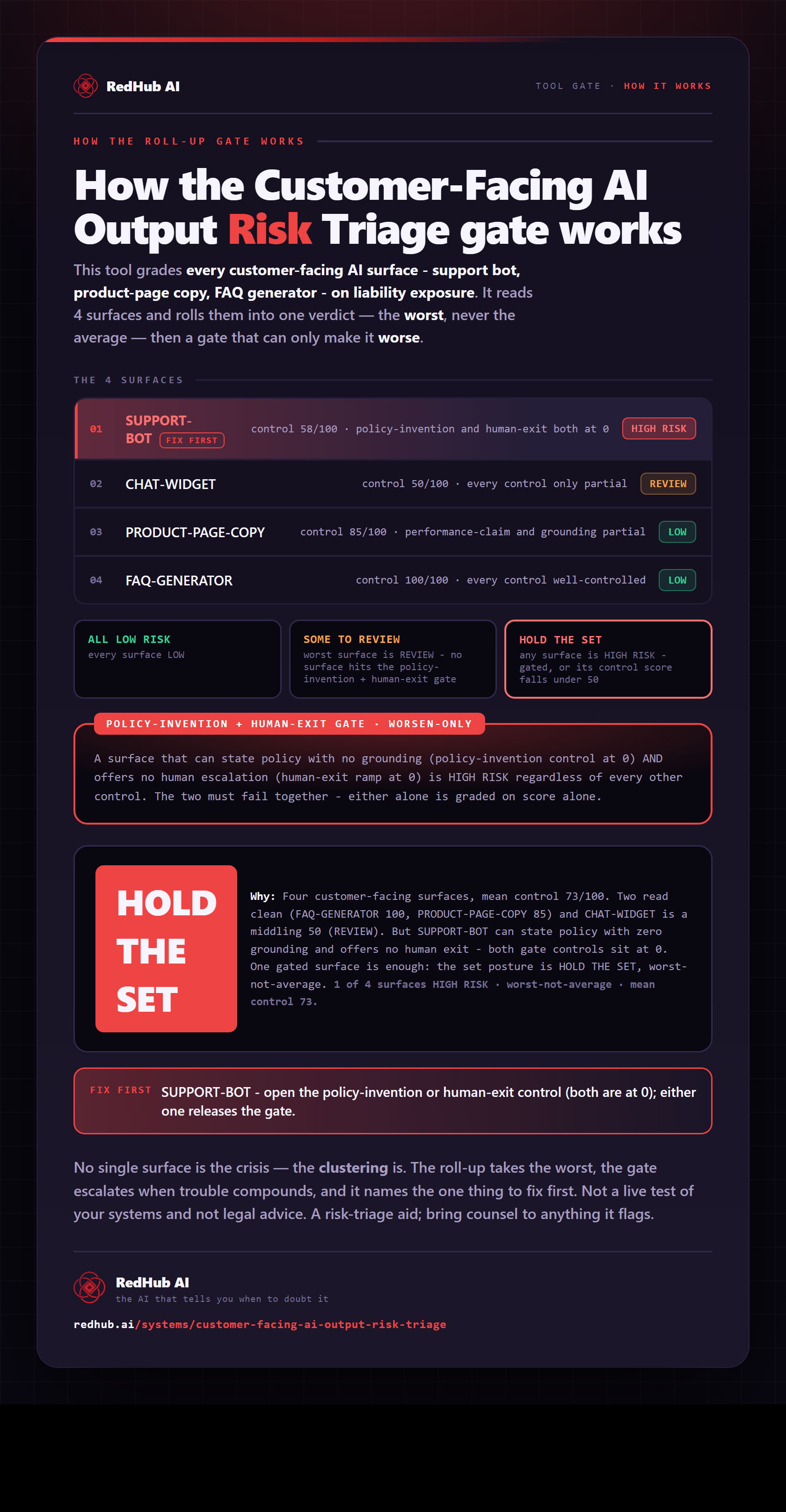
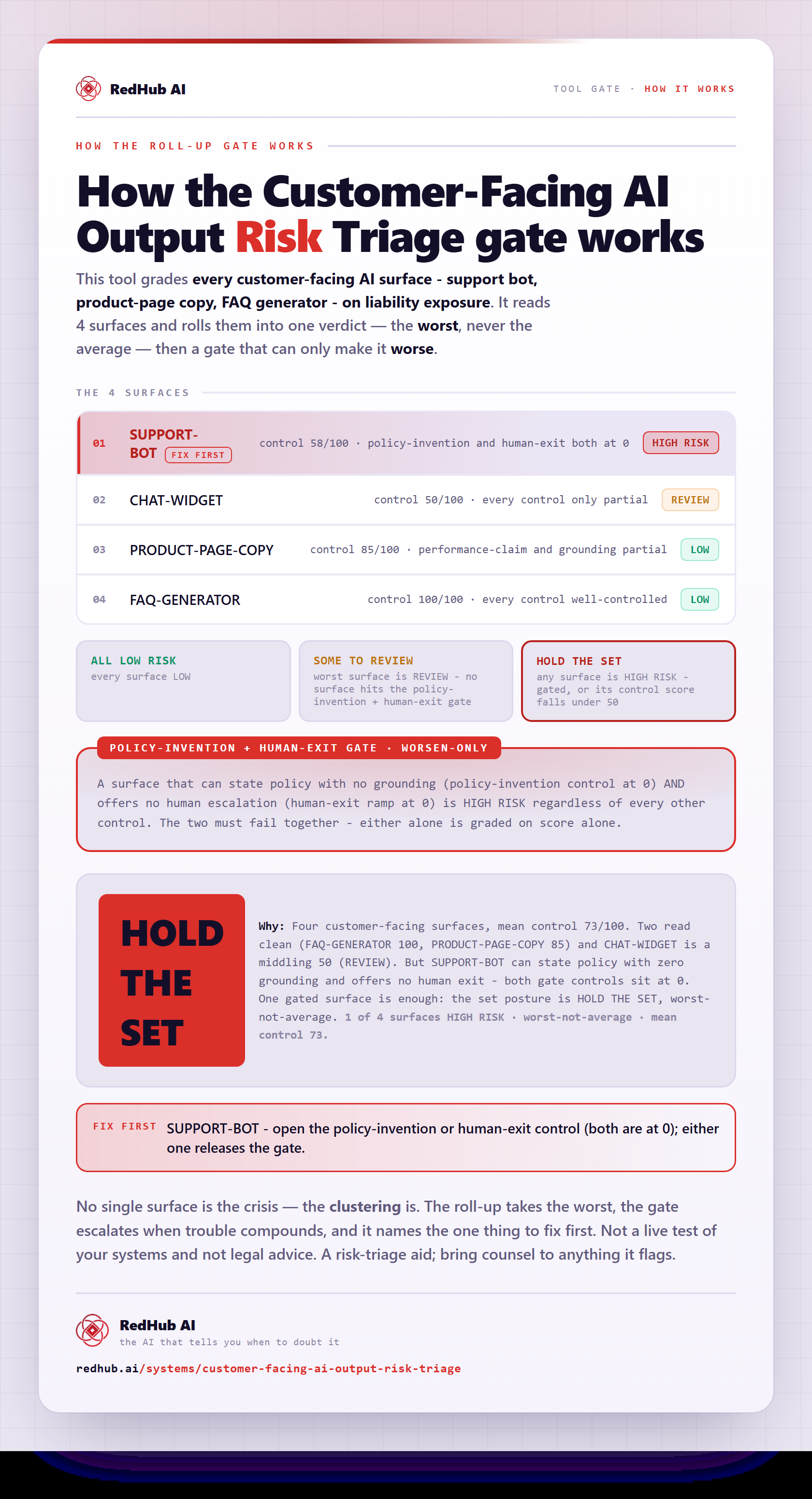
The gate this post refers to, drawn from the tool’s own logic. See the tool.