AI Governance Operating System: Beyond the Policy PDF
RedHub AI Editorialupdated October 2, 20266 min read

Jump to a section7
A policy PDF can tell staff not to paste customer data into a public chatbot, and that rule still matters. It cannot stop an agent that retrieves data, calls tools or emails a customer on a Sunday night with nobody watching. An AI governance operating system covers that second case: the repeatable processes, controls, records and decisions that keep AI use accountable while it runs, not only on paper. Its processes run at the moment the system acts, and its records show afterward what it did.
TL;DR: Policy-only AI governance worked when AI meant staff typing into a chat window. Once AI can act, governance has to run alongside it: a live inventory, risk tiers before access, tests before releases, monitoring, reviews and a way to stop an agent. NIST's AI Risk Management Framework, which NIST says is intended for voluntary use, gives that work a four-part backbone: Govern, Map, Measure and Manage. The NIST AI RMF / US AI Governance Readiness Kit ($149) maps your program to those four functions. Start with the pillar: Enterprise AI Control Plane: When Agents Skip the Checkpoint.
Where the policy PDF stops working
Last spring, a landscaping and snow-removal company with about 40 staff wrote an AI policy. (The company is made up for this post.) One line reads: "A person reviews every AI-written message before it goes to a customer." Everyone signed it.
In September the office manager connected a scheduling assistant to the company inbox. It confirms jobs, offers new times when a storm forces a reschedule, and writes the emails itself. Its setup screen had a toggle labeled "send automatically," and the toggle was on. Nobody broke the policy on purpose. The policy is still true on paper. It now describes a company that no longer exists.
That is the failure a PDF cannot catch. The rule was fine. Nothing connected it to the moment a new tool went live, and nothing checked afterward whether it still held.
What makes it an operating system
An AI governance operating system combines people, policies, system design, testing, monitoring and incident response into a routine that runs whether or not anyone remembers. Some of it can live in software, and most of it is habit. The test: ask what the scheduling assistant did last Tuesday, and who approved it to do that. A policy tells people what they should do. An operating system lets you show what the system actually did.
That last part is the "proof" leg of our Policy, People and Proof framework. Policy and training still come first. The operating system keeps proof current once AI starts acting on its own.
The NIST backbone
NIST's AI Risk Management Framework, released on January 26, 2023, organizes AI risk work into four connected functions: Govern, Map, Measure and Manage. NIST's own page (opens in a new tab) says the framework is "intended for voluntary use." It suits an operating model because each function names ongoing work, not a document you write once.
The right-hand column below is our translation of each function into everyday tasks. NIST's text is broader, so read the column as one practical way to run each function, not as what the framework requires.
| NIST function | Our operational translation |
|---|---|
| Govern | Assign owners, set risk appetite, approve standards, train teams and define accountability |
| Map | Inventory models, agents, data, tools, users, workflows and possible harms |
| Measure | Test quality, security, bias, reliability, tool behavior, cost and compliance performance |
| Manage | Apply controls, monitor live systems, respond to incidents, update policies and communicate results |
Run the landscaping example through it. Map would have caught the scheduling assistant, because a working inventory includes tools staff switch on themselves. Measure would check a sample of its emails for wrong dates and wrong customers. Manage would put the review rule inside the tool, by turning the toggle off or limiting automatic sends to plain confirmations. Govern names who owns all of that.
The minimum operating cadence
A small program can run on six recurring pieces.
- A model and agent inventory that is updated when systems change, not once a year.
- Risk tiering before an agent receives tools or sensitive data.
- Evaluation and regression testing before material releases, meaning a re-run of real tasks to confirm a change made nothing worse.
- Runtime monitoring and incident escalation for high-impact workflows.
- A quarterly review of vendors, access, performance, costs and retired dependencies.
- A documented process for stopping, investigating and improving an agent after it fails.
The first item does most of the work. Its trigger is the change itself. In the landscaping company, "a new tool connects to the inbox" should have been the event that added a row, and adding the row should have prompted someone to ask about that toggle. Our AI governance checklist covers how to build that first inventory.
When the system turns into theater
An operating system can decay into ritual. A monthly review that approves everything is a cost with no control in it. A log nobody reads is storage, not evidence. And six recurring processes can be more than a 40-person company has people for.
The way through is to run each piece at the depth its risk calls for. For the landscaping company, the quarterly review can be one hour with a spreadsheet: every AI tool, who owns it, what it can send, and whether that changed. An hour that happens beats a two-day review that keeps getting postponed.
The common claim that governance speeds adoption holds only under one condition. Teams have to know the approval path, the required controls and how a new use gets tested, so each proposal does not reopen the same argument. The landscaping company's line between useful and theater will not sit where a regional bank's does, and it shifts the day another tool starts sending on its own. Nobody outside the company can draw it.
Stand up the four functions without a blank page
The NIST AI RMF / US AI Governance Readiness Kit maps your AI governance to Govern, Map, Measure and Manage with a readiness assessment, an AI use-case register, a maturity scorecard, model-card and policy skeletons, and a vendor-questionnaire answer bank. It refuses to mark a high-impact use case with no oversight as ready. Governance guidance, not legal advice.
Get the NIST AI RMF Readiness Kit — $149Pairs well with
The AI Acceptable Use Policy Builder ($69) generates a tailored AI policy plus an Excel tool register and data matrix by company size and industry. The AI Incident Postmortem & Readiness Gate ($79) grades a finished AI-incident postmortem and gates the close, returning CLEARED TO CLOSE AS DESCRIBED, FINISH ACTIONS or NOT CLOSEABLE. The ISO 42001 AIMS Readiness & Gap Diagnostic ($249) scores an AI management system across six clause-groups drawn from ISO 42001, from your own evidence marks, takes the weakest group as the headline, and returns CERTIFIABLE, GAPS TO CLOSE or NOT READY. It is a readiness self-assessment, not a certification; ISO does not certify organizations.
More in this guide
What is an AI governance operating system?
It is the set of repeatable processes, controls, records and decisions that keep AI use accountable while the systems run. It combines people, policies, system design, testing, monitoring and incident response, and it is a way of working rather than one software product.
Is an AI policy document enough?
A policy is the starting point, but not enough once AI can act on its own. A document cannot notice a new tool, check whether a rule still holds, or show what an agent did last week. Those need an inventory, tests, monitoring and records.
What are the four NIST AI RMF functions?
NIST's AI Risk Management Framework organizes AI risk work into four functions: Govern, Map, Measure and Manage. NIST released the framework on January 26, 2023. This is a description of the framework, not legal advice.
Is the NIST AI Risk Management Framework mandatory?
NIST's page describes the framework as intended for voluntary use. Whether a law, contract or customer asks something specific of your business is a separate question for counsel. This is a description of the framework, not legal advice.
What is the minimum AI governance cadence?
An inventory updated when systems change, risk tiering before agents get tools or sensitive data, testing before releases, monitoring for high-impact workflows, a quarterly review of vendors and access, and a documented way to stop and fix an agent after it fails.
Can a small company run an AI governance operating system?
Yes, if each piece runs at the depth its risk calls for. A small company's quarterly review can be one hour with a spreadsheet listing every AI tool, its owner and what it can send or change.
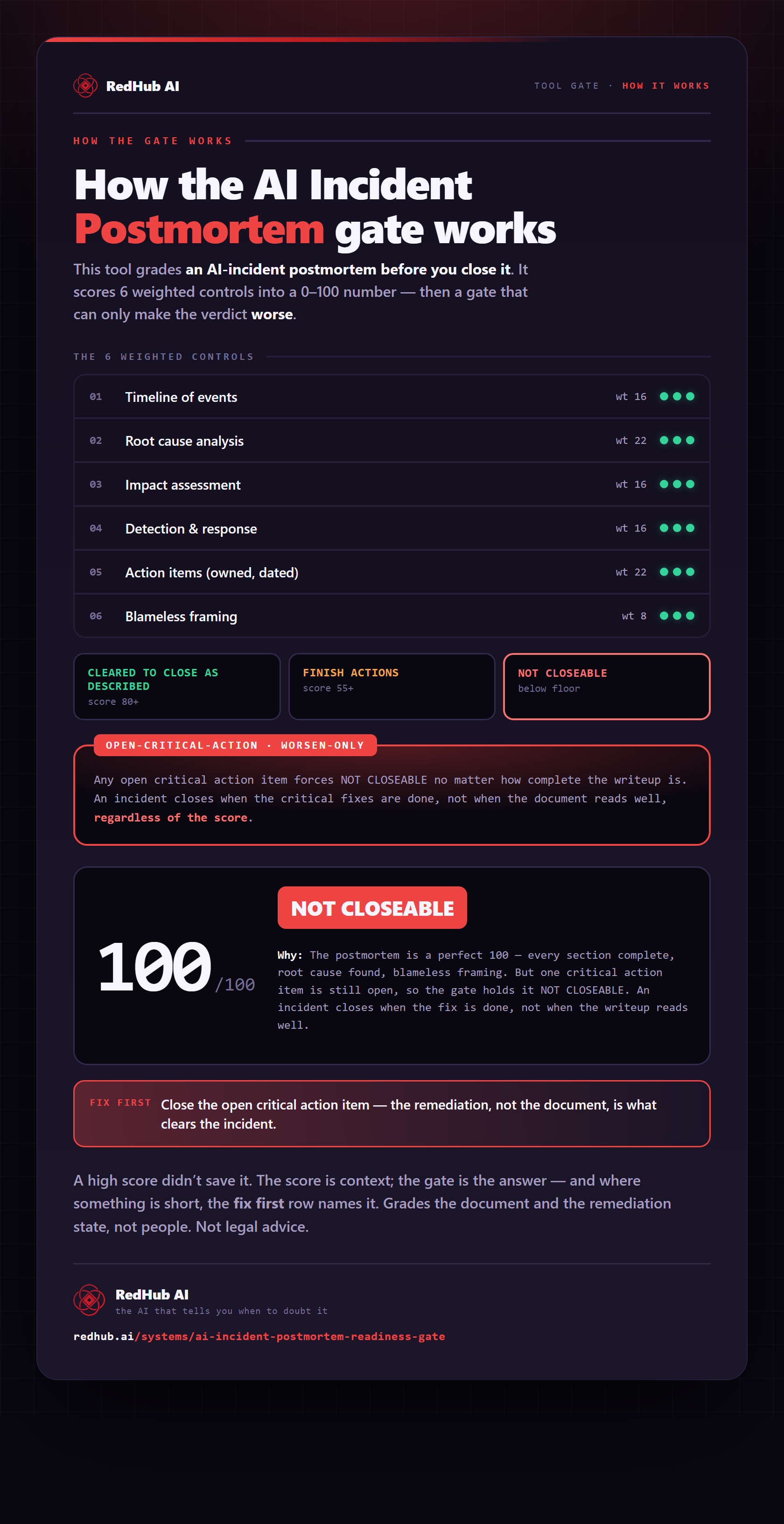
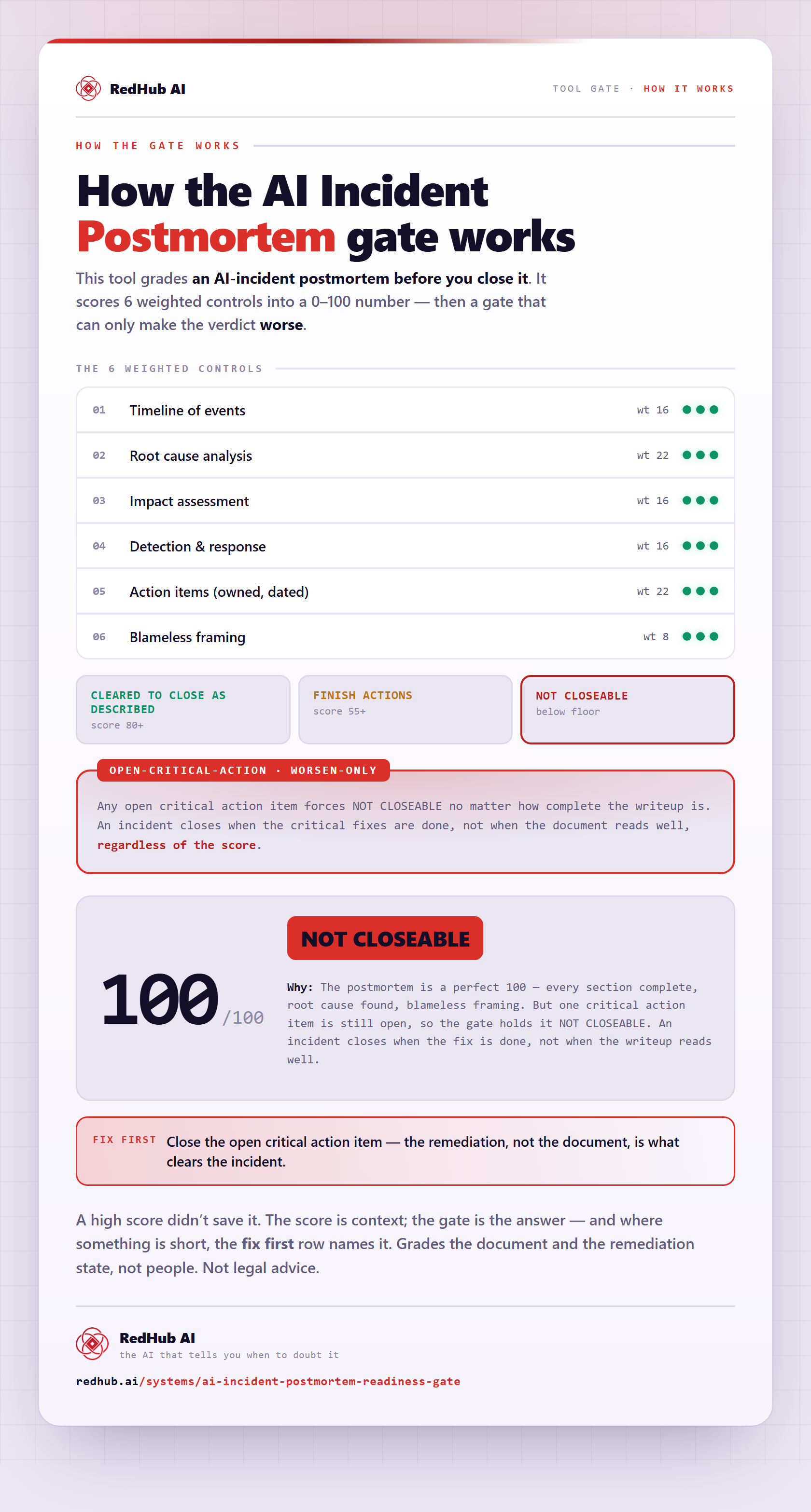
The gate this post refers to, drawn from the tool’s own logic. See the tool.