Shadow AI Risks: What Ungoverned AI Tools Expose
RedHub AI Editorialupdated September 7, 20265 min read

Jump to a section7
Ungoverned AI tools mainly expose one thing: data leaving your business into a vendor's systems on terms nobody on your team read — customer information, source code, financial figures, or internal strategy, sitting inside a tool's storage, training pipeline, or retention policy with no visibility from your side.
TL;DR: The risk in shadow AI isn't the tool itself — it's the data flowing into it and where that data goes next, which nobody has checked because nobody knew the tool was in use. This is the "why it matters" companion to the Shadow AI pillar guide; once you understand the exposure, score it with the Shadow AI Discovery & Risk-Triage Kit — $69.
The Real Exposure Isn't the Tool — It's What Goes Into It
It's easy to treat shadow AI as a "which apps are on the list" problem. That framing misses the point. A free summarization tool is harmless if the only thing it ever sees is a public blog draft. The same tool becomes a real exposure the moment someone pastes a customer's contract, a candidate's resume, or a spreadsheet of unpaid invoices into it. The tool doesn't change — the data going into it does. That's why triage has to look at what's actually being fed to a tool, not just whether the tool "sounds risky."
The Categories of Exposure Worth Naming
Most shadow AI exposure falls into a handful of recognizable buckets. None of these require a data breach to matter — the exposure exists the moment the data leaves your control, whether or not anything ever goes wrong downstream.
- Customer and prospect data. Names, emails, deal details, support tickets — pasted into a chatbot to draft a reply or summarize a thread, now sitting inside a vendor's account with terms your team never reviewed.
- Regulated or sensitive personal data. Health information, financial account details, background-check results — categories that carry their own handling expectations regardless of which tool touches them.
- Source code and internal IP. A snippet pasted into a code-assistant tool to debug a problem, now potentially retained or used to improve a model outside your control.
- Financial and strategic detail. Board decks, pricing models, unreleased plans — summarized or analyzed by a tool with an unclear retention policy.
- Contractual exposure. A customer contract that promises data stays within named, approved vendors — quietly violated the moment an unapproved tool touches that customer's information.
Why "We'll Just Ban It" Doesn't Work
A blanket ban feels like the fast fix, and it almost never holds. People adopted the tool because it solved a real problem faster than the approved alternative — ban it without a replacement and it either comes back under a different name within weeks, or the underlying problem it solved goes unsolved and someone finds a different unsanctioned tool to fix it. Discovery and triage exist to avoid that trap: you find out what the tool is actually being used for, how much exposure it carries, and then route it — into governance if it's worth keeping under supervision, toward a sanctioned replacement if it isn't, or out entirely if the exposure outweighs the value.
How to Actually Score Exposure Instead of Guessing
Scoring exposure consistently means resisting the urge to rank by gut feeling. A workable approach weighs three things for every tool on your inventory: how sensitive the data it touches is, how many people are feeding it that data, and how often. A tool one person uses occasionally on non-sensitive text ranks low. A tool half your support team uses daily on live customer tickets ranks at the top of your list, even if it's a household-name product nobody thinks twice about.
- Rate the sensitivity of the data involved — public, internal, customer, or regulated.
- Rate the reach — how many people, how often.
- Combine the two into one exposure score so tools can be ranked against each other instead of judged in isolation.
That scoring step only works once you've actually collected the inventory it's scoring — see how to take an honest inventory of your AI tools if you haven't started there yet.
To put a number on the exposure rather than a list, the free GenAI Security Assessment (opens in a new tab) asks 24 questions about what the AI already in use exposes you to. It never asks whether you have an inventory — that is a different assessment — and it measures what is arranged and practiced, not what would hold against somebody trying.
What Comes After the Score
A ranked list of exposure tells you where to look first — it doesn't write your policy or map every data flow on its own. The Shadow AI Discovery & Risk-Triage Kit's Shadow AI Triage tab produces that ranking and, where a tool needs governing, points at the single one to govern first; from there, the AI Governance & Acceptable Use Starter Kit ($39) is where you write the rules for what's allowed, and the Vendor & Sub-Processor Data-Flow Register ($89) is where you track exactly where a kept tool's data travels next. This is general operational guidance, not legal advice — data-handling obligations vary by industry and jurisdiction, so confirm yours with qualified counsel.
Pairs well with
Score exposure first with the anchor kit, then govern what you keep with the AI Governance & Acceptable Use Starter Kit ($39) and track its data flow with the Vendor & Sub-Processor Data-Flow Register ($89). Start from the full picture in the Shadow AI pillar guide.
More in this guide
What's the biggest risk of shadow AI?
Data leaving your business into a vendor's tool on terms your team never reviewed — customer, financial, or code data with no visibility into how it's stored, retained, or used to train the vendor's model.
Is every unsanctioned AI tool automatically high risk?
No — risk depends on what data goes into it and how many people use it, not on whether it was officially approved. A tool touching only public information carries far less exposure than an approved-sounding one touching customer data.
Should we just ban every tool we didn't approve?
A blanket ban usually backfires — the tool solved a real problem, so banning it without a replacement often just pushes the same use case toward a different, still-unsanctioned tool. Triage and route instead of banning outright.
How do I rank which tool to deal with first?
Combine how sensitive the data is with how many people use the tool and how often — the widest-reaching tool touching the most sensitive data is almost always the top priority.
Does shadow AI create legal liability?
It can, depending on your industry, your contracts, and the data involved — but that's a legal question, not an operational one. This is general operational guidance, not legal advice; confirm your specific obligations with qualified counsel.
What's the difference between risk scoring and governance?
Risk scoring tells you which tool matters most right now; governance is the ongoing policy that decides what's allowed going forward. The Shadow AI Discovery & Risk-Triage Kit does the scoring — the AI Governance & Acceptable Use Starter Kit does the policy.
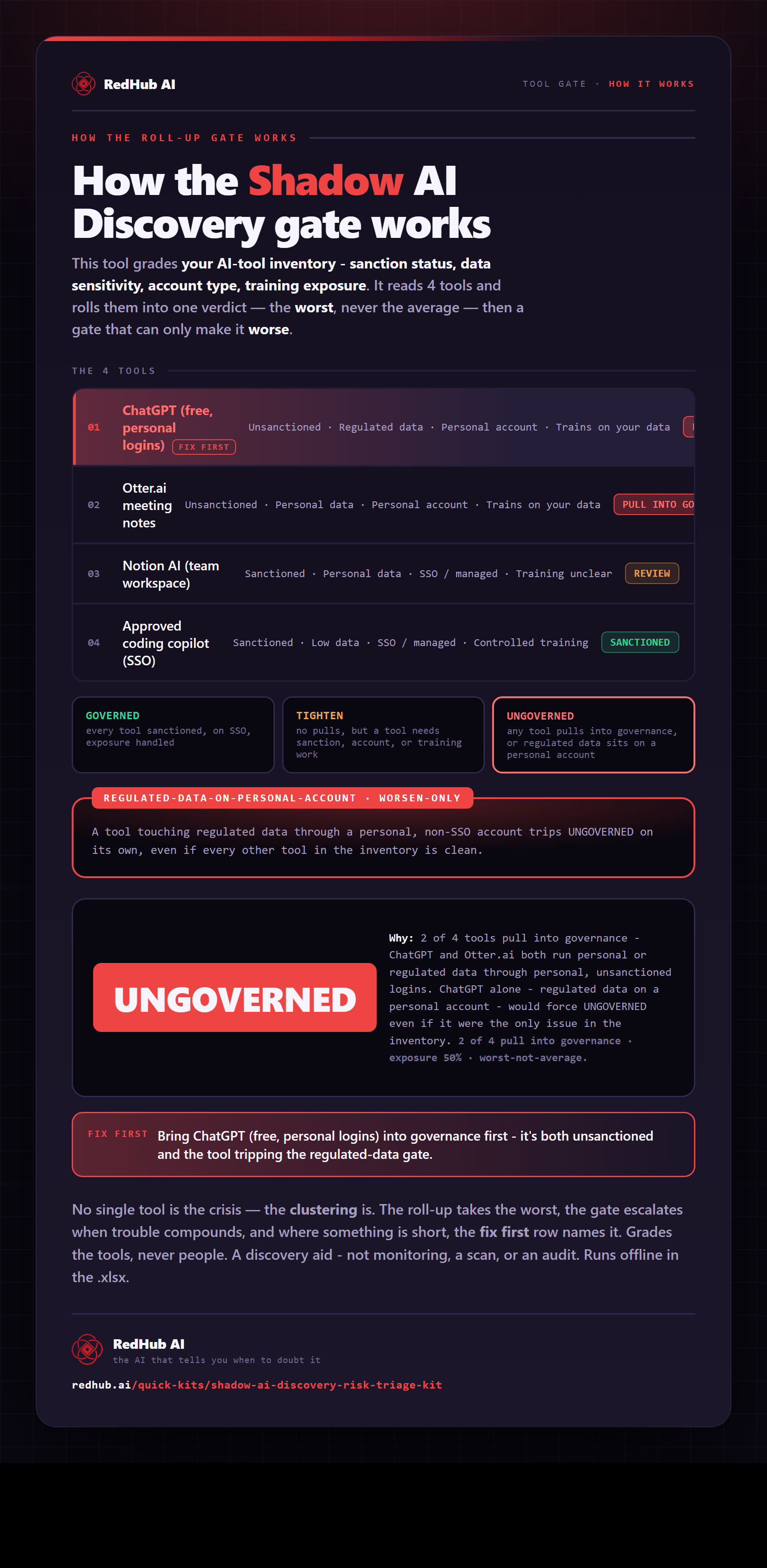
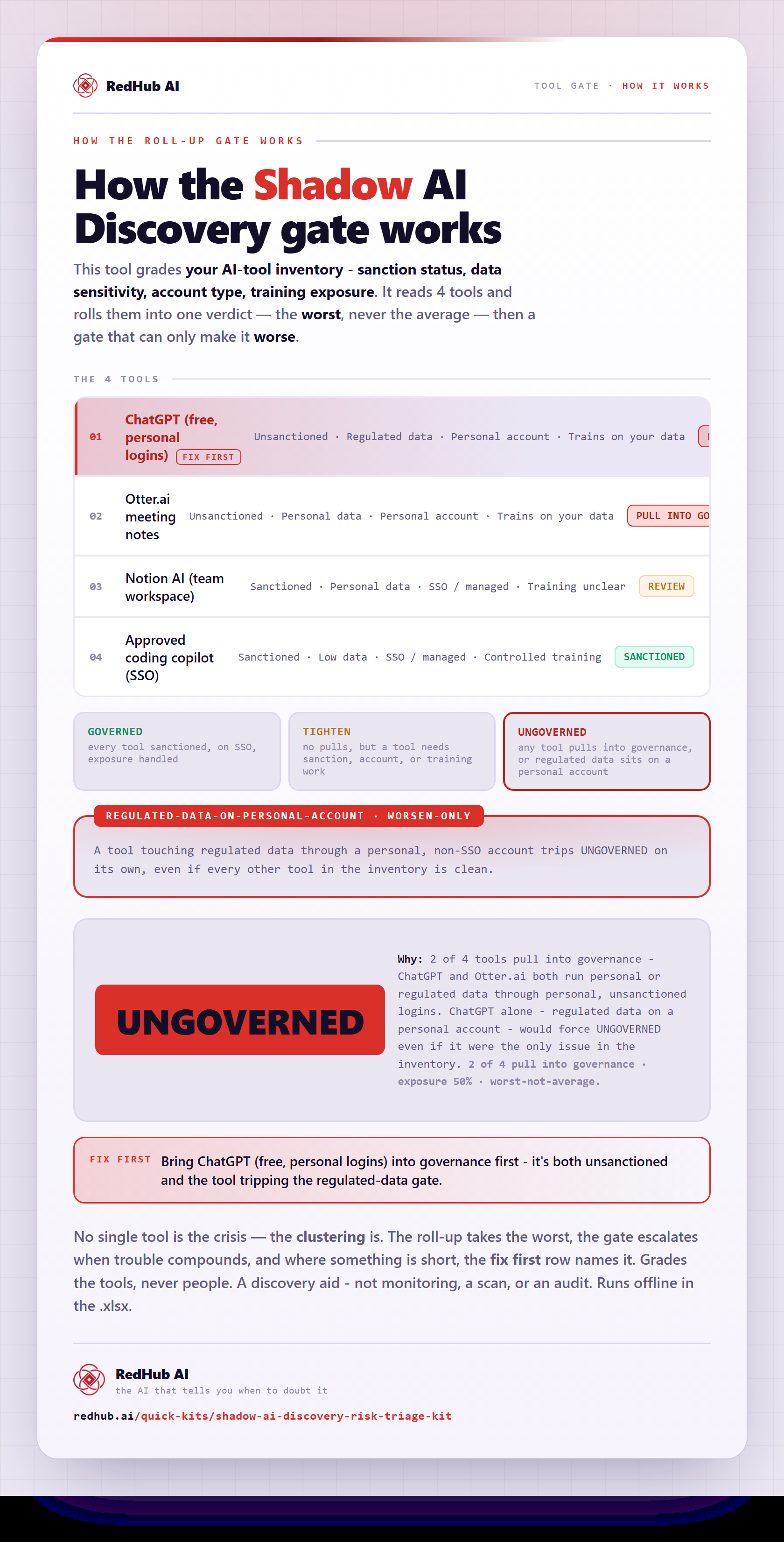
The gate this post refers to, drawn from the tool’s own logic. See the tool.