

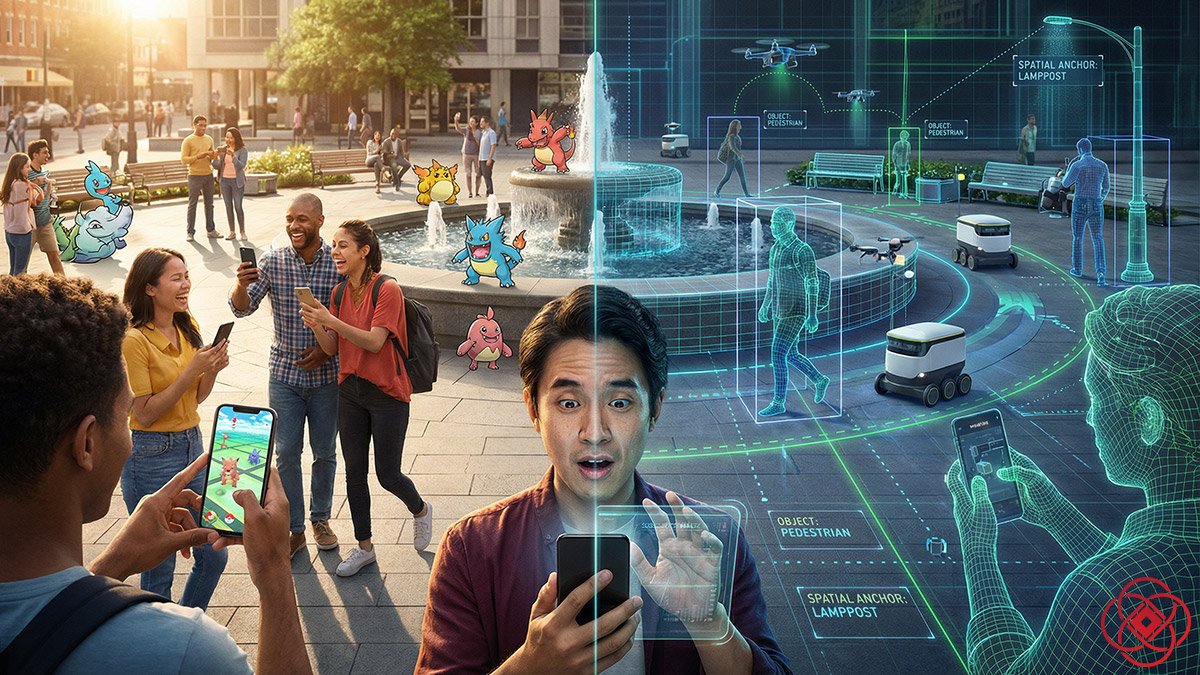
The Hidden AI Map Behind Pokémon Go
How millions of players unknowingly built the spatial intelligence infrastructure that powers tomorrow's robots and AR devices.
TL;DR
- What it is: Niantic turned Pokémon Go into a crowdsourced mapping operation that built a detailed 3D model of the walkable world.
- Who it's for: Robotics companies, AR developers, and AI systems that need precise spatial awareness beyond GPS accuracy.
- How it works: Players scanning locations for gameplay generated millions of images that trained Visual Positioning Systems and Large Geospatial Models.
- Bottom line: What looked like entertainment was infrastructure—your gaming habit helped train the machines that will navigate our physical world.
What is the hidden AI map behind Pokémon Go?
The hidden AI map behind Pokémon Go is a comprehensive spatial intelligence database built from player-generated scans, photos, and movement patterns. It helps robotics companies, AI agents, and AR systems understand physical spaces with precision that GPS alone cannot provide.
Best for: Delivery robots, AR navigation, smart glasses. • Not ideal for: Privacy-conscious users seeking data transparency. • Fast takeaway: Players mapped the world while catching Pokémon—the data became more valuable than the game.
For years, it looked harmless. People walked through parks staring at their phones. They stopped at murals, statues, and downtown corners. They spun PokéStops. They caught monsters. They played.
That was the story we saw.
The real story was bigger.
While millions of people were hunting Pokémon, Niantic was collecting something far more valuable than game activity. It was building a map. Not a normal map. A living, visual, 3D map of the real world.
That is the part most people missed.
This was never just about a game. It was about training machines to understand space, movement, and location at a level that old technology could never reach. Every scan. Every photo. Every mapped landmark. Every little bit of effort from players added another piece.
Brick by brick, players helped build the foundation for physical AI.
That is the pivot. And it matters more than most people realize.
The game was never the end goal
A lot of people thought Pokémon Go was the product. It was not.
It was the engine that got people outside. It got them moving. It got them scanning the world. It turned ordinary users into data collectors without making the job feel like work.
That is the genius of it.
Niantic found a way to make infrastructure feel like entertainment.
Then the company made its move. It sold its gaming division to Scopely for $3.5 billion and spun out Niantic Spatial. That move told you everything. The map had become more important than the game.
The fun was the front door. The real asset was the data.
That is why people got upset. Once that became clear, Reddit and X lit up. Some people felt tricked. Others said the terms were there the whole time and nobody should act surprised.
But that argument misses the larger point.
The point is not whether people clicked "agree." The point is that modern digital life keeps teaching the same lesson: what feels small to you may be huge to the company behind it.
Your gaming habit may be training the robot workforce
This got even clearer when Niantic licensed its spatial data to Coco, a delivery robotics company.
At first, that sounds strange. What does catching Pikachu have to do with sidewalk robots?
A lot, actually.
A game character and a delivery robot may seem like different things. But both need to know where they are. Both need to move through the world. Both need to understand curbs, sidewalks, obstacles, and people. Both need precise spatial awareness.
That is the connection.
The same map that helps place a digital creature on a sidewalk can help a robot avoid crashing into a stroller.
That means the data built through play now has industrial value. Not maybe. Not someday.
Right now.
Google mapped the roads. Niantic mapped the spaces between them.
To understand why this matters, you have to see what kind of map Niantic built.
Google spent years mapping the drivable world. That was a massive achievement. Street View cars covered roads, highways, and major routes. It gave us the world from behind a windshield.
But the world is not just roads.
The real action happens off the road. In parks. In plazas. On walking paths. Around fountains. Near storefronts. Through campuses. Across all the places where cars do not go, but people do.
That is where Niantic focused.
It built what you could call the walkable world.
That changes everything.
Because the walkable world changes faster. Roads do not move much. But storefronts change. Public spaces shift. Landmarks get updated. Local gathering places come and go. Social spaces are more alive, more messy, and more dynamic than road systems.
So a map of those places becomes incredibly valuable.
And because players are always moving through them, Niantic created something powerful: a map that can keep updating itself through human behavior.
That is hard to beat.
GPS is good. Until it really matters.
Most people think GPS solves location. It does not.
It solves rough location.
That was enough for an earlier era. It could get you close. It could tell you what street you were on. It could help you drive somewhere.
But for robots, AR, and smart glasses, "close enough" is not enough.
If a system is off by a few meters, that is not a small mistake. That is the difference between a sidewalk and traffic. Between a door and the wall next to it. Between an AR object floating in the general area and one locked exactly where it belongs.
And in dense cities, GPS often struggles even more. Tall buildings block signals. Reflections confuse the system. Accuracy gets worse when you need it most.
That is why Visual Positioning System, or VPS, matters.
Instead of relying only on satellites, VPS uses camera views and matches them against detailed 3D maps of real places. The result is much more precise. Not just "you are here." More like: "you are standing right here, facing this direction, next to this exact object."
That is the big unlock.
It is what makes the digital world stick to the physical one. And it is what lets machines move through human space with much more confidence.
The next step is giving machines a sense of place
Then things get even more interesting.
Niantic is not just building detailed maps. It is pushing toward something bigger: a system that can understand location from visual clues the way a skilled human can.
Think about someone who can look at a blurry photo and still guess where it was taken. They notice the road markings, the plants, the shape of the sidewalk, the feel of the place. They do not just see an image. They read the environment.
Now imagine training a machine to do that.
That is the idea behind a Large Geospatial Model.
This is not just a library of photos. It is a kind of visual brain. A system trained on huge numbers of images so it can recognize the patterns of the real world and place itself inside them.
That matters because perfect maps do not exist everywhere. There are gaps. There are weak spots. There are places not fully scanned yet.
A system like this helps fill those gaps.
It gives robots, smart glasses, and future devices a better chance to figure out where they are, even with less-than-perfect input.
That moves spatial intelligence from simple storage to real understanding.
The map became the side effect
This may be the smartest part of the whole story.
Mapping the world is expensive. Really expensive.
Traditionally, it takes fleets of vehicles, special sensors, huge teams, and endless cost. That is how companies have done it for years.
Niantic found another way.
It turned data collection into a game mechanic.
That is a very different model.
People were not hired. They were engaged.
They were not sent on mapping assignments. They were sent on quests.
They were not doing infrastructure work. They were having fun.
And that is why this worked so well.
The game improved the map. The map improved the game. Then the map became more valuable than the game itself.
That is how modern platforms win.
They make the user action feel small while the system-level benefit becomes enormous.
What looks like play on the surface can become infrastructure underneath.
Niantic is not the whole story. It is one layer of a much bigger one.
This is where the story gets a little unsettling.
Because Niantic is not building this reality map alone.
A lot of companies are collecting different pieces of the same world.
Some are capturing the human point of view through wearable devices, glasses, and body cameras.
Some are mapping homes through robot vacuums, security systems, and mixed reality headsets.
Some are mapping streets through cars, autonomous vehicles, and license plate networks.
Some are mapping the planet from above with satellites and radar systems.
Each one sees a different slice.
Put those slices together and you get something much larger: a layered model of physical reality that is increasingly detailed, increasingly current, and increasingly useful to machines.
That is the real shift.
We are no longer just using digital tools in the world. We are helping train a model of the world itself.
This is what physical AI really means
Physical AI sounds futuristic, but the inputs are ordinary.
A jog tracked on an app. A room scanned by a headset. A sidewalk crossed by a delivery robot. A neighborhood recorded by a car. A park explored through a phone game.
All of these actions create data.
All of that data teaches systems how the world works.
How people move. How places change. How objects sit in space. How environments are recognized. How navigation becomes safer, faster, and more precise.
That is what is being built under our feet.
A world model.
Not a metaphorical one. A practical one.
A machine-readable version of reality.
And once that exists, it changes what machines can do.
The real question is not whether this is clever
It is.
The real question is whether we are comfortable with the trade.
Because that is what this has always been: a trade.
You got a game. They got the map.
You got fun, movement, discovery, and a reason to go outside.
They got scans, images, behaviors, and a better model of the world.
For a long time, that trade was invisible.
Now it is not.
And once you see it, you start seeing it everywhere.
The devices we use for convenience. The apps we use for fitness. The tools we use for safety. The games we use for fun. They are not just helping us live in the world.
They are helping build a version of the world that machines can use.
That may lead to better robotics. Better AR. Better navigation. Better systems.
It may also lead to a reality where everyday life becomes unpaid training data for an ever-expanding machine layer wrapped around the physical world.
That is the real pivot.
Not from one game to another.
From play to infrastructure.
From entertainment to intelligence.
From catching monsters to teaching machines how to see.
Should you care about the hidden AI map behind Pokémon Go?
Yes, if: You use location-based apps, play AR games, or want to understand how everyday digital activities contribute to AI training infrastructure.
Maybe not if: You are comfortable with data collection as the standard trade-off for free digital services, and you do not work in robotics, AR, or enterprise AI sectors.
Best first step: Read the data policies of apps you use daily, especially those with location tracking, and decide which trade-offs align with your comfort level.
FAQ
What is the hidden AI map behind Pokémon Go in simple terms?
It is a detailed 3D map of real-world locations that Niantic built using photos and scans from Pokémon Go players. This map helps robots and AR devices understand physical spaces more accurately than GPS alone.
How is Niantic's spatial map different from Google Maps?
Google Maps focuses on roads and drivable routes. Niantic's map covers the walkable world—parks, plazas, sidewalks, and pedestrian spaces where cars do not go. It provides visual positioning data that is more precise than GPS, especially in dense urban areas.
What is a Visual Positioning System (VPS)?
VPS uses camera images matched against 3D maps to determine exact location and orientation. Unlike GPS, which can be off by several meters, VPS can pinpoint where you are standing, which direction you face, and what objects surround you—critical for robots and AR applications.
What is a Large Geospatial Model?
A Large Geospatial Model is an AI system trained on millions of location images to recognize places from visual clues alone. It works like a human who can identify a location from a blurry photo by reading environmental patterns—road markings, plants, architecture, and spatial relationships.
Did Pokémon Go players know they were helping build AI infrastructure?
Most did not realize the full scope. While Niantic's terms disclosed data collection, the industrial applications—like licensing spatial data to robotics companies—became clear only after the $3.5 billion gaming division sale and the spin-out of Niantic Spatial as a separate infrastructure company.
How does this spatial data help delivery robots?
Delivery robots need to navigate sidewalks, avoid obstacles, and understand pedestrian spaces. Niantic's map provides detailed information about curbs, walkways, storefronts, and real-world obstacles that GPS and road maps do not cover, making autonomous navigation safer and more reliable.