Multi-Agent Orchestration: A Practical Guide for Dev Teams
RedHub AI Editorialupdated October 4, 20268 min read
Jump to a section8
Multi-agent orchestration is the practice of coordinating several LLM agents, each with its own instructions, tools and scope, so they finish one task together instead of one agent carrying everything in a single sprawling prompt. You orchestrate when a task splits into clearly separate jobs, when steps need different tools or permissions, or when one context window can't hold the whole problem. It is not free. Anthropic's engineers reported in June 2025 that, in their data, multi-agent systems used about 15 times the tokens of an ordinary chat, against about 4 times for a single agent. So the starting point is one well-instrumented agent, and you add agents only when a specific bottleneck makes the case.
TL;DR: Orchestration coordinates specialized agents into one flow. Use it when sub-jobs are genuinely separable or a single context can't hold the task, not because more agents sounds better. Every added agent adds token cost, latency and failure surface, so start with one agent and split only under pressure. The three building-block shapes are sequential (a pipeline), parallel (fan out, then merge) and hierarchical (an orchestrator delegating to workers). Whatever you build, it isn't reliable until it runs against an eval harness with golden cases, failure-mode notes and a cost and latency budget.
What orchestration actually means
An agent is a loop. The model gets a goal, picks an action (call a tool, ask a sub-question, write an answer), sees the result and loops again until it decides it's done. A single-agent system is one of those loops with a set of tools. Multi-agent orchestration is a layer above that: code that decides which agent runs, in what order, with what inputs, and what happens to each agent's output.
That layer is ordinary software. Conditionals, queues, state, retries. Teams underestimate it. The agents are probabilistic, so the glue holding them together should be boringly deterministic. When a team calls its multi-agent system flaky, look at the glue first: a missing timeout, no max-step budget, or no schema check on the hand-off between two agents.
When to orchestrate, and when not to
Reach for multiple agents when at least one of these is clearly true:
- Separable sub-jobs with different skills. Classifying an intent, retrieving documents and writing a compliance-checked reply are different jobs with different prompts and tools. Splitting them lets you test and fix each one alone.
- Different permissions or tools per step. A research step that can browse should not share a context, or credentials, with a step that can execute code. Separate agents give you a real trust boundary.
- Context that won't fit. If a task needs more source material than one context window holds well, workers that each take a slice keep every agent inside the window where it reasons best.
- Parallelism that saves wall-clock time. Ten independent lookups finish faster as a fan-out than as one agent working through them in order.
Stay with one agent when the task is one coherent job, when the "steps" are phases of the same reasoning, or when you haven't instrumented the agent well enough to know where it fails. Splitting an unmeasured agent into three unmeasured agents triples the mystery.
The default has limits, though, and the same Anthropic team shows where. In its June 2025 write-up, How we built our multi-agent research system (opens in a new tab), a lead Claude Opus 4 agent directing Claude Sonnet 4 subagents outperformed single-agent Claude Opus 4 by 90.2% on Anthropic's internal research eval. That was breadth-first research, where many searches run at once. The same post says most coding tasks have fewer truly parallel pieces than research, and those models have since been replaced by newer ones. Whether your workload sits closer to their research case or their coding case is a question only your own eval can answer.
The three building-block patterns
Most orchestrations can be described as a mix of three shapes. Learn these and the named patterns become variations you can reason about.
| Shape | How it runs | Best for | Main risk |
|---|---|---|---|
| Sequential (pipeline) | Agent A, then B, then C, each output feeding the next | Staged work where each step depends on the last (extract, validate, format) | Errors compound; one bad hand-off poisons everything after it |
| Parallel (fan-out and merge) | One input splits to N workers at once, then a merge step combines results | Independent sub-tasks: multi-source research, batch classification, map-reduce over documents | Quality is won or lost at the merge; workers can duplicate or contradict |
| Hierarchical (orchestrator and workers) | A lead agent plans, delegates to specialist workers and assembles the result | Open-ended tasks where the sub-jobs aren't known until the work starts | The orchestrator can loop, over-delegate or spawn runaway workers without a budget |
The agent orchestration patterns guide walks through each shape and its trade-offs. The orchestrator-worker guide covers the hierarchical case on its own, because it's the one teams most often get wrong.
A worked example: support triage
Say you're routing support tickets. A clean orchestration looks like this:
- A classifier agent reads the ticket and returns a structured intent (
billing,technicaloraccount) plus a confidence score. - Plain orchestration code, not an agent, checks the confidence. If it's below a threshold, or the intent is
unknown, the ticket goes to a human and the run stops. - For a confident classification, the code dispatches to the matching specialist agent, which has only the tools that role needs. The technical agent can run diagnostics; the billing agent can read invoices.
- The specialist's answer passes a lightweight check before it's sent, so a hallucinated refund or a wrong account action gets caught.
Very little of that is AI. The agents supply the judgment. The reliability comes from the plain-code gates around them: the confidence threshold, the tool scoping, the pre-send check. Agents propose, and deterministic code disposes.
Claude Agent SDK or LangGraph?
Both are reasonable picks, and the choice is a trade-off. As of October 2026, the two projects describe themselves this way in their own docs.
Claude Agent SDK
- Anthropic says it gives you the same tools, agent loop and context management that power Claude Code
- Its docs list hooks, subagents, MCP and permissions among its capabilities
- Programmable in Python and TypeScript, and built around Claude models
LangGraph
- LangChain calls it a low-level orchestration framework and runtime for long-running, stateful agents
- Checkpointers persist graph state, which supports human-in-the-loop pauses and resuming after failures
- Python and JavaScript versions; you bring the model, so it isn't tied to one provider
Pick by your portability needs and your team's comfort, then hold the choice loosely, because the patterns port between them. Both projects ship changes often, so check their changelogs before you build on a detail from any blog post, this one included.
You can't call it reliable until you've measured it
Agents rarely die in production because the pattern was wrong. They die because nobody tested the pattern against realistic failure. Before an orchestration goes live it needs three things the demo never had:
- An eval harness with golden cases and scoring, so a prompt tweak that quietly breaks step 3 fails a test instead of a customer.
- Failure-mode notes. For each agent: where it breaks, why, and what the system does about it (retry, degrade or escalate).
- A cost and latency budget. Tokens, p50 and p95 latency, and retry rate per pattern, so you choose patterns that fit your unit economics as well as your accuracy targets. Our guide to the true cost of an AI agent shows what belongs in that number.
Measurement also settles arguments. A team that can show cost per run and pass rate for the single-agent version and the split version doesn't need to debate the architecture in a meeting.
Stop rebuilding orchestration patterns from blog posts
The Agent Orchestration Cookbook gives you five multi-agent patterns with full code in the Claude Agent SDK and LangGraph, in Python and TypeScript, with a control-flow eval, failure notes and a directional cost model for each pattern.
Get the Agent Orchestration Cookbook — $79Pairs well with
The Agent Use-Case Fit & Proof-of-Value Gate ($99) scores whether a proposed agent is worth building at all and returns BUILD, PILOT FIRST or DON'T BUILD. The Agent Reliability Harness ($149) evaluates agent runs at the trajectory level (tool choice, argument validity, step efficiency, cost and policy) and returns a SHIP, HOLD or FIX verdict you can gate CI on. The AI Agent Go-Live Readiness Gate ($79) rates five operational controls, including a tested rollback path, and returns READY, FIX or DO NOT DEPLOY.
More in this guide
What is multi-agent orchestration in simple terms?
It's coordinating several LLM agents, each with its own job, tools and scope, so they solve one task together. A layer of ordinary code decides which agent runs, in what order, with what inputs, and what to do with each result. The agents are probabilistic; the code around them should be deterministic.
Do I always need multiple agents?
No. A single well-instrumented agent is the usual starting point. Multiple agents pay off when sub-jobs are genuinely separable, need different tools or permissions, don't fit in one context, or can run in parallel to save real time. Each agent you add raises cost, latency and failure surface.
How much more do multi-agent systems cost?
It depends on your workload. In its June 2025 write-up on its research system, Anthropic reported that in its data multi-agent systems used about 15 times the tokens of a chat, against about 4 times for a single agent. Measure your own cost per run before and after a split.
What are the core orchestration patterns?
Three shapes cover most designs: sequential (a pipeline where each step feeds the next), parallel (fan out to workers, then merge) and hierarchical (an orchestrator that plans and delegates to workers). Named patterns like supervisor or router are variations on these.
Should I use the Claude Agent SDK or LangGraph?
Both work. The Claude Agent SDK packages the agent loop and tools behind Claude Code, with hooks, subagents and MCP, for teams committed to Claude. LangGraph is a provider-neutral orchestration runtime with checkpointing and human-in-the-loop support. The patterns port between them either way.
Why do orchestrated agents fail in production when they worked in the demo?
The demo never met the edge cases. An agent loops on an input the happy path didn't cover, or a hand-off fails a schema check nobody wrote. The fix is an eval harness, failure-mode notes and a cost budget, covered in the failure-modes guide.
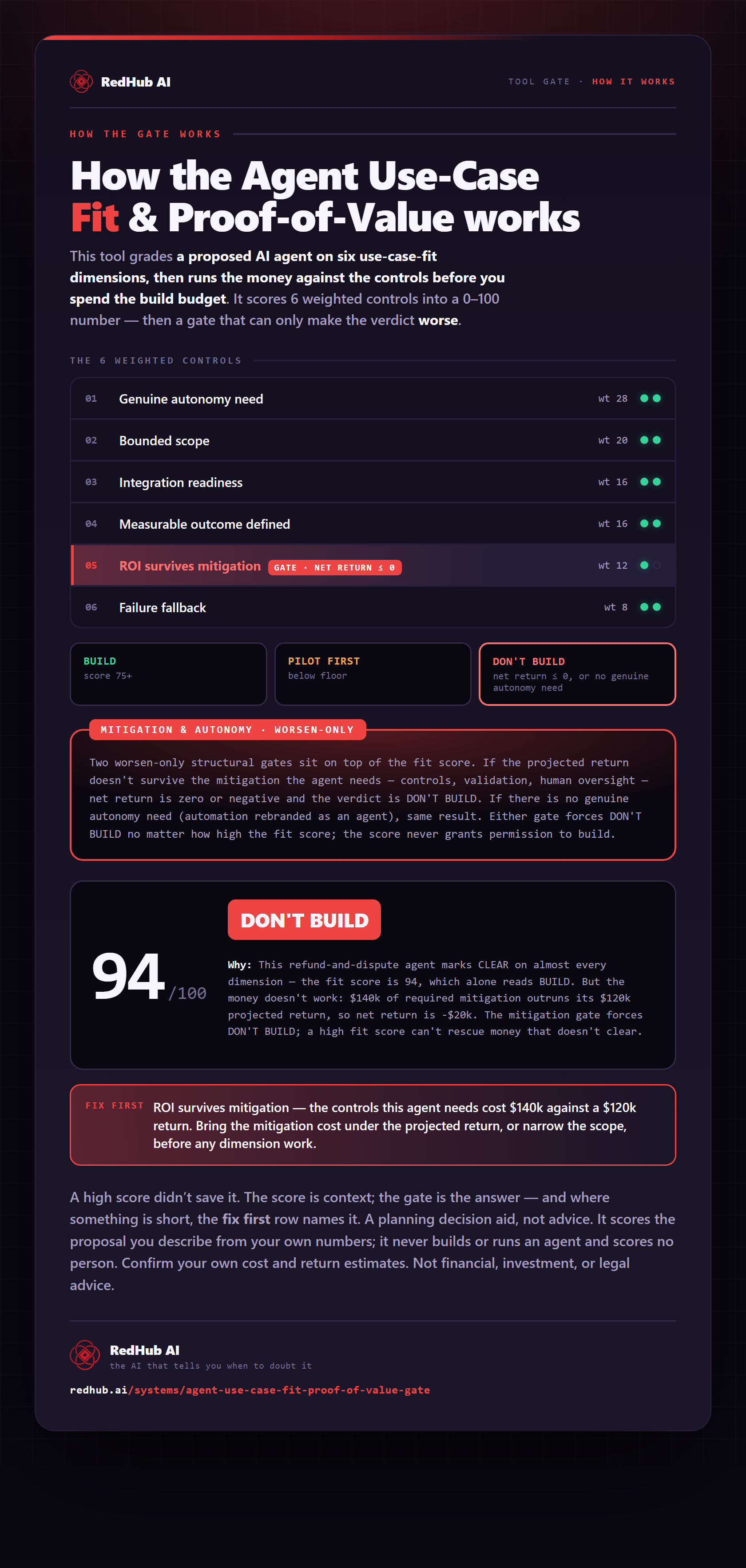
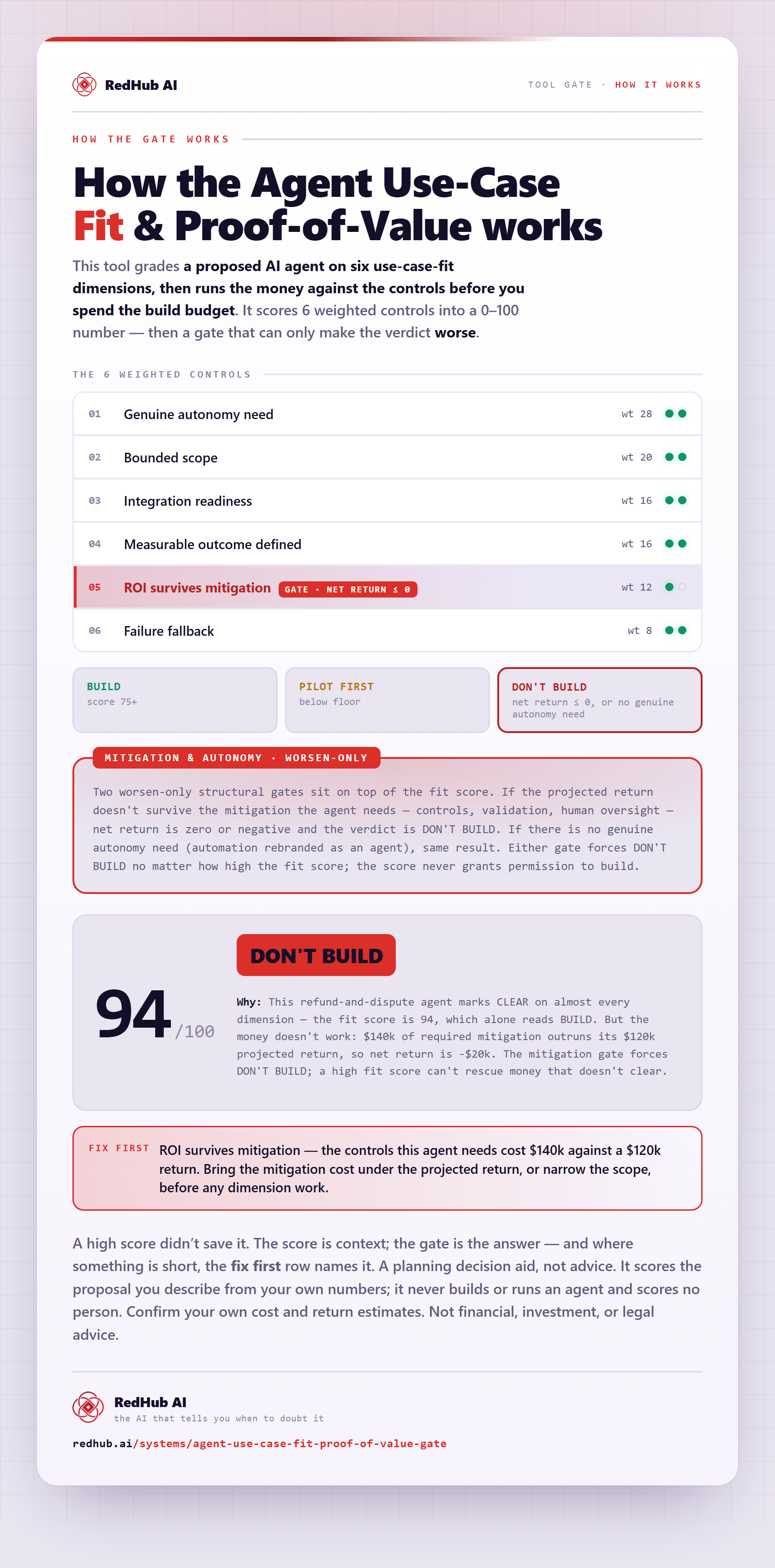
The gate this post refers to, drawn from the tool’s own logic. See the tool.