Single-Agent vs Multi-Agent: When You Actually Need Orchestration
RedHub AI Editorialupdated October 4, 20266 min read

Jump to a section7
In the single agent vs multi agent decision, start with one agent and split only when a specific bottleneck forces it: sub-jobs that need different skills, a trust boundary between steps, a task too large for one context window, or work that genuinely runs in parallel. One well-instrumented agent costs less, answers faster, is easier to debug and has fewer seams to break. More agents can look like sophistication on a diagram. Each one you add also adds token cost, latency and places for a hand-off to fail. So the useful question is what problem a second agent solves that you can't solve inside the first.
TL;DR: One agent is the starting point: less cost, less latency, one thing to observe and test. Split into multiple agents only for a concrete reason, such as separable skills, a real trust boundary, context that won't fit or true parallelism. When you compare the two designs, compare them at the same cost, because a multi-agent system may win partly by spending more tokens. Instrument the single agent first and let the data show where a boundary helps.
Why one agent wins by default
A single agent is one loop with a set of tools. That gives you four practical advantages:
- Lower cost. One agent's context and reasoning, instead of several agents each loading context and passing messages back and forth.
- Lower latency. No hand-off round trips, no merge step, no planning overhead from an orchestrator.
- Easier to debug. One trace to read. When it fails, you look in one place instead of across a graph of agents.
- Smaller failure surface. Fewer seams means fewer schema mismatches, fewer timeouts and fewer places for a null to slip through.
Coordination is also hard for the models themselves. In its June 2025 write-up on its multi-agent research system, Anthropic's engineering team wrote that "LLM agents are not yet great at coordinating and delegating to other agents in real time." Current models with good tool use can handle multi-step tasks, several tools and branching logic inside one loop. Some multi-agent designs would be more reliable collapsed back into one agent.
The four reasons to actually split
There are good reasons to orchestrate. Each one is concrete and testable:
| Reason to split | What it looks like | Why one agent struggles |
|---|---|---|
| Separable skills | Classify intent, then research, then draft a checked reply | Different prompts and tools per job; isolating them lets you test and fix each one alone |
| Trust boundary | A browsing step and a code-executing step | You don't want one context, or one set of credentials, doing both |
| Context won't fit | Summarizing more source material than one window holds well | Workers each take a slice and stay inside the window where the model reasons best |
| True parallelism | Ten independent lookups | A fan-out finishes in the time of the slowest worker instead of the sum of all ten |
The trust-boundary row is the one teams skip most often, and it matters more as agents get real credentials. Our guide to AI agent permissions covers how to scope each agent's access. If your task hits one of these four, orchestration can earn its cost. If it doesn't, you're paying a multi-agent tax for a diagram.
A fair comparison is harder than it looks
Suppose you build both versions and the multi-agent one scores higher. That still doesn't prove the architecture is better. In the same research-system write-up, Anthropic reported that on the BrowseComp browsing benchmark, token usage by itself explained 80% of the performance variance, with the number of tool calls and the model choice as the other two factors. Anthropic read that as support for its multi-agent design, because separate context windows let the system spend more tokens in parallel.
For your own decision, it raises a harder question. Is the multi-agent version better, or is it just allowed to spend more? Give the single agent the same token budget and the same tool access, then compare. If the gap closes, you were measuring the budget. If it holds, the split is doing real work. We can't tell you in advance which you'll find, and on some tasks the answer will change with the next model release.
The trap: splitting an agent nobody measured
The most common mistake is splitting an agent that was never instrumented. A single agent misbehaves, so the team breaks it into three agents and hopes the structure fixes it. Now there are three unmeasured agents and two new hand-offs, and the original problem is still there, harder to see.
Instrument first. Add tracing. Log where the single agent loops, hallucinates or blows its token budget. Then decide whether a boundary helps. Often the fix is a better prompt or a tool the agent was missing, rather than an org chart of agents.
A quick decision path
- Start with one agent. One loop, the tools it needs, and tracing from day one.
- Measure where it fails. Loops, hallucinations, context overflow, cost spikes. Find the real bottleneck.
- Match the failure to a split reason. Does it map to separable skills, a trust boundary, context limits or parallelism? If yes, split exactly there. If no, fix the single agent.
- Re-measure at matched cost. Confirm the split improved cost, latency or reliability on the same golden cases, with the same budget, and not just the diagram.
When you do split, the agent orchestration patterns guide covers the sequential, parallel and hierarchical shapes, and the multi-agent orchestration guide ties the whole decision together.
Know what a split will cost before you make it
Every pattern in the Agent Orchestration Cookbook comes with a cost model: the per-run formula, what it scales with and the levers that move it. It carries no measured token counts or latency numbers, so your own runs supply the prices.
Get the Agent Orchestration Cookbook — $79Pairs well with
The Agent Use-Case Fit & Proof-of-Value Gate ($99) scores whether a proposed agent is worth building and returns BUILD, PILOT FIRST or DON'T BUILD. The Prompt Evaluation & Versioning System ($49) runs regression tests on your prompts and benchmarks cost against quality across Claude, GPT and Gemini. The Agent Reliability Harness ($149) evaluates agent runs at the trajectory level (tool choice, argument validity, step efficiency, cost and policy) and returns SHIP, HOLD or FIX.
More in this guide
Is a multi-agent system always better than a single agent?
No. A single well-instrumented agent is cheaper, faster, easier to debug and has fewer failure modes. Multiple agents help when a concrete bottleneck forces the split: separable skills, a trust boundary, context that won't fit, or genuine parallelism.
When do I actually need multiple agents?
When at least one is clearly true: the sub-jobs need different prompts and tools, a step needs a real permission boundary (browsing versus executing code), the task is too big for one context window, or independent sub-tasks can run in parallel to save real time.
My single agent keeps failing. Should I split it up?
Not until you've measured why it fails. Splitting an uninstrumented agent creates several uninstrumented agents plus new hand-offs. Add tracing and find the real bottleneck. Often the fix is a better prompt or a missing tool.
Does multi-agent cost more?
Usually. Each agent loads its own context and passes messages, and a fan-out multiplies tokens with the number of workers. Anthropic reported that token usage alone explained 80% of the performance variance on the BrowseComp benchmark, so some of a multi-agent system's edge can come from spending more.
How do I prove a split was worth it?
Measure both versions on the same golden cases with the same token budget: cost per run, p50 and p95 latency, and pass rate. If the multi-agent version doesn't beat the single agent on the metric you split for, collapse it back.
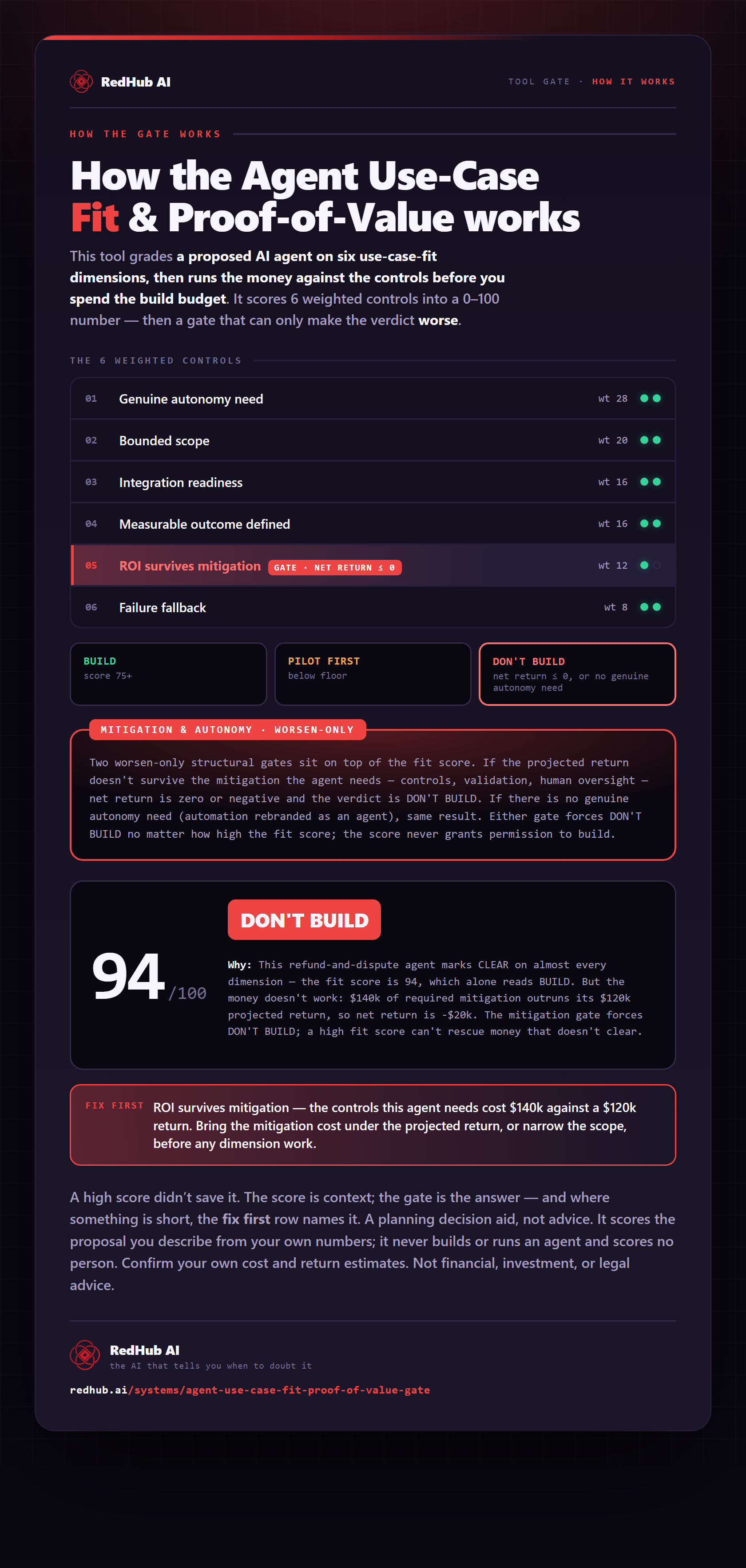
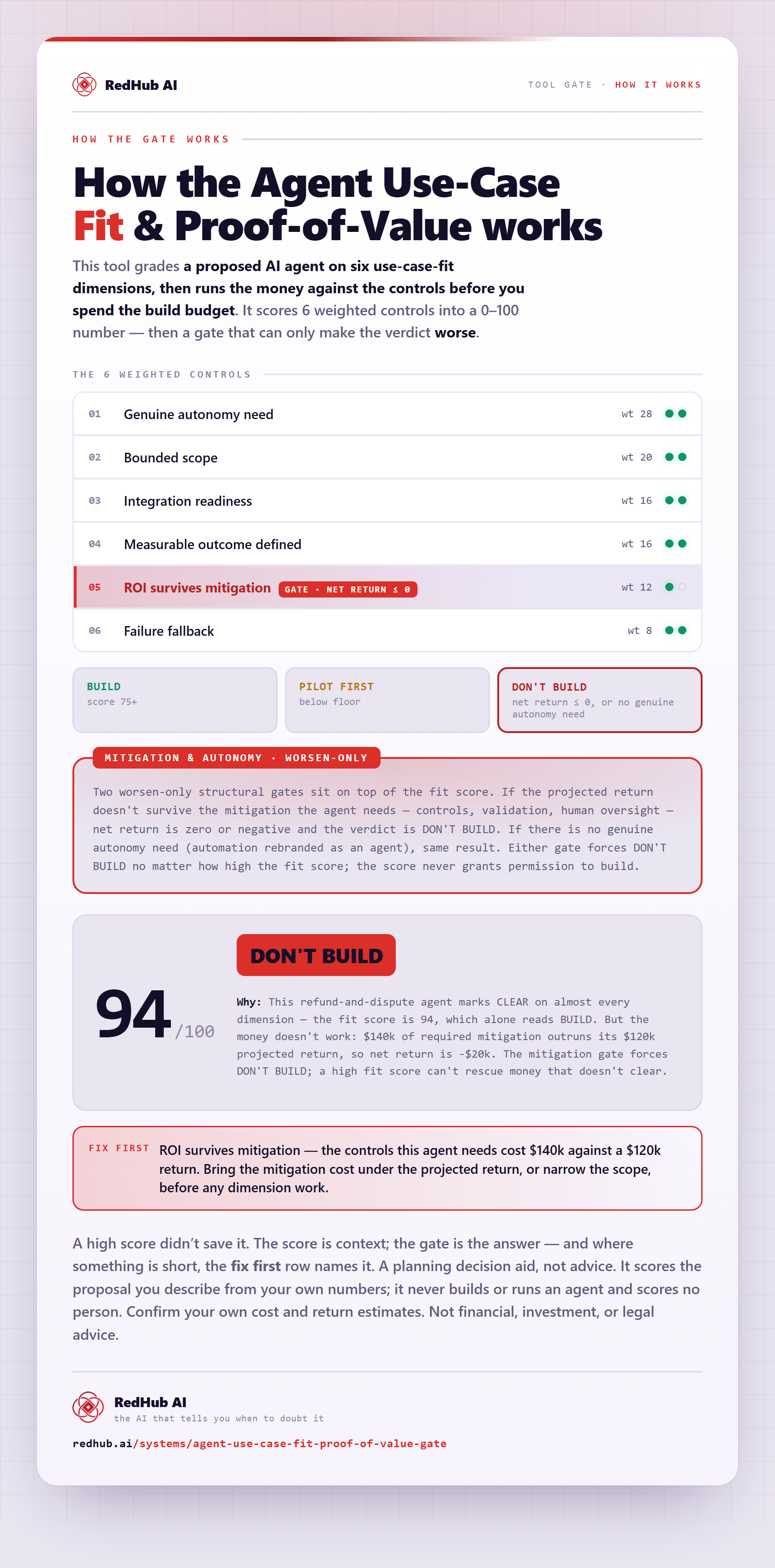
The gate this post refers to, drawn from the tool’s own logic. See the tool.