The Lead-Generation Funnel: Find Your One Bottleneck
RedHub AI Editorialupdated October 7, 20265 min read

Jump to a section7
A lead generation funnel is the path a stranger takes to become a lead your sales side can work, and it produces only as much as its weakest stage lets through. Six stages carry the load: capture, speed-to-lead, qualification, definition and handoff, nurture, and source ROI. Most funnels have one stage holding the rest back. Work on any other stage and the output barely changes. So the first job is to find that stage, using your own ratings, before you spend anything on a fix.
TL;DR: Rate each of the six stages, then look at the lowest one, not the average. Fix that stage, score again, and repeat. The Lead-Gen Funnel Diagnostic ($79) scores the six stages 0 to 100 from ratings you enter, reports the lowest as your funnel score, and returns FLOWING, LEAKING or CLOGGED. Where a stage is short, it names the stage and the kit built for it. The rest of this guide: the six stages, where leads drop off, the metrics worth tracking, and fixing one stage at a time.
The average hides the stage that matters
The Diagnostic ships with a worked sample, and the sample makes the argument better than a principle does. Its six stage scores are Capture 80, Speed-to-lead 46, Qualification 80, Definition and handoff 73, Nurture 73 and Source ROI 74.
The average of those six is 71. On the Diagnostic's own scale, 70 and up reads FLOWING, so the average says the funnel is fine. The verdict it returns is LEAKING, because the funnel score is the lowest stage, and the lowest stage is 46.
Think about what that funnel looks like from the inside. The landing page works. The qualification rubric works. And new leads wait for a first reply, and some of them go cold while they wait. A better landing page sends more leads into the same wait.
Six stages, six different fixes
Each stage asks one question. The questions below are the ones the Diagnostic uses.
| Stage | The question |
|---|---|
| Capture | Are visitors becoming leads at all? |
| Speed-to-lead | Do you reach new leads while they are warm? |
| Qualification | Are you working the right leads? |
| Definition and handoff | Do marketing and sales agree, and do leads survive the handoff? |
| Nurture | Do not-yet-ready leads get worked, not dropped? |
| Source ROI | Are you spending on channels that pay back? |
A slow first reply and an unclear offer have nothing in common as repairs. One is a routing rule. The other is a page rewrite. That is why "improve the funnel" is not a task anyone can start on Monday. The guide to the lead funnel stages walks through how each one breaks.
Rate your own funnel, not someone else's
We are not going to give you a "good" conversion rate for each stage. A rate from another company's traffic, offer and price would tell you nothing true about yours, and chasing it can send you to repair a stage that was working.
The Diagnostic takes a different input. For each stage you rate three things from 0 to 5, which makes 18 ratings in all. Under Speed-to-lead, for example, you rate how fast the first touch is, whether leads are routed to a named owner, and whether nights and weekends are covered. The ratings are weighted into a 0 to 100 score per stage. No outside benchmark enters the math.
The weak point in the method is the person rating
A score built from your own ratings is only as honest as you are on the day you fill it in. The stage you already suspect is the easiest one to mark up a point, and one generous rating can move the constraint to a different stage. The Diagnostic's operating guide says this plainly and has no mechanism to stop it.
Two habits help. Have a second person rate the funnel separately and compare. And where you have counts, check the rating against them: finding where leads drop off shows the arithmetic. Neither habit removes the judgment. A 3 for "leads routed to an owner" is still someone's opinion of a shared inbox.
Fix one, then score again
Once the lowest stage is repaired, a different stage becomes the lowest. That is the method working. You fix one stage, rate the funnel again, and let the new low point choose the next job. How to fix a leaking lead funnel covers the loop, including the cases where going one at a time is too slow, and the lead funnel metrics guide covers what to watch between rounds.
Find the stage that is holding the funnel back
The Lead-Gen Funnel Diagnostic scores six stages 0 to 100 from your own 0 to 5 ratings and reports the lowest stage as your funnel score: FLOWING at 70 and up, LEAKING from 45 to 69, CLOGGED under 45. Where a stage is short, it names that stage and the RedHub kit that addresses it. A runnable Python engine and a workbook produce the same result. It diagnoses and routes. It does not do the repair.
Get the Lead-Gen Funnel Diagnostic — $79Pairs well with
These are three of the six kits the Diagnostic routes to. The Speed-to-Lead Routing Kit ($69) is where the sample funnel above would be sent: it audits who gets a new lead, how fast, and what happens after hours, and returns PASS, FIX or BLOCK. The Lead-Capture Page Kit ($79) grades an opt-in page on six levers and returns GO LIVE, TIGHTEN or REWORK. The MQL to SQL Definition & Handoff Kit ($49) scores your two lead definitions and the handoff between teams as TIGHT, LEAKY or BROKEN.
More in this guide
What is a lead generation funnel?
It is the path from stranger to a lead your sales side can work. This guide uses six stages: capture, speed-to-lead, qualification, definition and handoff, nurture, and source ROI. The funnel produces only as much as its weakest stage lets through.
Why look at the lowest stage and not the average?
An average lets five strong stages cover for one weak one. In the Diagnostic's worked sample the six stages average 71, which would read FLOWING, but Speed-to-lead scores 46, so the verdict is LEAKING.
How do I find my funnel's bottleneck?
Rate each stage against what is true today, then find the lowest score. Use counts where you have them to check the ratings. An outside benchmark cannot tell you which of your stages is weakest.
Should I compare my funnel to industry benchmarks?
Not to pick what to fix. A rate from another company's traffic, offer and price says nothing about which of your stages is weakest, and it can send you to repair a stage that was working.
Does the Lead-Gen Funnel Diagnostic fix my funnel?
No. It scores six stages from ratings you enter and returns FLOWING, LEAKING or CLOGGED. Where a stage is short, it names that stage and the kit built for it. With every stage at 70 or above it names nothing. It grades stages, not people.
What do I do after fixing the weakest stage?
Rate the funnel again. A different stage is now the lowest, and that one chooses the next job. Stop when the next stage down is not costing you enough pipeline to be worth the work.
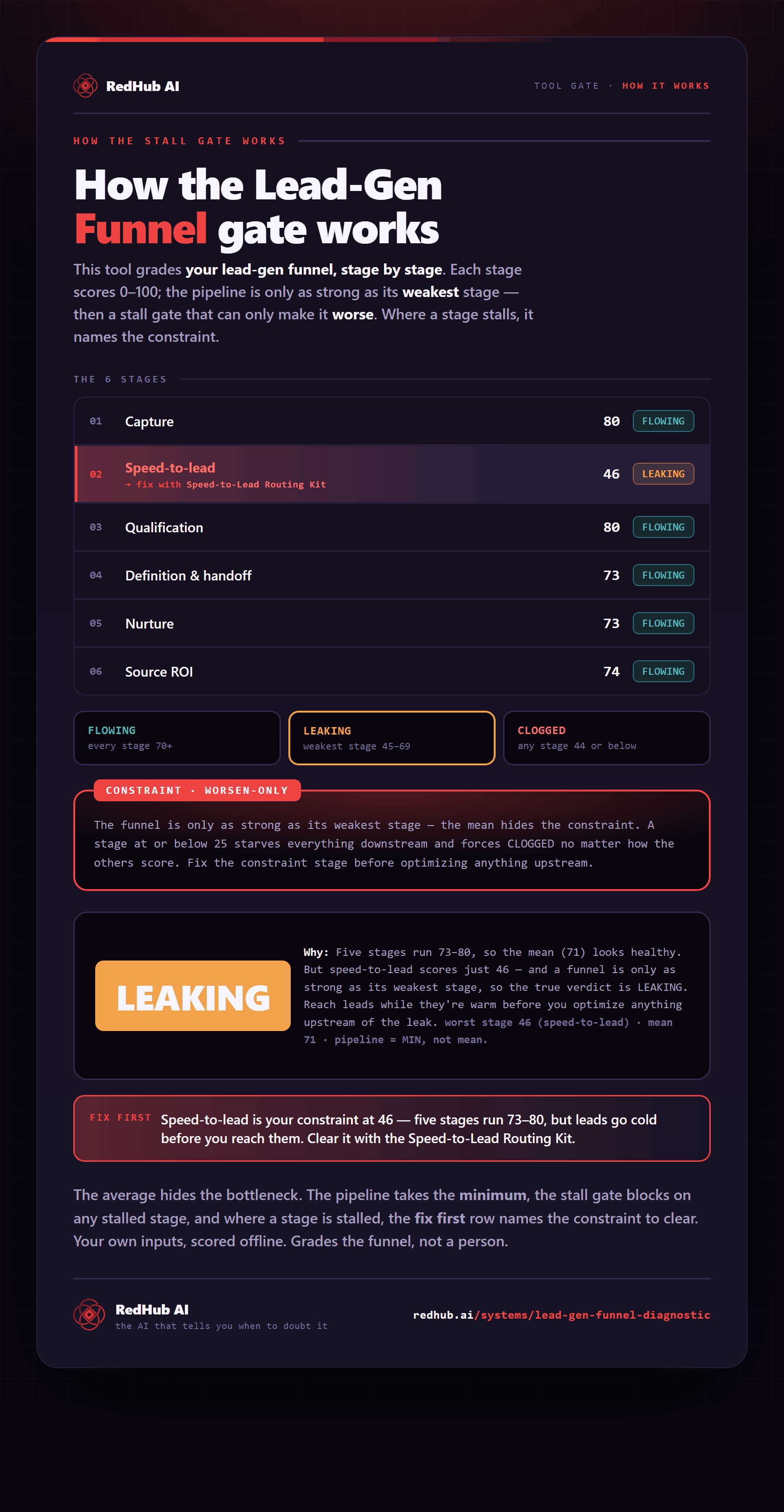
The gate this post refers to, drawn from the tool’s own logic. See the tool.